The Budget and Accounting Act of 1921 established the GAO- Legislative Branch- to audit financial transactions of which branch of the Government? - ANSWER Executive Branch
The GPRA requires agencies to define goals, s
...
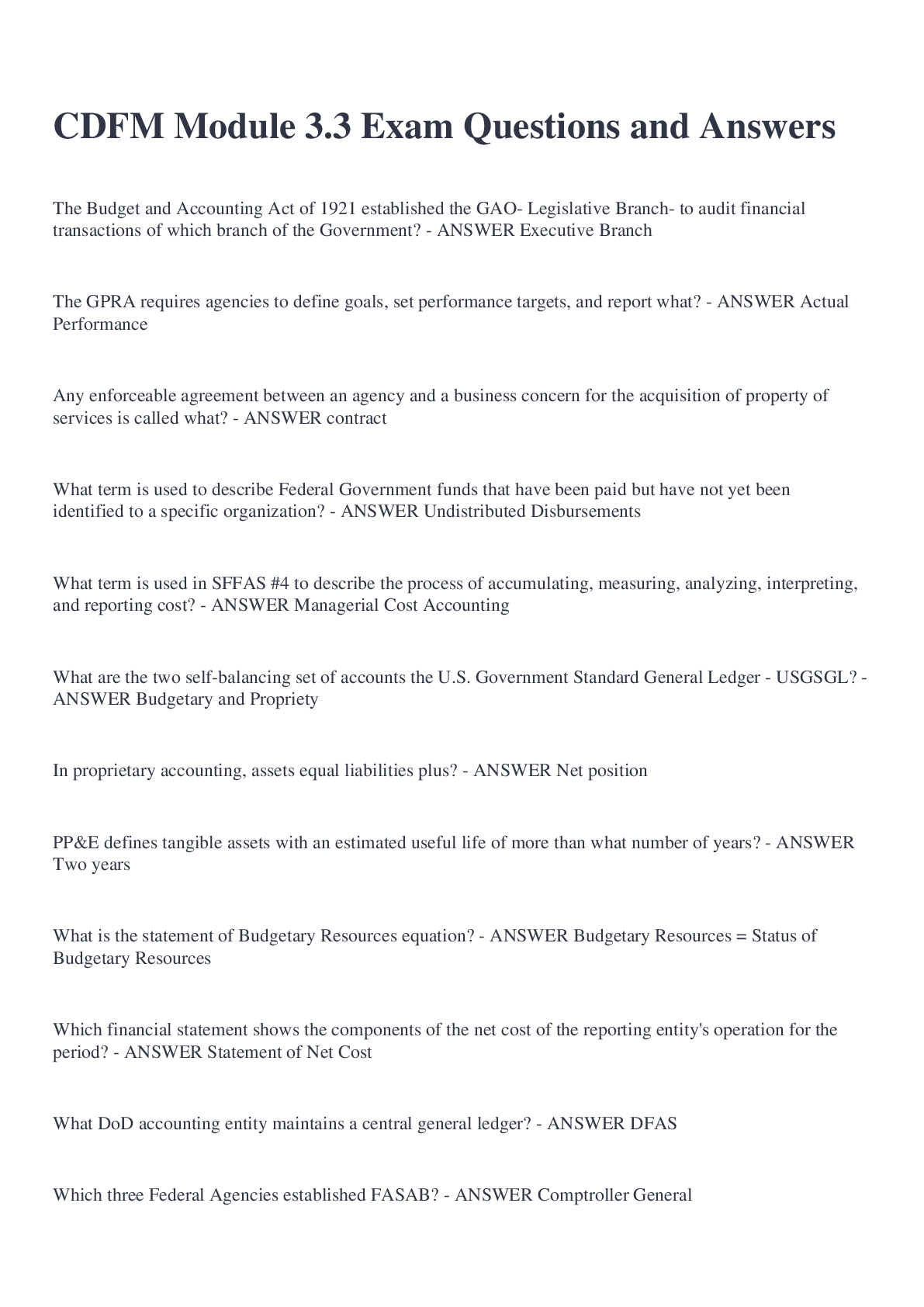
The Budget and Accounting Act of 1921 established the GAO- Legislative Branch- to audit financial transactions of which branch of the Government? - ANSWER Executive Branch
The GPRA requires agencies to define goals, set performance targets, and report what? - ANSWER Actual Performance
Any enforceable agreement between an agency and a business concern for the acquisition of property of services is called what? - ANSWER contract
What term is used to describe Federal Government funds that have been paid but have not yet been identified to a specific organization? - ANSWER Undistributed Disbursements
What term is used in SFFAS #4 to describe the process of accumulating, measuring, analyzing, interpreting, and reporting cost? - ANSWER Managerial Cost Accounting
What are the two self-balancing set of accounts the U.S. Government Standard General Ledger - USGSGL? - ANSWER Budgetary and Propriety
In proprietary accounting, assets equal liabilities plus? - ANSWER Net position
PP&E defines tangible assets with an estimated useful life of more than what number of years? - ANSWER Two years
What is the statement of Budgetary Resources equation? - ANSWER Budgetary Resources = Status of Budgetary Resources
Which financial statement shows the components of the net cost of the reporting entity's operation for the period? - ANSWER Statement of Net Cost
What DoD accounting entity maintains a central general ledger? - ANSWER DFAS
Which three Federal Agencies established FASAB? - ANSWER Comptroller General
Department of Treasury
OMB
What are the three accounting systems that make up the Federal accounting framework? - ANSWER Budgetary Accounting
Financial Accounting
Managerial Cost Accounting
Federal accounting must satisfy two sets of users of accounting information/reports which are? - ANSWER External users
Internal users
Required audited financial statements for the business activities of the 24 designated CFO agencies. - ANSWER CFO Act
Where do the statutory requirements come from? - ANSWER The Constitution
No money shall be drawn from the Treasury but in Consequence of Appropriations and a regular statement of Account of the Receipts and Expenditures of all public Money shall be published from time to time. - ANSWER Article 1, Section 9, Clause 7
Where can we see the products of all accounting transactions? - ANSWER Balance Sheets, Statement of Net Cost, and Statements of Operations and Changes in Net position
Established the GAO to audit the Executive Branch. - ANSWER 1921 Budget and Accounting Act
Established the GSA - ANSWER 1949 Federal Property and Administrative Services Act
1. required apportionment, allocation systems
2. expanded anti-deficiency, required reporting
3. mandated principles/standards and
4. established Joint Financial Management Improvement Program (JFMIP) - ANSWER 1950 Accounting and Auditing Procedures Act
Required agencies to pay bills when due or pay interest and to not pay in advance unless advantageous to the governments. - ANSWER 1982 Prompt Payment Act
As amended by the Debt Collection Improvement Act of 1996, strengthened ability to collect receivables from people who owe the government - ANSWER 1982 Debt Collection Act
Required agencies to set up an Internal Control Program and report annually any aspects of their accounting systems not conforming to GAO's principles/standards. - ANSWER 1982 Federal Managers' Financial Integrity Act
Required appointment of a Chief Financial Officer in 24 major Federal Agencies and required financial reports for business operations. - ANSWER 1990 CFO Act
Required agencies to:
1. Define long term goals
2. Set performance targets
3. Report actual performance - ANSWER 1993 GPRA
1. required systems to support the control of cost of Government
2. required application of accounting standards to produce consistency in financial reporting
3. required financial management systems to support full-cost reporting and full disclosure of financial data - ANSWER 1996 FFMIA
1. required direct deposit of Federal wages, salary and retirement payments
2. amended the CFO act to require a consolidated financial statement for the entire Executive Branch- prepared by the Treasury Department and audited by the GAO
3. Required 24 Agencies to submit audited financial statements - ANSWER 1994 Government Management Reform Act
Required each covered Executive Branch Agency to prepare and submit audited financial statements - ANSWER 2002 Accountability of Tax Dollars Act
Required that DoD financial statement be validated as ready for audit by 30 September 2017. - ANSWER 2009 National Defense Authorization Act
The government organizations that most affect the decisions of DoD Financial Managers are? - ANSWER OMB
GAO
Department of Treasury
FASAB
Conducts a continuous program for improving accounting and financial reporting in the Federal Government. - ANSWER OMB
Audits the financial performance of the Executive Branch and is often referred to as the "watchdog" of Congress. - ANSWER GAO
The Federal Governments banker treasury; manages balances and flow of funds and compiles the consolidated Federal financial statements and published the U.S. Standard General Ledger. - ANSWER Department of Treasury
Established in 1990 by the Comptroller General is responsible for codifying the Generally - Accepted Accounting Principles - GAAP for the Federal Government - ANSWER FASAB
What is the mission statement of the Federal Accounting Standards Advisory Board- FASAB - ANSWER To recommend accounting standards for the Federal Government after considering the financial and budgetary information needs of congressional oversight groups, Executive agencies and the needs for other users of Federal financial information.
Once the FASAB recommendation is adopted, where is it published? - ANSWER As a Statement of Federal Financial Accounting Concept or a Statement of Federal Financial Accounting Standard.
What are the three approved Accounting Standards Boards? - ANSWER Financial Accounting Standards Board
Government Accounting Standards Board
Federal Accounting Standards Advisory Board
Issues standards of accounting, referred to as the Generally Accepted Accounting Principles- GAAPS for non-governmental, not for profit, entities. - ANSWER Financial Accounting Standards Board
Issues Generally Accepted Accounting Principles for state and local government, not for profit entities. - ANSWER Government Accounting Standards Board
Was finally recognized as the body designated to establish GAAP for the Federal Government in October 1999 by the American Institute of Certified Public Accountants - AICPA- governing council. - ANSWER Federal Accounting Standards Advisory Board
What are the three agencies that share responsibility for implementing the Federal Accounting Standards? - ANSWER OMB
GAO
Department of Treasury
Implements an approved standard by publishing the standard and updating OMB Circular A-136. The published standards become Federal GAAP and must be followed by Federal Executive Branch agencies. - ANSWER OMB
Formulated the Generally Accepted Government Auditing Standards that are to be used by Government auditors in performing statement audits. - ANSWER GAO
Performs several basic functions associated with implementing a Federal accounting standard. The U.S. General Ledger feeds all financial reports and makes the consolidated financial statements possible. - ANSWER Department of Treasury
How many Accounting Standards are there? - ANSWER Seven
Focuses on the uses, user need, and objectives of Federal Financial Reporting.
Its objectives are Budgetary Integrity, Operating Performance, Systems and Control and the concept of Stewardship which links to the Preamble of the Constitution Requirement of Promoting the General Welfare. - ANSWER SFFAC 1
This concept is implemented by OMB Circular A 136, Federal Financial Reporting Requirements, which includes prescribing the form and content of the financial statements. - ANSWER SFFAC 2
Issued in April 1999, and describes the concepts recommended for Management's Discussion and Analysis reports. - ANSWER SFFAC 3
Was issued in January 2003 and identifies the intended audience for the Consolidated Financial Report. The five audiences for the CFR are: Citizens, Citizen Intermediaries, Congress, Federal Executives, and Program Managers with - ANSWER SFFAC 4
Establishes two basic recognition criteria that an item must meet to be a candidate for recognition in the body of a financial statement:
1. The item must meet the definition of an element
2. The item must be measurable, meaning a monetary amount can be determined with reasonable certainty or is reasonable estimable. - ANSWER SFFAC 5
Amends SFFAC 2 to discuss process and factors the Board considers when deciding whether the information should be considered basic information, required supplementary information or other accompanying information. it. - ANSWER SFFAC 6
Expresses an objective to identify and elucidate the conceptual issues relevant to establish measurement standards in the future for accrual basis financial statements. Applies mainly to assets and liabilities. - ANSWER SFFAC 7
Are essential for public accountability and for an efficient and effective functioning of our democratic system of government. - ANSWER Accounting and financial reporting standards
The principle adviser to the Secretary and Deputy Secretary of Defense for budgetary and fiscal matters. - ANSWER USD/C
The Managerial Cost Accounting Standards and Concepts was issued on? - ANSWER July 1995
Serves as the CFO of the DoD and is responsible for formulating and promulgating DoD wide Financial Management policies, overseeing accounting and finance operations and systems, implementing initiative for improving financial management, and performing financial management analysis. - ANSWER USD/C
Directs the Defense Finance and Accounting Service- DFAS? - ANSWER USD/C
Within the office of the USD/C, the Deputy CFO represents? - ANSWER Chief Financial Officers Council.
DFAS maintains a central general ledger to: - ANSWER 1. Account for DoD Resources
2. Determine cost of operations and
3. Report DoD financial position and cost of operations.
Accounting and Policy procedures - ANSWER Volume 4
Reporting Policy Procedures - ANSWER Volume 6A
Travel Policy and Procedures - ANSWER Volume 9
Non Appropriated Funds Policy and Procedures - ANSWER Volume 13
Security Assistance Policy and Procedures - ANSWER Volume 15
Administrative Control of Funds and Anti-deficiency act - ANSWER Volume 14
Accounts that temporarily account for transactions that you know belong to the government but you cannot match to a specific receipt or expenditure account. - ANSWER Clearing Accounts
The greater part of the budget and record receipts not earmarked by law for a specific purpose, such as all income tax receipts. - ANSWER General Funds
Are revolving funds used for programs authorized by law to conduct a cycle of business type operations, primarily with the public, in which outlays generate collections. - ANSWER Public Enterprise Funds
Expenditure accounts authorized by law to facilitate financing transactions primarily within and between federal agencies. - ANSWER Intragovernmental Funds
The receipt and expenditure monies held in trust by the Government for carrying out specific purposes and programs in accordance with terms of a statue that designates the fund as a? - ANSWER Trust Funds
Credited with collections earmarked by law to carry out a cycle of business type operations. - ANSWER Trust Revolving Funds
Funds in which government acts as a true trustee - ANSWER Deposit Funds
Receipt accounts for Federal Fund receipts that laws have earmarked for specific purposes and associated appropriations accounts for the expenditure of earmarked receipts. - ANSWER Special Funds
What are the categories of appropriations? - ANSWER 1. Annual appropriations
2. Multiyear appropriations
3. No-Year appropriations
4. Permanent appropriations
Funds that allow the Secretary of the Treasury to pay without further enactment by Congress. - ANSWER Permanent Appropriations
Military and civilian pay are recorded as obligations when? - ANSWER In the month or pay period earned
Permanent change of station costs are recorded as obligations when? - ANSWER Orders are issued
Are the recovery of excess payments and are credited to the appropriation that made the payment. - ANSWER Refunds
Are amounts earned and collected from the selling of goods and services. - ANSWER Reimbursements
Include the issuance of checks, disbursement of cash, or electronic transfer of funds made to liquidate a Federal obligation. - ANSWER Outlays
T/F? The proprietary and budgetary sets of general ledger accounts are independently self-balancing? - ANSWER True
Is concerned primarily with the legal requirement to control and properly manage budget authority provided to entities in appropriations. - ANSWER Budgetary Accounting
Resources (Credit) include: - ANSWER 4119 Other Appropriations Realized
4201 Total Actual Resources Collected
Resources = Status of Resources - ANSWER Budgetary Accounting
Captures costs and revenues and then applies them to the appropriate period. - ANSWER Proprietary Accounting
Assets = Liabilities + Net Position - ANSWER Proprietary Accounting
Consists of the full cost of the outputs produced by that program plus any non productions costs then can be assigned to the program. - ANSWER Gross Cost of Program
Expenses - Exchange Revenue = - ANSWER Net Cost Operations
What are the selected Asset Accounts? - ANSWER 1. Fund Balance with Treasury
2. Undistributed disbursements
3. Imprest Fund
4. Accounts Receivable
5. Advances
The aggregate amount of funds an entity has at the Treasury to make expenditures and to pay liabilities or to purchase assets, goods, and services. It is similar to a bank balance. - ANSWER Fund Balance with Treasury
Are federal government funds that have been paid, but for whatever reason, have not yet been identified to a specific organization. - ANSWER Undistributed disbursements
A petty cash fund in the form of currency or coin for specifically authorized cash payments. - ANSWER Imprest Fund
Are amounts owed to the entity. - ANSWER Accounts Receivable
Occur when an entity has given funds to others in anticipation of receiving a future benefit. - ANSWER Advances
When the Federal Government advances funds to a traveler for expenses to official travel. The amount must be recognized as an asset or receivable. - ANSWER Accounting for travel advances
Consists of tangible assets that meet all for the following:
1. Estimated life of 2 years or more
2. Not intended for sale
Acquired or constructed with the intention of being available for use by entity
3. Have an initial acquisition cost, book value or estimated fair market value that equals or exceeds DoD capitalization threshold - ANSWER General Property, Plant and Equipment
What are the three categories of Property, Plant, and Equipment that have been identified for accounting and reporting purposes? - ANSWER 1. General PP&E
2. Heritage Assets
3. Stewardship Land
Examples of General PP&E include: - ANSWER Real property, land buildings and structures.
Is included in the financial statements on the Balance Sheet and is depreciated in accordance with the DoD standard recovery periods? - ANSWER General PP&E
Consists of the amount paid for the asset plus transportation, installation and other related cost of obtaining the asset and preparing it for use. - ANSWER Acquisition Value of General PP&E Asset
Tangible assets classified as either Heritage assets or stewardship land - ANSWER Stewardship PP&E
Are unique to one or more of the following reasons: historical, natural, cultural, educational significance, artistic importance, or significant architectural characteristics. - ANSWER Heritage Assets
Land and land rights other than that acquired for or in connection with General PP&E. - ANSWER Stewardship Land
T/F? The costs of acquiring Heritage Assets and Stewardship Land are not expensed in the period incurred? - ANSWER False, They are
DoD Financial Reporting includes: - ANSWER 1. Balance Sheet
2. Statement of Net Cost
3. Statement of Changes in Net Position
4. Statement of Budgetary Resources
5. Statement of Custodial Activity
Presents, as of a specific time, amounts of future economic benefits owned or managed by the reporting entity (assets), amounts owed by the entity (liabilities) and the difference (net position). - ANSWER Balance Sheet
Statement of Custodial Activity is required for? - ANSWER Entities that collect non exchange revenue for the General Fund of the Treasury.
Significant accounting principles and policies used by an organization should be summarized as a? - ANSWER Footnote
The Department is committed to having fully auditable financial statements by? - ANSWER By 2017
SECDEF outlined an accelerated goal of achieving an auditable Statement of Budgetary Resources - SBR-? - ANSWER For General Funds in 2014
The Department manages its improvement activities through the? - ANSWER FIAR Plan
Reports the beginning net position, the items that caused net position to change during the reporting period and the ending net position - ANSWER Statement of Changes in Net Position
Provide information regarding how budgetary resources were made available as well as their status at the end of the period. - ANSWER Statement of Budgetary Resources
Required for entities that collect non exchange revenue for the General Fund of the Treasury, a trust fund or other recipient entities. - ANSWER Statement of Custodial Activity
Is the gross cost incurred by the reporting entity less any exchange revenue earned from its activities. - ANSWER Net cost of operations
Managerial Cost Reporting requirements are: - ANSWER 1. Direct Costs- Direct Labor and Materials.
2. Indirect Costs- Overheard
3. Intra-entity Costs- General and Administrative
4. Inter-entity Costs
Cost of good and services received from other entities - ANSWER Inter entity Costs
The quotient of two numbers, that, by itself, is almost meaningless. - ANSWER ratio
Measure of an entity's ability to meets its current obligations. - ANSWER Current Ratio
There are two main ways to use a ratio for performance analysis. - ANSWER Trend analysis
Comparative analysis
The manager determines how the entity is performing at a single point in time relative to other like entities or to a DoD standard. - ANSWER Comparative Analysis
Determining how the ratio has behaved across time. - ANSWER Trend Analysis
A test of an entity's immediate solvency is made by comparing the sum of cash and aged accounts receivable, commonly referred to as? - ANSWER Quick Assets- not including inventory
The total of the quick assets, when divided by current liabilities, gives the ratio of quick assets to current liabilities? - ANSWER Acid-test Ratio
Total current assets divided by total current liabilities gives the ratio of? - ANSWER Current Ratio
T/F? An entity with a satisfactory current ratio may be in an unsatisfactory condition in terms of immediate solvency when inventories form a significant part of the current asset total. - ANSWER True
Proprietary Accounting Account Codes - ANSWER 1000 Assets
2000 Liabilities
3000 Net Position
Expenses Account Code - ANSWER 6000
Budgetary Accounting Account Code - ANSWER 4000
Gains and Loses Account Codes - ANSWER 7000
Budgetary or Proprietary? Congress APPROPRIATES and the President signs the appropriation act for $100M for the year, and Treasury issues the appropriation warrant. - ANSWER Budgetary and Proprietary
Budgetary or Proprietary? With the receipt of the allotment the installation/activity may begin its operations. A purchase request and commitment form for supplies estimated cost $2M is issued: - ANSWER Budgetary
Budgetary or Proprietary? A purchase order for supplies estimated to cost $2M is issued, Delivery is not expected for at least 30 days, th
[Show More]









![Preview of THE TEFL ACADEMY LEVEL 5 - ASSIGNMENT C - AUTHENTIC MATERIAL [2026]](https://browseimages.nyc3.digitaloceanspaces.com/paper-images/2026/04/10/HpVkRcWV2026-04-10-11-5769d96426bd64f.png)