NUR 2180 Physical Assessment Module 5 Quiz Study Guide
1. Understand the procedure to perform light palpation on the abdomen
o Light palpation is used to detect tenderness. The examiner should systematically pa
...
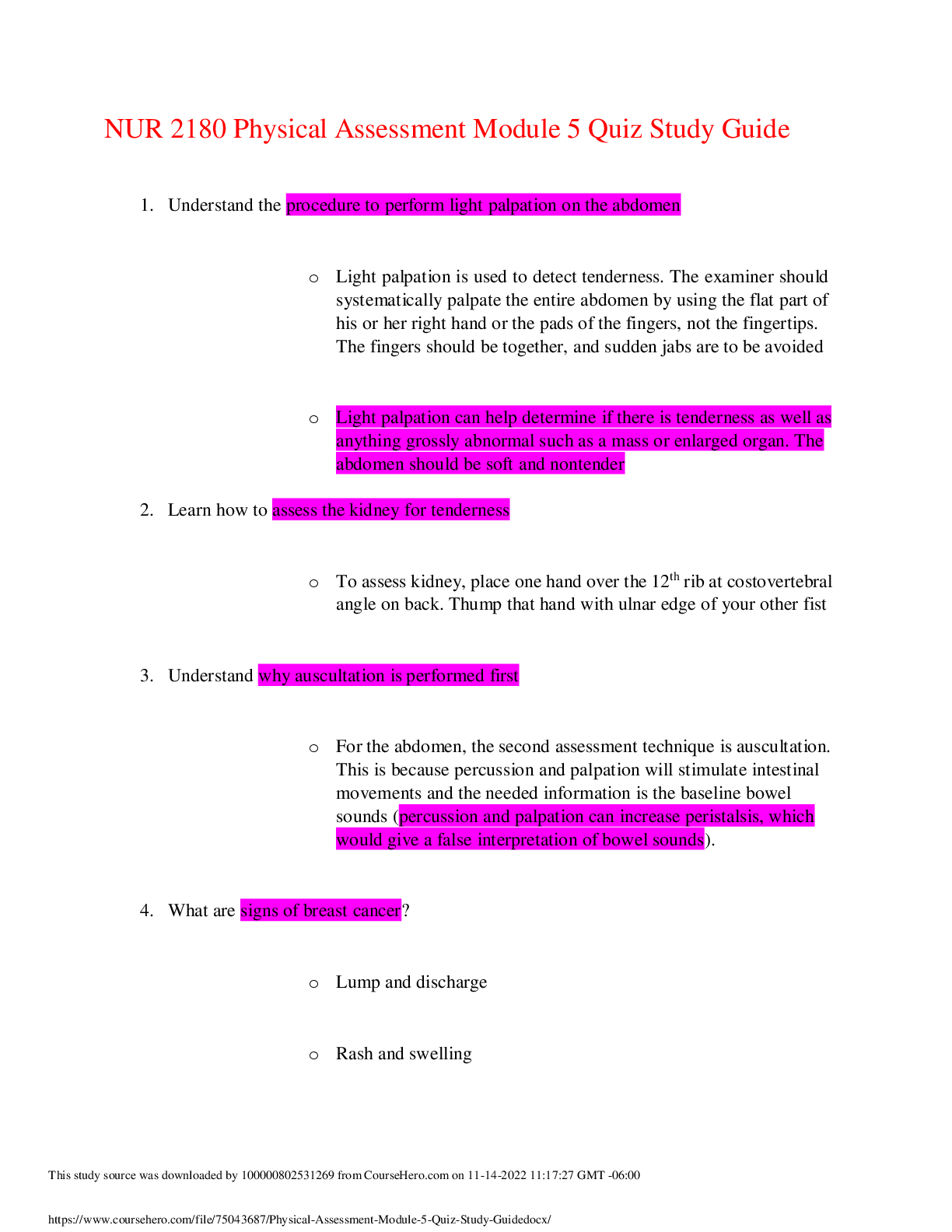
NUR 2180 Physical Assessment Module 5 Quiz Study Guide
1. Understand the procedure to perform light palpation on the abdomen
o Light palpation is used to detect tenderness. The examiner should systematically palpate the entire abdomen by using the flat part of his or her right hand or the pads of the fingers, not the fingertips.
The fingers should be together, and sudden jabs are to be avoided
o Light palpation can help determine if there is tenderness as well as anything grossly abnormal such as a mass or enlarged organ. The abdomen should be soft and nontender
2. Learn how to assess the kidney for tenderness
o To assess kidney, place one hand over the 12th rib at costovertebral angle on back. Thump that hand with ulnar edge of your other fist
3. Understand why auscultation is performed first
o For the abdomen, the second assessment technique is auscultation. This is because percussion and palpation will stimulate intestinal movements and the needed information is the baseline bowel sounds (percussion and palpation can increase peristalsis, which would give a false interpretation of bowel sounds).
4. What are signs of breast cancer?
o Lump and discharge
o Rash and swelling
o Trauma and history of breast disease
o Treatment and medications
o Patient centered care
5. Understand the role of the Registered Nurse in male or female genitourinary examinations
o The registered nurse’s primary job in terms of assessment of the genitalia, rectum, anus, or prostate is, in most cases, aiding the physician, nurse practitioner, or physician’s assistant in the assessment, helping to position the client and collect specimens
6. Understand what hypoactive and hyperactive bowel signs are
o If you hear approximately 5-30 sounds/minute, they are considered to be normoactive; less than 5 sounds/minute are considered hypoactive; more than 30 sounds/minute are considered hyperactive
7. Understand the location of the costovertebral angle
o The costovertebral angle (CVA) is located on your back at the bottom of your ribcage at the 12th rib. It’s the 90-degree angle formed between the curve of that rib and your spine
8. Know what organs are located in a particular quadrant (RUQ, RLQ, LUQ, LLQ)
o Right upper quadrant (RUQ) – Liver, Gallbladder, Duodenum,
Head of pancreas, Right kidney, and adrenal gland
o Right lower quadrant (RLQ) – Cecum, Appendix, Right ovary and tube, right ureter, and Right spermatic cord
o Left upper quadrant (LUQ) – Stomach, Spleen, Left lobe of liver, Body of pancreas, Left kidney and adrenal gland, Splenic flexure of colon, and part of transvers and descending colon
o Left lower quadrant (LLQ) – Part of descending colon, sigmoid colon, Left ovary and tube, Left ureter and Left spermatic cord
9. Know the term for benign temporary enlargement of one or both breasts in males
o Gynecomastia
10. Understand the importance of the axilla in the breast exam
o Following direct palpation of the breast, the axillary region should be palpated. This is because the axillary lymph nodes are usually the first site of spread in the setting of breast cancer
11. Know the abnormalities in breast skin, tissue, nipples, and areolas during a breast assessment
o
12. Understand the types of bowel sounds
o Hypoactive – decreased, can follow abdominal surgery or with inflammation
o Hyperactive – loud, high-pitched signal increased motility
13. Know abnormal findings for an abdominal examination
o Abdnormal distention
-Obesity
-ascites
-ovarian cyst
- tumor
o Inspection
-Umbilical hernia
-Epigastric hernia
-Incisional hernia
-Diastasis recti
o Abnormal bowel sounds
-Succussion splash
-Marked peristalsis
- Hypoactive bowel sounds
-Hyperactive bowel sounds
14. Know the types of abdomen shapes (rounded, scaphoid, protuberant, globular)
o Flat -
o Rounded -
o Scaphoid - Sunken
o Protuberant – Protruding (sticking out)
o Globular – Globe shape
15. What is rebound tenderness?
o Rebound tenderness is a clinical sign that a doctor or other health care provider may detect in physical examination of a patient's abdomen. It refers to pain upon removal of pressure rather than application of pressure to the abdomen. It represents aggravation of the parietal layer of peritoneum by stretching or moving. Rebound tenderness can be associated with peritonitis, which can occur in diseases like appendicitis, and may occur in ulcerative colitis with rebound tenderness in the right lower quadrant
16. Know how to assess for bowel sounds and the different quadrants
o When you auscultate the abdomen, use the diaphragm, and listen in all four quadrants. Listen long enough to determine the frequency of the bowel sounds. If you hear nothing, it is necessary to listen 5 minutes before it can be said that bowel sounds are absent
17. Know the location of the liver
o Place your left hand under person's back parallel to 11th and 12th ribs and lift up to support abdominal contents. Place your right hand on RUQ with fingers parallel to midline. Push deeply down and under the right costal margin
18. Understand why you would use the bell or the diaphragm of your stethoscope
o The diaphragm is generally superior for hearing medium or high- pitched sounds
o The bell will be better for hearing low-pitched sounds.
[Show More]