Education  >  EXAM  >  Psychology Test #1(Answered) (All)

Psychology Test #1(Answered)

Document Content and Description Below

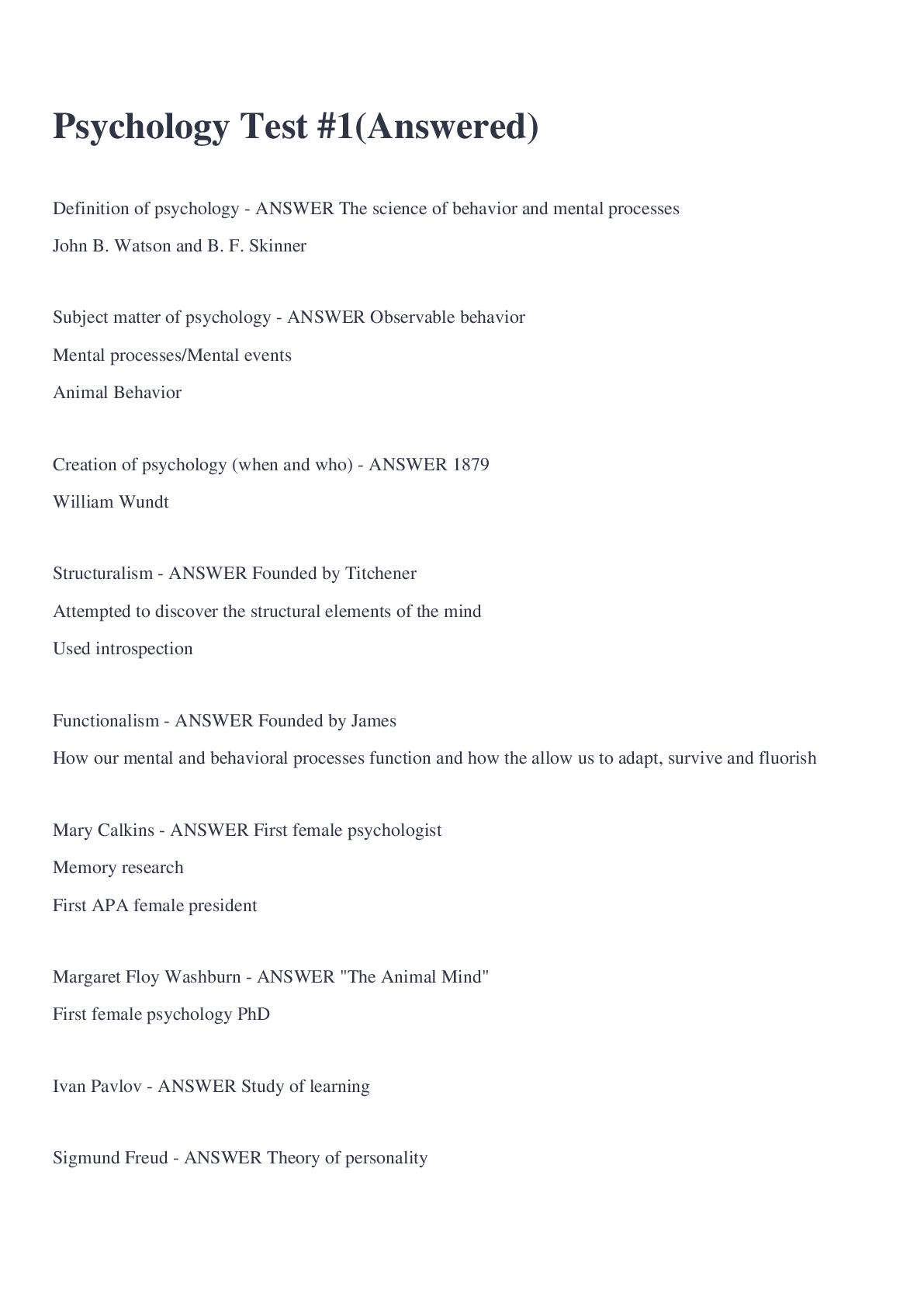
Definition of psychology - ANSWER The science of behavior and mental processes John B. Watson and B. F. Skinner Subject matter of psychology - ANSWER Observable behavior Mental processes/Mental e ... vents Animal Behavior Creation of psychology (when and who) - ANSWER 1879 William Wundt Structuralism - ANSWER Founded by Titchener Attempted to discover the structural elements of the mind Used introspection Functionalism - ANSWER Founded by James How our mental and behavioral processes function and how the allow us to adapt, survive and fluorish Mary Calkins - ANSWER First female psychologist Memory research First APA female president Margaret Floy Washburn - ANSWER "The Animal Mind" First female psychology PhD Ivan Pavlov - ANSWER Study of learning Sigmund Freud - ANSWER Theory of personality Jean Plaget - ANSWER Observer of children Behaviorism - ANSWER Psychology should be an objective science that studies behavior without reference to mental processes Humanistic psychology - ANSWER Emphasized the growth potential of healthy people and the individual's potential for personal growth Carl Rogers and Abraham Maslow Effect of current environmental influences and the fulfillment of our needs Cognitive neuroscience - ANSWER Study of the brain activity linked with cognition Ways we perceive, process, and remember information Behavior - ANSWER Any action we can observe and record Mental processes - ANSWER Internal, subjective experiences we infer from behavior Nature-nurture issue - ANSWER Controversy over the relative contributions of biology and experience Nurture works on what nature endows On the Origin of Species - ANSWER Published in 1859 by Charles Darwin Natural selection Natural selection - ANSWER Among the range of inherited trait variations, those contributing to reproduction and survival will most likely be passed on to succeeding generations Biopsychosocial approach - ANSWER Considers the influences of biological, psychological, and social-cultural factors Biological influences - ANSWER Natural selection Genetic predispositions Brain mechanisms Hormonal influences Psychological influences - ANSWER Learned behaviors Emotional responses Cognitive processing and perceptual interpretations Social-cultural influences - ANSWER Presence of others Cultural, societal, and family expectations Group influences Compelling modes Neuroscience - ANSWER How the body and brain enable emotions, memories, and sensory experiences Evolutionary - ANSWER How the natural selection of traits promoted the survival of genes Behavior genetics - ANSWER How much our genes and our environment influences our individual differences Psychodynamic - ANSWER How behavior springs from unconscious drives and conflicts Behavioral - ANSWER How we learn observable responses Cognitive - ANSWER How we encode, process, store, and retrieve information Social-cultural - ANSWER How behavior and thinking vary across situations and cultures Biological psychologists - ANSWER Links between brain and mind Developmental psychologists - ANSWER Changing abilities throughout life Cognitive psychologists - ANSWER How we perceive, thing, and solve problems Personality psychologists - ANSWER Persistent traits Social psychologists - ANSWER How we view one another Applied research - ANSWER Tackles practical problems Counseling psychologists - ANSWER Help people to cope with challenges and crises and to improve their personal and social functioning Clinical psychologists - ANSWER Asses and treat mental, emotional, and behavior disorders Psychiatrists - ANSWER Medical doctors licensed to prescribe drugs and otherwise treat physical causes of psychological disorders Hindsight bias - ANSWER The tendency to believe , after learning an outcome, that one would have foreseen it Critical thinking - ANSWER Thinking that does not blindly accept arguments and conclusions Examines assumptions, discerns hidden values, evaluated evidence, and assesses conclusions Theory - ANSWER Explanation using an integrated set of principles that organizes observations and predicts behaviors or events Hypothesis - ANSWER A testable prediction, often implied by a theory Operational definition - ANSWER Statement of the procedures used to define research variables Descriptive methods - ANSWER Describe behaviors Correlational methods - ANSWER Associate different factors Experimental methods - ANSWER Manipulate factors to discover their effects Case study - ANSWER Examines one individual in depth Suggest directions for further study May be misleading Survey - ANSWER Looks at many cases in less depth Asks people to report their behavior or opinions Can be biased by wording and sample characteristics Population - ANSWER All the cases in a group being studied, from which samples may be drawn Random sample - ANSWER Every member of the population has an equal chance of participating Ideal sample size - ANSWER Large Naturalistic observations - ANSWER Observing and recording behavior in naturally occurring situations without trying to manipulate and control the situation Cannot explain the behavior, only describe it Correlation - ANSWER A measure of the extent to which two factors vary together, and thus of how well either factor predicts the other Correlation coefficient - ANSWER A statistical index of the relationship between two things Less scatter - ANSWER More correlation Positive correlation - ANSWER Slope is positive Directly proportional Negative correlation - ANSWER Slope is negative Indirectly proportional Illusory correlation - ANSWER A perceived but nonexistent correlation When we believe there is a relationship between two things, we are likely to notice and recall instances that confirm our belief Experiment - ANSWER Manipulates one or more factors to observe the effect on some behavior or mental process Can determine causality Percentage of scores that lie within one standard deviation of the mean - ANSWER 68% Percentage of scores that lie within two standard deviation of the mean - ANSWER 95% When is a difference reliable - ANSWER Representative (not biased) sample Less-variable observations (lower standard deviations) Large sample size Statistical significance - ANSWER How likely it is that an obtained result occurred by chance To be significant, usually must be less than 5% How to study mental processes/events - ANSWER Biologically Infer mental processes from observable behavior Converging conclusion making Introspection Problems with introspection - ANSWER People may intentionally lie Memories may not be accurate Why study animals? - ANSWER Helps us understand human behavior To understand animal behavior Pros of studying animals - ANSWER Fewer ethical considerations Convenient Fewer demand characteristics More control over the experiment Shorter lifespans Reductionism Breed faster Ward and Jenkins (1965) - ANSWER Hypothetical cloud seeding experiment Illusory correlation Confirmation bias Marcus (1986) - ANSWER Stability of political attitudes Recollection is biased by current thoughts Heuristics - ANSWER Mental shortcuts Allow us to think quickly Sacrifices accuracy Kahneman - ANSWER Economics didn't predict well because it assumed rational behavior Availability heuristic - ANSWER Estimating the probability or frequency of an event based on its availability in memory Inductive inference - ANSWER Specific to general Probability Deductive inference - ANSWER General to specific Certainty Scientific process - ANSWER Observations Inductive inference Theory Deductive inferences Hypothesis Relate results to theory Null hypothesis - ANSWER No relationship Control group Experimental hypothesis - ANSWER Predicted relationship Experimental group Demand characteristics - ANSWER Cues in an experiment that suggest to subjects how they are to behave Why used descriptive methods - ANSWER Overcome demand characteristics Initial stages of research Ethically not possible to do experiment Institutional Animal Care and Use Committee (IACUC) - ANSWER Vet, ethics specialist, others Makes sure research follows federal guidelines for ethical research of animals Ethical guidelines for animals (vertebrates and up) - ANSWER Must make their lives as comfortable as possible and their deaths as quick as possible Strict guidelines about housing, feeding, and air quality Vary by species Ethical guidelines for humans - ANSWER No lasting or serious harm Informed consent Freedom from coercion Confidentiality Debriefing Institutional Review Board (IRB) - ANSWER Determines whether human research is ethical Ethologists - ANSWER Study animals in their natural habitats Goldberger - ANSWER Proved correlation does not prove causality Pellegra was not caused by transfer of bodily fluids Positively skewed normal curve - ANSWER Shifted to the left More extremes at the positive end Negatively skewed normal curve - ANSWER Shifted to the right More extremes at the negative end Variance (s²) - ANSWER Sum of (x - mean)²/n Standard deviation (s) - ANSWER Square root of variance Community psychologists - ANSWER Mental health in community settings Interaction between people and their physical, social, political, and economic environments Educational psychologists - ANSWER Relationship between learning and our physical and social environments Experimental psychologists - ANSWER Basic behavioral processes in research Forensic psychologists - ANSWER Apply psychological principles to legal issues Health psychologists - ANSWER Psychology's contribution to promoting health and preventing disease Industrial/organizational psychologists - ANSWER Relationship between people and their working environments Neuropsychologists - ANSWER Relationship between neurological processes and behavior Psychometric/quantitative psychologists - ANSWER Methods and techniques used to acquire psychological knowledge Rehabilitation psychologists - ANSWER Work with people who have lost optimal functioning after an accident, illness, or other even School psychologists - ANSWER Assessment of and intervention for children in educational settings Social psychologists - ANSWER Our interactions with others Sport psychologists - ANSWER Psychological factors that influence, and are influenced by, participation in sports and other physical activities Neuron - ANSWER Nerve cell The basic building block of the nervous system Sensory neurons - ANSWER Carry incoming information from the sensory receptors to the brain and spinal cord Motor neurons - ANSWER Carry outgoing information from the brain and spinal cord to the muscles and glands Interneurons - ANSWER Within the brain and spinal cord Communicate internally and intervene between the sensory inputs and motor outputs Dendrite fibers - ANSWER The bushy, branching extensions of a neuron Receive messages and conduct impulses toward the cell body Axon - ANSWER The extension of a neuron, ending in branching terminal fibers Passes messages to other neurons, muscles, or glands Myelin sheath - ANSWER A layer of fatty tissue segmentally encasing the fibers of many neurons Enables faster transmission of neural impulses Laid down up to age 25 Action potential - ANSWER A neural impulse A brief electrical charge that travels down an axon Resting potential - ANSWER Positive-outside/negative-inside state Selectively permeable - ANSWER Very selective about what it lets in Refractory period - ANSWER Resting pause in which the neuron pumps the positively charged ions back outside Excitatory signal - ANSWER Accelerates above base rate of firing Inhibitory signal - ANSWER Decelerates below base rate of firing Threshold - ANSWER The level of stimulation required to trigger an neural impulse All-or-none response - ANSWER Either fires or doesn't No in-between Synapse - ANSWER Junction between the axon tip of the sending neuron and the dendrite or cell body of the receiving neuron Synaptic gap/cleft - ANSWER Tiny gap at a synapse Neurotransmitters - ANSWER Chemical messengers that cross the synaptic gaps between neurons Bind to the receptor sites on the receiving neuron, affecting whether that neuron will fire Reuptake - ANSWER Reabsorption of the neurotransmiters by the sending neuron Acetylcholine - ANSWER Enables muscle action, learning, and memory Dopamine - ANSWER Influences movement, learning, attention, and emotion Serotonin - ANSWER Affects mood, hunger, sleep, and arousal Norepinephrine - ANSWER Helps control alertness and arousal GABA - ANSWER A major inhibitory neurotransmitter Glutamate - ANSWER A major excitatory neurotransmitter, involved in memory Endorphins - ANSWER Natural, opiate-like neurotransmitters linked to pain control and to pleasure Response to pain and vigorous exercise How drugs affect brain chemistry - ANSWER Bind with the receptor sites of natural neurotransmitters Can make the body stop producing its own neurotransmitters Agonist - ANSWER Similar enough to a neurotransmitter to mimic its effects May block the neurotransmitter's reuptake Antagonist - ANSWER Enough like the neurotransmitter to occupy its site, but not similar enough to stimulate the receptor Blocks a neurotransmitter's functioning Nervous system - ANSWER The body's speedy electrochemical communication network, cosisting of all the nerve cells of the peripheral and central nervous systems Central nervous system - ANSWER Brain and spinal cord [Show More]

Last updated: 3 years ago

Preview 1 out of 22 pages

Buy Now

Instant download

We Accept:

Payment methods accepted on Scholarfriends (We Accept)
Preview image of Psychology Test #1(Answered) document

Buy this document to get the full access instantly

Instant Download Access after purchase

Buy Now

Instant download

We Accept:

Payment methods accepted on Scholarfriends (We Accept)

Reviews( 0 )

$7.00

Buy Now

We Accept:

Payment methods accepted on Scholarfriends (We Accept)

Instant download

Can't find what you want? Try our AI powered Search

45
0

Document information


Connected school, study & course


About the document


Uploaded On

Nov 21, 2022

Number of pages

22

Written in

All

Seller


Profile illustration for Nancylect
Nancylect

Member since 3 years

102 Documents Sold

Reviews Received
9
2
1
0
4
Additional information

This document has been written for:

Uploaded

Nov 21, 2022

Downloads

 0

Views

 45

Document Keyword Tags

Recommended For You

Get more on EXAM »

$7.00
What is Scholarfriends

Scholarfriends.com Online Platform by Browsegrades Inc. 651N South Broad St, Middletown DE. United States.

We are here to help

We're available through e-mail, Twitter, and live chat.
 FAQ
 Questions? Leave a message!


Copyright © Scholarfriends · High quality services·