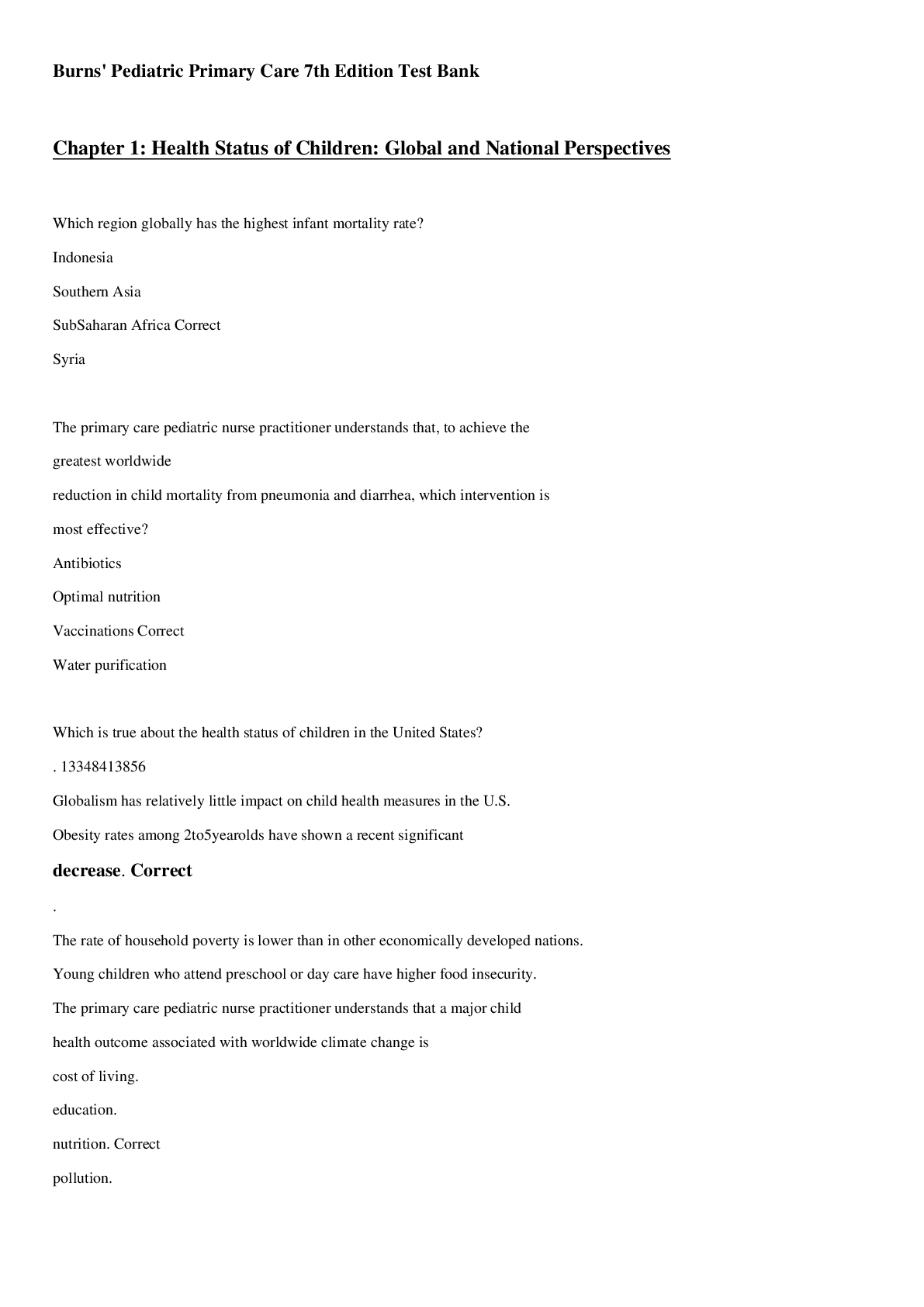
NURS MISC final Test Bank Pediatric Primary Care 6th Edition Burns Dunn Brady
Questions
1. A child who has attention-deficit/hyperactivity disorder (ADHD) has difficulty ID: 13348413834
stopping activities to begin o
...
NURS MISC final Test Bank Pediatric Primary Care 6th Edition Burns Dunn Brady
Questions
1. A child who has attention-deficit/hyperactivity disorder (ADHD) has difficulty ID: 13348413834
stopping activities to begin other activities at school. The primary care pediatric nurse
practitioner understands that this is due to difficulty with the self-regulation component of
A. emotional control.
B. flexibility. Correct
C. inhibition.
D. problem-solving.
2. The primary care pediatric nurse practitioner cares for a preschool-age child ID: 13348413832
who was exposed to drugs prenatally. The child bites other children and has tantrums when
asked to stop but is able to state later why this behavior is wrong. This child most likely has a
disorder of
A. executive function. Correct
B. information processing.
C. sensory processing.
D. social cognition.
3. The primary care pediatric nurse practitioner uses the Neurodevelopmental ID: 13348413842
Learning Framework to assess cognition and learning in an adolescent. When evaluating
social cognition, the nurse practitioner will ask the adolescent
A. about friends and activities at school. Correct
B. if balancing sports and homework is difficult.
C. to interpret material from a pie chart.
D. to restate the content of something just read.
4. The primary care pediatric nurse practitioner is evaluating a school-age child ID: 13348413838
who has been diagnosed with ADHD. Which plan will the nurse practitioner recommend asking
the child‟s school about to help with academic performance?
A. 504 Correct
B. FAPE
C. IDEA
D. IEP
5. The parent of a child diagnosed with ADHD tells the primary care pediatric ID: 13348413844nurse practitioner that the child gets overwhelmed by homework assignments, doesn‟t seem to
know which ones to do first, and then doesn‟t do any assignments. The nurse practitioner
tells the parent that this represents impairment in which executive function? A.
Activation Correct
B. Effort
C. Emotion
D. Focus
6. The primary care pediatric nurse practitioner is considering medication ID: 13348413826
options for a school-age child recently diagnosed with ADHD who has a primarily hyperactive
presentation. Which medication will the nurse practitioner select initially?
A. Low-dose stimulant
B. Moderate-dose stimulant Correct
C. Low-dose non-stimulant
D. Moderate-dose non-stimulant
7. The parent of a 4-year-old child reports that the child gets upset when the ID: 13348413824
hall light is left on at night and won‟t leave the house unless both shoes are tied equally tight. The
primary care pediatric nurse practitioner recognizes that this child likely has which type of
sensory processing disorder?
A. Dyspraxia
B. Over-responder Correct
C. Sensory seeker
D. Under-responder
8. The parent of a preschool-age child who is diagnosed with a sensory ID: 13348413828
processing disorder (SPD) asks the primary care pediatric nurse practitioner how to help the
child manage the symptoms. What will the nurse practitioner recommend?
A. Establishing a reward system for acceptable behaviors
B. Introducing the child to a variety of new experiences
C. Maintaining predictable routines as much as possible Correct D.
Providing frequent contact, such as hugs and cuddling
9. The primary care pediatric nurse practitioner is performing an examination on ID: 13348413846
a 5-year-old child who exhibits ritualistic behaviors, avoids contact with other children, and has
limited speech. The parent reports having had concerns more than 2 years ago about autism, but
was told that it was too early to diagnose. What will the nurse practitioner do first?
A. Administer an M-CHAT screen to screen the child for communication andContinue
socialization delays.
B. Ask the parent to describe the child‟s earlier behaviors from infancy through
preschool. Correct
C. Reassure the parent that if symptoms weren‟t present earlier, the likelihood of
autism is low.
D. Refer the child to a pediatric behavioral specialist to develop a plan
of treatment and management.
10. The primary care pediatric nurse practitioner is examining a 3-year-old child ID: 13348413830
who speaks loudly, in a monotone, does not make eye contact, and prefers to sit on the exam
room floor moving a toy truck back and forth in a repetitive manner. Which disorder does the
nurse practitioner suspect?
A. Attention-deficit/hyperactivity disorder
B. Autism spectrum disorder Correct
C. Executive function disorder
D. Sensory processing disorder
11. The primary care pediatric nurse practitioner is selecting a medication for a ID: 13348413836
12-year-old child who is newly diagnosed with ADHD. The child is overweight, has a history of an
atrial septal defect at birth, and reports mild shortness of breath during exercise. What will the
nurse practitioner prescribe?
A. A low-dose stimulant medication
B. A non-stimulant medication
C. Behavioral therapy only
D. Cardiovascular pre-screening Correct
12. The primary care pediatric nurse practitioner is conducting a follow-up ID: 13348413840
examination on a child who has recently begun taking a low-dose stimulant medication to treat
ADHD. The child‟s school performance and home behaviors have improved. The child‟s parent
reports noticing a few tics, such a twitching of the eyelids, but the child is unaware of them and
isn‟t bothered by them. What will the nurse practitioner recommend?
A. Adding an alpha-agonist medication
B. Changing to a non-stimulant medication
C. Continuing the medication as prescribed Correct
D. Stopping the medication immediatelyQuestions
1. The primary care pediatric nurse practitioner uses a shared decision-making ID: 13348425786
(SDM) model when working with families of children with chronic health conditions. When using this
model, the nurse practitioner can expect
A. considerably more time in each encounter.
B. improved patient health outcomes. Correct
C. less PNP involvement in health care decisions.
D. lower provider and higher patient satisfaction.
2. The primary care pediatric nurse practitioner diagnoses a 5-year-old child with ID: 13348425782
asthma and prescribes an oral steroid and a short-acting beta-adrenergic medication via a
metered-dose inhaler to manage acute symptoms. Along with education about the prescribed
medications, what information is important to give the child‟s family at this visit?
A. An asthma action plan
B. Effects and side effects of current medications
C. Information about spirometry testing
D. Instructions for medications at school
3. The parent of a child with complex health care needs tells the primary care ID: 13348425764
pediatric nurse practitioner that the child has had difficulty breathing the past two nights but can‟t
articulate specific symptoms. The child has normal oxygen saturations and a normal respiratory rate
with clear breath sounds. What will the nurse practitioner do?
A. Admit the child to the hospital for close observation and monitoring of respiratory status.
B. Encourage the parent to call when concerned and schedule a follow-up appointment
the next day. Correct
C. Perform a complete blood count, blood cultures, and a chest radiograph to evaluate
symptoms.
D. Reassure the parent that the child has a normal exam and is most likely not ill.
4. Which characteristic is the key criterion that identifies a child has having special ID: 13348425780
needs?
A. Cognitive function
B. Emotional health
C. Health service requirements Correct
D. Medical diagnosis
Correct5. The primary care pediatric nurse practitioner is performing a well baby ID: 13348425774
examination on a 2-week-old infant who was recently discharged home from the neonatal intensive
care unit. The mother reports that the infant was born at 26 weeks‟ gestation and states she was told
that her baby will probably have developmental delays. What is the most important aspect of long-term
management for this infant?
A. Careful monitoring of attainment of developmental milestones Correct
B. Familiarizing the parent with laws that mandate educational support
C. Providing genetic counseling to the infant‟s parents
D. Referral to social services for assistance with resources
6. The primary care pediatric nurse practitioner is preparing to perform a well child ID: 13348425790
examination on a 5yearold child who has multiple developmental and cognitive delays. The child‟s
mother is angry and tells the nurse practitioner that her friends‟ children are all preparing for
kindergarten. The nurse practitioner will
A. allow the mother to express her feelings, understanding that she is experiencing
grief. Correct
B. reassure the mother that special educational opportunities are available for her child.
C. suggest that the mother find a support group with other children with special needs.
D. tell her that most schools provide services for children with special health care needs.
7. The parent of a toddler who has special health care needs is resistant to a ID: 13348425766
suggestion that her child needs a gastrostomy tube for nutrition. The toddler has fallen from the 10th
percentile to the 5th percentile in the past few months and resists taking in appropriate amounts of
food by mouth even with assistance from occupational therapy. What will the primary care pediatric
nurse practitioner do?
A. Inform the mother that, since other options have failed, the gastrostomy tube is the only
option.
B. Refer the child to a dietician to teach the mother the importance of adequate nutrition.
C. Set weight gain and food intake goals with the mother and schedule regular visits to
monitor weight. Correct
D. Suggest that the gastrostomy tube may be tried temporarily and
removed once the child gains weight.
8. What is the most important role of the primary care pediatric nurse practitioner ID: 13348425792
who provides care for a child with special health care needs who sees several specialists and
receives community and school-based services?
A. Assessing the parent‟s ability to perform home care tasks
B. Coordinating services to ensure continuity of care Correct
C. Monitoring the family‟s adherence to the health care planD. Ordering medications and other prescribed treatments
9. A toddler swallowed a coin several days prior. The child‟s parent has not found ID: 13348425776
the coin in the child‟s stool. Which imaging test will the primary care pediatric nurse practitioner
employ to evaluate this ingestion?
A. Abdominal ultrasound
B. Computed tomography
C. Conventional radiograph Correct
D. Magnetic resonance imaging
10. The primary care pediatric nurse practitioner is assessing an ill 2-month-old infant ID: 13348425772
who is febrile and refusing most fluids. The preliminary blood work indicates a viral infection and
shows that the infant is hydrated. The infant is alert. The infant‟s parents are attentive and live
close by. What will the nurse practitioner do?
A. Administer a parenteral antibiotic and antipyretic and send the infant home.
B. Admit the infant to an inpatient hospital unit for overnight monitoring.
C. Give the parents sick care instructions and follow up in the clinic in the
morning. Correct
D. Send the infant to the urgent care center for intravenous fluids.
11. A toddler is prescribed a liquid oral medication. The parent tells the primary care ID: 13348425784
pediatric nurse practitioner that the child refuses to take medications and usually spits them out.
What will the nurse practitioner do?
A. Demonstrate oral medication administration with the toddler in the office. rrect
B. Instruct the parent to hide the medication in a favorite food or beverage.
C. Order the medication to be given via another route if possible.
D. Tell the parent to offer the child a reward each time the medication is taken.
12. The primary care pediatric nurse practitioner orders a pulmonology consult for a ID: 13348425788
child who has severe asthma. The nurse practitioner writes “child with asthma refractory to
conventional treatments needs suggestions for alternative treatments.” The nurse practitioner
expects the pulmonologist to
A. confirm the medical diagnosis for the child‟s parents.
B. make recommendations for disease management. Correct
C. stress the importance of adherence to the medication regimen.
D. take over management of this child‟s chronic illness.13. The primary care pediatric nurse practitioner cares for several families with K. L. ID:
chronically ill children who text status updates about their children to a mobile device that has an
encryption- protection platform installed. If the nurse practitioner misplaces the mobile device, it is
important to
A. disconnect the user from the system to avoid a data breach. Correct
B. notify the families that their messages may be read by others.
C. obtain a new device as soon as possible to resume communication.
D. upload the messages from another remote device.
14. The parent of an 18-month-old child calls the clinic to report that the child has a
I.
J. ID:
rectal temperature of 100.4°F (38°C). The child is playing normally, taking fluids well, and has a
slightly reduced appetite. What will the primary care pediatric nurse practitioner recommend?
G.
A. Administering an antipyretic medication
B. Bringing the child to the clinic for evaluation
C. Offering extra fluids and calling if symptoms change orrect D.
Ordering outpatient lab work such as a CBC
15. The parent of a preschool-age child calls the clinic to report that the child has H. ID:
clear, watery drainage from both eyes, mild erythema of the conjunctiva, and no fever or other
symptoms. What will the primary care pediatric nurse practitioner recommend?
A. Allow the child to go to preschool. Correct
B. Bring the child to the clinic for a culture.
C. Keep the child home for 2 days.
D. Use antibiotic eyedrops for 3 days..
16. A parent brings a 4-month-old infant to the clinic who has had a low-grade fever
E.
F. ID:
for 24 hours. The primary care nurse practitioner notes that the infant has a weak cry, slightly dry
oral mucosa, mottled skin, and a respiratory rate of 65 breaths per minute and sleeps unless
stimulated by the examiner,. What will the nurse practitioner do?
A. Administer oral fluids in the clinic.
B. Admit the infant to the hospital. Correct
C. Order outpatient laboratory tests.
D. Send the infant home with close follow-up.Questions
1. A pharmaceutical company has developed a new drug that was tested only ID: 13348428705
on adults. The FDA has declared this drug to have potential benefits for ill children. According to
the Pediatric Research Equity Act (PREA), what may the pharmaceutical company be required to
do?
A. Conduct pediatric drug studies to determine whether the drug is safe and effective in
children. Correct
B. Provide labeling stating that the safety and efficacy of the drug is not established
for children.
C. Receive a patent extension for conducting pediatric studies to determine use in
children.
D. Survey existing data about the drug to determine potential use in the
pediatric population.
2. The primary care pediatric nurse practitioner prescribes a new medication for ID: 13348428709
a child who develops a previously unknown adverse reaction. To report this, the nurse
practitioner will
A. access the BPCA website.
B. call the PREA hotline.
C. log onto the FDA Medwatch website. Correct
D. use the AAP online PediaLink program.
3. The primary care pediatric nurse practitioner is considering use of a relatively ID: 13348428701
new drug for a 15-month-old child. The drug is metabolized by the liver, so the nurse
practitioner will consult a pharmacologist to discuss giving the drug:
A. less often or at a lower dose. Correct
B. more often or at a higher dose.
C. via a parenteral route.
D. via the oral route.
4. The primary care pediatric nurse practitioner is considering using a drug for ID: 13348428707
an “offlabel” use in a child. The nurse practitioner has used the drug in a similar situation
previously, has consulted a pharmacology resource and the FDA website, and has determined
that there are no significant contraindications and warnings for this child. What else must the
nurse practitioner do when prescribing this drug?
A. Discuss recommendations with the parents and document their consent. Correct
B. Document anecdotal reports of previous use of the drug by other providers.C. Follow up daily with the parents to determine safe administration of the drug.
I.
D. Report this use to the FDA Medwatch website for tracking purposes.
5. The primary care pediatric nurse practitioner is counseling an adolescent J. ID:
who was recently hospitalized for an asthma exacerbation and learns that the child usually
forgets to use twice- daily inhaled corticosteroid medications that are supposed to be given at
0800 and 2000 each day. Which strategy may be useful in this case to improve adherence?
A. Ask the adolescent to identify two times each day that may work better. Correct
B. Consider having the school nurse supervise medication administration.
G.
C. Prescribing a daily oral corticosteroid medication instead.
D. Suggest that the parent enforce the medication regimen each day.
6. The primary care pediatric nurse practitioner is treating a toddler who has a H. ID:
lower respiratory tract illness with a low-grade fever. The child is eating and taking fluids well and
has normal oxygen saturations in the clinic. The nurse practitioner suspects that the child has a
viral pneumonia and will
A. order an anti-viral medication and schedule a follow-up appointment.
B. prescribe a broad-spectrum antibiotic until the lab results are received.
C. teach the parents symptomatic care and order labs to help with the
diagnosis. Correct
D. write a prescription for an antibiotic to be given if the child‟s condition worsens.
E.
7. The single mother of a 4-year-old who attends day care tells the primary care F. ID:
pediatric nurse practitioner that she had difficulty giving her child a twice-daily amoxicillin for 10
days to treat otitis media during a previous episode several months earlier because she works
two jobs and is too busy. The child has an ear infection in the clinic today. What will the nurse
practitioner do?
C.
A. Administer an intramuscular antibiotic.
B. Order twice-daily amoxicillin for 5 days.
C. Prescribe azithromycin once daily for 5 days. Correct
D. Reinforce the need to adhere to the plan of care.
8. The parent of a school-age child who has asthma tells the primary care D. ID:
pediatric nurse practitioner that the child often comes home from school with severe wheezing
after gym class and needs to use his metered-dose inhaler right away. What will the nurse
practitioner do?
A. Recommend that the child go to the school nurse when symptoms start.
B. Review the child‟s asthma action plan and possibly increase his steroid dose.Continue
C. Suggest asking the school to excuse the child from gym class.
D. Write the prescription for two metered-dose inhalers with spacers. CorrectQuestions
1. The primary care pediatric nurse practitioner is evaluating a 10-year-old child ID: 13348428717
who is describing shooting pain in both legs associated with aching, tingling, and burning. The
child is unable to pinpoint specific locations for this pain. Which type of pain does the nurse
practitioner suspect?
A. Chronic pain
B. Neuropathic pain Correct
C. Somatic pain
D. Visceral pain
2. A 3-year-old child is recovering from injuries sustained in a motor vehicle ID: 13348428721
accident. How will the primary care pediatric nurse practitioner evaluate this child‟s pain?
A. Ask the child to rate pain intensity on a 4- to 5-item pain discrimination scale.
B. Have the child describe any pain as “no pain, a little pain, or a lot of pain.” Correct
C. Question the child about the intensity and specific location of any pain.
D. Rely on nonverbal responses such as facial expressions and limb movements.
3. A 4-year-old child has just been released from the hospital after orthopedic ID: 13348428725
surgery on one leg following a bicycle accident. The child is sitting quietly on the exam table.
When asked to rate pain, the child points to the “1” on a faces rating pain scale. What will the
primary care pediatric nurse practitioner do next?
A. Assess the child‟s vital signs and ability to walk without pain. Correct
B. Refill the prescription for a narcotic analgesic medication.
C. Suggest that the parents give acetaminophen for mild pain.
D. Teach the parent to give analgesics based on the child‟s report of pain.
4. A developmentally and cognitively disabled 10-year-old child who is unable to ID: 13348428727
communicate must undergo a series of surgeries, and the child‟s parent asks how to know if
the child is in pain and when to give pain medication. What will the primary care pediatric nurse
practitioner teach this parent to use to assess this child‟s pain?
A. Comfort scale
B. FLACC scale
C. NCCPC-R Correct
D. Non-verbal observationsCorrect
5. The primary care pediatric nurse practitioner is preparing to perform a painful ID: 13348428723
procedure on a 4-month-old infant. Besides providing local anesthesia, what other pain control
method provides analgesic effects?
A. Providing toys
B. Singing or music
C. Sucrose solution Correct
D. Swaddling or cuddling
6. An adolescent female reports moderate dysmenorrhea with periods and tells the
primary care pediatric nurse practitioner that 400 mg ibuprofen every 6 to 8
completely control her pain. What will the nurse practitioner recommend?
A. Increasing the ibuprofen dose to 600 to 800 mg every 6 to 8 hours
B. Taking extra-strength acetaminophen 1000 mg every 4 to 6 hours
C. Taking naproxen 500 mg initially and then 250 mg every 6 to 8 hours D.
Using extended-release naproxen 500 mg every 12 hours
7. What is the most important dose-limiting factor when prescribing
acetaminophen with hydrocodone?
A. Acetaminophen dose Correct
B. Gastrointestinal side effects
C. Pruritis symptoms
D. Urinary retention
8. An adolescent takes ibuprofen, acetaminophen, and a tricyclic antidepressant
ID: 13348428733
hours doesn‟t
ID: 13348428731
ID: 13348428719
(TCA) to treat phantom limb pain and reports that the medications are no longer effective.
What will the primary care pediatric nurse practitioner do?
A. Change the TCA to a selective serotonin reuptake inhibitor.
B. Evaluate the adolescent for drug-seeking behavior.
C. Increase the TCA dose and reevaluate in 2 to 3 weeks.
D. Refer the adolescent to a pain management specialist. Correct
9. The parent of a school-age child with a chronic pain condition tells the ID: 13348428729
primary care pediatric nurse practitioner that the child has requested to stay home from school
more often in the past few months. The child‟s exam does not reveal any significant change in
pathology, and a review of the child‟s medications indicates appropriate dosing of analgesic
medications. What will the nurse practitioner recommend?
A. Assessing the child‟s pain every day to determine changesContinue
B. Ensuring the child stays quiet in bed with videos when having pain
C. Having the child do homework when staying home from school Correct
D. Requiring the child to go to school even during pain episodesQuestions
1. A 2-month-old infant has a staccato cough and fever. Which aspect of the history is
most important in determining the diagnosis?
A. Day care attendance
B. Immunization history Correct
C. Medication history
D. Past medical history
2. When reviewing a white blood cell (WBC) count, the primary care pediatric nurse
practitioner suspects a viral infection when which WBC element is elevated?
A. Bands
B. Leukocytes
C. Lymphocytes
D. Neutrophils
3. Which lab value is most concerning in an infant with fever and a suspected
bacterial infection?
A. C-reactive protein of 11.5 mg/L Correct
B. Lymphocyte count of 8.7
C. Platelet count of 475
D. White blood cell count of 14
4. A toddler is receiving long-term antibiotics to treat osteomyelitis. Which laboratory
ID: 13348428747
ID: 13348428799
ID: 13348428751
ID: 13348428793
test will the primary care pediatric nurse practitioner order to monitor response to therapy in this
child?
A. Blood cultures
B. Erythrocyte sedimentation rate (ESR) Correct
C. Serum procalcitonin (Pro-CT)
D. White blood count (WBC)
[Show More]








.png)

.png)