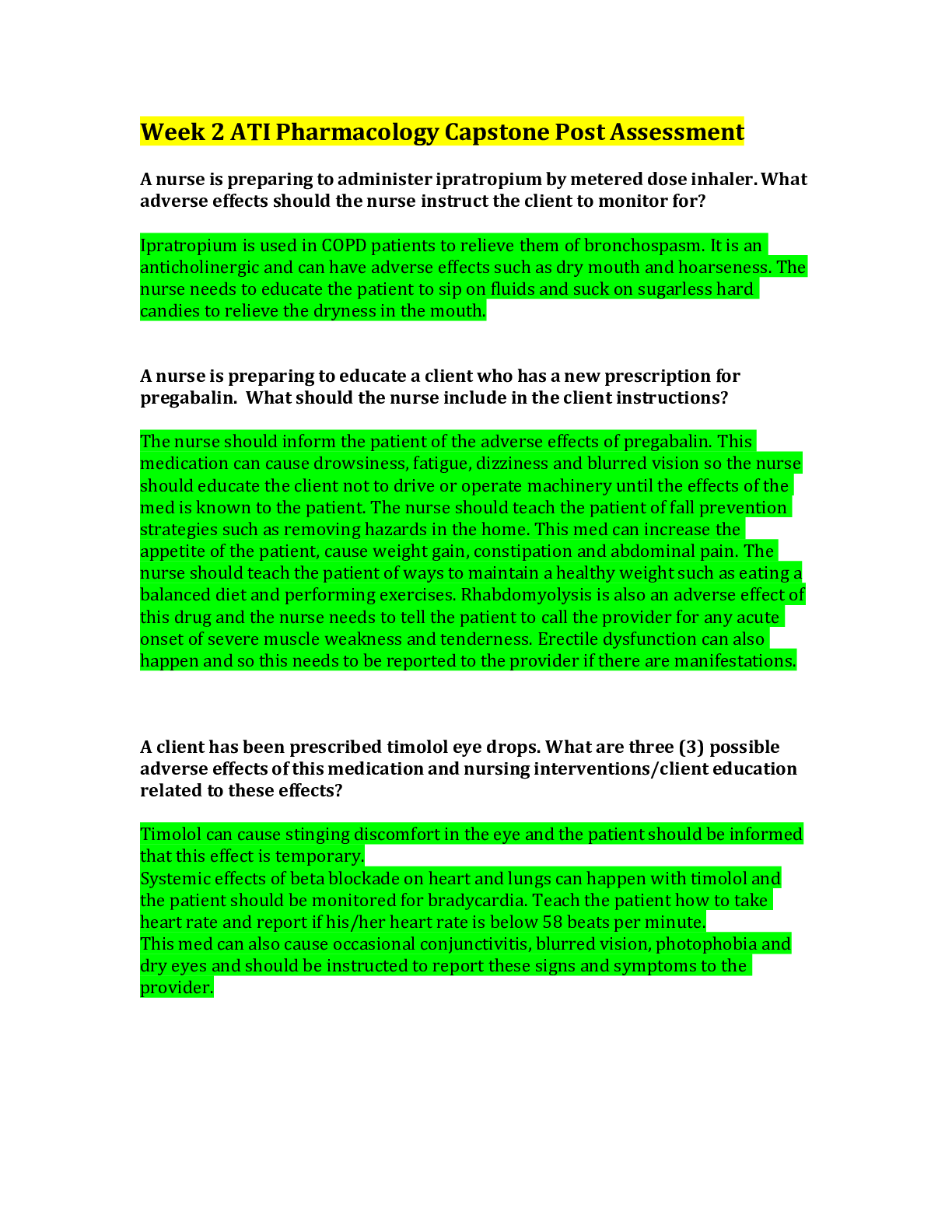
Week 2 ATI Pharmacology Capstone Post Assessment
1. A nurse is preparing to administer ipratropium by metered dose inhaler.
Whatadverse effects should the nurse i
...
Week 2 ATI Pharmacology Capstone Post Assessment
1. A nurse is preparing to administer ipratropium by metered dose inhaler.
Whatadverse effects should the nurse instruct the client to monitor for?
Ipratropium is used in COPD patients to relieve them of bronchospasm. It is an
anticholinergic and can have adverse effects such as dry mouth and
hoarseness. Thenurse needs to educate the patient to sip on fluids and suck on
sugarless hard candies to relieve the dryness in the mouth.
2. A nurse is preparing to educate a client who has a new prescription for
pregabalin. What should the nurse include in the client instructions?
The nurse should inform the patient of the adverse effects of pregabalin. This
medication can cause drowsiness, fatigue, dizziness and blurred vision so the
nurseshould educate the client not to drive or operate machinery until the
effects of the med is known to the patient. The nurse should teach the patient of
fall prevention strategies such as removing hazards in the home. This med can
increase the appetite of the patient, cause weight gain, constipation and
abdominal pain. The nurse should teach the patient of ways to maintain a
healthy weight such as eating abalanced diet and performing exercises.
Rhabdomyolysis is also an adverse effect ofthis drug and the nurse needs to tell
the patient to call the provider for any acute onset of severe muscle weakness
and tenderness. Erectile dysfunction can also happen and so this needs to be
reported to the provider if there are manifestations.
3. A client has been prescribed timolol eye drops. What are three (3)
possible adverse effects of this medication and nursing
interventions/client educationrelated to these effects?
Timolol can cause stinging discomfort in the eye and the patient should be
informedthat this effect is temporary.
Systemic effects of beta blockade on heart and lungs can happen with timolol
andthe patient should be monitored for bradycardia. Teach the patient how to
take heart rate and report if his/her heart rate is below 58 beats per minute.
This med can also cause occasional conjunctivitis, blurred vision, photophobia
anddry eyes and should be instructed to report these signs and symptoms to
the provider.
4. What is the difference between a long term and rescue inhalers?
Long term inhalers are used for long-term control of airflow disorders such as
asthma, Montelukast is a long term inhaler. Rescue inhalers work fast by
bronchodilation and they are used to prevent an asthma episode or relieve from
acurrent asthma episode, Albuterol is a rescue inhaler.
5. How would you instruct a new client on the use of an inhaler?
If the patient is taking both a beta 2 agonist and a glucocorticoid, the patient
needs totake the beta 2 agonist first, then the glucocorticoid for better absorption.
Inspatient to rinse their mouth after use of inhalers to prevent oral fungal
infections. There are two kinds of inhalers, a metered dose inhaler or MDI and
a dry-powder inhaler. For MDIs, instruct client to use a spacer, shake the
inhaler 5-6 times, whenthey inhale the medication, they should count to 3-5
seconds while inhaling so the medication can be delivered in the air passages,
hold breath for 10 seconds, take out the inhaler then exhale out. For DPIs, they
should not shake the inhaler and follow manufacturers instructions to inhale
and exhale completely, no spacer needed.
6. What are timolol ophthalmic drops used to treat?
Timolol drops are used to treat primary open angle glaucoma to reduce the
pressurein the eye.
7. What pregnancy category is pregabalin?
.
[Show More]