CONCEPT: HEALTH PROMOTION AND MAINTENANCE 1 Latest updated 2022
MENSTRUATION
Ovulation:
Purpose: prepare uterus for pregnancy
Note: Ovum/egg is viable inside the uterus within hours Sperm is via
...
CONCEPT: HEALTH PROMOTION AND MAINTENANCE 1 Latest updated 2022
MENSTRUATION
Ovulation:
Purpose: prepare uterus for pregnancy
Note: Ovum/egg is viable inside the uterus within hours Sperm is viable inside the uterus within days
Menstruation
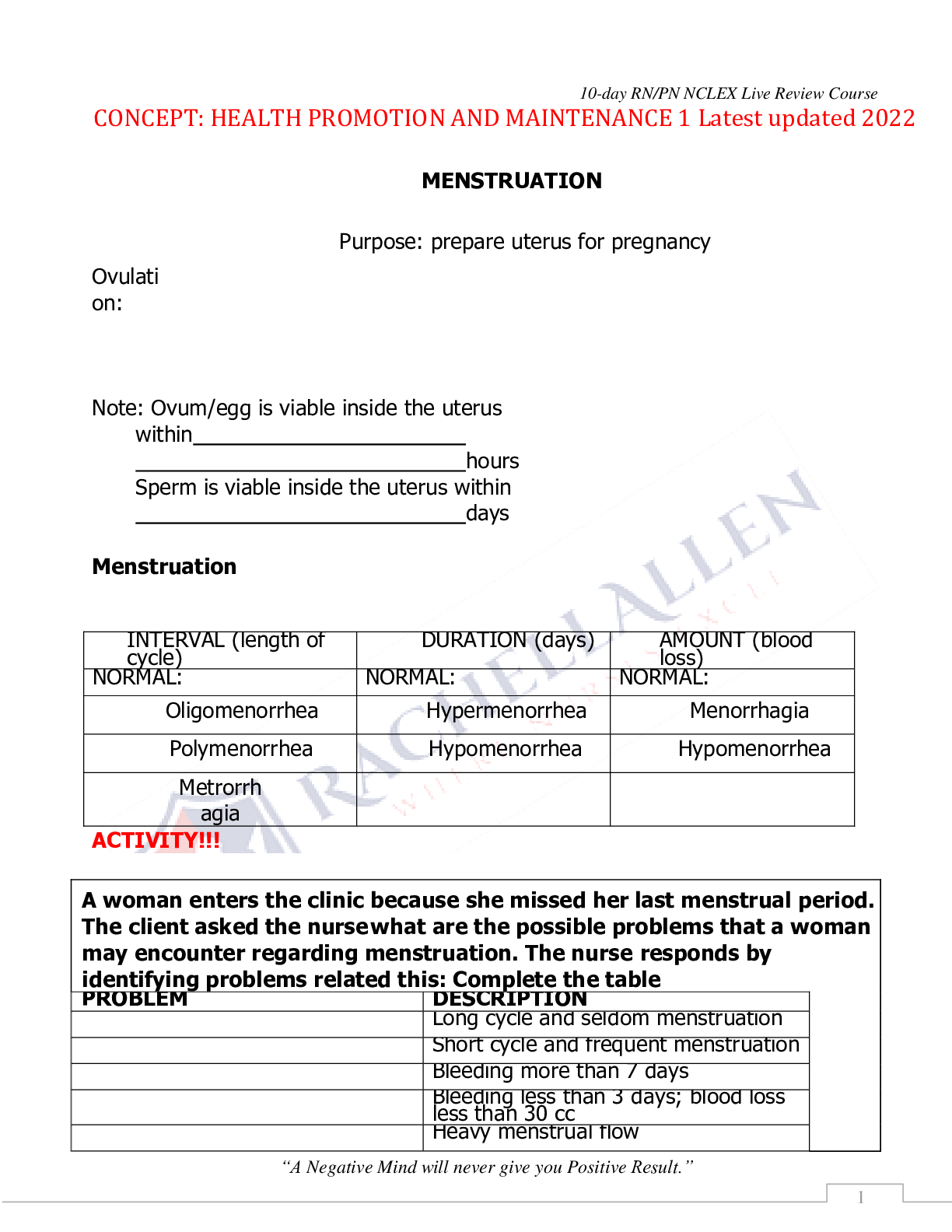
INTERVAL (length of cycle) DURATION (days) AMOUNT (blood loss)
NORMAL: NORMAL: NORMAL:
Oligomenorrhea Hypermenorrhea Menorrhagia
Polymenorrhea Hypomenorrhea Hypomenorrhea
Metrorrhagia
ACTIVITY!!!
A woman enters the clinic because she missed her last menstrual period. The client asked the nurse what are the possible problems that a woman may encounter regarding menstruation. The nurse responds by identifying problems related this: Complete the table
PROBLEM DESCRIPTION
Long cycle and seldom menstruation
Short cycle and frequent menstruation
Bleeding more than 7 days
Bleeding less than 3 days; blood loss less than 30 cc
Heavy menstrual flow
Bleeding in between menstruation
FETAL GROWTH AND DEVELOPMENT
1. AOG – Age of gestation
2. Basis:
a. LMP – Last Menstrual Period (First day)
b. Date of quickening – First fetal movement
c. Fundic height (Bartholomew’s rule)
- distance from the pubic bone to the fundus Pre: bladder
12 weeks -
16 weeks -
20 weeks -
36 weeks -
3. Emphasis of development
First trimester: Organogenesis - initiate the development of fetal organs Second trimester: Fetal length
Third trimester: Rapid growth and development
DEVELOPMENTAL EVENTS
First month (4 weeks) 1. Germ layer formation
a) Ectoderm – epidermis, skin, hair, nails, cornea, enamel
b) Mesoderm:
Musculoskeletal, Circulatory, Reproductive, Ureter, Kidney
c) Endoderm:
Bladder, Urethra, Neck, GI
2. Brain or nervous system development
3. Fetal heart beat but not audible
4. Development of trachea and esophagus
Second month (8 weeks) 1. Organogenesis is complete
2. Development of placenta
3. Development of sex organs
Third month (12 weeks) 1. Complete placenta and barrier
2. Production of amniotic fluid
Volume: ml If low:
high:
pH:slightly alkaline (Nitrazine test: ) Color:
3. Audible FHT by _
4. Bone formation
Fourth month (16 weeks) 1. Audible FHT by _
2. Visualization of skeletal outline
3. Human face appearance
4. Development of external genitalia
5. Lanugo (fine hair)
Fifth month (20 weeks) 1. – first fetal movement felt by
2. Vernix (cheesy like substance acts as a lubricant to allow easy passage of the baby to the birth canal)
3. Audible FHT by
Sixth month (24 weeks) 1. Term size
2. Scalp hair
3. Pinkish, wrinkled skin (lack of brown fats)
Seventh month (28 weeks) 1. Development of alveoli (air sacs)
2. Production of surfactant- makes the lungs able to
expand
Eight month (32 weeks) 1. Decreased lanugo and vernix
2. Rapid fat deposition
3. Viable
Ninth month (36 weeks) 1. Lanugo and vernix caseosa disappearance
2. Amniotic fluid decreases
3. Birth position assumed
4. Lightening(baby settles in the pelvis, ready to be delivered)
PRENATAL CARE – is a preventive healthcare that benefit both mother and child
1. Assessment
a. Prenatal History:
Gravida (G) – no. of pregnancies
Para (P) – no. of pregnancies that reached the age of viability Term (T) - wks
Preterm (P) - wks
Abortion(A) - wks Living (L)
ACTIVITY!!!
b. AOG
c. EDC/EDD – Expected date of confinement (EDC) / Expected due date (EDD) Naegele’s Rule standard way of calculating the due date of pregnancy
January - March April – December
ACTIVITY!!!
2. Signs and symptoms of pregnancy
Onset Presumptive Probable Positive
First trimester B A U
N Positive Hegar’s – Goodell’s –
Chadwicks – Fetal heart tone (FHT): 12 wks - 16 wks -
20 wks -
Second trimester Quickening – first fetal movement
Chloasma – darkening of the skin
“mask of pregnancy” Ballotement – the use of a finger to push sharply against the uterus and detect the presence of a fetus by its return impact.
Braxton hick’s- painless false contractions Fetal outline
UTZ (ultrasound)
ACTIVITY!!!
3. Weight monitoring:
1st tri: lbs or lb/mo. 2nd tri: lbs or lbs/mo. 3rd tri: lbs or lbs/mo. Entire duration: lbs
4. Diagnostic tests:
a. Rubella Titer – antibody titer to determine if patient is already immune to rubella
>1:8 –
<1:8 – : Avoid exposure to large crowds and contact with children If not immune – give
NOTE: Avoid getting pregnant for at least after the vaccination If already pregnant: never give vaccination, do it after delivery
Assess: eggs and gelatin allergies
b. Alpha-fetoprotein Screening (AFP) – protein produced by the liver of unborn baby Normal value: 2.5 MoM (Multiples of Mean)
Results: High -
Low - Health teaching (diet):
QUESTION!!!
c. Chorionic Villi Sampling – uses a catheter to get a sample
Pre: consent; Bladder Intra: Monitor Maternal VS and FHR Post: WOF –
d. Amniocentesis – a needle is inserted in the abdomen thru the uterus, guided by an
ultrasound
Pre: consent; Bladder Intra: Monitor Maternal VS and FHR Post: WOF -
Complication:
e. Lecithin/Sphingomyelin ratio – test for lung maturity Normal:
f. Leopold’s Maneuver
Pre: bladder hands
Fundus Fetal Back & Spine Symphysis Pubis Pelvic
DETERMINE: HEAD: BUTTOCKS:
DETERMINE: DETERMINE: DETERMINE: FETAL BACK: ENGAGED:
NOT ENGGAGED:
5. Activities of daily living
a) Smoking
Still birth, abortion, small for gestational age
b) Alcoholism
C R I M P
c) Sexual activity – generally but there will be changes in desire Avoided if: Pre-term labor – labor contractions before the 37th week
Incompetent cervix – due to weak cervix
d) Traveling/employment
Prolonged sitting/standing Management:
6. Frequency of pre-natal visits
0-7 months:
7-9 mos:
9 mos and up:
7. Nutritional requirements
2,500 kcal/day or add 300 kcal to usual diet
PHYSIOLOGIC CHANGES IN PREGNANCY
CARDIOVASCULAR 1. Supine hypotension
2. Ankle edema, varicosities, possible clot formation
3. Physiologic anemia
4. Uterine pressure
ENDOCRINE
Hormones increases in activity 1. Increased activity of adrenal cortex
2. Increased activity of thyroid gland
3. Increased activity of anterior pituitary gland
4. Placental hormones
a) HCG (Human Chorionic Gonadotropin) N&V (1st tri) -
N&V beyond 1st tri –
b) HPL (Human Placental Lactogen)
- facilitates protein synthesis and transport of amino acid to the fetus
c) Estrogen
d) Progesterone
GIT 1. Nausea & vomiting
Mgt: -mall frequent meals
E -at dry toast or crackers
A -void gastric irritants and gas forming foods S -it upright
2. Constipation
Mgt: F -iber increase L -ots of fluid E -xercise
A -mbulation
3. Heartburn
Mgt: same with N&V
4. Hemorrhoids – severe dilation of rectal veins Mgt: Correct constipation
warm sitz bath – to promote circulation for healing cold compress - to prevent swelling
MUSCULO-SKELETAL
1. Leg cramps due to Phosphorus and Calcium imbalance
2. Muscle relaxation
joints affected = waddling gait WOF:
3. Backache due to Lordosis – inward curvature of the spine Mgt: Pelvic rock exercise
Low heeled shoes
REPRODUCTIVE 1. Amenorrhea –absence of menstruation
2. Leukorrhea – milky white vaginal discharge
3. Chadwick’s – bluish discoloration of the cervix and vagina
4. Goodell’s – softening of the cervix
5. Hegar’s – softening of the uterus
6. Breast changes
7. Colostrum production – thin watery high protein fluid
- contains antibodies
ACTIVITY!!! (LIST DOWN APPROIPRIATE NURSING INTERVENTION FOR EACH PROBLEM)
PROBLEM NURSING INTERVANTION
Supine Hypotension
Ankle Edema
Physiologic Anemia
Nausea and Vomiting
Constipation
Hemorrhoids
Leg Cramps
Backache
COMPLICATED PREGNANCY
BLEEDING IN PREGNANCY
**TO DETERMINE CAUSE: Trimester (AOG)
1st: 1-12 wks
2nd: 13-27 wks 3rd: 28 and up
First Trimester Bleeding
ABORTION
BLEEDING, CONTRACTION, DILATION
Products of conception: Placental and fetal tissue TYPES:
1. INDUCED – intentional termination of pregnancy
2. SPONTANEOUS – miscarriage (pregnancy loss)
A. THREATENED – vaginal bleeding during the first 20 weeks of pregnancy
B. INEVITABLE – cervical dilation and uterine contractions Missed - products of conception are expelled
Incomplete - products of conception are expelled Complete - products of conception are expelled
MANAGEMENT:
ECTOPIC PREGNANCY
- implantation outside of the uterus
Risk factors: Pelvic inflammatory Disease (PID)
-Infection
-IUD (Intrauterine Device)
-In vitro fertilization (IVF) S/Sx:
Sharp, stabbing unilateral pain Shoulder pain
Scanty vaginal spotting Rupture:
Diagnosis:
Mgt: Methotrexate (chemotherapy agent and Immunosuppressant)
-to attack the fast growing cells Mifepristone (abortifacient)
Salphingectomy – removal of the fallopian tube
Second Trimester Bleeding
HYDATIDIFORM MOLE
- also known as Gestational trophoblastic disease
- abnormal proliferation of trophoblastic villi
S/Sx
High HCG levels
Hyperemesis gravidarum – excessive vomiting more than 3 months Hypertension
Height of fundus greater than AOG Heart tone absent
History of grapelike clusters upon ultrasound
Associated with:
Mgt: Avoid getting pregnant for at least
Methotrexate
D&C, hysterectomy (removal of the uterus)
INCOMPETENT CERVIX
- premature dilation of the cervix
Cause: Unknown
Damage due to previous surgery or trauma Assessment:
Management:
Third Trimester Bleeding
1. Placenta Previa 2. Abruptio Placenta
Placenta Previa Abruptio Placenta
Risk factors Maternal age African american Previous history of
Smoking HTN
Cocaine use DM
Polyhydramnios
Pain
Bleeding
Uterus
Management
Monitor VS and FHR Left side lying Oxygen
Fluids
Monitor VS and FHR Left side lying Oxygen
Fluids
ACTIVITY!!!
BIOPHYSICAL PROFILE
Non stress test Contraction stress test
- Assesses fetal well being – blood flow&oxygen
• EVERY TIME THERE IS PRESS THE BUTTON.
• Done 1 hour post meal -
Duration:
Measures: FHR acceleration r/t fetal movement
RESULTS
NORMAL/ REACTIVE ABNORMAL / NON-REACTIVE - Evaluates fetal response to stress of labor
EMPTY
MAY PROVIDE
Duration:
Measures: FHR deceleration r/t to uterine contraction RESULTS
(-) NORMAL (+)ABNORMAL
Pregnancy Induced Hypertension (PIH)
Risk factors: History of preeclampsia, heart disease, DM, renal problems, hydramnios
Obesity
Multiple gestation
Extremes in age:
Low socioeconomic background
African American
Nulligravid(never been pregnant)/ Primipara (giving birth for the first time)
Distention(over) of the uterus
BP Edema Proteinuria Others
Gestational HTN
Mild Preeclampsia
Severe Preeclampsia
Eclampsia
Management:
Diet:
Seizure precaution
DOC Antidote:
Anti-HTN drugs
If eclampsia, delivery
Rh incompatibility
Exposure: birth, miscarriage, trauma, puncture WOF: ERYTHROBLASTOSIS FETALIS
Diagnosis: Coomb’s test
Treatment:
How to prevent RH Incompatibility:
Coomb’s test ( )
wk of pregnancy
within hrs post exposure
LABOR AND DELIVERY
Causes of Labor Onset
1. Decreased placental function due to aging placenta
2. Decreased progesterone
3. Increased oxytocin
4. Increased uterine stretch
5. Increased prostaglandin
4P
A. PASSAGE – the pelvis
Factors Affecting Labor and Delivery
B. PASSENGER – the baby
will first contact the cervix
A. Cephalic – head first
B. Breech – buttocks and legs first
C. Shoulder
2. Position – relationship of the fetal presenting part to the mother’s pelvis
3. Station – relationship of presenting part to ischial spine
Above the ischial spine Below the ischial spine
C. POWER – the ability to push
Stages of Labor and delivery
I. – Onset of true labor full cervical dilation
II. – Full cervical dilation birth of baby
III. – Birth of baby placental delivery
IV. – Puerperium - period within 6 weeks after childbirth (post partum)
D. PSYCHE – the emotional state during birth of the baby
FIRST STAGE:
True Labor False Labor
Interval
Contraction
Pain
Cervical changes
PHASES OF LABOR
Latent Active Transitional
Dilation
Frequency
Duration
Intensity Mild Moderate Strong
FHR VARIABILITIES
FHR Pattern Description Nursing Interventions
EARLY Deceleration
FHR at the of uterine contractions (UC) then returns to baseline at the of UC
LATE Deceleration
FHR the onset of UC and continues beyond the end of UC
VARIABLE Deceleration
FHR is in relation to UC
SECOND STAGE:
Intrapartal Care:
1. Assessment – Mother - VS
Fetus -FHR
2. Nutrition: if presenting part is known: yogurt Unknown presenting part: NPO
3. Comfort measures
a. Position: Squatting, On all fours, Semi-sitting
b. Sacral pressure – relieves back pain
c. Effleurage – light massage
d. Breathing technique Latent- Chest Active - Abdominal
Transitional – Pant pant blow (Hee-Hee-Ho)
e. Encourage voiding – to allow more space for contraction
f. Analgesics: Nalbuphine Hcl (Nubaine)
Meperidine (Demerol)
WOF:
Contraindicated:
Antidote:
g. Anesthesia
• Pudendal block – anesthesia injected in the pudendal canal where pudendal nerve is located
• Epidural – (side lying position)
WOF:
• Spinal – (sitting with back arched)
WOF:
THIRD STAGE
Signs of placental separation:
Lengthening of the cord Change in shape of the uterus – Calkin’s sign
Sudden gush of blood Firm contraction
Appearance of placenta at vaginal opening
Presentation:
1. Shiny Schultz – side: , separation: center
2. Dirty Duncan – side: , separation: edges
FOURTH STAGE:
Involution – return of reproductive parts to their non-pregnant state
1. Uterus: Firm and Contracted
Placement: Immediately post placental delivery –
After 1 upto 24 hours - Then it will decrease
2. After pains – intermittent cramping DOC: NSAIDS
V. Lochia – vaginal discharge not clotted and not foul smelling
Pattern Duration (days) Color
1-3 Dark red
4-9 Pink to brown
10 and up White
4. Abstinence – 3-4 weeks to prevent vaginal and cervical infection
5. Temperature – 1st 24 hours: (normal) increased in temperature due to dehydration After 24 hours: 100.4F – (abnormal) INFECTION
POINTS TO REMEMBER:
POST-PARTAL BLEEDING
BOGGY BLEEDING SHOCK OTHER MGT
UTERINE ATONY
(Abnormal relaxation of
the uterus) 1st 24 hours
Ask patient to void Fundal massage
Oxytocin
RETAINED PLACENTA
After 24 hours
CLOT FORMATION
DILATATION AND CURETTAGE (D&C)
Gestational Diabetes Mellitus
Risk factors: Native american, Hispanic, Asian
Obesity Age
History: DM, Polycystic ovarian syndrome (PCOS), large babies, unexplained fetal loss, congenital anomalies (previous pregnancy)
Diagnostic test:
Oral Glucose Tolerance Test (OGTT)
Management: Increase fiber , Low fat, Adequate glucose, Exercise WOF: Hypoglycemia in baby after birth
WHY? Because babies are exposed to high blood sugar levels from the mother
PRIORITY: Assess glucose and feed the baby
CONCEPT: HEALTH PROMOTION AND MAINTENANCE 2
INFANT
0-18 months
DEVELOPMENTAL LEVELS
Freud: Oral Erickson: Trust vs.
Mistrust PLAY: Solitary HOSPITALIZATION: Satisfy oral needs CONCEPT OF DEATH: None SIGNIFICANT PERSON: mother
Fear: Stranger Anxiety
ACCIDENTAL INJURY: aspiration/ fall/SIDS
• They play with their body and senses
• Toys: mobiles, rattles, teething rings, music boxes and squeeze toys
TODDLER
18months – 3 y.o.
DEVELOPMENTAL LEVELS
Freud: Anal – toilet training
Erickson: Autonomy vs. shame & Doubt (Independence) Play: Parallel HOSPITALIZATION: Security objects CONCEPT OF DEATH: Reversible / Temporary SIGNIFICANT PERSON: Parents
FEAR: separation Anxiety
ACCIDENT/ INJURY: poisoning/ Fall / Thermal Burns MVA, drowning, child abuse
Criteria for toys: Safe
Goal
Purpose – Talk and walk Toys: push and pull toys, talking toy telephone, blocks Behaviours to observe:
Negativisim – Intervention: Set limits and offer choices Temper tantrums- Intervention: ignore and time outs Ritualistic Behavior – Security objects, routines and rituals
PRESCHOOL
3 y.o. – 6 y.o. Oedipal – Mama’s boy
DEVELOPMENTAL LEVELS Electra – Daddy’s girl
PRESCHOOL:
Freud: Phallic
Erickson: Initiative vs. Guilt
PLAY: associative / cooperative HOSPITALIZATION:Explain using
paper dolls and puppets CONCEPT OF DEATH: Reversible
/ Temporary
SIGNIFICANT PERSON: Immediate
family FEAR: Body mutilation/fear of castration
ACCIDENT/ INJURY: motor accident
• Loves to share and imitate adults into play
• Toys role playing games – play school, play house, doctor-nurse kit
Behaviors to observe:
Why stage
Imaginative > fear of dark,
telling tall tales > makes the story exaggerated
SCHOOL-AGE
6 – 12 y. o DEVELOPMENTAL LEVELS
SCHOOL-AGE: ( normal homosexual )
Freud: Latency
Erickson: Industry v. Inferiority PLAY: Competitive
HOSPITALIZATION:Explain using simple diagrams / Illustrations
CONCEPT OF DEATH: Irreversible / Permanent
SINIFICANT PERSON: teacher FEAR: Doing wrong
ACCIDENT/ INJURY: Motor accident, head injury Greenstick fracture
• Toys Card games, scrabble, skipping rope Behaviors to observe:
Achievement-ORIENTED years
ADOLESCENT 12 – 20 y.o.
DEVELOPMENTAL LEVELS ADOLESCENT:
Freud: Genital
Erickson: Identity vs. Role confusion SIGNIFICANT PERSON: Peers
Fear: Body Image Disturbance
ACCIDENT/ INJURY: sports accident, Drugs, Alcohol,
Suicide, MVA, STI’s , Infectious Mononucleosis
• Bodily changes which corresponds to puberty
• Moody and unpredictable
FINE MOTOR SKILLS GROSS MOTOR SKILLS
0 – Reflex grasp
3 – Hands held open 6 – Palmar grasp
9 – Pincer grasp
10 – Points at object
11 – Puts object in container
12 –Throws objects (2 tower blocks) 12-13 – Drinks from a cup, feeds self with spoon
2 yrs – 5 Tower blocks
2 ½ - 7-8 Tower blocks
3 – Unbutton – starts to copy circle, cross &square
4 – Button
6 – Tying shoe laces 0 – Head lag 2 – Lifts head
4 – Full head control 5 – Roll over
6 – Sits with support 7 – Foot in mouth
8 – Sits without support 9 – Crawl
10 – Stands with support 11 – Cruising
12 – Stands alone 14-15 – Walks alone 3y.o – Tricycle
4 y.o. - Bicycle
SPEECH
GROWTH PRINCIPLES
1 – 2 MONTHS COOS
2 – 4 MONTHS LAUGHS , MAKES
CONSONANT SOUNDS 6 MONTHS IMITATIVE SOUNDS
8 – 9 MONTHS PRONOUNCES SYLLABLES
(DA-DA)
12 MONTHS SAYS 4 – 5 WORDS
2 YEARS FIRST PHRASE, 300 WORDS
2 ½ YEARS KNOWS FIRST NAME
3 YEARS 3 – 4 WORD SENTENCES,
900 WORDS
Physiologic loss of weight a couple of weeks after birth will be observed:
5 – 10%
Rapid Stages: Infancy, Adolescence
Slow Periods: Toddler, Pre-schooler , School age
Reminder:
2x the weight: 6 months 3x the weight:12 months 4x the weight: Toddler
Length: 50 % increase at 12 months
CHILDHOOD IMMUNIZATION
General Contraindication and Precaution General Side Effects
Anaphylactic reaction from previous dose
Live vaccines such as MMR, Varicella, Polio, Rotavirus are contraindicated for:
Pregnant, patients with decreased immune system and with allergies to gelatin
Moderate to severe acute illness with or without fever
Swelling Tenderness Erythema
Fever (low grade)
VACCINE IMMUNOGLOBULIN
ACTIVE IMMUNIZATION PASSIVE IMMUNIZATION
MADE UP OF LIVE VIRUSES TO HELP THE CONTAINS ANTIBODIES BODY PRODUCE ANTIBODIES
BEGIN TO WORK IN SEVERAL WEEKS WORKS IMMEDIATELY PROVIDES DECADES OF PROTECTION PROVIDES FEW MONTHS OF PROTECTION
THE NEONATES
(Birthmarks)
REFLEXES DISAPPEARANCE
Roof of the mouth is touched Sucking and Rooting 3 – 4 months
Corner of the mouth is stroked
“Fencing” Tonic Neck
Pushes food out of the mouth Extrusion 4 months
Hold tightly Palmar Grasp 6 months
Due to a loud sound/noise Startle Reflex 4 months
Sensation of falling Moro Reflex 6 months
Stroke the sole of the foot Babinski Reflex 12 months
THE RISK NEONATES
CARDIOVASCULAR DISORDER
ACYANOTIC
Atrial Septal Defect (ASD) – Foramen ovale fails to close – Inc. blood flow in the Right atrium – causes an Increase in Heart rate
A "hole" in the wall that separates the top two chambers of the heart.
This defect allows oxygen-rich blood to leak into the oxygen-poor blood chambers in the heart. ASD is a defect in the septum between the heart's two upper chambers (atria). The septum is a wall that separates the heart's left and right sides.
Patent Ductus Arteriosus (PDA) – Ductus Arteriosus fails to close –causes machine like murmur
Coarctation of the Aorta (COA) – Narrowing of Aorta – causes Hypertension in upper extremities and hypotension in lower extremities
Coarctation of the aorta — or aortic coarctation — is a narrowing of the aorta, the large blood vessel that branches off your heart and delivers oxygen-rich blood to your body. When this occurs, your heart must pump harder to force blood through the narrow part of your aorta.
DIAGNOSTIC AND MANAGEMENT FOR ACYANOTIC HEART DEFECTS
• Chest Radiography
• Echocardiography
• Cardiac Catheterization
Corrective Surgery
Open Heart
• Induction of asystole
• Induction of hypothermia
• Use of bypass machine Close Heart:
• Indomethacin (IV) For Patent Ductus Arteriosus - IT CLOSES THE DUCTUS ARTERIOSUS MUSCLE
Balloon angioplasty Management for Coarctation of the Aorta Management:
1. Drugs:
Digoxin – give before meals
Note: Heart rate ( Bradycardia) WOF: Digoxin toxicity Hypokalemia – may cause toxicity
Withhold Digoxin if:
Infant – < 100 bpm Adult – <60 bpm
Antidote: Digoxin Immune Fab (Digibind)
Diuretics
ACE Inhibitors – decreases peripheral vascular resistance
2. Diet: Low Sodium
3. Decrease O2 demand:
Cluster care – to do things all at once to provide longer rest periods Quiet play / activity
Decrease anxiety and stress
CYANOTIC
A. Transposition of the great vessels
B. Tetralogy of Fallot
Pulmonary Artery Stenosis
Right Ventricular Hypertrophy Overriding Aorta
Ventricular Septal Defect
Symptoms:
• Exertional Dyspnea
• “Tet spells” – “Blue spells” – Hypercyanotic - presence of cyanosis
• Clubbing of fingers
• Polycythemia
• Stunted Physical Growth and delayed development
Management:
• Dec O2 Demand
• Propranolol
• Monitor Hgb and Hct count
• Positioning during attacks: Squatting / Knee chest
• Give Oxygen
• Monitor Activity tolerance
Surgery:
Palliative: Blalock- Tausig - surgical procedure to temporarily direct the blood flow to the lungs and relieve cyanosis while waiting for the corrective surgery.
Complete: Brock Procedure – surgical technique for correction of pulmonic stenosis, excision of the fibromuscular obstruction in the right ventricle.
ACQUIRED HEART DISEASE RHEUMATIC HEART FEVER
- An autoimmune disease that affects
CONNECTIVE TISSUES. It manifests 2-6 weeks after untreated GABHS infection of URTI (upper respiratory tract)
Diagnostic: JONES CRITERIA Positive if:
2 Major criteria or
1 Major and 2 Minor criteria
Management:
Control joint pain (large joints) and inflammation Bed rest
Antibiotics
Salicylates (Aspirin) WOF: Reye’s syndrome
***Antibiotic prophylaxis for dental work and invasive procedures to prevent INFECTIVE ENDOCARDITIS
KAWASAKI DISEASE
- An acute systemic inflammatory illness. Cause: Unknown
Most serious complication:
Cardiac complication (affects the coronary arteries)
Common to Asians:
Boys under 5 years old Japanese and Korean
Assess: Heart sounds Examine eye for conjunctivitis Monitor I and O
Diet: soft foods and liquids Passive ROM
Med“icAaNtioegna:tiAvsepMiriinn,d Iwgil(lInVe)ver give you Positive Result.”
28
GASTROINTESTINAL PROBLEMS
Pyloric Stenosis
Narrowing of Pyloric Sphincter Diagnostic finding: String sign Manifestations: Radiographic finding – a patient is given a
Abdominal distention radio opaque dye (barium) and x-rays are
Projectile vomiting taken. Dye will take on the appearance of Weight loss thin string as it passes through the
Hypokalemia narrowed pyloric sphincter.
Olive shaped mass
Surgery: Fredet-Ramstedt Procedure (Pylorotomy with Pyloroplasty) – to dilate narrowed pyloric sphincter
Nursing Consideration: Pre: Intravenous Fluid (IVF), NPO
Post: Monitor, I&O, Small frequent feeding (SFF), Feed infant slowly,
burping frequently
Intussusception
Imperforated Anus
-Telescoping of the intestine
Signs and Symptoms:
• Spasmodic Abdominal pain
• Blood with mucous (Currant jelly stool)
• Sausage shaped mass
• Bile stained vomitus
Mgt:
• Barium Hydrostatic reduction technique No opening in the anus
Normal passage of meconium: 24-36 hours post birth
Management:
Colostomy and Anoplasty Small frequent feedings (SFF) Stay upright
If with suspicion:
Notify the MD
No rectal temperatures
HIRSCHPRUNG DISEASE
-Absence of ganglion cells in the Large intestine – “AGANGLIONIC MEGACOLON”
Signs and Symptoms:
• Initial: Absence of stool
• Constipation
• Ribbon-like stool
• Pellet-like stool
• Abdominal Distention with possible fecaloid vomitus
• Weight loss Dx:
• Rectal Biopsy
• Barium enema
Surgery: Endorectal Pull –through procedure
Esophageal Atresia and Tracheoesophageal Fistula
Ends in a blind pouch
Connection between the esophagus and trachea
Cleft Lip Cleft Palate
Cause:
Gender: Multifactorial
MALE Hypervitaminosis, drugs, smoking
FEMALE
Surgery Cheiloplasty – to save the sucking reflex
at 3-6 mos. Palatoplasty / Uranoplasty – to prevent faulty speech habits
at 6-24 mos.
Position post surgery
Feeding Supine
Dropper, nipple with large holes Prone –for proper drainage to prevent aspiration
No straws
Use CUP (ex. sippy cups)
Protection Logan bow device Elbow restraint
Logan bow device – a wire piece attached to the patients cheeks and pushes the cheeks together NOTE: AVOID CRYING – it stresses the suture line
NEUROLOGIC DISORDERS
NEURAL TUBE DEFECTS
Spina bifida occulta – Fissure in the spinal column
Meningocele – Protrusion (sac) containing: Meninges and Spinal fluid Myelomeningocele – Protrusion (sac) containing: Meninges, Spinal fluid and nerves
Over-all objective: Protect the sac from infection and pressure Intervention:
1. Position: prone
2. Feeding: hold the baby, avoid pressure on the sac
3. Cover: gauze + NSS
4. Bowel function: Increase in fiber
5. Monitor infection – check temperature
6. Provide adequate nutrition
7. Monitor: Increase ICP
HYDROCEPHALUS
Causes:
Tumor, hemorrhage, infection or trauma Signs and symptoms:
• S/sx of Increase in ICP
Infant – irritability, restlessness, shrill cry (high pitched)
Toddler – irritability, lethargy, lack of appetite, headache, nausea and vomiting Older children – altered LOC
• Sun set eyes – eyes are driven downward
• Frontal bossing – protruding forehead
• Dilated scalp veins
• Increase head circumference
• Macewen’s sign - tapping over the frontal and temporal lobe
(+) sign is known as having a “CRACKED POT SOUND” – sound of a broken vessel or container
Nursing Care:
• Side lying position
• Measure Head circumference
• Prevent increase in ICP: Quiet and non-stimulating environment
Surgery: Ventriculoperitoneal shunt
(VP SHUNT) - SHUNTING FLUIDS FROM THE VENTRICLES TO PERITONEUM
Pre-op: Side lying position
Monitor I&O
Small Frequent Feedings Reposition head frequently
Post-op: Flat on bed for the 1st 24 hours then semi fowler’s after 24 hours
31
CEREBRAL PALSY
Impaired movement and posture
Assessment:
Feeding difficulties
Abnormal motor performance Stiff, rigid, arms and legs Developmental milestones Persistent infantile reflexes Abnormal posturing
Seizures
NURSING INTERVENTIONS:
Goal: Early detection and Intervention
-Assess child’s developmental level
-Maximize the child’s asset and
minimize the limitations
-Mobilizing device: WHEELCHAIR
-Encourage communication and Interaction
-Provide SAFETY!
Candidate for tonsillectomy:
5 episodes in a year
1 episode in 3 consecutive years
Pre-op: Check dental and bleeding status check for loose teeth – to prevent
aspiration Post-op:
Position: side lying (semi-prone)
Observe for bleeding : FREQUENT SWALLOWING Prevent bleeding – ICE COLLAR
DIET: clear and non-irritating fluids
AVOID: red, purple and brown fluids
crunchy foods, hot and spicy foods, citrus fruits/juices
Allowed to give: water, apple juice, popsicle
EPIGLOTITIS
CAUSE: Haemophilus influenza COMMON: 2-5 y/o
Signs and symptoms:
Drooling , Dyspnea, Dysphagia
Stridor
The child is in tripod position
-leaning forward-
Management:
Tracheostomy, Antibiotics , Corticosteroids (PRN) , O2
***Do not put anything in the clients mouth!
HYPOSPADIAS & EPISPADIAS
A congenital condition in males in which the opening of the urethra is on the underside of the penis.
Cause: Genetics
Abnormal Embryonic Development Abnormal position of Urethra
Mgt:
- done before circumcision, at 6-18 mos Cantwell technique (Epispadias) Mathieu technique (Hypospadias) Principles:
1. Create a hole on tip
2. Cover the excessive hole
3. Fix the bend
Post-op:
VS, antibiotics, IFC
REFER: (-) URINE OUTPUT within 1
hour
Newborn Care – Dressing the umbilical cord
CORD CARE:
1. DO NOT MOIST REGULARLY – Air Dry and Alcohol
NOTE: FALLING OFF UMBILICAL CORD ON THE 7th DAY WOF: ALWAYS WET UMBILICAL CORD
Patent Urachus – opening between the navel (belly button)
and the urinary bladder INFECTED UMBILICAL CORD IS KNOWN AS Omphalitis
CHILD ABDUCTION – forcibly taking someone away against
their will
Common: PRESCHOOLER
Nursing interventions
Instruct parents to teach child the basic guidelines on personal safety:
Don’t go anywhere alone
Always tell an adult where you’re going and when you’ll return
Say NO if you feel uncomfortable with a situation.
Don’t talk with strangers or get into their cars.
Don’t help anyone to look for a lost dog or cat and don’t accept candies from strangers.
If lost in a store, don’t wander around looking for the parent, go at once
to a clerk/guard.
• Children need to learn their full name, address, and parents’ name.
• Watch out for PTSD in any child who experienced abduction.
[Show More]


- Test Bank.png)