Principle incident/
events required to be reported to DoD counterintelligence (CI) organizations - ANSWER espionage, sabotage, terrorism, cyber
Indicators of insider threats - ANSWER 1. Failure to report overseas tra
...
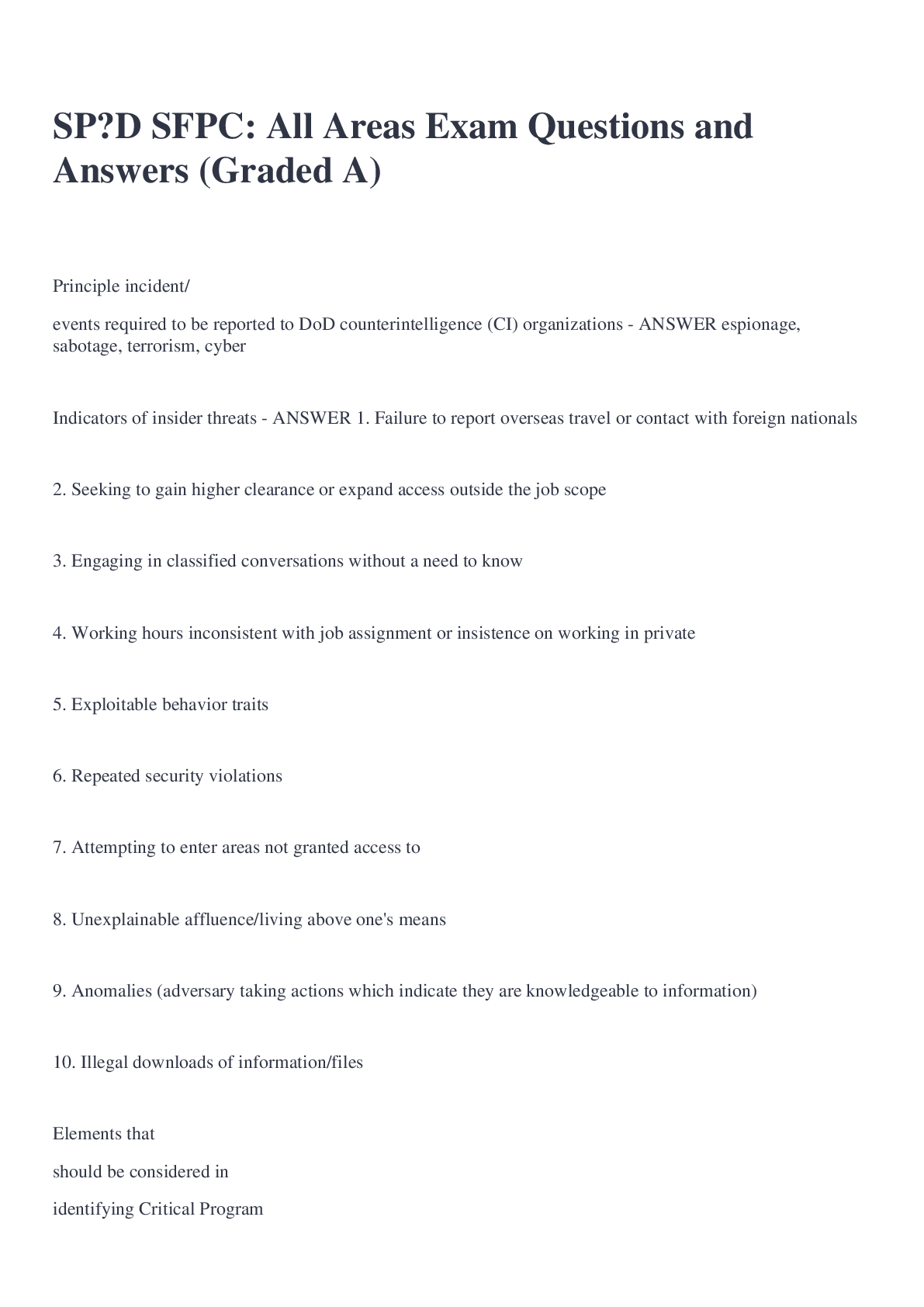
Principle incident/
events required to be reported to DoD counterintelligence (CI) organizations - ANSWER espionage, sabotage, terrorism, cyber
Indicators of insider threats - ANSWER 1. Failure to report overseas travel or contact with foreign nationals
2. Seeking to gain higher clearance or expand access outside the job scope
3. Engaging in classified conversations without a need to know
4. Working hours inconsistent with job assignment or insistence on working in private
5. Exploitable behavior traits
6. Repeated security violations
7. Attempting to enter areas not granted access to
8. Unexplainable affluence/living above one's means
9. Anomalies (adversary taking actions which indicate they are knowledgeable to information)
10. Illegal downloads of information/files
Elements that
should be considered in
identifying Critical Program
Information - ANSWER Elements which if compromised could:
1. cause significant degradation in mission effectiveness,
2. shorten the expected combat-effective life of the system
3. reduce technological advantage
4. significantly alter program direction; or
5. enable an adversary to defeat, counter, copy, or reverseengineer the technology or capability.
asset, threat, vulnerability, risk, countermeasures - ANSWER Elements that a
security professional should
consider when assessing and
managing risks to DoD assets
The three categories of
Special Access Programs - ANSWER acquisition, intelligence, and operations and support
Three different types
of threats to classified
information - ANSWER Insider Threat, Foreign Intelligence Entities (FIE) and Cybersecurity Threat
The concept of an insider threat - ANSWER An employee who may represent a threat to
national security. These threats encompass potential espionage, violent acts against the Government or the nation, and unauthorized disclosure of classified information, including the vast amounts of classified data available on interconnected United States Government computer networks and systems.
The purpose of the
Foreign Visitor Program - ANSWER To track and approve access by a foreign entity to information that is classified; and to approve access by a foreign entity to information that is unclassified, related to a U.S. Government contract, or plant visits covered by ITAR.
Special Access
Program - ANSWER A program established for a specific class of
classified information that imposes safeguarding and access requirements that exceed those normally required for information at the same classification level.
Enhanced security requirements for protecting Special Access Program (SAP) information - ANSWER Within Personnel Security:
• Access Rosters;
• Billet Structures (if required);
• Indoctrination Agreement;
• Clearance based on an appropriate investigation completed within the last 5
years;
• Individual must materially contribute to the program in addition to having the
need to know;
• All individuals with access to SAP are subject to a random counterintelligence scope
polygraph examination;
• Polygraph examination, if approved by the DepSecDef, may be used as a
mandatory access determination;
• Tier review process;
• Personnel must have a Secret or Top Secret clearance;
• SF-86 must be current within one year;
• Limited Access;
• Waivers required for foreign cohabitants, spouses, and immediate family
members.
Within Industrial Security:
The SecDef or DepSecDef can approve a carve-out provision to relieve Defense
Security Service of industrial security oversight responsibilities.
Within Physical Security:
• Access Control;
• Maintain a SAP Facility;
• Access Roster;
• All SAPs must have an unclassified nickname/ Codeword (optional).
Within Information Security:
• The use of HVSACO;
• Transmission requirements (order of precedence).
Responsibilities of the Government SAP Security Officer/Contractor Program
Security Officer (GSSO/
CPSO) - ANSWER From Revision 1 Department of Defense Overprint to the National
Industrial Security Program Operating Manual Supplement - 1 April
2004:
• Possess a personnel clearance and Program access at least equal to
the highest level of Program classified information involved.
• Provide security administration and management for his/her
organization.
• Ensure personnel processed for access to a SAP meet the prerequisite
personnel clearance and/or investigative requirements specified.
• Ensure adequate secure storage and work spaces.
• Ensure strict adherence to the provisions of the NISPOM, its
supplement, and the Overprint.
• When required, establish and oversee a classified material control
program for each SAP.
• When required, conduct an annual inventory of accountable
classified material.
• When required, establish a SAPF.
• Establish and oversee a visitor control program.
• Monitor reproduction and/or duplication and destruction capability
of SAP information
• Ensure adherence to special communications capabilities within the
SAPF.
• Provide for initial Program indoctrination of employees after their
access is approved; rebrief and debrief personnel as required.
• Establish and oversee specialized procedures for the transmission of
SAP material to and from Program elements
• When required, ensure contractual specific security requirements
such as TEMPEST Automated Information System (AIS), and
Operations Security (OPSEC) are accomplished.
• Establish security training and briefings specifically tailored to the
unique requirements of the SAP.
The four Cognizant
Security Agencies (CSAs) - ANSWER Department of Defense
(DoD), Director of National Intelligence (DNI), Department of Energy (DoE), and the Nuclear Regulatory Commission (NRC).
Cognizant Security Agencies (CSA)s' role in the National Industrial Security Program (NISP). - ANSWER Establish an industrial security program to safeguard classified information under its
jurisdiction.
Critical Program Information
in DoD - ANSWER 1. U.S. capability elements that contribute to the warfighter's advantage throughout the
life cycle, which if compromised or subject
to unauthorized disclosure, decrease the advantage.
2. Elements or components of a Research, Development, and Acquisition (RDA) program that, if compromised, could cause significant degradation in mission effectiveness; shorten the expected combat-effective life of the system;
reduce technological advantage; significantly alter program direction; or enable an adversary to defeat, counter, copy, or reverse engineer the technology or capability. Includes information
about applications, capabilities, processes and
end-items. Includes elements or components critical to a military system or network mission effectiveness. Includes technology that would
reduce the U.S. technological advantage if it came under foreign control.
Primary authorities governing foreign disclosure of classified military information - ANSWER 1. Arms Export Control Act
2. National Security Decision Memorandum 119
3. National Disclosure Policy-1
4. International Traffic in Arms Regulation (ITAR)
5. E.O.s 12829, 13526
6. Bilateral Security Agreements
7. DoD 5220.22-M, "NISPOM,"
The purpose of the DD Form 254 - ANSWER Convey security requirements, classification guidance and provide handling procedures for classified material received and/or generated on a classified contract.
Factors for determining
whether U.S. companies are under Foreign Ownership, Control or Influence
(FOCI) - ANSWER 1. Record of economic and government
espionage against the U.S. targets
2. Record of enforcement/engagement
in unauthorized technology transfer
3. Type and sensitivity of the information that shall be accessed
4. The source, nature and extent of FOCI
5. Record of compliance with pertinent U.S. laws, regulations and contracts
6. Nature of bilateral & multilateral security & information exchange
agreements
7. Ownership or control, in whole or part, by a foreign government
The purpose and the function of the Militarily Critical Technologies List (MCTL). - ANSWER 1. Serves as a technical reference for the development and implementation of DoD technology, security policies on international transfers of
defense-related goods, services, and technologies as administered by the Director, Defense Technology Security
Administration (DTSA).
2. Formulation of export control proposals and export license review
Security Infraction - ANSWER This event cannot reasonably be expected to and does not result in the loss, compromise, or suspected compromise of classified information
DoD Manual 5200.01, Volumes 1-4 - ANSWER The manual that governs the DoD Information Security Program
E.O. 13526 - ANSWER The executive order that governs the DoD Information Security Program
32 CFR Parts 2001 & 2003,
"Classified National Security
Information; Final Rule" - ANSWER The Information Security Oversight Office (ISOO) document that governs the DoD Information Security Program
Security Violation - ANSWER An event that results in or could be expected to result in the loss or compromise of
classified information
Unauthorized Disclosure - ANSWER Communication or physical
transfer of classified or controlled unclassified information to an unauthorized recipient
SSBI - ANSWER Initial investigation for military, contractors, and civilians:
· Special-Sensitive positions
· Critical-Sensitive positions1
· LAA
· Top Secret clearance eligibility
· IT-I duties
ANACI - ANSWER Initial investigation for civilians:
· Noncritical-Sensitive positions2
· Confidential and Secret clearance eligibility
· IT-II duties
NACLC - ANSWER Initial National Agency Check with Law and Credit for military and contractors:
· Secret or Confidential clearance eligibility
· All military accessions and appointments
· IT-II duties
· IT-III duties (military only)
NACI - ANSWER National Agency Check with Inquiries for civilians and contractors:
· Non-Sensitive positions
· Low Risk
· HSPD-12 Credentialing
NAC - ANSWER The fingerprint check portion of a PSI
The purpose of due process in
Personnel Security Program (PSP) - ANSWER Ensures fairness by providing the
subject the opportunity to appeal an
unfavorable adjudicative determination
The key procedures for initiating
Personnel Security Investigations (PSIs) - ANSWER 1. Validate the need for an investigation
2. Initiate e-QIP
3. Review Personnel Security Questionnaire (PSQ) for completeness
4. Submit electronically to OPM
DoD position sensitivity types
and their investigative requirements. - ANSWER 1. Critical Sensitive
2. Non-Critical Sensitive
3. Non-Sensitive
Investigative requirement for a Critical- Sensitive position - ANSWER SSBI, SSBI-PR, or PPR
Investigative requirement for a Non-Critical Sensitive position - ANSWER ANACI or NACLC
Investigative requirement for a Non-Sensitive position - ANSWER NACI
Revocation - ANSWER The term when current security clearance eligibility determination is rescinded
Denial - ANSWER The term when an initial
[Show More]