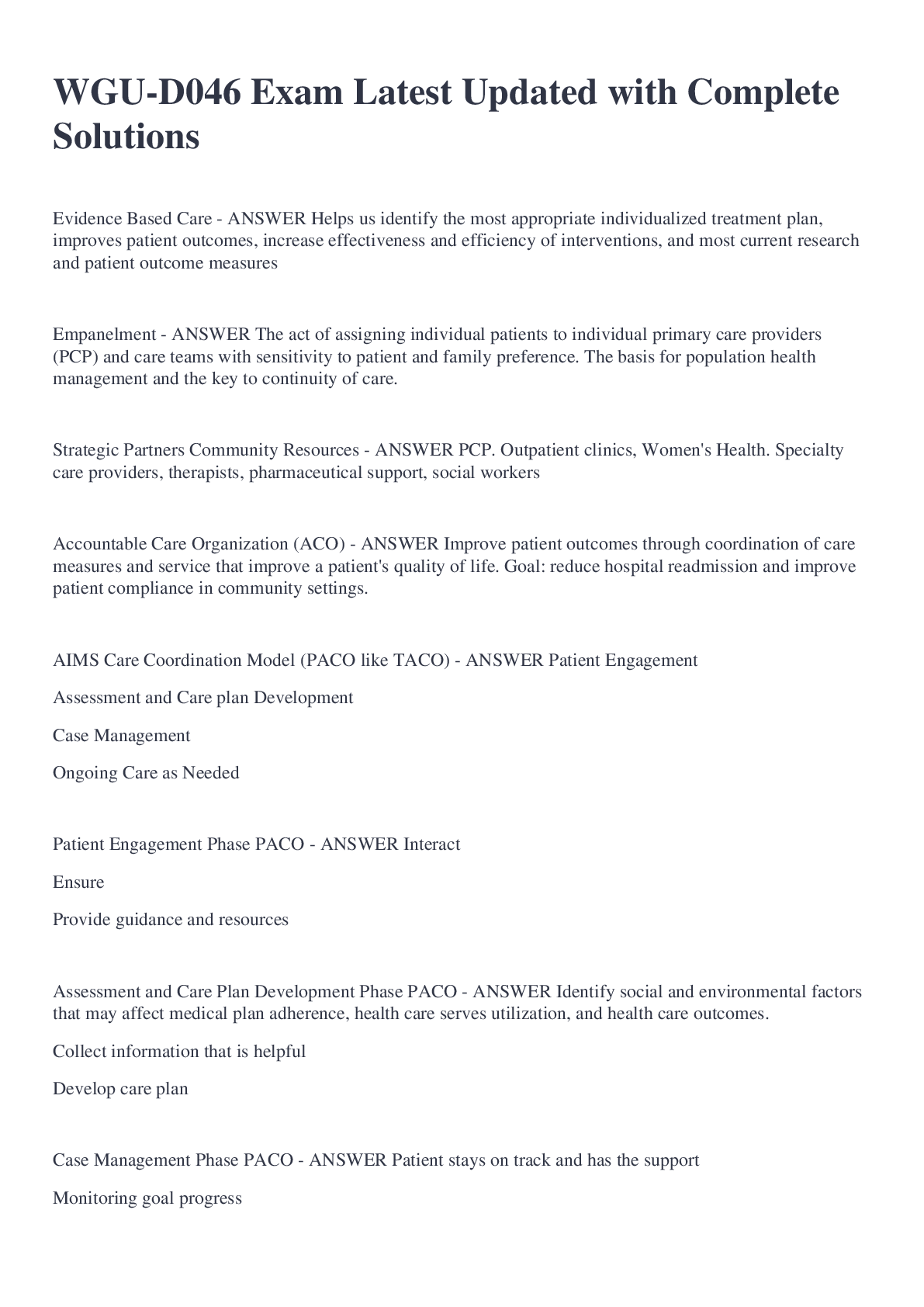
Evidence Based Care - ANSWER Helps us identify the most appropriate individualized treatment plan, improves patient outcomes, increase effectiveness and efficiency of interventions, and most current research and patient
...
Evidence Based Care - ANSWER Helps us identify the most appropriate individualized treatment plan, improves patient outcomes, increase effectiveness and efficiency of interventions, and most current research and patient outcome measures
Empanelment - ANSWER The act of assigning individual patients to individual primary care providers (PCP) and care teams with sensitivity to patient and family preference. The basis for population health management and the key to continuity of care.
Strategic Partners Community Resources - ANSWER PCP. Outpatient clinics, Women's Health. Specialty care providers, therapists, pharmaceutical support, social workers
Accountable Care Organization (ACO) - ANSWER Improve patient outcomes through coordination of care measures and service that improve a patient's quality of life. Goal: reduce hospital readmission and improve patient compliance in community settings.
AIMS Care Coordination Model (PACO like TACO) - ANSWER Patient Engagement
Assessment and Care plan Development
Case Management
Ongoing Care as Needed
Patient Engagement Phase PACO - ANSWER Interact
Ensure
Provide guidance and resources
Assessment and Care Plan Development Phase PACO - ANSWER Identify social and environmental factors that may affect medical plan adherence, health care serves utilization, and health care outcomes.
Collect information that is helpful
Develop care plan
Case Management Phase PACO - ANSWER Patient stays on track and has the support
Monitoring goal progress
Modifying the care plan as necessary
Ongoing Care as Needed Phase PACO - ANSWER Ensuring that community-based resources are in place
Contact the care coordinator should new challenges arise
Summarize achieved goals or negotiate continued work
Closing the case if appropriate
Value Based Healthcare - ANSWER Quality case as the leading driver. Quality over quantity
Scope of Practice - ANSWER a set of regulations and ethical considerations that define the scope, or extent and limits, of the EMT's job
fee-for-service - ANSWER Health plan that repays the policyholder for covered medical expenses
Diagnostic Related Groups (DRGs) - ANSWER Patient classification system to help control and standardize costs for inpatient services. Used along with patient and regional demographic data to determine the median cost for a particular procedure/service. Categorize patients into groups based on -diagnoses, type of treatment (ex. surgical), complications or comorbidities, age, gender, discharge status. Determine length of stay, average cost the hospital should charge for similar patients.
Care Coordination Process - ANSWER 1. Client identification and selection
2. Assessment and problem/ Opportunity identification
3. Development of the case management plan
4. Implementation and coordination of care activities
5. Evaluation of the case management plan and follow-up
6. Termination of the case manage
Active Listening to Care Coordinators - ANSWER Undivided attention, appropriate body language signals, patient acknowledgment, behaviors that convey a nonjudgmental attitude and respectful respectful responses.
Affortable Care Act - ANSWER Provides healthcare options via state-run insurance exchanges. The law prevents the use of medical history to refuse employment or insurance, if eligible.
Key Communication Skills - ANSWER 1. Set the Stage
2. Elicit Information
3. Give Information
4. Understand the patient's perspective
5. End the Encounter
Set the Stage - ANSWER Greet the patient
Find out how the patient is feeling
Introduce the computer
Explain and reassure
Elicit Information - ANSWER Look at computer intermittently while talking to patient
Point to relevant areas
Avoid computer when patient is emotional
Involve patient in confirming data is correct
Give Information - ANSWER Verify patient can see screen
Encourage patient to ask questions
Share Materials
Keep balanced eye contact
Understand Patients Perspective - ANSWER Patients perspective on the use of the computer in the healthcare environment
End encounter - ANSWER Provide handouts or websites references
Motivational interviewing - ANSWER Aimed at persuading patients and using positive reinforcement to maintain adherence with their treatment plan and follow through on appointments throughout care transitions with care providers and community resources.
Collaborative relationship - ANSWER Interprofessional care teams works in partnership with the patient and the family in planning and implementing care
Effective communication - ANSWER Verbal and/or nonverbal exchanges that establish trust with the patient
Respectful care - ANSWER Considers values, preferences, and expressed needs of patient
Holistic perspective - ANSWER Planning and delivering care based on knowledge of the multiple facts of the person and the family
Individualized care - ANSWER Tailoring care plans and care delivery to the needs and wishes of the patient and family
Interprofessional coordination - ANSWER Multiple people working together as a synergistic team
Self-awareness - ANSWER Self-reflection to gain an understanding of one's own assumptions and becoming open to beliefs and values other than one's own
Empowerment - ANSWER Providing patients or caregivers important health information and encouraging them to participate in the patient's care
Interpersonal relationships - ANSWER Establishing trust, listening to families life stories, coming to know the family
Cultural knowledge - ANSWER Gaining an understanding and appreciation for culturally specific beliefs and healthcare practices
Cultural Skills - ANSWER Cultural knowledge and self-awareness incorporating into clinical practices
Warm Transfer - ANSWER Ideal, providers are contacted when care will be transferred from one provider to another.
Ensure services are not duplicated, unnecessary referral, or procedures that increase cost
Cold Transfer - ANSWER From one provider to another without preliminary contact or introduction.
Unclear expectations concerning the care to be administered
Case management models - ANSWER 1. AIMS
2. Wraparound Care Coordination
3. Primary Care Coordination
4. Acute Care Coordination
5. Post-Acute/ long term
6. PCMH and Medical Neighborhood Collaborative Care Model
7. Brokerage
AIMS - ANSWER Ambulatory Integration of the Medical and Social
AIMS Engagement phase - ANSWER Validating concerns, reinforcing HSC role as a helper/resource, giving information to address immediate concerns
Wraparound - ANSWER Team based coordination for children and youth with complex behavioral health needs
Primary Care coordination - ANSWER Care for patients with chronic disease and conditions
Ex: diabetes, high cholesterol, high blood pressure
Think PCP
Acute Care - ANSWER Requires more complex level of care due to the critical and emergent condition
Ex: stroke or heart attack
Think emergency room
Post-acute/ Long term care - ANSWER Predominately senior aged patients with mental and/or memory disorder in addition to physical
Ex: Post stroke, dementia
PCMH & Medical Neighborhood - ANSWER PCMH = PCP
medical home interacts within the "neighborhood" of resources
Ex: outpatient caregivers, specialists, hospitals, mental behavioral health, etc.
[Show More]