What exactly does the SPD do?
1. receives
2. cleans
3. decontaminate
4. assemble
5. disinfect
6 sterilize reusable and surgical devices for safe and effective patient care
What preferred name is recommended
...
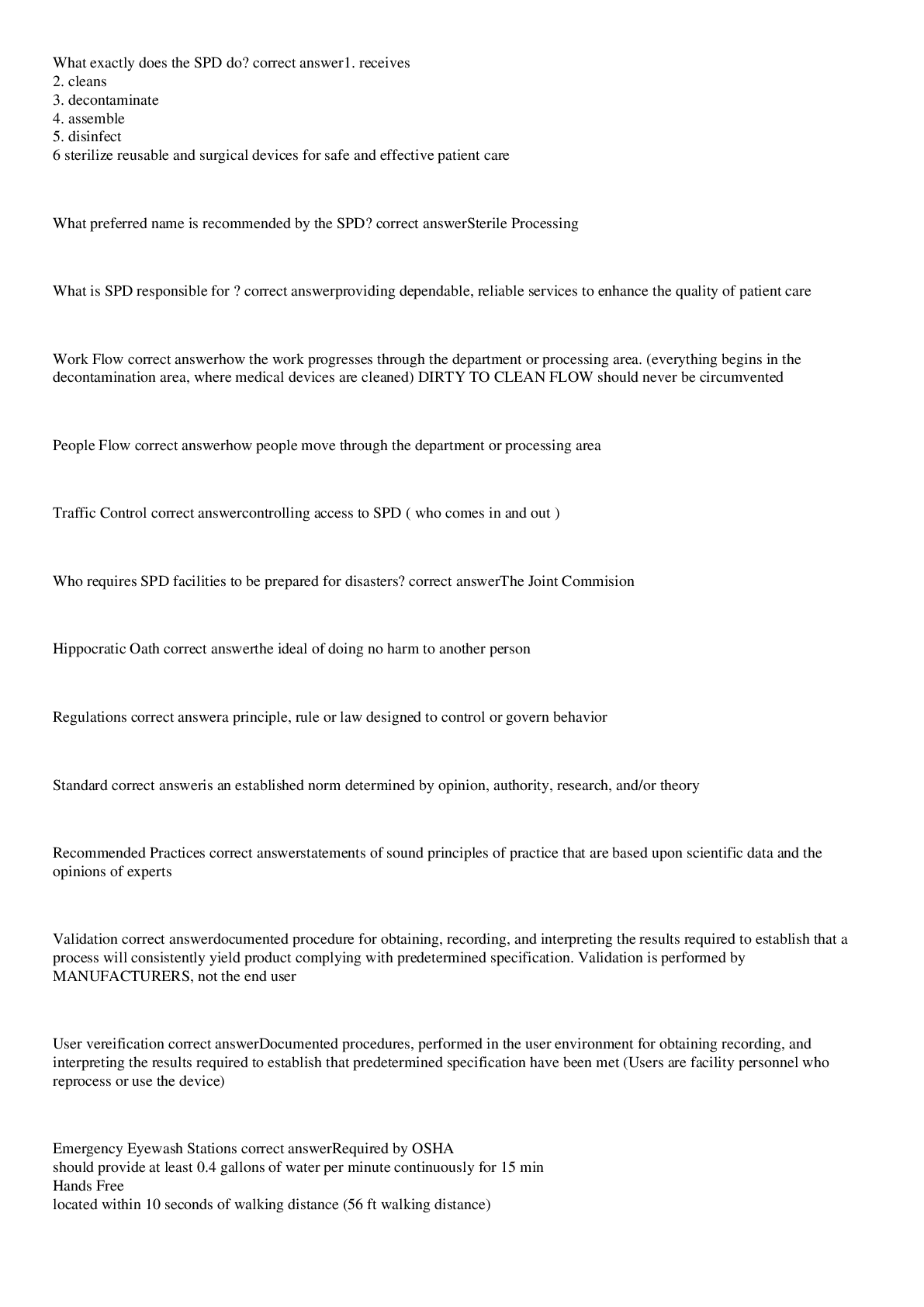
What exactly does the SPD do?
1. receives
2. cleans
3. decontaminate
4. assemble
5. disinfect
6 sterilize reusable and surgical devices for safe and effective patient care
What preferred name is recommended by the SPD?
Sterile Processing
What is SPD responsible for ?
providing dependable, reliable services to enhance the quality of patient care
Work Flow
how the work progresses through the department or processing area. (everything begins in the decontamination area, where medical devices are cleaned) DIRTY TO CLEAN FLOW should never be circumvented
People Flow
how people move through the department or processing area
Traffic Control
controlling access to SPD ( who comes in and out )
Who requires SPD facilities to be prepared for disasters?
The Joint Commision
Hippocratic Oath
the ideal of doing no harm to another person
Regulations
a principle, rule or law designed to control or govern behavior
Standard
is an established norm determined by opinion, authority, research, and/or theory
Recommended Practices
statements of sound principles of practice that are based upon scientific data and the opinions of experts
Validation
documented procedure for obtaining, recording, and interpreting the results required to establish that a process will consistently yield product complying with predetermined specification. Validation is performed by MANUFACTURERS, not the end user
User vereification
Documented procedures, performed in the user environment for obtaining recording, and interpreting the results required to establish that predetermined specification have been met (Users are facility personnel who reprocess or use the device)
Emergency Eyewash Stations
Required by OSHA
should provide at least 0.4 gallons of water per minute continuously for 15 min
Hands Free
located within 10 seconds of walking distance (56 ft walking distance)
Blue Diamond
Health Hazard
Red Diamond
flammability
Yellow Diamond
instability
White Diamond
special hazard information
Center for Disease Control and Prevention
publish widely respected recommendations and guidelines on such topics as hand hygiene, isolation precautions, environmental infection control, and disinfection and sterilization, when new or emerging diseases are identified, the CDC also publishes guidelines .
Fire Extinguisher
Class A
cloth, wood, paper, rubber, and many plastics
Fire Extinguisher
Class B
gasoline, alcohol, diesel oil, oil-based paints, lacquers, etc.. flammable gases
Fire Extinguisher
Class C
Energized Electrical Equipment
[Show More]