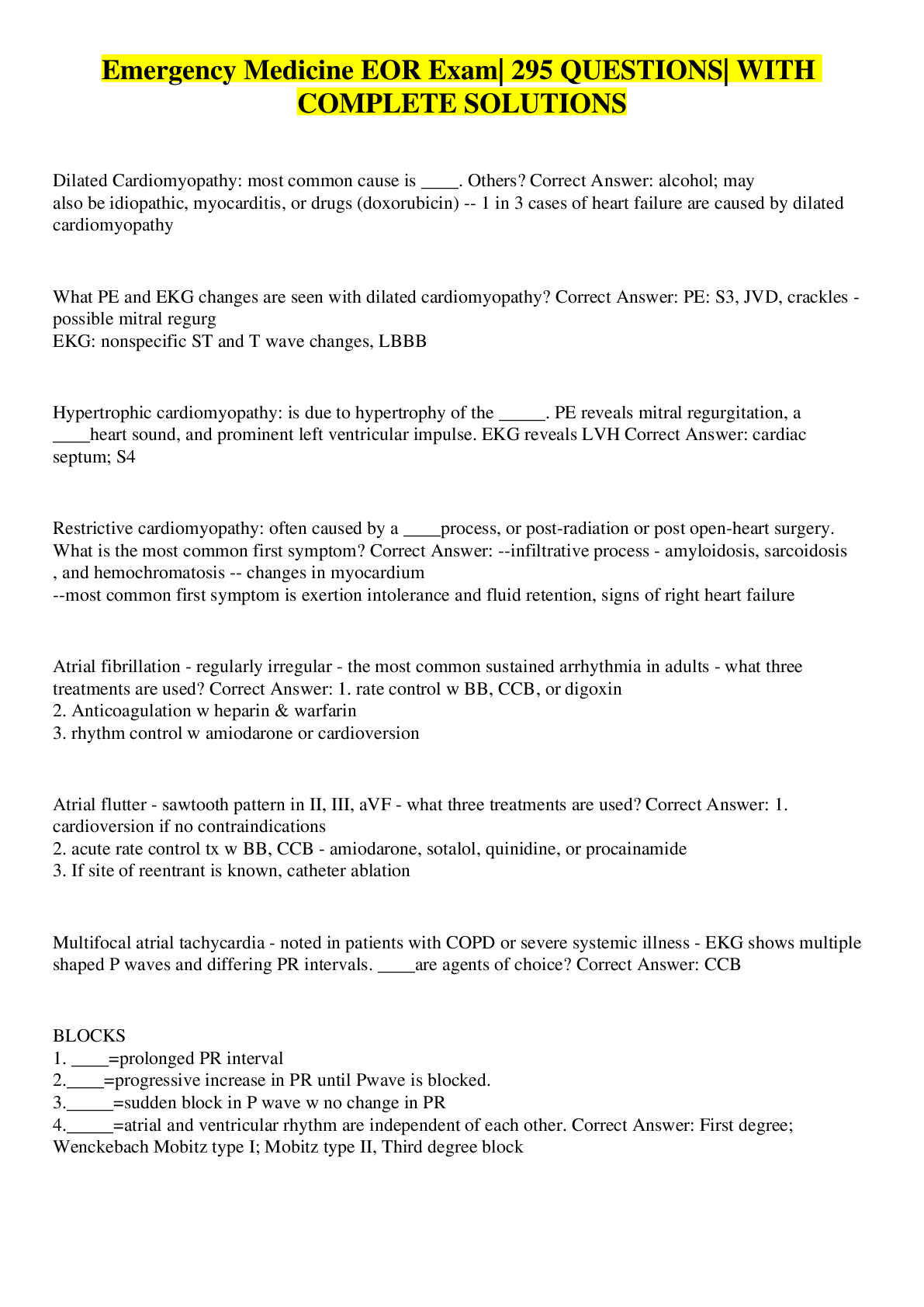
Dilated Cardiomyopathy: most common cause is ____. Others? Correct Answer: alcohol; may also be idiopathic, myocarditis, or drugs (doxorubicin) -- 1 in 3 cases of heart failure are caused by dilated cardiomyopathy
Wh
...
Dilated Cardiomyopathy: most common cause is ____. Others? Correct Answer: alcohol; may also be idiopathic, myocarditis, or drugs (doxorubicin) -- 1 in 3 cases of heart failure are caused by dilated cardiomyopathy
What PE and EKG changes are seen with dilated cardiomyopathy? Correct Answer: PE: S3, JVD, crackles - possible mitral regurg
EKG: nonspecific ST and T wave changes, LBBB
Hypertrophic cardiomyopathy: is due to hypertrophy of the _____. PE reveals mitral regurgitation, a ____heart sound, and prominent left ventricular impulse. EKG reveals LVH Correct Answer: cardiac septum; S4
Restrictive cardiomyopathy: often caused by a ____process, or post-radiation or post open-heart surgery. What is the most common first symptom? Correct Answer: --infiltrative process - amyloidosis, sarcoidosis, and hemochromatosis -- changes in myocardium
--most common first symptom is exertion intolerance and fluid retention, signs of right heart failure
Atrial fibrillation - regularly irregular - the most common sustained arrhythmia in adults - what three treatments are used? Correct Answer: 1. rate control w BB, CCB, or digoxin
2. Anticoagulation w heparin & warfarin
3. rhythm control w amiodarone or cardioversion
Atrial flutter - sawtooth pattern in II, III, aVF - what three treatments are used? Correct Answer: 1. cardioversion if no contraindications
2. acute rate control tx w BB, CCB - amiodarone, sotalol, quinidine, or procainamide
3. If site of reentrant is known, catheter ablation
Multifocal atrial tachycardia - noted in patients with COPD or severe systemic illness - EKG shows multiple shaped P waves and differing PR intervals. ____are agents of choice? Correct Answer: CCB
BLOCKS
1. ____=prolonged PR interval
2.____=progressive increase in PR until Pwave is blocked.
3._____=sudden block in P wave w no change in PR
4._____=atrial and ventricular rhythm are independent of each other. Correct Answer: First degree; Wenckebach Mobitz type I; Mobitz type II, Third degree block
A _____may develop after acute MI, PE, aortic stenosis and is due to a conduction delay in the right or left bundles. Correct Answer: Bundle branch block
[Show More]