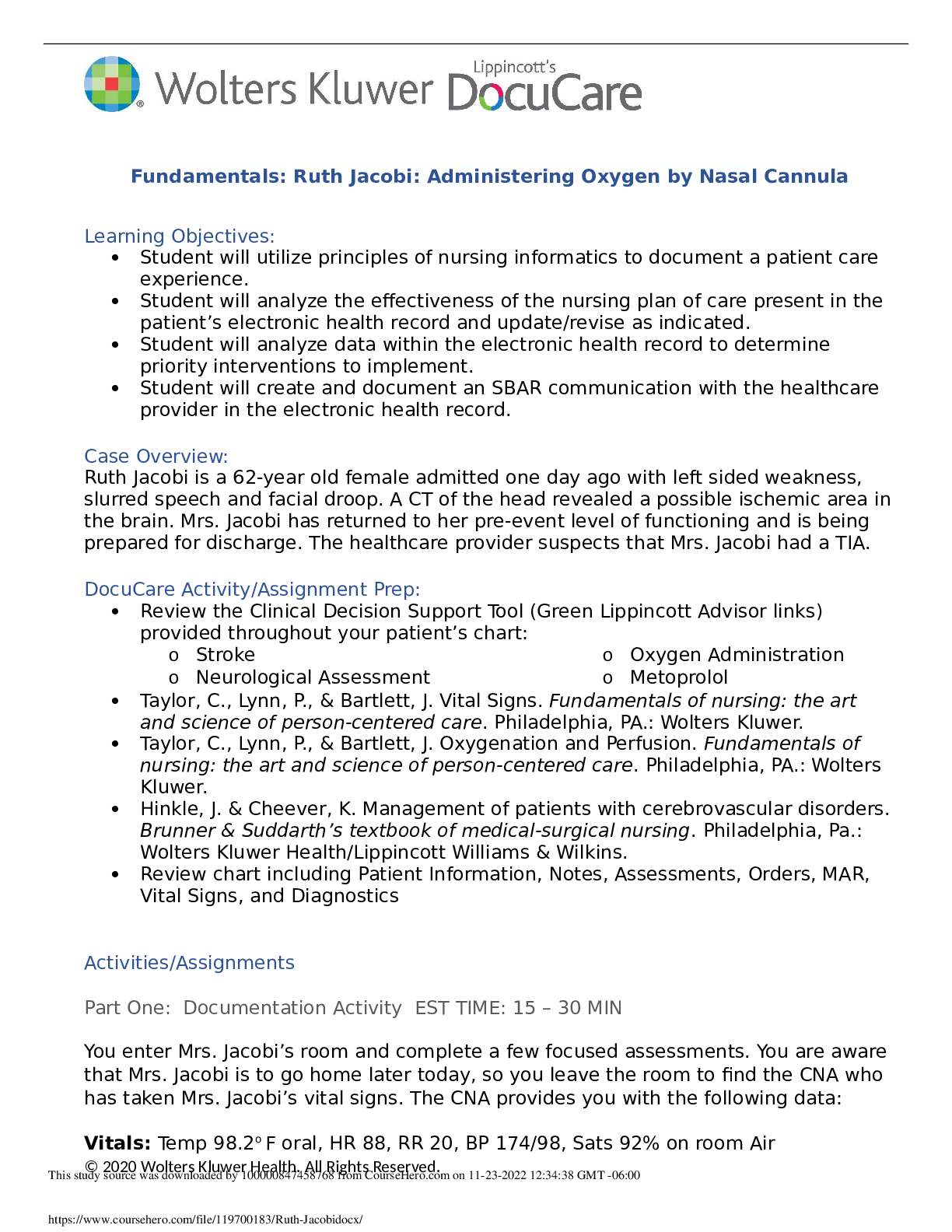
Fundamentals: Ruth - Administering Oxygen
Learning Objectives:
• Student will analyze data to determine priority interventions to implement.
• Student will create an SBAR communication.
Case Overview:
Ruth Jacob
...
Fundamentals: Ruth - Administering Oxygen
Learning Objectives:
• Student will analyze data to determine priority interventions to implement.
• Student will create an SBAR communication.
Case Overview:
Ruth Jacobi is a 62-year old female admitted one day ago with left sided weakness, slurred speech and facial droop. A CT of the head revealed a possible ischemic area in the brain. Mrs. Jacobi has returned to her pre-event level of functioning and is being prepared for discharge. The healthcare provider suspects that Mrs. Jacobi had a TIA.
Home Meds: Toprol XL 25 mg po daily for HTN
Medical/Surgical Hx: Unremarkable
Assignment Prep:
• May review the Lippincott Advisor in CoursePoint+ for information on the following:
o Stroke
o Neurological Assessment
o Oxygen Administration
o Metoprolol
Resources:
• Lippincott Advisor for Education. Wolters Kluwer
• Taylor, C., Lynn, P., & Bartlett, J. Vital Signs. Fundamentals of nursing: the art and science of person-centered care. Wolters Kluwer.
• Taylor, C., Lynn, P., & Bartlett, J. Oxygenation and Perfusion. Fundamentals of nursing: the art and science of person-centered care. Wolters Kluwer.
Assessments
You enter Mrs. Jacobi’s room and complete a few focused assessments. You are aware that Mrs. Jacobi is to go home later today. You obtain the following vital signs:
Vitals: Temp 98.2o F oral, HR 88, RR 20, BP 174/98, Sats 92% on room Air
Upon assessment, you also have collected the following data from your focused assessments:
Mrs. Jacobi is alert, oriented to person, place, time and situation. She has full muscle strength and movement of all extremities. Her pupils are PERRL and 3mm in diameter. She is cooperative and calm. She states she has a slight headache, which she rates as 3/10. Her heart rate is regular with S1, S2, peripheral pulses are +3 and equal bilaterally. Capillary refill time is less than 3 seconds and her skin is pink, warm, dry with elastic turgor. Her lungs are clear to auscultation in upper lobes bilaterally. Her lower lobes are diminished but clear. She has an occasional non-productive cough. She denies shortness of breath.
Assignment 1: (25%)
After reviewing Mrs. Jacobi’s chart and the data you have entered, identify the relevant data related to the patient situation. Analyze the data, ask yourself these questions:
• What information is relevant (Recognizing Cues/Assessing)
• What does it make you think? (Analyzing Cues – DO NOT provide Nursing Diagnosis)
• What do you think should be done? (Prioritize Hypotheses & Generate Solutions/Planning)
• Which interventions are most appropriate to do now? How should they be accomplished? (Take Action/Implementing)
Assignment 2: (25%)
Use your answers to the questions above to create an SBAR communication with Mrs. Jacobi’s Healthcare Provider regarding your concerns.
S:
B:
A:
R:
In response to your SBAR communication with the Healthcare Provider, you receive the following orders via telephone:
• Oxygen via NC at 2LPM. Continuous Pulse Oximetry while on Oxygen
• Hold discharge for now
• Metoprolol 10mg IV now, recheck BP 15 minutes after administration.
• Call Healthcare Provider if SBP is above 140 or DBP is above 100
• Chest X-ray - A/P view to rule out Respiratory Disease
Assignment 3: (25%)
Document the interventions you identify as being a priority for Mrs. Jacobi (Take Action/Implementing). Document these interventions in the space provided below:
Nurse’s Notes:
An hour has passed since implementing your interventions with Mrs. Jacobi. You receive the following information regarding Mrs. Jacobi:
• Chest X-ray – small pleural effusions in lower lung fields
Upon reassessment, you also obtain the following data:
• Oxygen Saturation 96% on 2 LPM
• Blood Pressure – 155/98 mm/Hg
Assignment 4: (25%)
Decide whether or not Mrs. Jacobi requires an immediate response by the nurse (Analyzing cues & Prioritizing hypotheses). Provide the data and rationale to support your decision in your documentation below:
Nurse’s Notes:
[Show More]

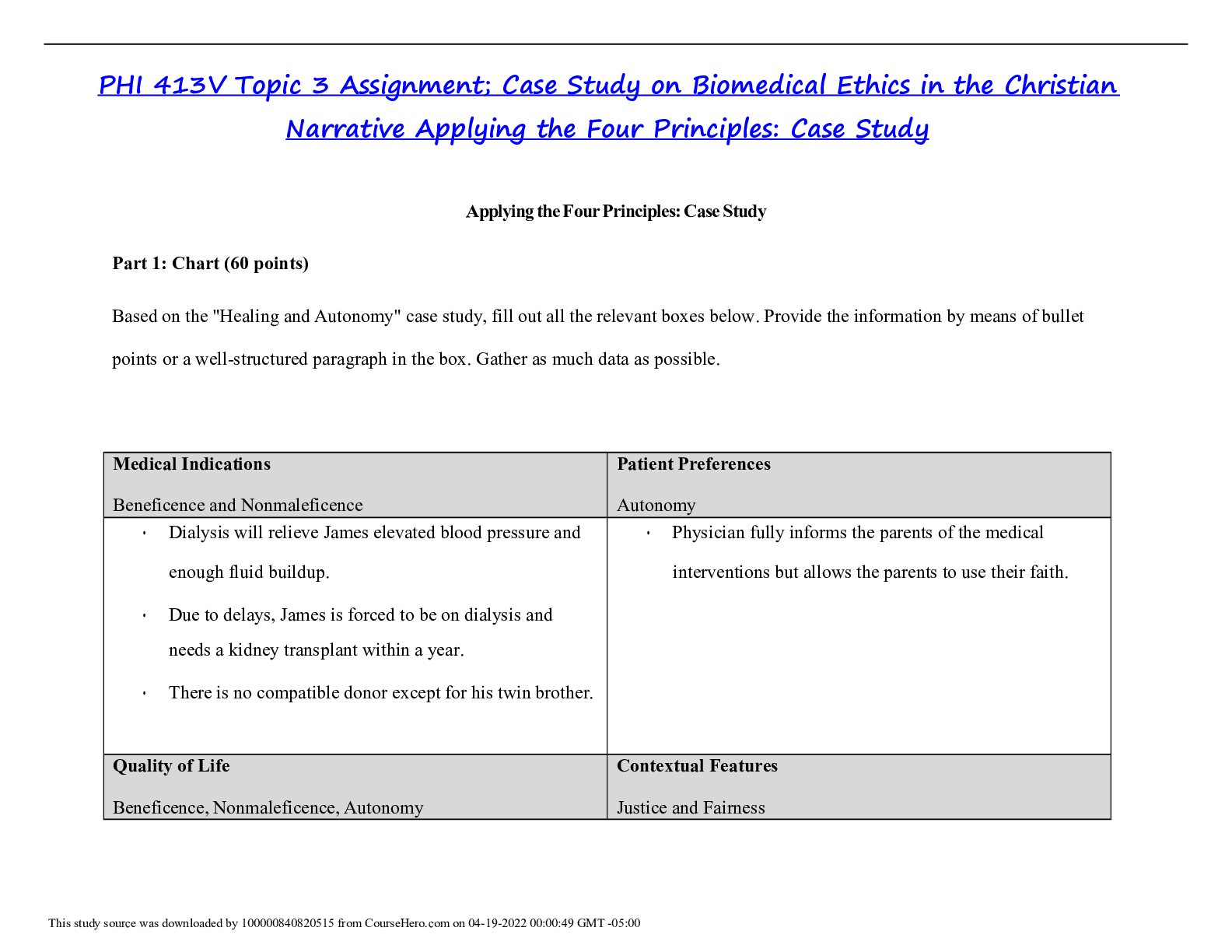
.png)
.png)





 (1).png)