What is an example of primary prevention? Correct Answer programs to promote physical exercise
What developments contributed to the rise of the social ecology paradigm in medicine and public health? Correct Answer shi
...
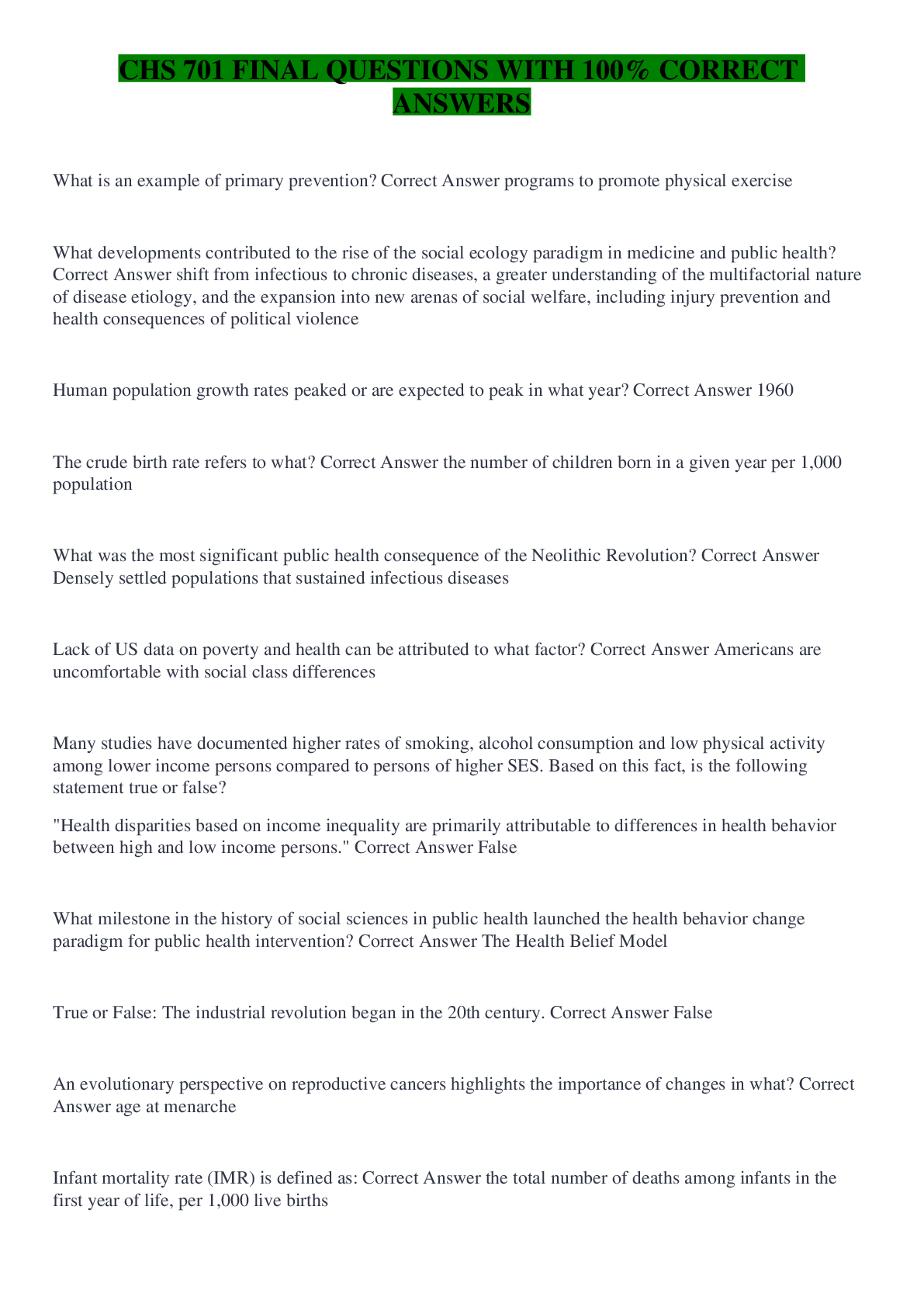
What is an example of primary prevention? Correct Answer programs to promote physical exercise
What developments contributed to the rise of the social ecology paradigm in medicine and public health? Correct Answer shift from infectious to chronic diseases, a greater understanding of the multifactorial nature of disease etiology, and the expansion into new arenas of social welfare, including injury prevention and health consequences of political violence
Human population growth rates peaked or are expected to peak in what year? Correct Answer 1960
The crude birth rate refers to what? Correct Answer the number of children born in a given year per 1,000 population
What was the most significant public health consequence of the Neolithic Revolution? Correct Answer Densely settled populations that sustained infectious diseases
Lack of US data on poverty and health can be attributed to what factor? Correct Answer Americans are uncomfortable with social class differences
Many studies have documented higher rates of smoking, alcohol consumption and low physical activity among lower income persons compared to persons of higher SES. Based on this fact, is the following statement true or false?
"Health disparities based on income inequality are primarily attributable to differences in health behavior between high and low income persons." Correct Answer False
What milestone in the history of social sciences in public health launched the health behavior change paradigm for public health intervention? Correct Answer The Health Belief Model
True or False: The industrial revolution began in the 20th century. Correct Answer False
An evolutionary perspective on reproductive cancers highlights the importance of changes in what? Correct Answer age at menarche
Infant mortality rate (IMR) is defined as: Correct Answer the total number of deaths among infants in the first year of life, per 1,000 live births
[Show More]