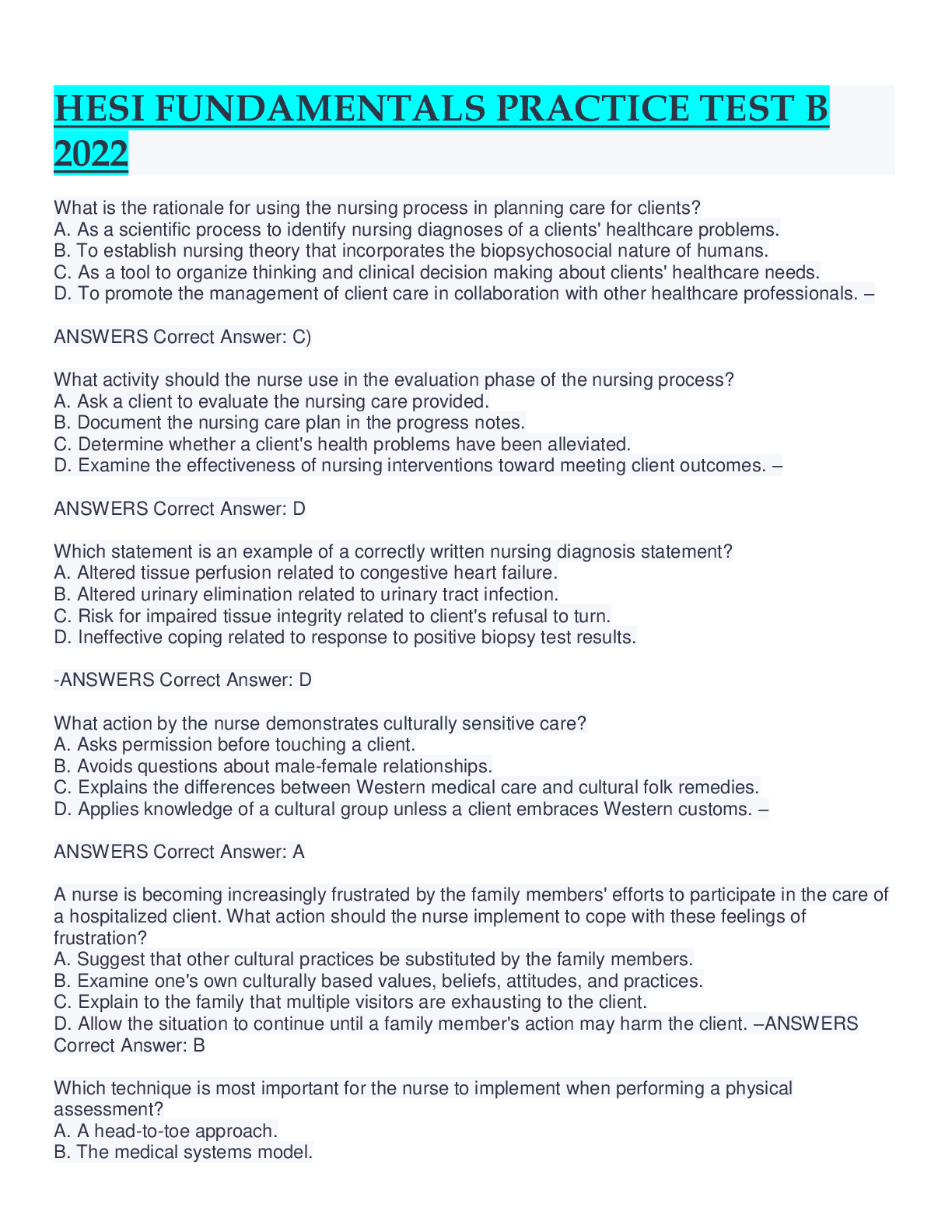
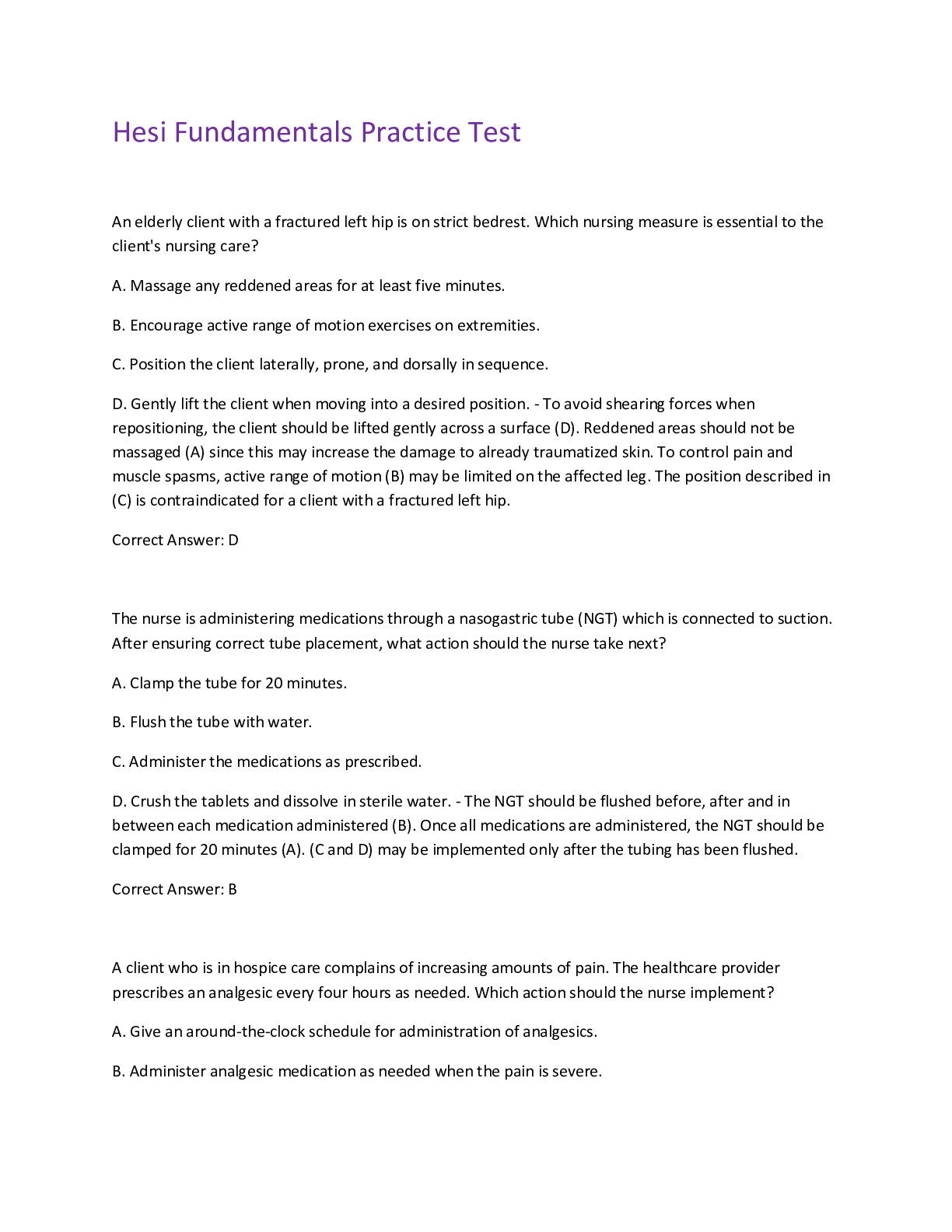
HESI FUNDAMENTALS PRACTICE TEST /
FINAL EXAM 1 (NCLEX)
A 35y/o client with cancer refuses to allow a nurse to insert an IV for scheduled
chemo & states that she's ready to go home to die. What intervention should the
...
HESI FUNDAMENTALS PRACTICE TEST /
FINAL EXAM 1 (NCLEX)
A 35y/o client with cancer refuses to allow a nurse to insert an IV for scheduled
chemo & states that she's ready to go home to die. What intervention should the
nurse initiate? - Evaluate the client's mental status for competence to refuse
treatment
Rationale: Competent clients have the right to refuse treatment. The nurse cannot
document until the HCP is notified of the patient's wishes & a d/c RX is obtained.
Advance directives & DNR are not necessary for competent client to refuse care.
A client with chronic renal disease is admitted to the hospital for evaluation prior to a
surgical procedure. Which laboratory test indicates client's protein status for the
longest length of time? - Serum albumin
Rationale: Serum albumin has a long half-life.
What client statement indicates to the nurse that the client requires assistance with
bathing? - "I don't understand why I'm so weak & tired."
How should the nurse handle linens that are soiled with incontinent feces? - Place
the soiled linens in a pillow case & deposit them in the dirty linen hamper
When caring for an immobile client, what nursing diagnosis has the highest priority? -
Impaired gas exchange
The nurse assesses an immobile, elderly male client & determines that his blood
pressure is 138/60, his temperature is 95.8F & his output is 100 mL of concentrated
urine during the last hour. He has wet sounding lungs & increased respiratory
secretions. Based on these assessment findings , what nursing action is most
important for the nurse to implement? - Turn the client q2h
Rationale: It will help move & drain respiratory secretions & prevent pneumonia from
occurring.
[Show More]