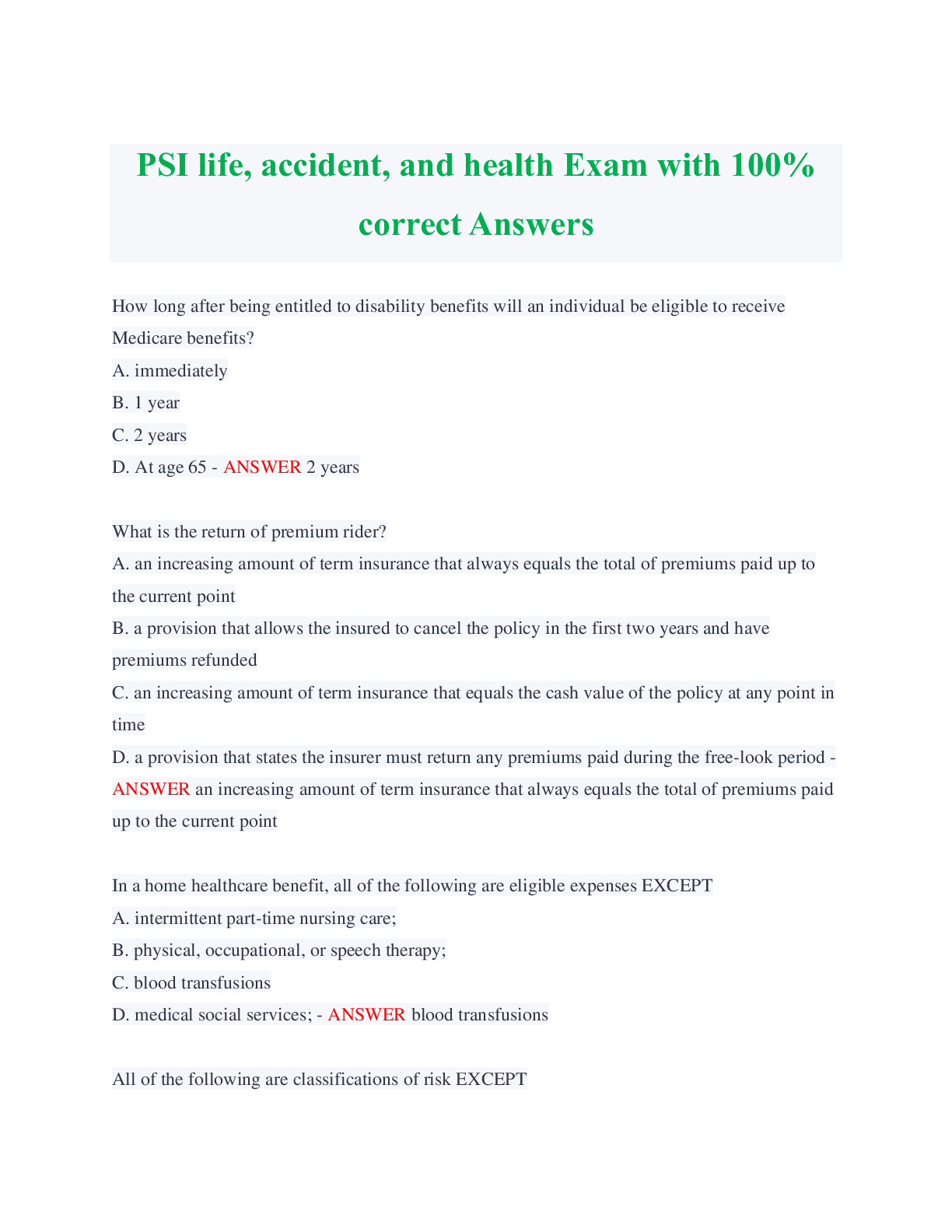
Project Life Cycle - ANSWER A series of phases that a project passes through from start to completion; a framework for managing the project.
Can be predictive or adaptive with phases that may be sequential, iterative
...
Project Life Cycle - ANSWER A series of phases that a project passes through from start to completion; a framework for managing the project.
Can be predictive or adaptive with phases that may be sequential, iterative, or overlapping.
Project Phase - ANSWER A collection of logically related project activities that produce one or more deliverable.
Can be described by a variety of attributes that may be measurable and unique to a specific phase.
Project Phase Examples - ANSWER Concept Development
Feasibility Study
Customer Requirements
Solution Development
Design
Prototype
Build
Test
Transition
Commission
Phase Gate - ANSWER A review at the end of a phase in which a decision is made to continue, modify, or end a phase or project.
The project's performance and progress are compared to the project and business documents. (1.2.4.3)
Phase Gate Examples - ANSWER Phase Reviews
Stage Gates
Kill Points
Phase Exists
Project Management Processes - ANSWER A systematic series of activities directed toward causing an end result where one or more inputs will be acted upon to create one or more outputs.
An output can be a deliverable or another type of outcome
Project Management Processes - ANSWER Processes are linked by the outputs they produce and may contain overlapping activities that occur throughout the project.
The output of one process generally results in an input to another process or a deliverable of the project or phase. (1.2.4.4)
Process Groups - ANSWER A logical grouping of project management processes to achieve specific project objectives.
Independent of process phases as well as the application area or industry focus
5 Process Groups - ANSWER Initiating, Planning, Executing, Monitoring & Controlling, Closing
Knowledge Areas - ANSWER An identified area of project management defined by its knowledge requirements and described in terms of its component processes, practices, inputs, outputs, tools, and techniques.
Project Management Processes are categorized by these, which are interrelated and interdependent.
10 Knowledge Areas - ANSWER project integration, scope, time, cost, quality, human resource, communications, risk, procurement, and stakeholder management
Project Integration Management - ANSWER Includes the processes and activities needed to identify, define, combine, unify, and coordinate the various processes and project management activities within the Project Management Process Groups.
Project Schedule Management - ANSWER Includes the processes required to manage the timely completion of the project. provides the steps for developing a schedule for a project and controlling that schedule to complete the work. Important tool for communicating and managing stakeholder expectations, team or individual assignments, and as a basis for performance reporting.
Project Quality Management - ANSWER Includes the processes and activities of the performing organization that determine quality policies, objectives, and responsibilities so that the project will satisfy the needs for which it was undertaken Compare work results to the quality requirements to ensure end result are acceptable. Ensure quality is measured using the right standards.
Entails:
- Plan Quality Management
- Manage Quality
- Control Quality
Trends:
1. Customer Satisfaction
2. Use of automated tools (PDCA, TQM, Six Sigma, Lean)
3. Management Responsibility
4. Mutually Beneficial Partnerships with Suppliers
Tailoring:
1. Policy Compliance and Auditing
2. Standards and Regulatory Compliance
3. Continuous Improvement
4. Stakeholder Engagement
Project Communications Management - ANSWER Includes the processes required to ensure timely and appropriate generation, collection, distribution, storage, retrieval, and ultimate disposition of project information
Project Procurement Management - ANSWER Includes the processes necessary to purchase or acquire products, services, or results needed from outside the project team.
Project Scope Management - ANSWER Includes the processes required to ensure the project includes all the work required, and only the work required, to complete the project successfully.
Project Resource Management - ANSWER Includes the processes to identify, acquire, and manage the resources needed for the successful completion of the project.
Project Risk Management - ANSWER Includes the processes of conducting risk management planning, identification, analysis, response planning, response implementation, and monitoring risk on a project.
Project Stakeholder Management - ANSWER Includes the processes required to identify the people, groups, or organizations that could impact or be impacted by the project, to analyze stakeholder expectations and their impact on the project, and to develop appropriate management strategies for effectively engaging stakeholders in project decisions and execution.
Work performance data - ANSWER The raw observations and measurements identified during activities being performed to carry out the project work.
Throughout the life cycle, much of this is collected and shared among project team members. It is collected and analyzed in context, aggregated, and transformed to become work performance information that can be communicated verbally or distributed as reports.
Business Documents - ANSWER Project Business Case and Project Benefits Management Plan
Project Business Case - ANSWER A documented economic feasibility study used to establish the validity of the benefits of a selected component lacking sufficient definition and that is used as a basis for the authorization of further project management activities.
When the possibility of a project is discuss, this should list the reasons for the project.
The project sponsor is accountable for the development and maintenance of this document.
Used throughout the project life cycle as basis to measure success and progress by comparing the actual project results with the document.
Benefits Management Plan - ANSWER The documented explanation defining the processes for creating, maximizing, and sustaining the benefits provided by a project.
Developed in the beginning of the plan by identifying the intended benefits of the project as well as any infromation from the business case.
Continuously aligned with the project charter and project management plan through collaboration of the manager and sponsor.
Agreements - ANSWER A mutually binding document that obligates a seller to provide the specific products, services, or results of a contract, memorandum of understanding (MOU), letters of agreement, verbal agreements, email, or other tangible forms.
will obligate the buyer (or sponsoring organization) to compensate the seller.
represents a legal relationship that is subject to remedy in the courts.
Project Charter - ANSWER A document issues by the project sponsor that formally authorizes the existence of a project and provides the project manager with the authority to apply organizational resources to project activities.
Developed early in the project and referenced as an input across many processes through the project life.
Project Management Plan - ANSWER A comprehensive document that describes how the project will be executed, monitored, and controlled.
Developed early in the project and referenced as an input in nearly all processes throughout the project. Updated when appropriate.
Composed of sub-components that address different Knowledge Areas of the project.
Project Documents - ANSWER A series of documents used through the project life. Many are created as a process output then used as other process inputs.
Dynamic Documents that may need updating. Once no changes are needed, they formally become a records and stored in an organizational repository.
Project Success Metrics - ANSWER To determine if project is successful: includes time, cost, scope, and quality of results.
It is possible for project to be successfully from scope, schedule, budget, but be unsuccessful from a business viewpoint.
3 Key Success Factory Questions - ANSWER What does success look like for this project?
How will success be measured?
What factors may impact success?
Project Success Factors - ANSWER One of the most common challenges in project management. Achievement of project objectives. Traditionally, measures are time, cost, scope, and quality.
2 categories of influences - ANSWER Enterprise Environmental Factors (EEFs) and Organizational Process Assets (OPAs)
Influence - ANSWER May have favorable or unfavorable impact on the project.
Enterprise Environmental Factors (EEFs) - ANSWER Mainly Originate outside the project or enterprise. (example: legal regulations or marketplace) Although can be internal (example: company culture or infrastructure)
Considered as inputs to the project management process.
[Show More]






.png)