information literacy - ANSWER the ability to recognize when information is needed as well as the skills to find, evaluate, and use needed information effectively
information - ANSWER used to describe data that has bee
...
information literacy - ANSWER the ability to recognize when information is needed as well as the skills to find, evaluate, and use needed information effectively
information - ANSWER used to describe data that has been interpreted
information science - ANSWER Focus on how to gather, process and transform information into knowledge. It also incorporates features from 5 other sciences
-communication science
-computer science
-social science
-library science
-cognitive science
clinical practice guidelines - ANSWER allow for the creation of nursing policies; rooted in evidenced based research
CPOE - ANSWER the name used to describe the process by which the physician or provider enters orders electronically into the HER
Radio Frequency Identifier (RFID) - ANSWER a type of technology that is used to identify and track supplies and medications within a healthcare environment
Nursing informatics - ANSWER uses information and technology to communicate, manage knowledge, mitigate error, and support decision making
Foundation of Knowledge model - ANSWER The basis for which knowledge is used to meet the needs of the healthcare delivery system
It is derived from its 3 key elements of knowledge acquisition, knowledge processing and knowledge dissemination
Strategic Planning - ANSWER the development of a comprehensive, long-range plan for guiding the activities and operations of an organization
Project Scope - ANSWER the size and details of a collaborative effort
Local area network (LAN) access - ANSWER the type of connection needed to access the EHR when an internet connection is lost
order entry systems - ANSWER this type of health information system ensures the accuracy of physician orders
Health information systems - ANSWER A group of systems used within the hospital to support and enhance healthcare
Perioperative Nursing Data Set (PNDS) - ANSWER Which nursing terminology contains a nursing diagnosis, interventions and outcomes specific to the perioperative experience
HL7 (Health Level 7) - ANSWER Acronym used to refer a standard of interoperability and exchange of clinical data
Using the EHR to document care of a patient with a fractured femur is an example of using the EHR in which way? - ANSWER Information system
How can using simulation technology with your patients improve overall outcomes? - ANSWER By allowing them hands on practice and immediate feedback of the skill being learned
Knowledge worker - nurses in this type of role: - ANSWER Are continuous learners
Use technology to support and inform nursing practice
Generate knowledge as a product
Characteristics of an experience nurse: - ANSWER Fully integrate informatics throughout the course of his/her practice, not just for basic data entry and retrieval
Know how to pull trends out of data
Characteristics of a beginner nurse: - ANSWER Uses information systems to manage patients
CPOE, Barcode Medication Administration, and Clinical Decision Support are all examples of: - ANSWER Information Technologies (functions within the information systems)
Clinical pathways and computer-generated care plans (examples of clinical decision support) are examples of - ANSWER how informatics can affect nursing
A patient's height, weight, code status, and date of birth are all examples of: - ANSWER Data
Emerging trends in healthcare - ANSWER Error reduction
A push for patient safety
Additional regulatory requirements
This is the purpose or reason for an organization's existence - ANSWER The mission
Reasons why it's important that selection committee Board Members understand software and electronic processes: - ANSWER It can affect success or failure of the project
It can impact business goals
They often determine budget allocations
Strategic planning is driven by: - ANSWER Organization's mission and values
Services offered
Long-term goals
National trends related to nursing informatics: - ANSWER Barcode medication administration
CPOE
Clinical decision support tools
4 Phases of the Information system life cycle - ANSWER Needs assessment phase - organization performs a gap analysis determining the "needs" and "wants" in an information system
System selection phase - Organization seeks out a vendor company that offers them a system that best fits their needs; RFI (request for information document), RFP (request for proposal), RFQ (request for quote)
System Implementation Phase - go-live planning; training of end-users; execute system changes
Maintenance Phase - problem solving/debugging; backup files; installing system upgrades
Why is the nurse's active participation in electronic patient information important? - ANSWER To ensure the information is current and accessible to the healthcare team
Responsibilities of the project implementation team: - ANSWER Knowledge of current workflows
Active involvement in user participation
Execution of system changes
A common request contained in a Request for Information (RFI) document includes: - ANSWER Company history
Essential component of the EHR: - ANSWER Evidence-based decision support
Assessment findings
Patient demographics
Vital signs
Function of EHR - ANSWER Barcode Medication Administration
Benefits to using the EHR: - ANSWER Reduces medication error
Improves provider documentation
Provide patient support (patient education material such as reducing sodium intake)
Primary goal of EHR functionality in contrast to that of a health information system: - ANSWER To promote patient safety
Health information systems is an umbrella term that incorporates the following: - ANSWER Administrative Information Systems (Registration system, financial system, scheduling systems)
Clinical Information Systems (laboratory systems, pharmacy systems, clinical documentation systems [EHR])
Potential challenges that can occur when implementing an EHR throughout a medical center with various outpatient clinics: - ANSWER Standardization of data/different data needs for each outpatient clinic
How does the EHR help patients receive quality care when going from one facility to another? - ANSWER By providing continuity of care; it allows healthcare professionals to see what the patient has been receiving, thereby providing the appropriate treatment
Which 2 items could the RN use to access a patient's meds from a med administration system such as a Pyxis? - ANSWER Barcoded ID card/employee badge
Biometrics such as a fingerprint
A registration system is also commonly referred to as - ANSWER an ADT system (admission, discharge, transfer)
Why is it important to secure staff nurses active participation when implementing a health information system: - ANSWER Nurses' knowledge of current patient care workflow may improve implementation decisions
Why are standardized terminologies important to nursing - ANSWER They improve communication among interdisciplinary teams
The development of Standardized Terminologies in Nursing Informatics is driven by the following principles: - ANSWER Accessibility
Ubiquity (can be applied and available wherever needed)
Longevity
Reusability
Why is it important that departments collaborate with one another when selecting a health information system: - ANSWER Collaboration leads to knowledge sharing
Clinical information systems are effective for all of the following: - ANSWER The information retrieved can be used to foster research
It can improve clinician workflow
Improves nursing documentation compliance
Financial systems are designed to: - ANSWER Manage the expenses and revenue of providing healthcare
Report and track fiscal outcomes as they relate to organizational goals
Help to determine the organization's strategic decision
What challenge might an organization face when trying to implement a health information system throughout their various specialty clinics: - ANSWER Identifying the different data needs for each specialty practice
Clinical decision support examples: - ANSWER Pop ups within an EHR
Computer generated care plans
Clinical based guidelines
Smart infusion pumps (have built in library; locks out when wrong calculation is entered)
Clinical pathways (very common within post-op patients)
Electronic drug references
Organization's culture of safety: - ANSWER Being a commitment of resources (organization has provided you with training, tools, technology, to properly treat patient)
Cross-collaboration (continuously collaborating with other healthcare workers; cross-monitoring [double nurse check off, like insulin])
Blame-free environment (if errors occur, we can use these as a teaching opportunity)
Information Security - ANSWER Greatest threats for data security = unauthorized personnel getting access to equipment; use of removable storage devices (flash drive)
2 governing authorities that govern nurses to protect patient information - ANSWER HIPAA
ANA Code of Ethics
Physical ways to protect patient information: - ANSWER Surveillance cameras
Use of restricted areas
Shredding hard copies of material
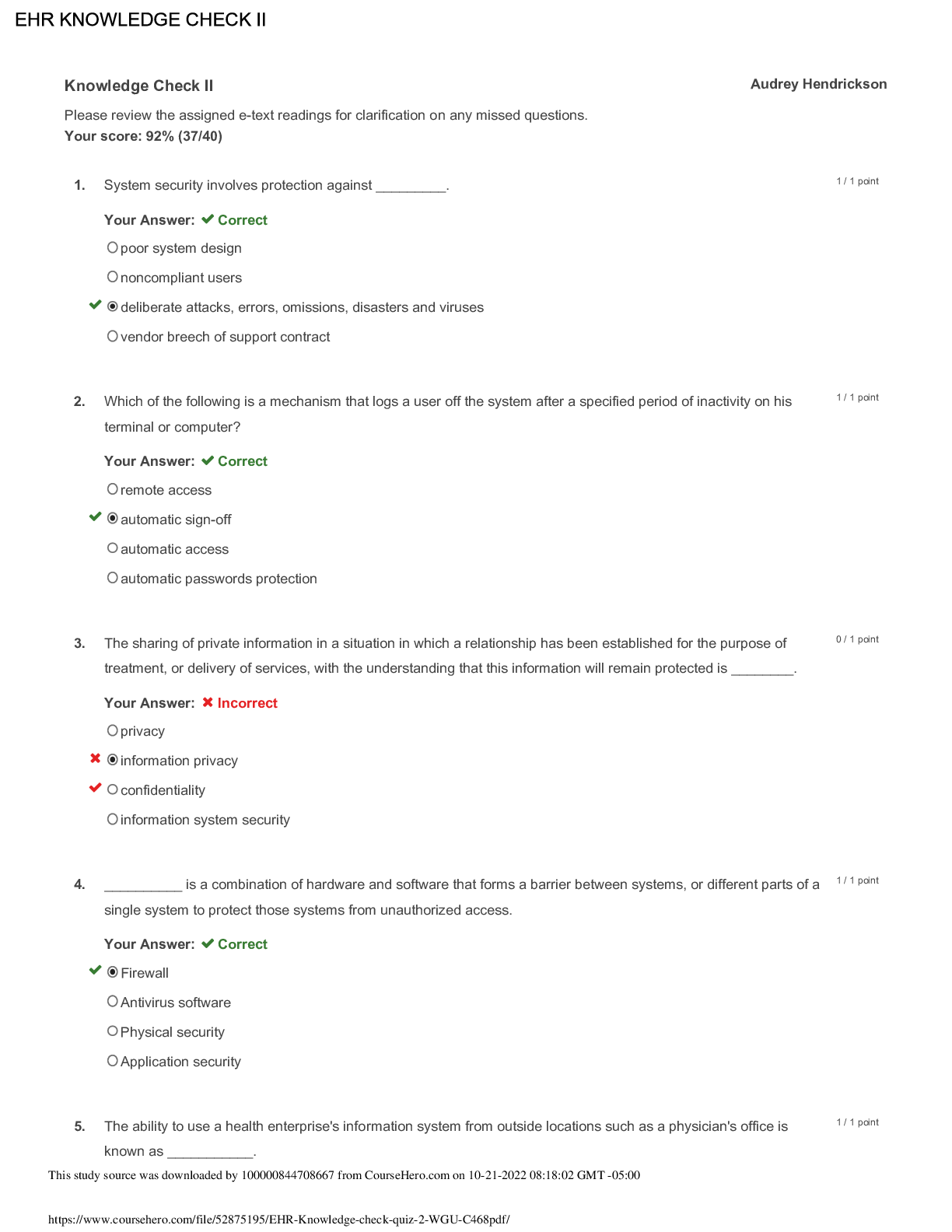
Logical ways to protect patient information: - ANSWER Installing firewalls
Use of biometrics (scanning fingerprints)
Authentication (user-specific passwords)
Automatic sign-off
Store and forward - used in telehealth - ANSWER form of transferring data from one location to another; used a lot of times with pathology reports and radiology images
Telehealth good for - ANSWER Access to care (rural areas)
Continuity of care (telemonitoring)
Ratio of patients to available providers (tele consultants)
Increase in chronic diseases (needing to be managed 24/7)
Ethical and legal implications with telehealth - ANSWER Telehealth nurses need to keep extensive documentation on a visit
Nurses need to be licensed in every state that they practice telehealth
Clinical applications in telehealth: - ANSWER Transmitting a chest xray to be read (store and forward technology)
Mobile device to monitor patient
Live video conferencing
[Show More]