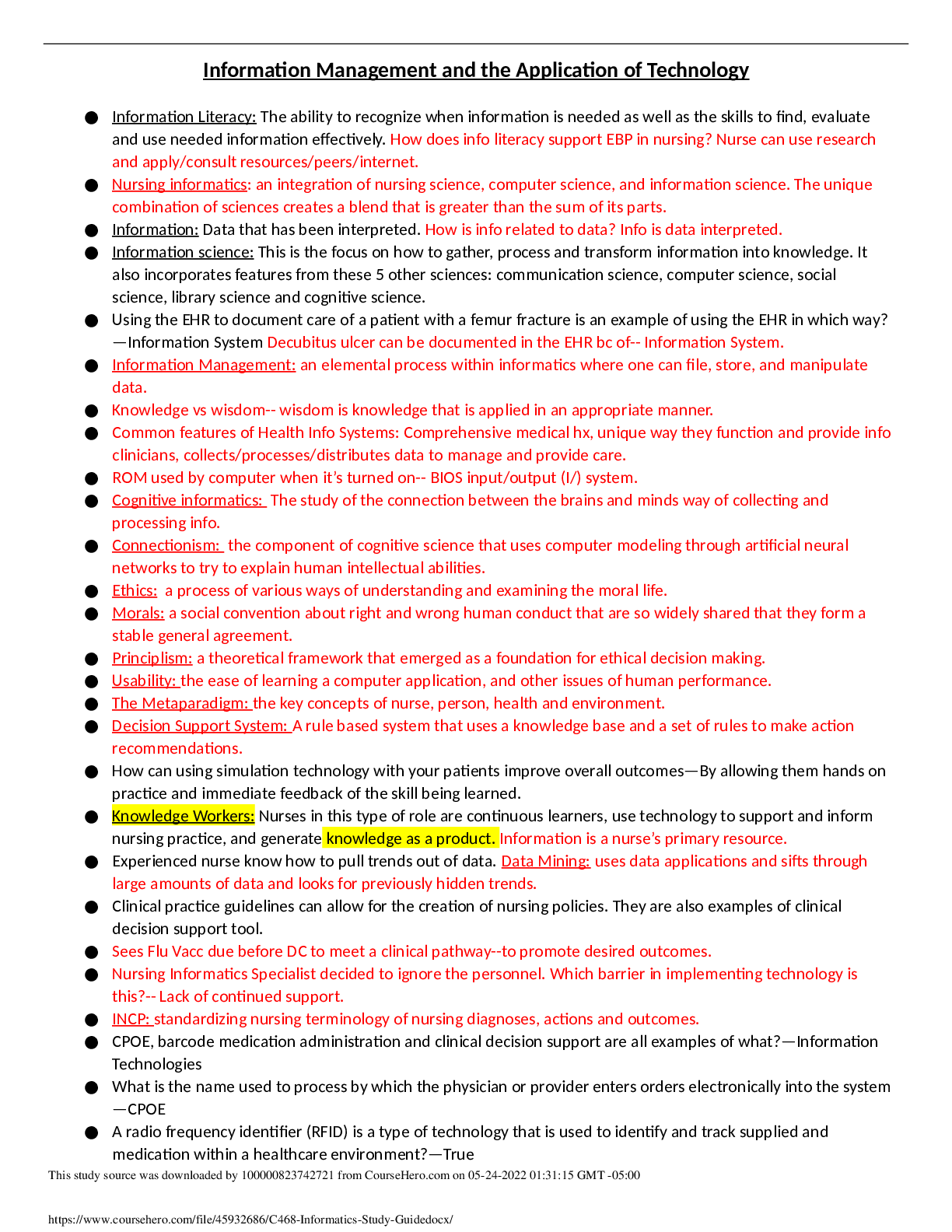
Information literacy - ANSWER Defined as the ability to recognize when information is needed as well as the skills to find, evaluate and use needed information effectively
Information - ANSWER Term used to describe da
...
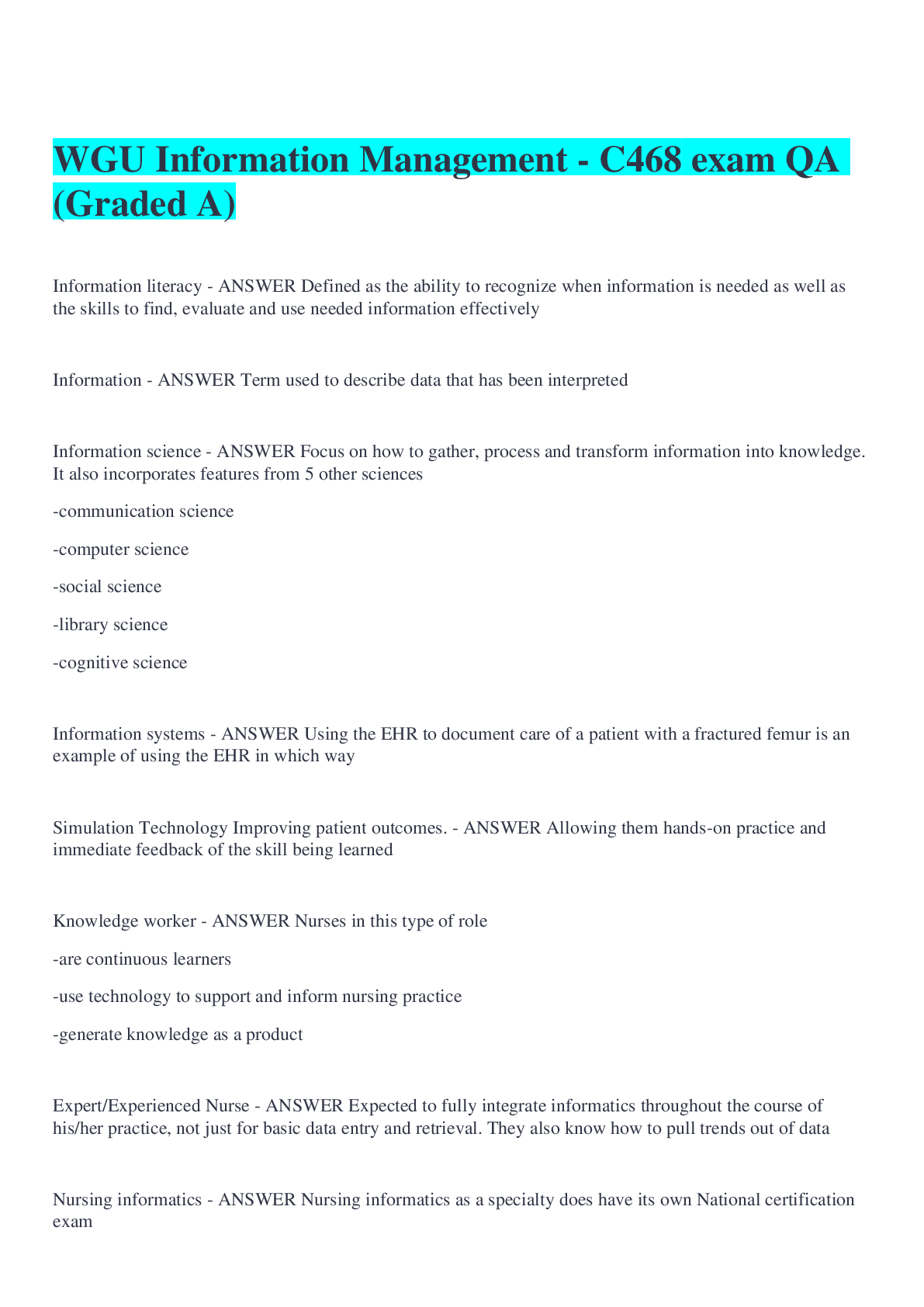
Information literacy - ANSWER Defined as the ability to recognize when information is needed as well as the skills to find, evaluate and use needed information effectively
Information - ANSWER Term used to describe data that has been interpreted
Information science - ANSWER Focus on how to gather, process and transform information into knowledge. It also incorporates features from 5 other sciences
-communication science
-computer science
-social science
-library science
-cognitive science
Information systems - ANSWER Using the EHR to document care of a patient with a fractured femur is an example of using the EHR in which way
Simulation Technology Improving patient outcomes. - ANSWER Allowing them hands-on practice and immediate feedback of the skill being learned
Knowledge worker - ANSWER Nurses in this type of role
-are continuous learners
-use technology to support and inform nursing practice
-generate knowledge as a product
Expert/Experienced Nurse - ANSWER Expected to fully integrate informatics throughout the course of his/her practice, not just for basic data entry and retrieval. They also know how to pull trends out of data
Nursing informatics - ANSWER Nursing informatics as a specialty does have its own National certification exam
Clinical practice guidelines - ANSWER Clinical practice guidelines can allow for the creation of nursing policies. True rooted in evidenced based research
Information technologies, not systems but functions within a system - ANSWER CPOE, bar code medication administration, and clinical decision support are all examples of what
Computerized Physician Order Entry (CPOE) - ANSWER The name used to describe the process by which the physician or provider enters orders electronically into the EHR
RFID - ANSWER A radio frequency identifier (RFID) is a type of (information) technology that is used to identify and track supplies and medications within a healthcare environment
Informatics affecting Nursing Practice - ANSWER Clinical pathways and computer generated care plans are examples of how informatics can affect nursing practice True, examples of clinical decision support
Nursing informatics - ANSWER The use of technology and information to help support all aspects of nursing practice
The foundation of knowledge model - ANSWER The basis for which knowledge is used to meet the needs of the healthcare delivery system
It is derived from its 3 key elements of knowledge acquisition, knowledge processing and knowledge dissemination
Data (not information until it has been analyzed) - ANSWER A patients height, weight, code status, and date of birth are all examples of what
Less consumer accountability - ANSWER Not an emerging trend in healthcare
Mission - ANSWER The purpose or reason for an organizations existence
Strategic planning, long-range - ANSWER The development of a comprehensive long range plan for guiding the activities and operations of an organization
They will need to be trained on the system - ANSWER Why is it not important that selection committee board members understand software and electronic processes
Strategic Planning - ANSWER Strategic planning is not driven by short term goals as Strategic Planning is a LONG TERM GOAL
Blogging - ANSWER Not a national trend related to nursing informatics
Needs assessment - ANSWER During which phase of the information life cycle should the "musts" and "wants" be determined
Information Life Cycle Phases - ANSWER 1. Needs assessment phase
2. System selection phase
3. System implementation phase
4. Maintenance phase
Project scope - ANSWER Term that defines the size and details of a collaborative effort
Nurses active participation in Electronic Information Importance - ANSWER To ensure the information is current and accessible to the healthcare team
Project Implementation Team Responsibilities - ANSWER Execution of system changes, active involvement in user participation, knowledge of current workflows
Company history - ANSWER A common request contained in a request for information (RFI) document includes what
System Implementation Role - ANSWER Go-live planning, applying system changes as needed, end-user training
Continuous - ANSWER Term that best describes the life cycle of an information system
EHR Essential Components - ANSWER Evidence-based decision support, assessment findings, vital signs, demographic data
EHR Function - ANSWER Bar-code medication administration
EHR Benefits - ANSWER Reduces medication errors, improves provider documentation
Patient Support Example - ANSWER Providing education material
EHR Primary Benefit - ANSWER One primary benefit of the EHR is a decreased wait time for diagnostic testing...FALSE
EHR Main Goal - ANSWER Primary goal of EHR functionality in contrast to that of a health information system is promoting patient safety
HIS Health Information System - ANSWER Broad term used to describe administrative and clinical systems to streamline work flow processes efficiency
Barrier to patient centered care - ANSWER Is waiting until the end of the shift to chart patient assessments a barrier to patient centered care...Yes, chart in real time.
Computer position can be a barrier if it is placed between the provider and the patient...pay attention to your patient.
Standardization of Data and Different data needs of each clinic - ANSWER What potential challenge can occur when implementing an EHR in a medical center with various outpatient clinics
Local Area Network (LAN) access - ANSWER What is the type of connection is needed to access the EHR when an internet connection is lost
EHR Information Includes - ANSWER Immunization history, CT scan results, date of birth
EHR Quality Care Between Facilities - ANSWER By providing continuity of care, interoperability
EHR - ANSWER The EHR is a longitudinal electronic patient record of all health care encounters...carries with the patient (longitudinal)
Medication Administration System (Pyxis) Access - ANSWER Barcode ID badge, fingerprint
Order entry system - ANSWER Type of health information system that ensures the accuracy of physician orders
ADT System (Admission, discharge, transfer) - ANSWER A registration system is also commonly refereed to as
Health information systems - ANSWER A group of systems used within the hospital to support and enhance healthcare
HIS Implementation Nursing - ANSWER It is important to secure staff nurses active participation when implementing a health information system b/c the nurses knowledge of current patient care workflow may improve implementation decisions
Standardized Terminologies important to nursing - ANSWER They improve communication within the interdisciplinary team
HIS Examples - ANSWER Laboratory system, pharmacy system, registration system
Perioperative nursing data set (PNDS) - ANSWER Which nursing terminology contains a nursing diagnosis, interventions and outcomes specific to the perioperative experience
Standardized Terminologies in Nursing Informatics Development is Driven by what Principles - ANSWER Accessibility, ubiquity, longevity, reusability
Collaboration when selecting a Health Care System - ANSWER Collaboration leads to knowledge sharing
Administrative Information System Examples - ANSWER Scheduling system, financial system, admission, discharge and transfer (ADT) system
Clinical Information Systems Examples of Effectiveness - ANSWER The information retrieved can be used to foster research, improves nursing documentation compliance, It can improve clinician workflow
HL7 (Health Level 7) - ANSWER Acronym used to refer a standard of interoperability and exchange of clinical data
Financial Systems are designed to do what - ANSWER Manage the expenses and revenue of providing healthcare, report and track fiscal outcomes as they relate to organizational goals, help to determine the organizations strategic direction
EHR implementation challenges in a medical center with various specialties - ANSWER Identifying the different data needs for each specialty practice
Clinical Decision Support Tool Characteristics - ANSWER Takes specific patient data, analyzes it and provides recommendations (next action)
Clinical Decision Support Tool Examples - ANSWER Computer generated care plans, alerts, smart pumps, electronic drug references
Culture of Safety Principles - ANSWER 1. Commitment of resources
2. Cross collaboration
3. Blame free environment
Security Threats to data/information - ANSWER 1. Unauthorized personal accessing equipment
2. Use of removable storage devices
Governing Authorities protecting Information - ANSWER 1. HIPPA
2. ANA code of ethics
HIPPA Privacy Act - ANSWER 1. Patients have ownership rights to their records
2. Patients can amend own records if information is incorrect
Physical/Logical Means of Protecting Information - ANSWER Physical - surveillance cameras, restricted areas, hard copy records being shredded
Logical - firewall protection, biometrics, authentication, automatic sign off on computers
Telehealth (Store and Forward Technology) - ANSWER Means of transferring data or images from one location to another, most often used for pathology reports and radiology images
Telehealth Driving Factors - ANSWER Access to care (removing geographical barriers), continuity of care, mobile devices, follow up calls, more patients than providers, increase in chronic diseases
Telehealth (Ethical and Legal Implications) - ANSWER Need for extensive documentation to avoid malpractice, providers need to be licensed in every state they practice Telehealth
Telehealth (Clinical vs Non-Clinical Applications) - ANSWER Clinical - imaging that needs to be read, mobile device to monitor patient, live video conferencing
Non-clinical - online database search, administrative team using video conferencing
Nursing Informatics Concepts - ANSWER Data, Information, Knowledge, Wisdom
Informatics System Considerations - ANSWER Technical Specifications - Downtime for Maintenance
Response Time - Time it takes system to process request
Architecture - Structure of system, open comm. each other
Connectivity - Interface the system in multiple ways
Testing - In different place than being used
Compatibility - With other systems
Computer Technology - ANSWER Collection of data for analysis used to justify the efficiency of particular interventions & improve quality care
Computer Hardware - ANSWER Input device, CPU, Secondary Storage, Output Device
ANA Terminologies - ANSWER NANDA, NIC, NOC, CCC, ICNP, PNDA, Omaha System
ARRA (American Recovery & Reinvestment Act - ANSWER Provides funds for adoption of technology and provides the right for every individual to receive electronic copy of EHR
EMR Basic Components - ANSWER Clinical messaging, email, data repository, clinical docum
CIS - ANSWER Access to client data to Plan, Implement, Evaluate Care
Clinical Term - ANSWER Enables the capture of data for patient care docum
Computer System - ANSWER Hardware, Software, Data, Procedures, Users
CPOE - ANSWER Needs downtime procedure or policy prior to implement
CPU - ANSWER BRAIN, computer chip processes all computer functions and uses
NO integration - ANSWER C-3PO and RUG's
EBP Attributes - ANSWER Increased job satisfaction, improved quality of care
EBP - ANSWER The use of research and evidence to inform clinical practice, an approach to provide care that integrates nursing experience and intuition with valid and current clinical research to achieve the best PT outcomes
EDI Electronic Data Interchange - ANSWER Permits multiple systems to acquire and share data
EBP Provides - ANSWER Standardized best practices, reduces time nurses spend gathering and assessing data, and provide care w/ clinical research
EMR - ANSWER Electronic version of the client data found in the traditional medical record
EMR Provides - ANSWER Legal record often restricted to a single visit of care, building block of EHR
HIPPA Compliant Codes - ANSWER ICD, ABC, Common Procedural Terms
HIPPA Provides - ANSWER Legal protections for personal health info, set standards for electronic data interchange of claims data, named specific code sets for use in Medicare related transactions and priv
HITECH (Health Information Technology for Economic and Clinical Health) - ANSWER Strengthened HIPPA security and privacy protection, provides financial incentive for user of EHR
Nurse uses Data - ANSWER Accessing Information, Collecting Data, Inputting Data, Analyzing Data
Informatics Innovator - ANSWER Process of making enhancements or improvements..creative
Informatics Nurse - ANSWER Advance knowledge and proficiency in the use of IT as it applies to nursing practice.
Interfacing Types - ANSWER 1. Point to Point - Enables 2 systems to communicate, expensive, has to have customized program
2. Interface Engine - Interfacing across several different systems.
Internet Security Measures - ANSWER 1. Firewall - Prevents unwanted access to the system and it's information
2. Limit web page access
3. Server Security - Information stored is not accessible to other systems if they are attacked
4. Update security software
Intranet/Extranet - ANSWER Intranet - Private networks that cannot be accessed outside the organization
Extranet - Network outside the organization that enables customers and suppliers access to the services.
MIPPA (Medicare Improvement for Patients and Providers Act) - ANSWER Financial Incentive for e-prescribing physicians
Telehealth Issues - ANSWER Lack of reimbursement, infrastructure, plug-play standard, license and liability issues, concerns r/t privacy confident.
Knowledge - ANSWER The synthesis of information from several sources to produce a single concept or idea Ex. journal about BP
LAN - ANSWER Connect a few computers to the server over a large area ex. doc's placing orders from home.
Needs to be Integrated - ANSWER ICD-9, G-Codes, ICD-10, CPT, HCSPC
Network - ANSWER Combination of hardware and software that allows communication & electronic transfer between computers
Connects Multiple computers in different locations
Novice - ANSWER Beginner w/ no experience with situations in which they are expected to perform a task...taught rules to guide actions
Nursing Informatics - ANSWER Integration of nursing science, computer science, and information science to manage and communicate data, information, knowledge, and wisdom into nursing practice.
Nursing Information System - ANSWER Standardized nursing language (SNL) 2 approaches
1. Nursing Process Approach & Critical Pathway - Multi Disciplinary teams throughout. Physician orders are present for the team to observe and follow, allows the team to update the POC when variances in the PT condition are noted.
2. Protocol Approach - Streamline documentation of assessment, med info, discharge info and education
Qualitative Research - ANSWER Concerned with finding out more about the human experience, accomplished through interviews and over a long period of time. EX How interventions could impact an entire population, content analysis, computers can code responses to questionnaires which can them be inputted in the informatics system for analysis.
Quantitative Research - ANSWER Concerned with objectivity, tight control over situations, define relationships between variables, seek correlation between data. EX Tries to discover how an intervention has impacted subjects IN DEPTH, tangible relations between variables.
EMR Adoption Stages - ANSWER 0-Organization
1. All 3 key ancillary departments (lab, pharm, radiology) installed
2. CDR - Clinical Data Repository provides physician access for reviewing orders and results. Possibly HIE Capable.
3. Nursing/Clinical Documentation - EMAR, first level of clinical decision support is implemented.
4. CPOE implementation
5. Closed loop med administration w/ bar codes is implemented, 5 rights of med. administration
6. Full physician documentation, full radiology and PACS
7. No more paper charts
Patient Information - ANSWER Standard (temp, weight), General, Targeted, Personalized (specific info on condition pt has been dx with ex DII), Tailored (Gleaned from EMR EHR focuses specifically on conditions IND Based)
Telemedicine - ANSWER Improve pt outcomes by permitting pts to
remain at home, allows pts to communicate w/
provider about blood glucose test or video
conference w/ them directly to develop pt
specific education opportunities, directed by
[Show More]

.png)