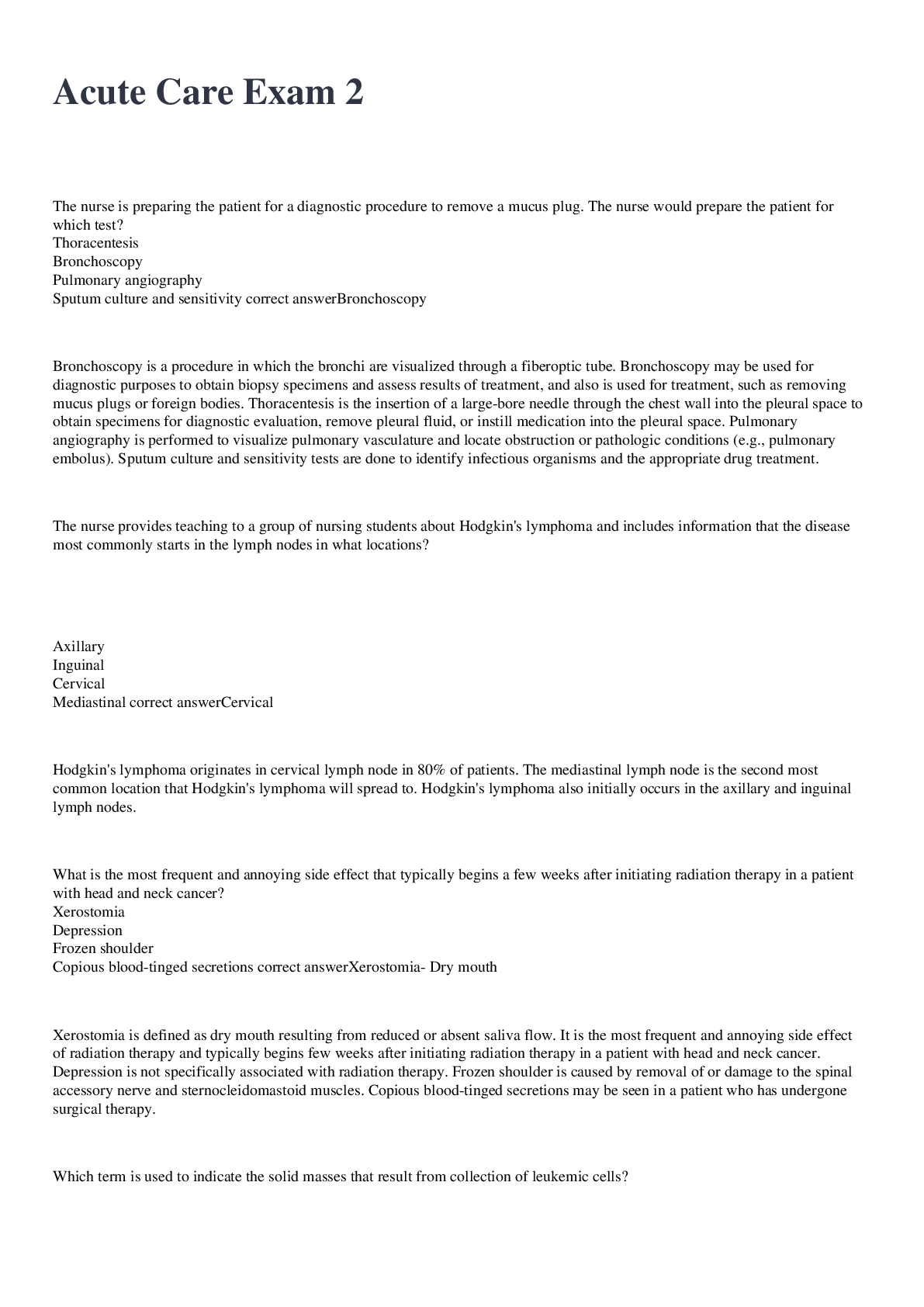
The nurse is preparing the patient for a diagnostic procedure to remove a mucus plug. The nurse would prepare the patient for which test?
Thoracentesis
Bronchoscopy
Pulmonary angiography
Sputum culture an
...
The nurse is preparing the patient for a diagnostic procedure to remove a mucus plug. The nurse would prepare the patient for which test?
Thoracentesis
Bronchoscopy
Pulmonary angiography
Sputum culture and sensitivity correct answerBronchoscopy
Bronchoscopy is a procedure in which the bronchi are visualized through a fiberoptic tube. Bronchoscopy may be used for diagnostic purposes to obtain biopsy specimens and assess results of treatment, and also is used for treatment, such as removing mucus plugs or foreign bodies. Thoracentesis is the insertion of a large-bore needle through the chest wall into the pleural space to obtain specimens for diagnostic evaluation, remove pleural fluid, or instill medication into the pleural space. Pulmonary angiography is performed to visualize pulmonary vasculature and locate obstruction or pathologic conditions (e.g., pulmonary embolus). Sputum culture and sensitivity tests are done to identify infectious organisms and the appropriate drug treatment.
The nurse provides teaching to a group of nursing students about Hodgkin's lymphoma and includes information that the disease most commonly starts in the lymph nodes in what locations?
Axillary
Inguinal
Cervical
Mediastinal correct answerCervical
Hodgkin's lymphoma originates in cervical lymph node in 80% of patients. The mediastinal lymph node is the second most common location that Hodgkin's lymphoma will spread to. Hodgkin's lymphoma also initially occurs in the axillary and inguinal lymph nodes.
What is the most frequent and annoying side effect that typically begins a few weeks after initiating radiation therapy in a patient with head and neck cancer?
Xerostomia
Depression
Frozen shoulder
Copious blood-tinged secretions correct answerXerostomia- Dry mouth
Xerostomia is defined as dry mouth resulting from reduced or absent saliva flow. It is the most frequent and annoying side effect of radiation therapy and typically begins few weeks after initiating radiation therapy in a patient with head and neck cancer. Depression is not specifically associated with radiation therapy. Frozen shoulder is caused by removal of or damage to the spinal accessory nerve and sternocleidomastoid muscles. Copious blood-tinged secretions may be seen in a patient who has undergone surgical therapy.
Which term is used to indicate the solid masses that result from collection of leukemic cells?
Purpura
Petechiae
Chloromas
Ecchymosis correct answerChloromas
Chloromas refers to the solid masses that result from collection of leukemic cells. Purpura refers to purple spots that occur on the skin as a result of a low platelet count. Petechiae are small red or purple spots on the skin from bleeding. Ecchymosis is discoloration of the skin from bleeding.
A student nurse is providing postoperative care to a patient who has undergone a laryngectomy and has a tracheostomy tube. Which action of the student nurse indicates the need for further training?
Encourages the patient to cough frequently
Suctions when coughing to clear secretions
Positions the patient in a semi-Fowler's position
Infuses saline into the tube to remove thickened secretions correct answerInfuses saline into the tube to remove thickened secretions
Infusing the normal saline solution into the tracheostomy tube can cause hypoxia and endothelial cell damage. Encouraging the patient to cough frequently removes the sputum from the lungs. Positioning the patient in a semi-Fowler's position decreases tension on the sutures and prevents edema and aspiration in the patient. Suctioning when coughing to remove secretions is a sign of good tracheostomy care.
While taking undiluted liquid iron that was prescribed, a patient asks the nurse why it must be drunk through a straw. How should the nurse respond?
It reduces iron absorption.
[Show More]