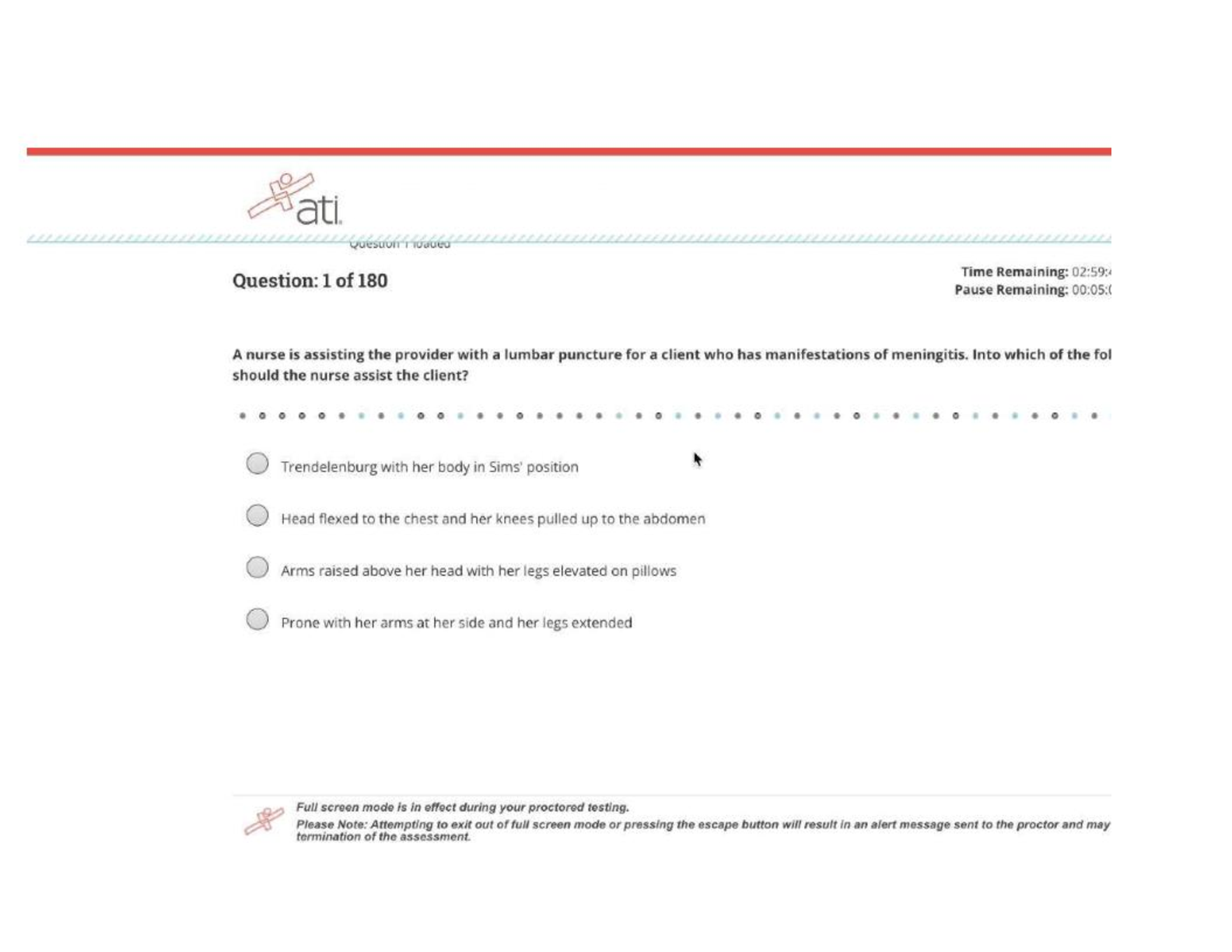
A nurse is caring for a client who is postprocedure following lumbar puncture and reports throbbing headache when sitting upright. Which of the following actions should the nurse take? (Select all that apply.)
A. Use th
...
A nurse is caring for a client who is postprocedure following lumbar puncture and reports throbbing headache when sitting upright. Which of the following actions should the nurse take? (Select all that apply.)
A. Use the GCS when assessing the pt.
B. Assist the client to a supine position
C. Administer an opioid medication
D. Encourage the client to increase fluid intake
E. Instruct the client to perform deep breathing and coughing exercises correct answersB. Assist the client to a supine position
C. Administer an opioid medication
D. Encourage the client to increase fluid intake
A nurse is caring for a client who experience a traumatic head injury and has an intraventricular catheter (ventriculostomy) for ICP monitoring. The nurse should monitor the client for which of the following complications related to the ventriculostomy?
A. Headache
B. Infection
C. Aphasia
D. HTN correct answersB. Infection
A nurse is assessing a client for changes in the LOC using the GCS. The client opens his eyes when spoken to, speaks incoherently, and moves his extremities when pain is applied. Which of the following GCS scored should the nurse document?
A. E2+V3+M5=10
B. E3+V4+M4=11
C. E4+V5+M6=15
D. E2+V2+M4=8 correct answersB. E3+V4+M4=11
A nurse is developing a plan of care for a client who is scheduled for cerebral angiography with contrast media. Which of the following statements by the client should the nurse report to the provider? (Select all that apply.)
A. "I think I might be pregnant."
B. "I take warfarin."
C. "I take antihypertensive medication."
D. "I am allergic to shrimp"
E. "I ate a light breakfast this morning." correct answersA. "I think I might be pregnant."
B. "I take warfarin."
D. "I am allergic to shrimp"
E. "I ate a light breakfast this morning."
A nurse is providing education to a client who is to undergo an EEG the next day. Which of the following information should the nurse include in the teaching?
A. "Do not wash your hair the morning of the procedure."
B. "Try to stay awake most of the night prior to the procedure."
C. "The procedure will take approximately 15 minutes."
D. "You will need to lie flat for 4 hours after the procedure." correct answersB. "Try to stay awake most of the night prior to the procedure."
A nurse is caring for a client who displays manifestations of stage III Parkinson's disease. Which of the following action should the nurse include?
A. Recommend a community support group
B. Integrate a daily exercise routine.
C. Provide a walker for ambulation.
D. Perform ADLs for the client. correct answersC. Provide a walker for ambulation.
A nurse is developing a plan of care for the nutritional needs of a client who has stage IV Parkinson's disease. Which of the following actions should the nurse include? (Select all that apply.)
A. Provide three large balanced meals daily.
B. Record diet and fluid intake daily.
C. Document weight every other week.
D. Offer cold fluids such as milkshakes.
E. Offer nutritional supplements between meals. correct answersB. Record diet and fluid intake daily.
C. Document weight every other week.
E. Offer nutritional supplements between meals.
A nurse is reinforcing teaching with a client who has Parkinson's disease and has a new prescription for bromocriptine. Which of the following instructions should the nurse include?
A. Rise slowly when standing
B. Expect urine to become dark-colored
C. Avoid foods containing tyramine
D. Report any skin discoloration correct answersA. Rise slowly when standing
A nurse is assessing a client for manifestations of Parkinson's disease. Which of the following are expected findings? (Select all that apply.)
A. Decreased vision
B. Pill-rolling tremor of the fingers
C. Shuffling gait
D. Drooling
E. Bilateral ankle edema
F. Lack of facial expression correct answersB. Pill-rolling tremor of the fingers
C. Shuffling gait
D. Drooling
F. Lack of facial expression
A nurse is caring for a client who has Parkinson's disease and is starting to display bradykinesia. Which of the following is an appropriate action by the nurse?
A. Teach the client to walk more quickly when ambulating.
B. Complete passive ROM exercises daily.
C. Place the client on a low-protein, low-calorie diet
D. Give the client extra time to perform activities correct answersD. Give the client extra time to perform activities
A nurse is caring for a client who has MS. Which of the following findings should the nurse expect?
A. Fluctuations in BP
B. Loss of cognitive function
C. Ineffective cough
D. Drooping eyelids correct answersB. Loss of cognitive function
A nurse is beginning a physical assessment of a client who has a new diagnosis of MS. Which of the following findings should the nurse expect? (Select all that apply.)
A. Areas of paresthesia
B. Involuntary eye movement
C. Alopecia
D. Increased salavation
E. Ataxia correct answersA. Areas of paresthesia
B. Involuntary eye movement
E. Ataxia
A nurse is teaching a client who has MS and a new prescription for baclofen. Which of the following statements should the nurse include in the teaching?
A. "This medication will help with your tremors."
B. "This medication will help with your bladder function."
C. "This medication can cause your skin to bruise easily."
D. "This medication can cause you to experience dizziness." correct answersD. "This medication can cause you to experience dizziness."
A nurse is teaching a client who will have an XRAY of the kidneys, ureters, and bladder. Which of the following statements should the nurse include in the teaching?
A. "You will receive contrast dye during the procedure."
B. "An enema is necessary before the procedure."
C. "You will need to lie in a prone position during the procedure."
D. "The procedures determines whether you have a kidney stone." correct answersD. "The procedures determines whether you have a kidney stone."
A nurse is monitoring a client who has a kidney biopsy for postoperative complications. Which of the following complications should the nurse identify as causing the greatest risk to the client?
A. Infection
[Show More]