Practice questions from psych nursing cert review guide
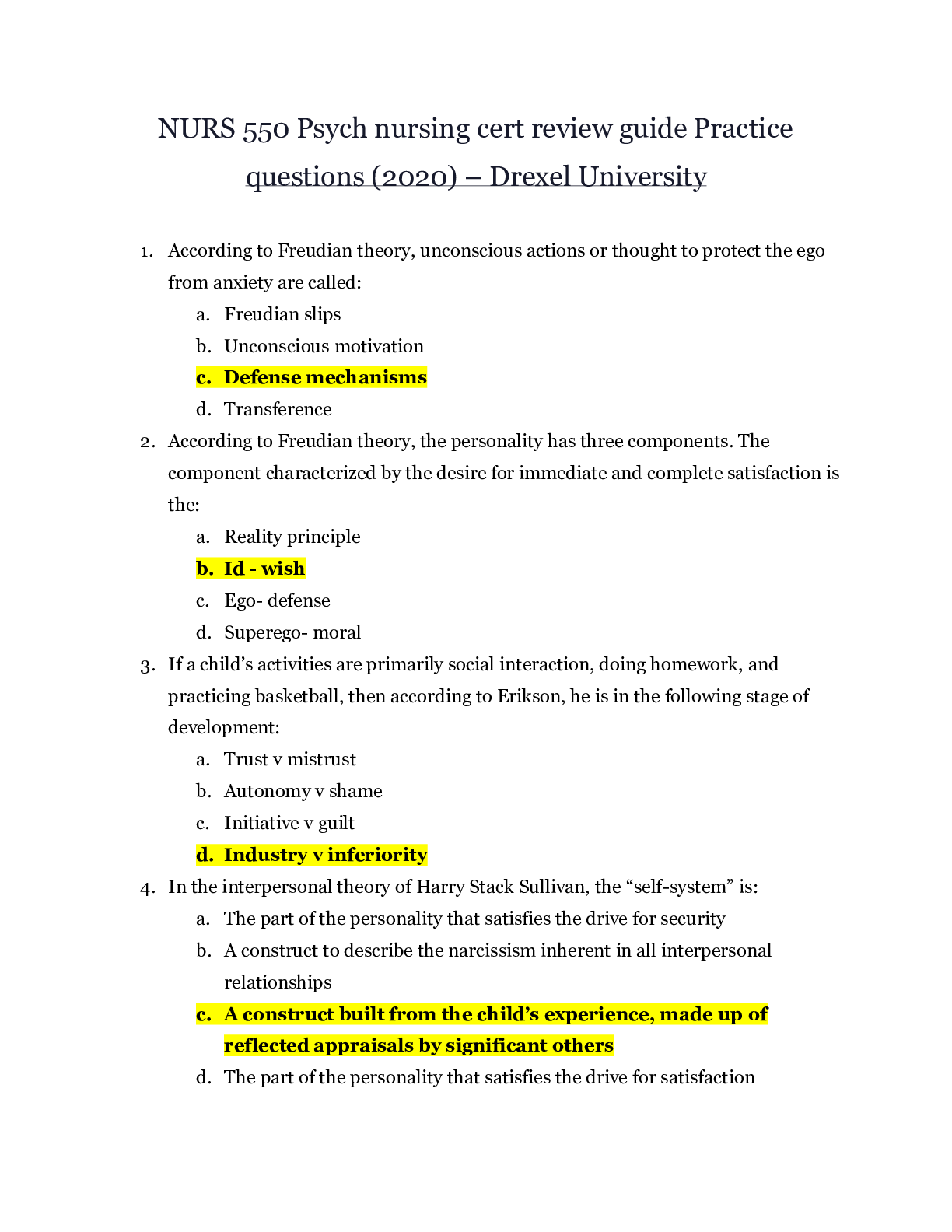
According to Freudian theory, unconscious actions or thought to protect the ego from anxiety are called:
Freudian slips
Unconscious motivation
Defense mechani
...
Practice questions from psych nursing cert review guide
According to Freudian theory, unconscious actions or thought to protect the ego from anxiety are called:
Freudian slips
Unconscious motivation
Defense mechanisms
Transference
According to Freudian theory, the personality has three components. The component characterized by the desire for immediate and complete satisfaction is the:
Reality principle
Id - wish
Ego- defense
Superego- moral
If a child’s activities are primarily social interaction, doing homework, and practicing basketball, then according to Erikson, he is in the following stage of development:
Trust v mistrust
Autonomy v shame
Initiative v guilt
Industry v inferiority
In the interpersonal theory of Harry Stack Sullivan, the “self-system” is:
The part of the personality that satisfies the drive for security
A construct to describe the narcissism inherent in all interpersonal relationships
A construct built from the child’s experience, made up of reflected appraisals by significant others
The part of the personality that satisfies the drive for satisfaction
According to Harry Stack Sullivan, the basic drives that underlie human behavior are:
The drive for satisfaction and the drive for security
The drive to fulfill basic physical needs and the drive to fulfill sexual needs
The drive to reduce anxiety and the drive to avoid fear
The drive for love and work
The existential theories of personality focus on:
The meaning of life for the individual
Present experience, with little attention to the past
One’s philosophy of life
Conforming to societal demands
According to Carl Rogers, the important attributes of the therapist are:
Congruence, unconditional positive regard, and empathetic understanding
Knowledge of Rogers’s theory, patience, and ability to interpret dreams
Knowledge of Rogers’s theory, congruence, and interest in human development
Willingness to drop facades, openness to individual meanings, and compassion
The therapist utilizing Gestalt therapy recognizes that introjection is:
A fantasy about what another person is experiencing
Accepting the beliefs and opinions of others without question
Turning back on oneself that which is meant for someone else
Merging with the environment
The main goal of Gestalt therapy is:
Dropping facades
Differentiating between self and others
Integration of self and world awareness
Resolving conflicts from the past
Techniques in Gestalt therapy do NOT include:
Playing the projection
Making the rounds
Exaggeration of a feeling or action
Paradoxical prescription
Behavioral theories of personality are concerned with:
Unconscious phenomena
Cognitions
Emotions
Reinforcement
Aaron Beck developed a theory of cognitive therapy after he discovered that his clients had “automatic thoughts.” The automatic thoughts:
Came from too much free association
Labeled, interpreted, and evaluated situations according to a personal set of rules
Indicated to the client that he should not trust the therapist
Warned clients of any physiological needs
The therapist who utilizes Beck’s therapy will warn the client:
To try to ignore or suppress his automatic thoughts
That emotionally healthy individuals do not have automatic thoughts
That automatic thoughts are deeply imbedded and cannot be changed
That a perception of reality is not necessarily reality
The therapist utilizing Beck’s therapy will help the client to:
Recognize and change his/her automatic thoughts
See reality as the therapist sees it
Change his/her reality be changing his/her environment
Recognize and accept that automatic thoughts suggest delusional thinking
The nurse utilizing Bowen’s theory in family therapy will observe the patterns of emotional interaction within a family. Bowen calls these patterns:
Triangles
The family projection process
The nuclear family emotional system
The family differentiation process
In Bowen’s Family Systems Therapy, the multigenerational family transmission process refers to:
Genetic traits
Relationships patterns and anxiety about specific issues that have been transmitted through the generations
Relationships between grandparents and grandchildren
Hereditary disorders
The nurse practicing Bowen’s Family Systems Therapy will guide family members to:
Use their sibling position to their advantage
Periodically cut off other family members emotionally
Create specific triangles
Increase differentiation of self
When the nurse using Minuchin’s Structural Family Therapy observes that a mother holds a 7-year-old child in her lap, answers questions for the child, and describes protecting the child from siblings and neighbors, the nurse will suspect:
Accommodation
Enmeshment
Disengagement
An unusual transaction
In Minuchin’s Structural Family Therapy, the main tasks of the therapist are:
Joining and restructuring
Clarifying the family structure and explaining it
Identifying family communication patterns and maintaining family strengths
Enacting the family structure and delineating boundaries
A therapist who utilizes Minuchin’s Structural Family Therapy will probably:
Point out family strengths
Identify multigenerational transactions
Maintain his/her position of authority
Decrease stress
A therapist who utilizes the Structural Family Therapy of Minuchin would NOT utilize symptoms by:
Moving to new symptoms
De-emphasizing symptoms
Exaggerating symptoms
Rewarding symptoms
A client seeks treatment from a Solution-Focused therapist for somatic complaints. What would the therapist’s question to her most likely be?
Can you tell me what happened in your childhood?
Tell me about the surgeries you have had?
When you aren’t in terrible pain, or visiting your doctor, what will you be doing instead?
What was going on in your life when the pain started?
Which of the following is NOT true of the Resolution or Termination phase of the nurse-client relationship?
Preliminaries for this phase are introduced in the Orientation phase
Talk about the impending separation should be avoided so that the client does not decompensate
The client should be encouraged to review his progress and goals
The nurse should model appropriate expression of feelings
Which of the following statements would the nurse NOT make in negotiating a contract with the client within the nurse-client relationship?
I would like to meet with you on a once a week basis while we are trying to resolve this crisis
We need about 10 sessions to work on this problem
I have malpractice insurance in case there is any problem
We will not be exploring your past, but only looking at things that are going on now
In a session with the nurse, the client begins to whine about his inability to complete his assigned task from the previous sessions. The nurse responds by scolding him for his failure. This is an example of:
Transference
Countertransference
Transference and countertransference
Goal setting
Sarah has been at least 10 minutes late for each of her previous sessions. Today she arrives 20 minutes late. The nurse should:
Express anger toward Sarah
Confront Sarah firmly and set limits on her behavior
Discuss terminating their sessions if she continues this pattern
Comment on her observations and assist Sarah to understand her behavior
Adrienne has just finished describing how devastated she was at the recent loss of her mother. Which of the following response by the nurse would NOT be a barrier to therapeutic communication?
I know how you feel. I lost my mother recently, too
Well, it’s better to have loved and lost, if you know what I mean
When did she die? Of what? Does anyone else in your family have that problem?
It sounds like it’s been a really tough period for you
A PMHNP has had several meetings with a therapy group. On this particular occasion, it is noted that members seem angry with the nurse and each other. They seem to be competing with each other to see who can refrain from breaking the silence longest. Which stage of group development do these behaviors signify?
Storming
Norming
Performing
Mourning
A PMHNP notes that members of her therapy group have become most supportive of one another and very attached to the group. Which stage of group development do these behaviors signify?
Forming
Storming
Norming
Performing
Whose responsibility is it to deal with transference issues in group therapy?
The nurse
The group members
The nurse and the group members
The group member who is involved in the transference
How should a member terminating be handled in groups?
Little attention should be paid to it since this person is now ready to leave and other members are more in need of assistance
Members may discuss it if they wish, but should be allowed to avoid it if it causes anxiety
Members should be encouraged to focus only on the positive aspects of the leaving so that negative feelings do not arise
Members should be encouraged to express whatever feelings arise in the process of leaving
A PMHNP is the family therapist for a family whose youngest child is the identified patient. The child has been brought in for therapy because he has been doing poorly and acting out at school. How will the nurse begin the initial session with the family?
By asking the child why he is doing poorly in school
By asking the parents why they think he is doing poorly in school
By asking each family member how they did in school
By asking questions about the family in general
A family with extremely rigid boundaries will probably NOT have:
Positive links to society
Clear boundaries
Strong parental coalition
Efficient negotiation and task performance
Mike Brown has completed gender reassignment surgery (male to female) and is now legally Mikaela Brown. Mikaela states that she is still attracted to females and not males. The PMHNP should classify Mikaela’s sexual orientation as?
Lesbian
Heterosexual
Homosexual
Bisexual
When assessing the relationship between a patient and her 10-month old infant, the PMHNP notes that the infant showed no distress when the mother briefly left the room and did not acknowledge the mother on her return. The PMHNP classifies this attachment style as:
Secure
Ambivalent
Disorganized
Avoidant
The area of psychology that involves the study of the mental process involved in attention, memory, and perception and how these processes affect behavior is:
Social psychology
Psychoanalysis
Cognitive psychology
Gestalt psychology
A 35-year old recently widowed patient was a happily married stay at home mom but has experienced severe anxiety and panic attacks since her husband’s death left her with few employable skills, little money, and three children to raise. Considering Maslow’s hierarchy of needs, this patient’s primary need at this time is likely to be:
Physiological
Love/belonging
Esteem
Safety/security
When conducting psychoeducation for a patient and family members, the initial action of the PMHNP is to:
Evaluate current knowledge
Develop written materials
Identify and mitigate barriers to learning
Plan lessons from simple to complex
An example of secondary prevention used by the PMHNP for an at-risk adolescent is:
Refer to Alateen if the parents are alcoholics
Refer to a support group for children of divorce
Work with the patient to modify negative behaviors
Provide sex education courses
The parents of a 15-year old boy are concerned that their son no longer wants to be involved in family activities. The PMHNP points out that, according to Erikson’s stages of human development, the key event during the stage of adolescence (12-18) is:
School
Love relationships
Peer relationships
Independence
A patient whose partner has left him for someone else and who spends an hour discussing all of the positive aspects of being single is probably using the defense mechanism of:
Displacement
Intellectualism
Denial
Rationalization
The PMHNP is conducting a smoking cessation class for a group of patients, and two patients are adamant in stating that they plan to resume smoking after discharge from the psychiatric facility. The best solution is to:
Exclude the two patients from the group
Warn patients that smoking could endanger their lives
Arrange for the two patients to meet a person with lung cancer from smoking
Provide information about symptoms of concern, such as increased cough
A 28-year old female patient who experienced sexual abuse as a child expresses distorted feelings of guilt and shame, blaming herself for the abuse and exhibiting low self-esteem. The most effective therapeutic approach is likely:
Therapeutic milieu
Psychoanalysis
CBT
EMDR
A patient in CBT for MDD is experiencing negative thoughts. The statement by the patient that indicates that she is applying principles learned in therapy is:
I know I need to change because I feel so worthless all the time
I can’t fix this situation, so I am going to think about being on a vacation
I should have known better than to think I could fix this situation
I want to feel better about this situation
According to CBT, the type of automatic thought exemplified when a patient states, “My mother thinks I’m a failure” is:
personalizing
all-or-nothing
discounting positives
mind reading
During a patient interview, the PMHNP notes that the patient is rubbing her hands together, sitting tensely, answering abruptly, and avoiding eye contact. The PMHNP tells the patient, “I can see that you are upset.” The therapeutic technique is:
Clarifying
Observing
Restating
Empathizing
A patient with bulimia nervosa is very angry at the PMHNP because of the restrictions that the PMHNP has prescribed after meals to prevent the patient form purging. However, the patient denies she is angry and accuses the PMHNP of being angry with her. This is an example of:
Suppression
Denial
Projection
Repression
Motivational interviewing for reduction of high-risk behavior includes which of the following components?
Vigorous confrontation of resistance to change
Maintenance of a detached, impersonal attitude
Encouragement of the client to accept the therapist as authoritative and to foster dependency
Developing discrepancy by helping the client to see how their day-to-day behavior deviates from their ideals
[Show More]












.png)


.png)