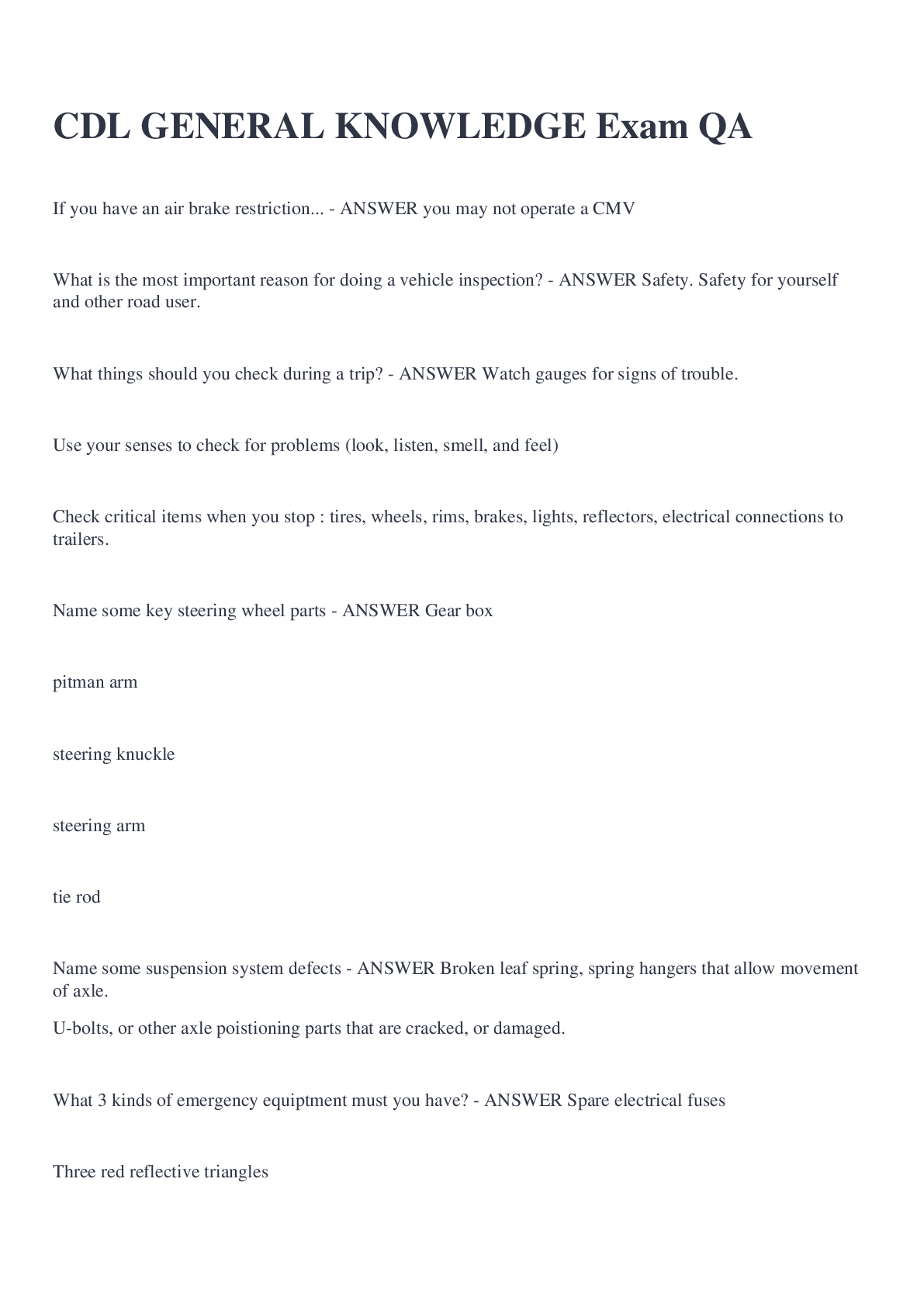
If you have an air brake restriction... - ANSWER you may not operate a CMV
What is the most important reason for doing a vehicle inspection? - ANSWER Safety. Safety for yourself and other road user.
What things sho
...
If you have an air brake restriction... - ANSWER you may not operate a CMV
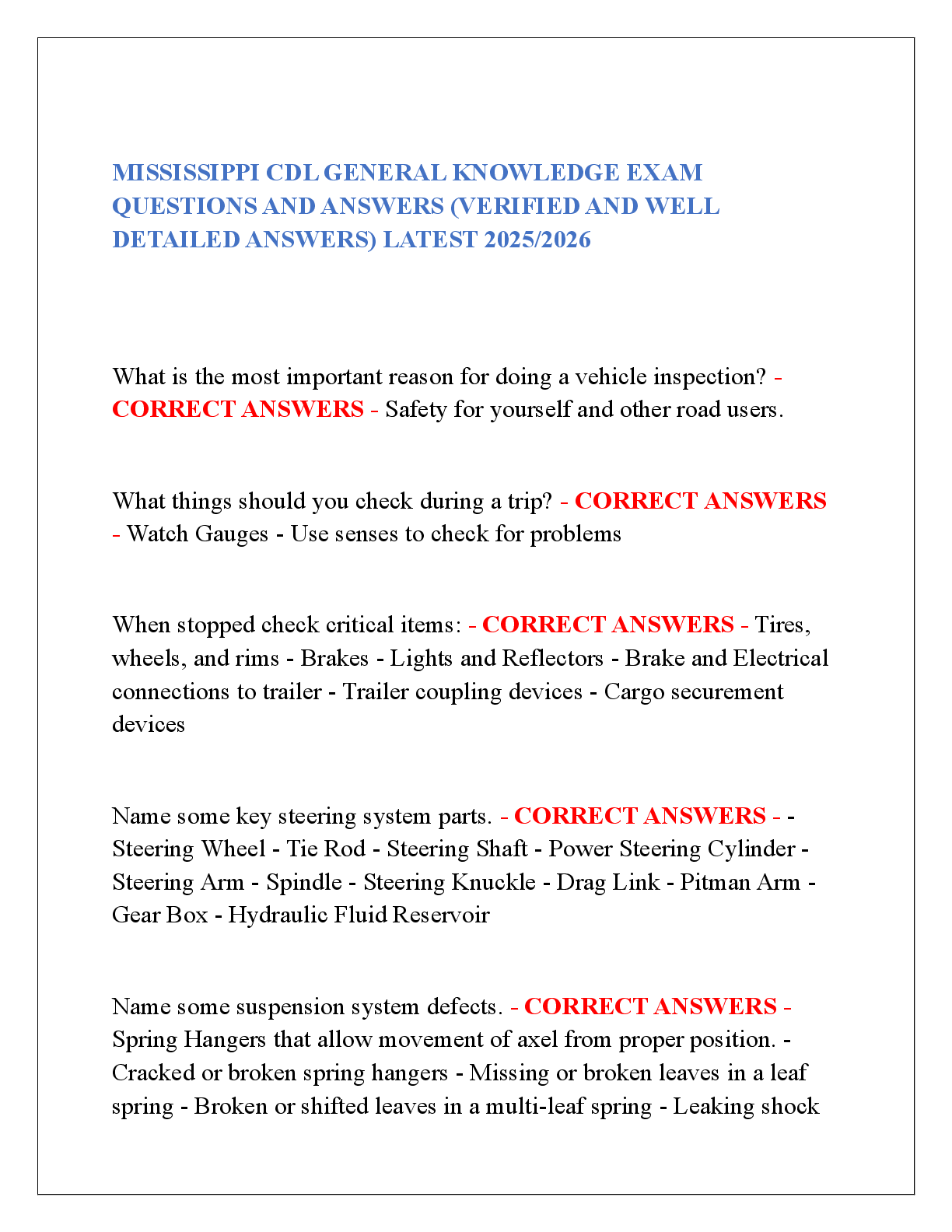
What is the most important reason for doing a vehicle inspection? - ANSWER Safety. Safety for yourself and other road user.
What things should you check during a trip? - ANSWER Watch gauges for signs of trouble.
Use your senses to check for problems (look, listen, smell, and feel)
Check critical items when you stop : tires, wheels, rims, brakes, lights, reflectors, electrical connections to trailers.
Name some key steering wheel parts - ANSWER Gear box
pitman arm
steering knuckle
steering arm
tie rod
Name some suspension system defects - ANSWER Broken leaf spring, spring hangers that allow movement of axle.
U-bolts, or other axle poistioning parts that are cracked, or damaged.
What 3 kinds of emergency equiptment must you have? - ANSWER Spare electrical fuses
Three red reflective triangles
properly charged and rated fire extinguisher.
What is the minimum tread depth for front tires? For all other tires? - ANSWER 4/32 on the front and 2/32 elsewhere
Name some things you should check on the front of your vehicle during the walk around inspection? - ANSWER Headlights, low and high beam.
Windshield wiper arms for proper spring tension.
Wiper blades for damage.
Reflectors
Turn Signals both left and right.
What should wheel bearing seals be checked for? - ANSWER Leaks, Leaks, LEAKS!!
How many red reflective triangles should you carry? - ANSWER Three
How do you test hydraulic breaks for leaks? - ANSWER Pump brake pedal three times and apply firm pressure to the pedal, hold for five seconds. The pedal should not move.
Why put the starter switch key in your pocket during the pre-trip inspection? - ANSWER To keep someone from running over you.
Why should you back toward the driver's side? - ANSWER So you can see better
backing toward the right side is very dangerous because you cant see as well.
If stopped on a hill, how can you start moving without rolling back? - ANSWER For manual transmission, partly engage the clutch before you take your right foot off the brake, or put the parking brake on whenever necessary to keep you from rolling back.
On a tractor-trailer equipped with a trailer brake hand valve, the hand valve can be applied to keep from rolling back.
When stopping a vehicle with a manual transmission, push the clutch in when the engine is close to - ANSWER Idle
When backing, why is it important to use a helper? - ANSWER There are blind spots you cant see!
What is the most important single you and your helper should agree on? - ANSWER stop, stop, stop!!
What are the two special conditions where you should downshift? - ANSWER Before entering a curve
Before starting down a hill
When should you down shift automatic transmissions? - ANSWER You can select a low range to get greater engine braking when going down grades
The lower ranges prevent the transmission from shifting up beyond the selected gears ( unless the governor rpm is exceeded )
TRUE OR FALSE:
Engine retarders keep you from skidding when the road is slippery - ANSWER False
What are the two ways to know when to shift? - ANSWER Use engine speed (rpm) or road speed (mph)
TRUE OR FALSE:
All drivers look ahead, but many don't look far enough ahead - ANSWER true
How far ahead does the manual say you should look ahead? - ANSWER Most good drivers look at least 12 to 15 seconds ahead
What are some things to look for ahead? - ANSWER Look for vehicles coming onto the highway, into your lane, or turning.
Watch for brake lights from slowing vehicles
by seeing these things far enough ahead, you can change your speed, if necessary.
Whats the most important way to see the sides and rear of your vehicles? - ANSWER WATCH YOUR MIRRORS!!
By using your mirrors you can see? - ANSWER Tires and cargos
Loose straps, ropes, or chains
TRUE OF FALSE :
Mirrors can only be checked accurately when the trailer is straight. - ANSWER True
TRUE OR FALSE:
There are blind spots that your mirrors cannot show you? - ANSWER True
Some drivers try to help out others by signaling when it is safe to pass. Should you do this? - ANSWER No, don't do it. You can be blamed if an accident occurs!
What does "communicating" mean in safe driving? - ANSWER Other drivers can't know what you are going to do until you tell them.
You communicate your intentions by using turn signals for turns and lane changes
When you pull off the road and stop, be sure to... - ANSWER Turn on the four-way emergency flashers
How should you put out the triangles? - ANSWER Hold them between yourself and the on-coming traffic for your own safety
If you stop on a 2-lane road carrying traffic in both directions, place warning devices within... - ANSWER 10 feet of the front or rear corners to mark location of vehicle and 100 feet behind and ahead of the vehicle.
It takes longer to stop on slippery surfaces, so you should.... - ANSWER Reduce speed by 1/3 on a wet road and 1/2 on packed snow
If the surface is icy, reduce speed to a crawl and stop driving as soon as you can safely do so.
Where should your reflectors be placed when stopped on a divided highway? - ANSWER Place warning devices 10 feet, 100 feet, and 200 feet in the rear toward the approaching traffic
What three things add up to total stopping distance? - ANSWER Preception Distance + Reaction Distance + Braking Distance = Total STopping Distance
If you go twice as fast, your stopping distance will increase by.. - ANSWER Four times as much
TRUE OR FALSE :
Empty trucks have the best braking - ANSWER False
What is hydroplaning? - ANSWER The tires loose their contact with the road and have little or no traction
Hydroplaning can occur at speeds as low as ___ mph if their is a lot of water. - ANSWER 30
What is "Black Ice?" - ANSWER A thin layer that is clear enough that you can see the road underneath it
It makes the road look wet
Any time the temp is below freezing and the road looks wet, watch out for black ice!
TRUE OR FALSE:
You should alwasy be able to stop within the distance you can see ahead. - ANSWER True
At night, you can't see as far with low beams, so you should.. - ANSWER Slow down
TRUE OR FALSE:
In heavy traffic, the safest speed is that of other vehicles as long as it is legal and not excessive for conditions. - ANSWER True
When driving through a roadway work zone, you should - ANSWER Decrease your speed for adverse weather or road conditions.
Decrease your speed even further when a worker is close to the roadway.
TRUE OR FALSE :
If the vehicle ahead of you is smaller than yours, it can probably stop faster than you can. - ANSWER True
How do you find out how many seconds of follwoing distance space you have? - ANSWER Wait until the vehicle ahead passes a pavement marking, or some other clear landmark. Count off the seconds.
Compare your count with the rule of one second for every ten feet of length.
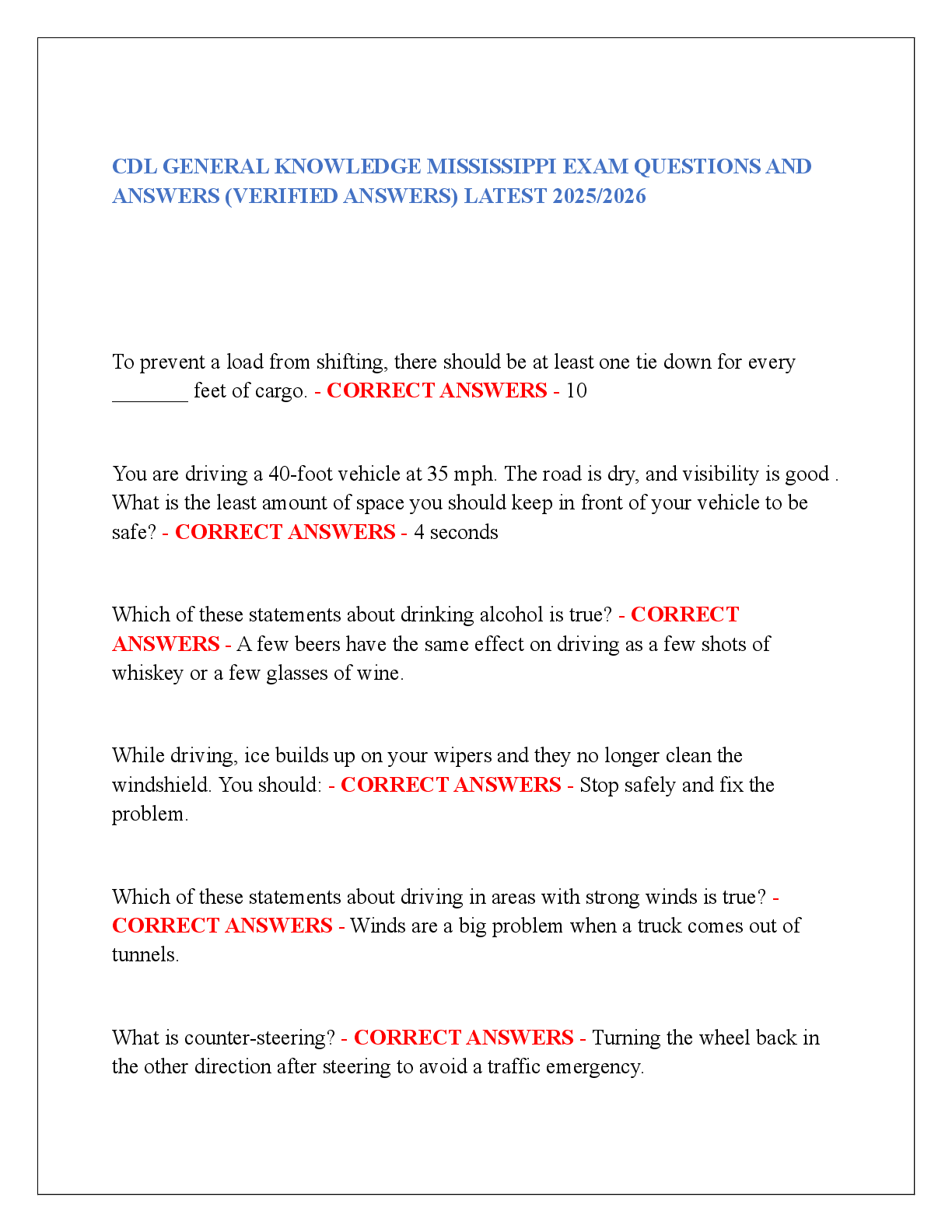
If you are driving a 40-foot vehicle at 35 mph, how many seconds of following distance should you allow? - ANSWER Four seconds
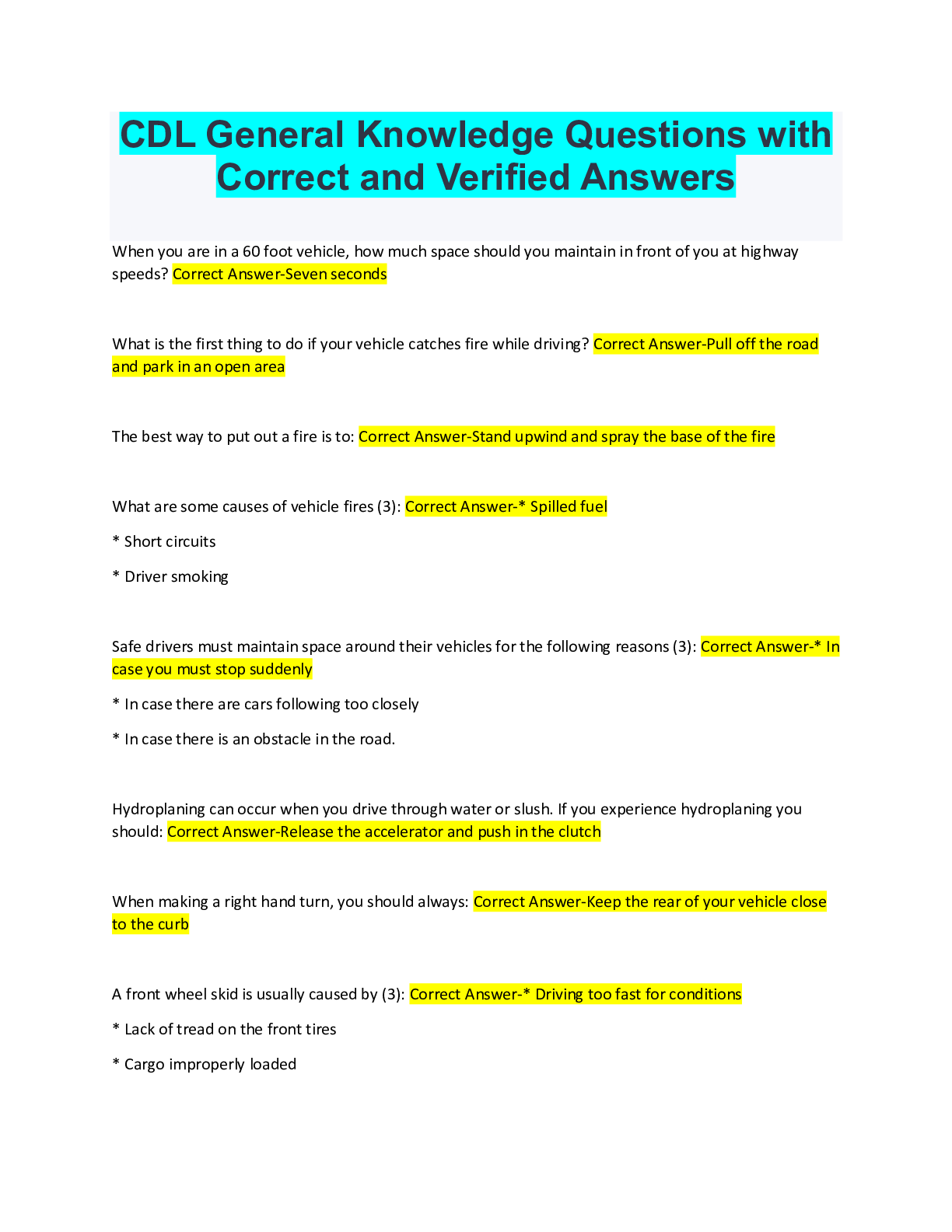
If you are driving a 60-foot vehicle at 55 mph, how many seconds of following distance should you allow? - ANSWER Seven seconds
Why should you avoid traveling next to other vehicles? - ANSWER Another driver may change lanes suddenly and turn into you
You may be trapped when you need to change lanes
Why are strong winds a problem? - ANSWER They make it difficult to stay in your lane and it is even worse for lighter vehicles.
TRUE OR FALSE :
You should decrease your following distance if somebody is follwoing you too closely. - ANSWER False
Many drivers forget about the space under their vehicles which can cause them to.. - ANSWER Get hung up
TRUE OR FALSE :
If you swing wide to the left before turning right, another driver may try and pass you on the right. - ANSWER True
TRUE OR FALSE :
Before you start across a road, make sure you can get all the way across before traffic reaches you. - ANSWER True
What is a hazard? - ANSWER A hazard is any road condition or other road user ( driver, bicyclist, pedestrian ) that is a possible danger.
Why should you make emergency plans when you see a hazard? - ANSWER Being prepared will reduce the danger!
How can you recognize distracted drivers? - ANSWER Vehicles that drift over the lane divider lines, or travel at inconsistant speeds.
What are some tips to follow so you wont become a distracted driver? - ANSWER Review and be totally familiar with all safety and usage features on any in-vehicle electronics, including your wireless phone, before you drive.
Pre-program radio stations and pre-load all cd's and cassets.
What is the definition of agressive driving and road rage? - ANSWER Agressive driving is the act of operating a motor vehicle in a selfish, bold, or pushy manner, w/o regard for the rights or safety of others. An agressive driver may change lanes abruptly and without warning.
Road rage is operating a vehicle with the intent of doing harm to others or physically assaulting a driver or their vehicle.
What should you do when confronted with an agressive driver? - ANSWER Make every attempt to get out of their way. Do not challenge them by speeding up.
Avoid eye contact, and ignore gestures and refuse to react with them.
What are some things you can do to reduce your stress before and while you drive? - ANSWER Listen to "easy listening" music
Give the drive your full attention. Don't allow yourself to become distracted by talking on you cell phone, eating, etc.
During night driving with low beams you can see about ___ feet ahead.
During night driving with high beams you can see about ___ feet ahead. - ANSWER 250
350-500
TRUE OR FALSE:
Dirty headlights may give only 90 % of the light they should? - ANSWER False
You should avoid driving through deep puddles or flowing water if possible. If you can't, you should... - ANSWER Gently put on brakes, this presses lining against brake drums.
Increase engine RPM and cross water while keeping light pressure on breaks.
At railroad crossings your speed must be... - ANSWER reduced in accordance with your ability to see approaching trains in any direction.
held to a point which will permit you to stop short of the tracks if a stop is necessary.
TRUE OR FALSE:
At a railroad crossing you should skip shift quickly on the tracks to get off them. - ANSWER False
TRUE OR FALSE:
It is illegal to shift gears while crossing railroad tracks. - ANSWER True
TRUE OR FALSE:
If your brakes fade, set the parking brake to stop the vehicle. - ANSWER False
TRUE OR FALSE:
You should use low beams whenever you can. - ANSWER False
The best advice for driving in fog is... - ANSWER DON'T!
During winter driving you should pay extra attention to the following... - ANSWER Tire chains
Defrosting and heating equiptment.
What effects can wet brakes cause? How can you avoid these problems? - ANSWER Can cause loss of braking power, wheel lockups, pulling to one side or the other.
Water in the brakes can cause the brakes to be weak, to apply unevenly, or to grab.
TRUE OR FALSE:
You should let air out of the hot tires so the pressure goes back to normal. - ANSWER False
In hot weather, inspect tires every... - ANSWER Every 2 hours or 100 miles
When can you safely remove the radiator cap? - ANSWER When system has cooled.
What factors determine your selection of a "safe" speed when going down a long, steep downgrade. - ANSWER Total weight of the vehicle and cargo.
Legnth of grade, steepness of grade, road conditions, and weather.
Why should you be in proper gear before starting down a hill? - ANSWER You may not be able to shft into lower gears.
You may not even be able to get back into any gear and all engine braking affect will be lost.
Descibe the proper braking technique when going down a long, steep downgrade. - ANSWER Apply the brakes just hard enough to feel a definate slow down. When your speed has been reduced to approximately 5 mph BELOW your "safe" speed, release the brakes. (this brake application should last for about 3 seconds)
When your speed has increased to your "safe" speed, repeate previous step.
Railroad crossings with steep approaches can cause... - ANSWER Your unit to hang up on the tracks.
TRUE OR FALSE:
Modern trucks may have to use lower gears going down a hill than would be required to go up the hill. - ANSWER True
TRUE OR FALSE:
Brakes kept in good condition rarely fail. - ANSWER True
If you loose your brakes on a downgrade, you should.... - ANSWER Use the escape ramp
[Show More]