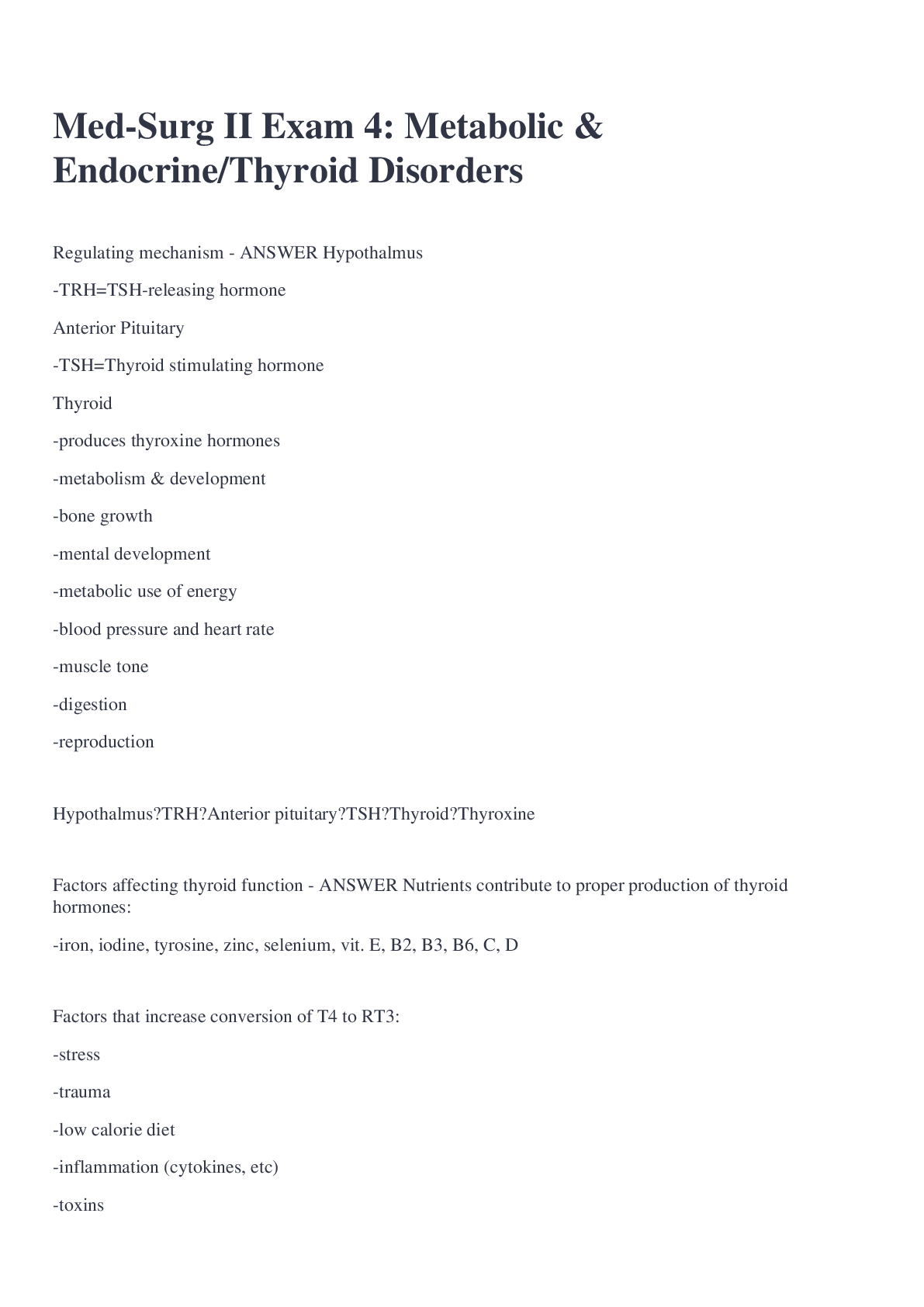
Regulating mechanism - ANSWER Hypothalmus
-TRH=TSH-releasing hormone
Anterior Pituitary
-TSH=Thyroid stimulating hormone
Thyroid
-produces thyroxine hormones
-metabolism & development
-bone growth
-ment
...
Regulating mechanism - ANSWER Hypothalmus
-TRH=TSH-releasing hormone
Anterior Pituitary
-TSH=Thyroid stimulating hormone
Thyroid
-produces thyroxine hormones
-metabolism & development
-bone growth
-mental development
-metabolic use of energy
-blood pressure and heart rate
-muscle tone
-digestion
-reproduction
Hypothalmus→TRH→Anterior pituitary→TSH→Thyroid→Thyroxine
Factors affecting thyroid function - ANSWER Nutrients contribute to proper production of thyroid hormones:
-iron, iodine, tyrosine, zinc, selenium, vit. E, B2, B3, B6, C, D
Factors that increase conversion of T4 to RT3:
-stress
-trauma
-low calorie diet
-inflammation (cytokines, etc)
-toxins
-infections
-liver/kidney dysfunction
-certain medications
Factors that inhibit proper production of thyroid hormones
-stress
-infection, trauma, radiation, medications
-fluoride (antagonist to iodine)
-toxins: pesticides, mercury, cadmium, lead
-autoimmune disease: celiac
Factors that increase conversion of T4 to T3
-Selenium
-zinc
Factors that improve sensitivity to thyroid hormones
-vitamin A
-exercise
-zinc
Hyperthyroidism Manifestations - ANSWER -intolerance to heat
-fine, straight hair
-bulging eyes
-facial flushing
-enlarged thyroid
-tachycardia
-↑ systolic BP
-breast enlargement
-weight loss
-muscle wasting
-localized edema
-menstrual Δ's (amenorrhea)
-tremors
-diarrhea
-finger clubbing
Graves' Disease - ANSWER -most common cause of hyperthyroidism
-toxic diffuse goiter
-autoimmune disorder
-antibodies attach to TSH receptors
-thyroid gland increases number and size of glandular cells
-enlarges gland, forms goiter, and overproduces thyroid hormones (thyrotoxicosis)
-can occur at any age
-most often women between 20 & 40 years
-women 10X more often than men
Graves' Disease Sx's - ANSWER -sweating
-exopthalmos
-goiter
-arrythmia and tachycardia
-nausea and diarrhea
-oligomenorrhea in females
-muscle weakness
-tremor
-headache
-weight loss
-nervousness
-emotional instability
Management of hyperthyroidism - ANSWER Beta-Blockers - Order of administration: 1
-decreases sympathetic hyperactivity
-partially blocks peripheral conversion of T4 to T3 (propranolol)
Propylthiouracil (PTU) - Order of administration: 2
-blocks synthesis of thyroid hormone
-decreases conversion of T4 to T3
-faster onset of action than methimazole
-preferred in pregnancy
Methimazone - Order of administration: 2
-Blocks synthesis of thyroid hormone
-teratogenic
Iodide - Order of administration: 3 or 4
-inhibits release of stored thyroid hormone
-Administer only after synthetic pathway has been bloked by PTU or Methimazole.
Steroids - Order of administration: 3 or 4
-decrease peripheral conversion of T4 to T3
-may treat the auto-immune process in Graves' disease.
Diagnostic criteria for Thyroid Storm - ANSWER Thermoregulatory Dysfunction
- 99-99.9° F (37.2-37.7° C) = 5
- 100-100.9°F (37.8-38.2° C) = 10
- 101-101.9°F (38.3-38.8° C) = 15
- 102-102.9°F (38.9-39.3° C) = 20
- 103-103.9°F (39.4-39.9° C) = 25
- ≥104°F (40.0°C) = 30
CNS
-agitation = 20
-delerium, psycosis, lethargy = 30
-seizure, coma = 40
GI/Hepatic Dysfunction
-diarrhea, N/V, abd. pain = 10
-severe jaundice = 20
Tachycardia
- 99-109 bpm = 5
- 110-119 bpm = 10
- 120-129 bpm = 15
- 130-139 bpm = 20
- ≥ 140 bpm = 25
Congestive Heart Failure
-pedal edema = 5
-bibasal rales = 10
-pulmonary edema = 15
-atrial fibrillation present = 10
-precipitant history present = 10
**A score ≥45 is highly suggestive of thyroid storm; 25-44 supports the diagnosis, <25 marks thyroid storm unlikely**
Precipitants of thyroid storm - ANSWER Medical
-infection/sepsis
-CVA
-MI
-CHF
-pulmonary embolism
-visceral infarction
-emotional stress
-acute manic crisis
Trauma
-thyroid surgery
-non-thyroid surgery
-blunt and penetrating trauma to the thyroid gland
-vigerous palpation of the thyroid gland
-burns
Endocrine
-Hypoglycemia
-DKA
-Hyperosmolar nonketotic coma
Drug-Related
-Iodine 131 therapy
-premature withdrawal of antithyroid therapy
-ingestion of thyroid hormone
-iodinated contrast agents
-Amiodarone therapy
-Iodine ingestion
-anesthesia induction
-misc. drugs: chemotherapy, pseudophedrine, organophosphates, aspirin
Pregnancy-Related
-toxemia of pregnancy
-hyperemesis gravidarum
-parturition and the immediate post-partum period
Treatment of thyroid storm - ANSWER Step 1: Block peripheral effect of thyroid hormone
-IV beta-blocker
Step 2: Stop the production of thyroid hormone
-PTU or Methimazole
-Dexamethasone or Hydrocortisone
Step 3: Inhibit hormone release
-Iodine 2-3 hours after anti-thyroid medication
Thyroid storm causes - ANSWER -Surgery
-Radioactive Iodine Therapy
-Severe illness
Thyroid storm diagnosis - ANSWER Clinical
-tachycardia
-hyperpyrexia
-thyrotoxicosis Sx's
Labs
-↓ TSH
-↑ T4
- FT4
Thyroid storm treatment - ANSWER -Propranolol IV vs. Verapamil IV
-PTU, Methimazole
-Sodium Iodide
-Acetominophen, cooling blankets
-Plasmapharesis (rare)
-Surgical (rare)
Hypothyroidism - ANSWER -occurs most often in women 30 to 60 y/o
-women affected 7 to 10X more than men
-incidence increases with age
-most cases from:
-thyroid surgery
-radioactive iodine treatment
-association between development of hypothyroidism and DM
-Three types:
-Primary - Disease of the thyroid
-Secondary - Disease of the pituitary
-Tertiary - Disease of the hypothalmus
Hypothyroidism Manifestations - ANSWER -intolerance to cold
-receding hairline
-facial & eyelid edema
-dull-blank expression
-extreme fatigue
-thick tongue, slow speech.
-anorexia
-brittle hair and nails
-menstrual disturbances
-constipation
-muscle aches and weakness
-dry skin - coarse & scaly
-lethargy
-apathy
-hair loss
Late clinical manifestations:
-subnormal temp
-bradycardia
-weight gain
-↓ LOC
-thickened skin
-cardiac complications
Thyroid Function Test Expectations for Hypothyroidism - ANSWER Serum T3 → decreased
Serum T4 → decreased
Free T4 Index →decreased
T3 Resin uptake→decreased
TSH → low in secondary or tertiary disease
TSH → high in primary disease
Hypothyroidism Diagnosis - ANSWER Normal thyroid state
TSH = 0.4-4.0 mlU/L
Free T4 = 0.8-2.7mg/dL
Primary hypothyroidism
TSH = >4.0 mlU/L
Free T4 = Decreased
Subclinical hypothyroidism
TSH = >5.0-10.0 mlU/L
Free T4 = Normal
Hypothyroidism Causes - ANSWER -Hashimoto's Thyroiditis - # 1 cause (auto-immune)
-Iodine deficiency (may be present in the developing world and developed world)
-incidence reduced w/the use of iodanted salt
-Congenital absence of thyroid
-Congenital enzyme defect of thyroid
-Post-ablative (RAI or surgery)
-Drug induced
-Lithium
-Amiodrone
Hypothyroidism nutritional support - ANSWER -Wild caught fish
-Coconut oil
-Seaweeds
-High fiber foods
-Fruits and vegetables
-Probiotic rich foods
-Sprouted seeds
-Clean water
-Bone broth
Hypothyroidism - Foods to avoid - ANSWER -Cruciferous vegetables
-Gluten
-Fatty foods
-Sugary foods
-Processed foods
-Coffee
Hypothyroidism Interventions - ANSWER -patient education
-drug therapy
-prevention of myxedema coma
-lifelong thyroid hormone replacement
-most common is levothyroxine sodium (Synthroid)
-low dose that is gradually increased
mcg NOT mg
-patient must take according to schedule and as directed
Myxedema coma - ANSWER -rare, serious life-threatening complication of untreated or poorly treated hypothyroidism
-decreased metabolism heart muscle becomes flabby and chamber size increases decreased CO
-decreased perfusion + slowed cellular metabolism = tissue and organ failure
-mortality rate is very high
-can be caused by various events, drugs, or conditions
[Show More]