1-1
Chapter 01
Chemistry: The Science of Change
1. What is a unifying principle that explains a body of experimental observations?
A. Law
B. Hypothesis
C. Theory
D. Phenomena
E. Prediction
Blooms: 2. Understand
...
1-1
Chapter 01
Chemistry: The Science of Change
1. What is a unifying principle that explains a body of experimental observations?
A. Law
B. Hypothesis
C. Theory
D. Phenomena
E. Prediction
Blooms: 2. Understand
Difficulty: Easy
Gradable: automatic
Subtopic: Scientific Method
Topic: Study of Chemistry
2. Which of the following is a tentative explanation for a set of observations?
A. Law
B. Hypothesis
C. Theory
D. Phenomena
E. Prediction
Blooms: 2. Understand
Difficulty: Easy
Gradable: automatic
Subtopic: Scientific Method
Topic: Study of Chemistry
3. What is the term used for findings that are summarized based on a pattern or trend?
A. Law
B. Hypothesis
C. Theory
D. Phenomena
E. Prediction
Blooms: 2. Understand
Difficulty: Easy
Gradable: automatic
Subtopic: Scientific Method
Topic: Study of Chemistry
4. Which of the following activities is not a part of good science?
A. Proposing a theory
B. Developing a hypothesis
C. Making quantitative observations
D. Designing experiments
E. Indulging in speculation
Blooms: 2. Understand
Difficulty: Easy
Gradable: automatic
Subtopic: Scientific Method
Topic: Study of Chemistry
5. Which of the following is a ‘substance’ according to the definition given in your textbook?
A. Air
B. Tap water
C. Sea water
D. Water
E. Toothpaste
Blooms: 3. Apply
Difficulty: Medium
Gradable: automatic
Subtopic: Classification and States of Matter
Subtopic: Properties of Matter
Topic: Study of Chemistry
1-2
6. Which of the following cannot be separated into simpler substances by chemical means?
A. Element
B. Emulsion
C. Compound
D. Homogeneous mixture
E. Heterogeneous mixture
Blooms: 4. Analyze
Difficulty: Medium
Gradable: automatic
Subtopic: Classification and States of Matter
Subtopic: Properties of Matter
Topic: Study of Chemistry
7. If a liquid contains 60% sugar and 40% water throughout its composition then what is it called?
A. Solute
B. Compound
C. Homogeneous mixture
D. Heterogeneous mixture
E. Solvent
Blooms: 4. Analyze
Difficulty: Medium
Gradable: automatic
Subtopic: Classification and States of Matter
Subtopic: Properties of Matter
Topic: Study of Chemistry
8. Which of the following does not have a uniform composition throughout?
A. Element
B. Compound
C. Homogeneous mixture
D. Heterogeneous mixture
E. Solvent
Blooms: 3. Apply
Difficulty: Easy
Gradable: automatic
Subtopic: Classification and States of Matter
Subtopic: Properties of Matter
Topic: Study of Chemistry
9. Which of the following is not an SI base unit?
A. Meter
B. Ampere
C. Second
D. Gram
E. Kelvin
Blooms: 2. Understand
Difficulty: Medium
Gradable: automatic
Subtopic: Measurement (SI Units)
Topic: Study of Chemistry
10. The SI base unit of mass is
A. mg.
B. g.
C. kg.
D. metric ton.
E. lb.
Blooms: 1. Remember
Difficulty: Medium
Gradable: automatic
Subtopic: Measurement (SI Units)
Topic: Study of Chemistry
1-3
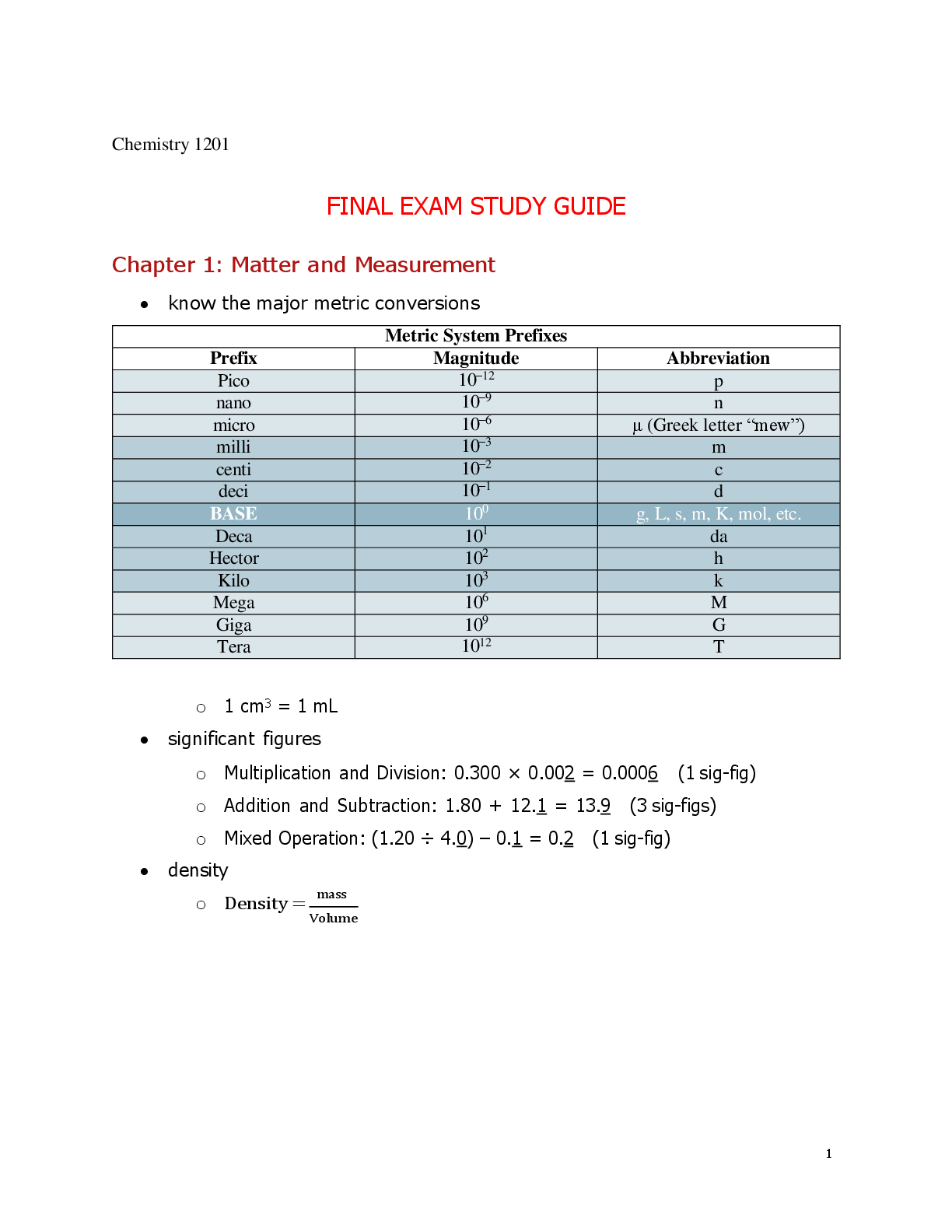
11. The SI prefix mega- (M) means
A. 10–6
B. 10–3
C. 103
D. 106
E. 109
Blooms: 1. Remember
Difficulty: Easy
Gradable: automatic
Subtopic: Measurement (SI Units)
Topic: Study of Chemistry
12. The SI prefixes milli- and mega- represent, respectively
A. 106 and 10–6
B. 10–3 and 106
C. 103 and 10–6
D. 10–3 and 109
E. 10–6 and 10–3
.
Blooms: 1. Remember
Difficulty: Medium
Gradable: automatic
Subtopic: Measurement (SI Units)
Topic: Study of Chemistry
13. How many micrograms are in 65.3 kg?
A. 0.653 μg
B. 6.53 × 10⁷ μg
C. 6.53 × 10⁴ μg
D. 6.53 × 10⁻⁸ μg
E. 6.53 × 10¹⁰ μg
Blooms: 3. Apply
Difficulty: Hard
Gradable: automatic
Subtopic: Dimensional Analysis
Subtopic: Measurement (SI Units)
Subtopic: Scientific Notation and Significant Figures
Topic: Study of Chemistry
14. A dose of medication was prescribed to be 35 microliters. Which of the following expresses that volume in centiliters?
A. 3.5 × 10⁵ cL
B. 3.5 × 10⁴ cL
C. 3.5 cL
D. 3.5 × 10⁻⁴ cL
E. 3.5 × 10⁻³ cL
Blooms: 3. Apply
Difficulty: Hard
Gradable: automatic
Subtopic: Dimensional Analysis
Subtopic: Measurement (SI Units)
Subtopic: Scientific Notation and Significant Figures
Topic: Study of Chemistry
15. How many milliliters is 0.0055 L?
A. 0.55 mL
B. 5.5 mL
C. 0.5 mL
D. 0.0000055 mL
E. 182 mL
Blooms: 3. Apply
Difficulty: Medium
Gradable: automatic
Subtopic: Dimensional Analysis
Subtopic: Measurement (SI Units)
Subtopic: Scientific Notation and Significant Figures
Topic: Study of Chemistry
1-4
16. How many hertz is 600.11 MHz?
A. 6.0011 × 10⁻⁴ Hz
B. 60.011 Hz
C. 6.0011 × 10⁶ Hz
D. 6.0011 × 10⁻² Hz
E. 6.0011 × 10⁸ Hz
Blooms: 3. Apply
Difficulty: Medium
Gradable: automatic
Subtopic: Dimensional Analysis
Subtopic: Measurement (SI Units)
Subtopic: Scientific Notation and Significant Figures
Topic: Study of Chemistry
17. The distance between carbon atoms in ethylene is 134 picometers. Which of the following expresses that distance in
meters?
A. 1.34 × 10⁻¹³ m
B. 1.34 × 10⁻¹² m
C. 1.34 × 10⁻¹⁰ m
D. 1.34 × 10⁻⁷ m
E. 1.34 × 10⁻⁶ m
Blooms: 3. Apply
Difficulty: Medium
Gradable: automatic
Subtopic: Dimensional Analysis
Subtopic: Measurement (SI Units)
Subtopic: Scientific Notation and Significant Figures
Topic: Study of Chemistry
18. Which of these quantities represents the largest mass?
A. 2.0 × 10² mg
B. 0.0010 kg
C. 1.0 × 10⁵ μg
D. 2.0 × 10² cg
E. 10.0 dg
Blooms: 4. Analyze
Difficulty: Hard
Gradable: automatic
Subtopic: Dimensional Analysis
Subtopic: Measurement (SI Units)
Topic: Study of Chemistry
19. The mass of a sample is 550 milligrams. Which of the following expresses that mass in kilograms?
A. 5.5 × 10⁸ kg
B. 5.5 × 10⁵ kg
C. 5.5 × 10⁻⁴ kg
D. 5.5 × 10⁻⁶ kg
E. 5.5 × 10⁻¹ kg
Blooms: 3. Apply
Difficulty: Hard
Gradable: automatic
Subtopic: Measurement (SI Units)
Subtopic: Scientific Notation and Significant Figures
Topic: Study of Chemistry
20. The average distance between the Earth and the Moon is 240,000 miles. Express this distance in kilometers. (1 mi = 1609
m)
A. 6.1 × 10⁵ km
B. 5.3 × 10⁵ km
C. 3.9 × 10⁵ km
D. 1.5 × 10⁵ km
E. 9.4 × 10⁴ km
Blooms: 3. Apply
Difficulty: Medium
Gradable: automatic
Subtopic: Dimensional Analysis
Subtopic: Measurement (SI Units)
Subtopic: Scientific Notation and Significant Figures
Topic: Study of Chemistry
1-5
21. How many inches are in 382.5 cm? (1 in = 2.54 cm)?
A. 150.6 in
B. 6.641 × 10⁻³ in
C. 151 in
D. 971.6 in
E. 972 in
Blooms: 3. Apply
Difficulty: Medium
Gradable: automatic
Subtopic: Dimensional Analysis
Subtopic: Measurement (SI Units)
Subtopic: Scientific Notation and Significant Figures
Topic: Study of Chemistry
22. How many cubic inches are in 1.00 liter? (1 in = 2.54 cm)
A. 61.0 in3
B. 155 in3
C. 394 in3
D. 1.64 × 10⁴ in3
E. none of them
Blooms: 3. Apply
Difficulty: Hard
Gradable: automatic
Subtopic: Dimensional Analysis
Subtopic: Measurement (SI Units)
Subtopic: Scientific Notation and Significant Figures
Topic: Study of Chemistry
23. How many inches are in 382.5 cm? (1 in = 2.54 cm)
A. 150.6 in
B. 6.641 × 10⁻³ in
C. 151 in
D. 971.6 in
E. 972 in
Blooms: 3. Apply
Difficulty: Medium
Gradable: automatic
Subtopic: Dimensional Analysis
Subtopic: Measurement (SI Units)
Subtopic: Scientific Notation and Significant Figures
Topic: Study of Chemistry
24. Given that 1 inch = 2.54 cm, 1.00 cm3 is equal to
A. 16.4 in3
B. 6.45 in3
C. 0.394 in3
D. 0.155 in3
E. 0.0610 in3
Blooms: 3. Apply
Difficulty: Hard
Gradable: automatic
Subtopic: Dimensional Analysis
Subtopic: Measurement (SI Units)
Subtopic: Scientific Notation and Significant Figures
Topic: Study of Chemistry
25. A large pizza has a diameter of 15 inches. Express this diameter in centimeters. (1 in = 2.54 cm)
A. 38 cm
B. 24 cm
C. 18 cm
D. 9.3 cm
E. 5.9 cm
Blooms: 3. Apply
Difficulty: Medium
Gradable: automatic
Subtopic: Dimensional Analysis
Subtopic: Measurement (SI Units)
Subtopic: Scientific Notation and Significant Figures
Topic: Study of Chemistry
1-6
26. The average distance between the Earth and the Moon is 240,000 miles. Express this distance in meters. (1 mi = 1609 m)
A. 6.1 × 10⁵ m
B. 5.3 × 10⁵ m
C. 3.9 × 10⁸ m
D. 1.5 × 10⁵ m
E. 9.4 × 10⁴ m
Blooms: 3. Apply
Difficulty: Medium
Gradable: automatic
Subtopic: Dimensional Analysis
Subtopic: Measurement (SI Units)
Subtopic: Scientific Notation and Significant Figures
Topic: Study of Chemistry
27. What is the volume in milliliters of a 32.0 fl oz can of juice? (1 fl oz = 29.6 mL)
A. 1.08 mL
B. 947 mL
C. 0.925 mL
D. 0.95 mL
E. 1.1 mL
Blooms: 3. Apply
Difficulty: Medium
Gradable: automatic
Subtopic: Dimensional Analysis
Subtopic: Measurement (SI Units)
Subtopic: Scientific Notation and Significant Figures
Topic: Study of Chemistry
28. How many mm3 are in 16.7 cm3?
A. 1.67 × 10⁻⁵ mm3
B. 1.67 × 10⁻⁸ mm3
C. 1.67 × 107 mm3
D. 1.67 × 104 mm3
E. 1.67 × 10⁻⁴ mm3
Blooms: 3. Apply
Difficulty: Hard
Gradable: automatic
Subtopic: Dimensional Analysis
Subtopic: Measurement (SI Units)
Subtopic: Scientific Notation and Significant Figures
Topic: Study of Chemistry
29. If a patient in the hospital is running a temperature of 39.5°C, what is this in degrees Fahrenheit?
A. 99°F
B. 101.3°F
C. 102.4°F
D. 103.1°F
E. 104°F
Blooms: 3. Apply
Difficulty: Medium
Gradable: automatic
Subtopic: Dimensional Analysis
Subtopic: Measurement (SI Units)
Subtopic: Scientific Notation and Significant Figures
Topic: Study of Chemistry
30. If normal body temperature is 98.6°F then what is this in degrees Celsius?
A. 34°C
B. 35.5°C
C. 36.4°C
D. 37.0°C
E. 38.7°C
Blooms: 3. Apply
Difficulty: Medium
Gradable: automatic
Subtopic: Dimensional Analysis
Subtopic: Measurement (SI Units)
Subtopic: Scientific Notation and Significant Figures
Topic: Study of Chemistry
1-7
31. Express 122.0°F in °C.
A. 50.0°C
B. 64.4°C
C. 67.8°C
D. 162.0°C
E. 219.6°C
Blooms: 3. Apply
Difficulty: Medium
Gradable: automatic
Subtopic: Dimensional Analysis
Subtopic: Measurement (SI Units)
Subtopic: Scientific Notation and Significant Figures
Topic: Study of Chemistry
32. The boiling point for liquid helium is 4.0 K. What is the temperature in degrees Fahrenheit?
A. –452.5°F
B. –498.9°F
C. –237.2°F
D. 131.8°F
E. 530.9°F
Blooms: 3. Apply
Difficulty: Hard
Gradable: automatic
Subtopic: Dimensional Analysis
Subtopic: Measurement (SI Units)
Subtopic: Scientific Notation and Significant Figures
Topic: Study of Chemistry
33. If the temperature is 38.0°F then what is the temperature in kelvins?
A. 3.33 K
B. 100.4 K
C. 276.5 K
D. 311.15 K
E. 235.15 K
Blooms: 3. Apply
Difficulty: Hard
Gradable: automatic
Subtopic: Dimensional Analysis
Subtopic: Measurement (SI Units)
Subtopic: Scientific Notation and Significant Figures
Topic: Study of Chemistry
34. Dry ice (carbon dioxide) changes from a solid to a gas at –78.5°C. What is this temperature in °F?
A. –173°F
B. –12.6°F
C. –109°F
D. –75.6°F
E. None of them is within 2°F of the right answer.
Blooms: 3. Apply
Difficulty: Hard
Gradable: automatic
Subtopic: Dimensional Analysis
Subtopic: Measurement (SI Units)
Subtopic: Scientific Notation and Significant Figures
Topic: Study of Chemistry
35. The boiling point for liquid nitrogen is 77 K. What is the temperature in degrees Fahrenheit?
A. –127°F
B. –289°F
C. –321°F
D. 177°F
E. 662°F
Blooms: 3. Apply
Difficulty: Hard
Gradable: automatic
Subtopic: Dimensional Analysis
Subtopic: Measurement (SI Units)
Subtopic: Scientific Notation and Significant Figures
Topic: Study of Chemistry
[Show More]
![Preview of Chem_All_In_One[ A+ ASSURED]](https://scholarfriends.com/storage/Chem_All_In_One.png)

.png)


![Preview of Test Bank - Maternal Child Nursing Care by Perry[NEWEST,UPDATED,2022/2023]](https://scholarfriends.com/storage/TestBank_Perry_Maternal_Child_Nursing_Care_6th_2017.png)

