Hurst Readiness Exam 3 Questions with Correct
Questions and Complete Solutions
Which menu selection by the client diagnosed with nephrotic syndrome indicates that
teaching of proper diet was understood? You answered t
...
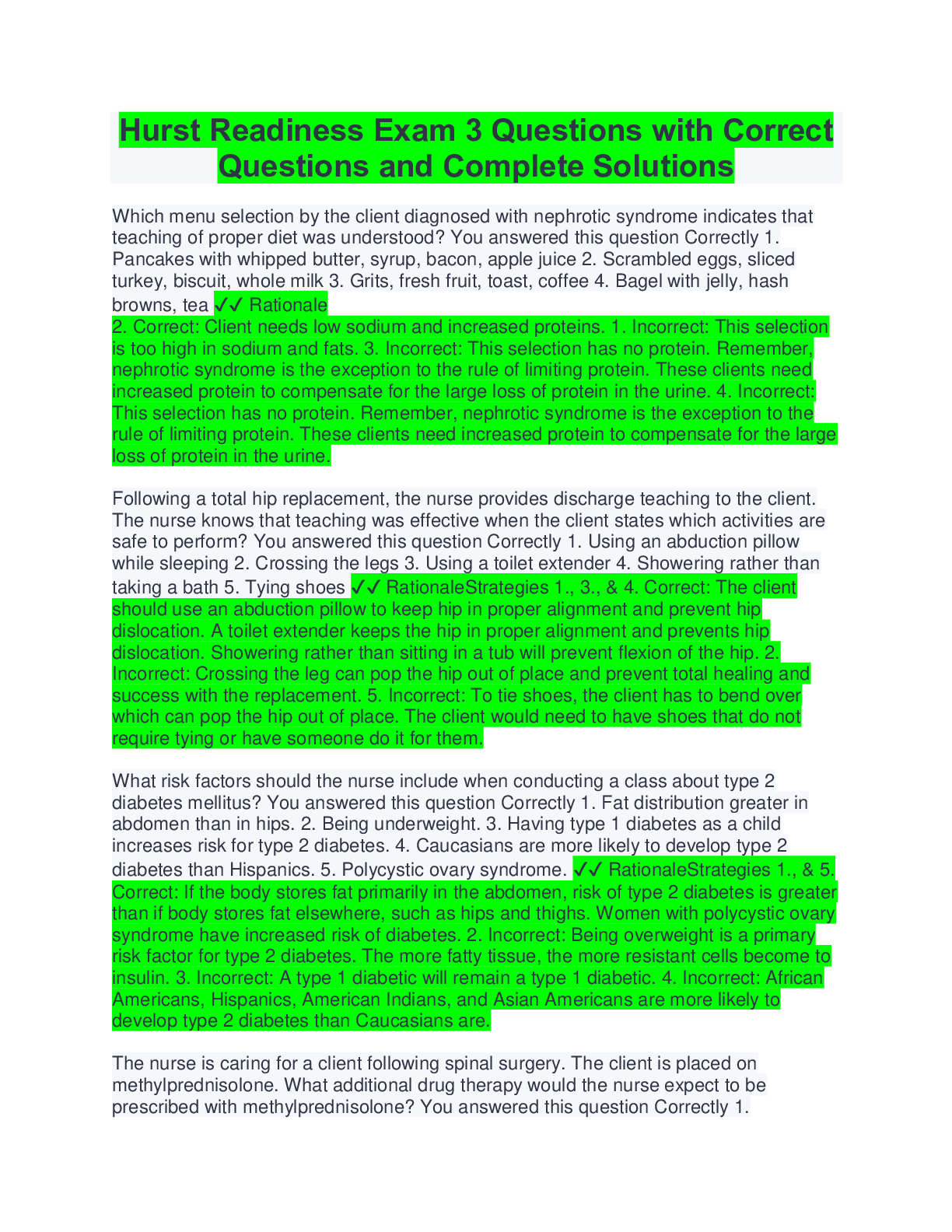
Hurst Readiness Exam 3 Questions with Correct
Questions and Complete Solutions
Which menu selection by the client diagnosed with nephrotic syndrome indicates that
teaching of proper diet was understood? You answered this question Correctly 1.
Pancakes with whipped butter, syrup, bacon, apple juice 2. Scrambled eggs, sliced
turkey, biscuit, whole milk 3. Grits, fresh fruit, toast, coffee 4. Bagel with jelly, hash
browns, tea ✔✔ Rationale
2. Correct: Client needs low sodium and increased proteins. 1. Incorrect: This selection
is too high in sodium and fats. 3. Incorrect: This selection has no protein. Remember,
nephrotic syndrome is the exception to the rule of limiting protein. These clients need
increased protein to compensate for the large loss of protein in the urine. 4. Incorrect:
This selection has no protein. Remember, nephrotic syndrome is the exception to the
rule of limiting protein. These clients need increased protein to compensate for the large
loss of protein in the urine.
Following a total hip replacement, the nurse provides discharge teaching to the client.
The nurse knows that teaching was effective when the client states which activities are
safe to perform? You answered this question Correctly 1. Using an abduction pillow
while sleeping 2. Crossing the legs 3. Using a toilet extender 4. Showering rather than
taking a bath 5. Tying shoes ✔✔ RationaleStrategies 1., 3., & 4. Correct: The client
should use an abduction pillow to keep hip in proper alignment and prevent hip
dislocation. A toilet extender keeps the hip in proper alignment and prevents hip
dislocation. Showering rather than sitting in a tub will prevent flexion of the hip. 2.
Incorrect: Crossing the leg can pop the hip out of place and prevent total healing and
success with the replacement. 5. Incorrect: To tie shoes, the client has to bend over
which can pop the hip out of place. The client would need to have shoes that do not
require tying or have someone do it for them.
What risk factors should the nurse include when conducting a class about type 2
diabetes mellitus? You answered this question Correctly 1. Fat distribution greater in
abdomen than in hips. 2. Being underweight. 3. Having type 1 diabetes as a child
increases risk for type 2 diabetes. 4. Caucasians are more likely to develop type 2
diabetes than Hispanics. 5. Polycystic ovary syndrome. ✔✔ RationaleStrategies 1., & 5.
Correct: If the body stores fat primarily in the abdomen, risk of type 2 diabetes is greater
than if body stores fat elsewhere, such as hips and thighs. Women with polycystic ovary
syndrome have increased risk of diabetes. 2. Incorrect: Being overweight is a primary
risk factor for type 2 diabetes. The more fatty tissue, the more resistant cells become to
insulin. 3. Incorrect: A type 1 diabetic will remain a type 1 diabetic. 4. Incorrect: African
Americans, Hispanics, American Indians, and Asian Americans are more likely to
develop type 2 diabetes than Caucasians are.
The nurse is caring for a client following spinal surgery. The client is placed on
methylprednisolone. What additional drug therapy would the nurse expect to be
prescribed with methylprednisolone? You answered this question Correctly 1.Pantoprazole 2. Phenytoin 3. Imipramine HCI 4. Aminocaproic acid ✔✔
RationaleStrategies 1. Correct: A potential side effect of methylprednisolone is a peptic
ulcer. The primary healthcare provider will prescribe a proton pump inhibitor or H2
blocker to prevent this side effect. 2. Incorrect: Phenytoin is an anticonvulsant. Seizures
are not a side effect of methylprednisolone. 3. Incorrect: Imipramine HCI is an
antidepressant which is not routinely given with methylprednisolone (Although mood
changes can occur with steroid administration, anti-depressants are not routinely given).
4. Incorrect: Aminocaproic acid is given when clients are bleeding. Bleeding is not a
side effect of methylprednisolone.
In what order, after initially washing hands, should the nurse change a dressing on an
infected abdominal surgical wound that has a Penrose drain and a large amount of
purulent drainage? Place in priority order from first to last. You answered this question
CorrectlyThe Correct Order Apply clean gloves. Remove soiled dressings. Discard
soiled dressings and clean gloves in red bag. Don sterile gloves. Clean surgical wound
with moistened sterile 4x4's. Clean around Penrose drain using a circular pattern inside
to outside. Place dry, sterile 4x4's over surgical wound and Penrose drain. Apply
abdominal dressing pad. Your Selected Order Apply clean gloves. Remove soiled
dressings. Discard soiled dressings and clean gloves in red bag. Don sterile gloves.
Clean surgical wound with moistened sterile 4x4's. Clean around Penrose drain using a
circular pattern inside to outside. Place dry, sterile 4x4's over surgical wound and
Penrose drain. Apply abdominal dressing pad. ✔✔ RationaleStrategies First, apply
clean gloves. Second, remove soiled dressings. Third, discard soiled dressings and
clean gloves in red bag. Fourth, don sterile gloves. Fifth, clean surgical wound with
moistened sterile 4x4's. Sixth, clean around Penrose drain using circular pattern inside
to outside. Seventh, place dry, sterile 4x4's over surgical wound and Penrose drain.
Eighth, apply abdominal dressing pad.
A client diagnosed with schizophrenia who is taking monthly haloperidol injections
develops slurred speech, shuffling gait and drooling. Which prescribed PRN medication
would the nurse administer? You answered this question Incorrectly 1. Lorazepam 2.
Atropine 3. Benztropine 4. Chlorpromazine ✔✔ RationaleStrategies 3. Correct: These
signs and symptoms are reflective of pseudoparkinsonism, a form of extrapyramidal
side effects which are side effects of the haloperidol. An anticholinergic agent maybe
used for treatment. This is an anticholinergic agent that may be used for extrapyramidal
side effects. 1. Incorrect: This is a sedative/hypnotic or antianxiety agent. It is not used
for treatment of extrapyramidal side effects. 2. Incorrect: This is an anticholinergic
agent, but not one commonly used to treat pseudoparkinsonism, a form of
extrapyramidal side effects. It is commonly used to treat arrhythmias and preoperatively
to decrease secretions. 4. Incorrect: This is another antipsychotic medication.
A nurse is caring for a client who reports fatigue, weight loss, afternoon fevers, night
sweats, cough, and hemoptysis. What interventions should the nurse initiate? You
answered this question Correctly 1. Wear an N95 respirator when caring for client. 2.
Restrict fluid intake to 500 mL per day. 3. Position client in semi-Fowler's position. 4.
Place client in a negative pressure airflow room. 5. Do not allow visitors for 48 hours.✔✔ RationaleStrategies 1., 3. & 4. Correct: The nurse should suspect that the client is
suffering from tuberculosis. Early pulmonary TB is asymptomatic. When the bacterial
load increases, nonspecific symptoms of fatigue, weight loss, afternoon fevers, and
night sweats may set in. As disease advances, cough, sputum production, and
hemoptysis may appear. This client has the classic symptoms of TB and should be
placed on airborne precautions. N95 respirator ensures that the nurse does not inhale
the TB organism. Placing in a semi-Fowler's position reduces the work of breathing. 2.
Incorrect: Unless contraindicated, 3-4 liters of fluid is needed per day to liquefy
secretions. 5. Incorrect: Visitors are allowed if standard and airborne precautions are
followed.
Which task should the nurse perform first? You answered this question Correctly 1.
Suctioning the tracheostomy. 2. Changing a colostomy bag that is leaking. 3.
Performing an admission assessment on a client. 4. Administering pain medication to a
postoperative client. ✔✔ RationaleStrategies 1. Correct: The tracheostomy tube must
be suctioned to keep the client's airway open. Suctioning the tracheostomy should take
priority. Remember, airway first. 2. Incorrect: The client may be uncomfortable from the
colostomy bag leaking. This task can be delegated. The suctioning of the client does not
have priority over airway. 3. Incorrect: Important, but not priority over airway. There is
no indication from the question that the new client is in distress. The priority intervention
is to maintain the airway. 4. Incorrect: Important, but it does not take priority over
airway.
A nurse is caring for a client hospitalized with Guillain-Barre syndrome. Which is the
most important nursing measure to include in the nursing care plan for this client? You
answered this question Correctly 1. Observation and support of ventilation 2. Insertion
of indwelling urinary catheter 3. Nasogastric suctioning 4. Frequent assessments of
level of consciousness ✔✔ RationaleStrategies 1. Correct: Guillain-Barre syndrome is
an acquired inflammatory disease that results in demyelinization of the peripheral
nerves. It is usually ascending in nature and can lead to respiratory paresis or paralysis.
2. Incorrect: Insertion of an indwelling urinary catheter may in fact be necessary but
does not prioritize higher than support of ventilation. 3. Incorrect: Nasogastric suctioning
is not a need identified with Guillain-Barre syndrome. Guillain-Barre does not affect the
LOC. 4. Incorrect: The client's cognitive function remains intact, and there is no data in
the stem of the question that indicates otherwise; therefore, ventilation is the priority.
[Show More]




 Answered 2023.png)