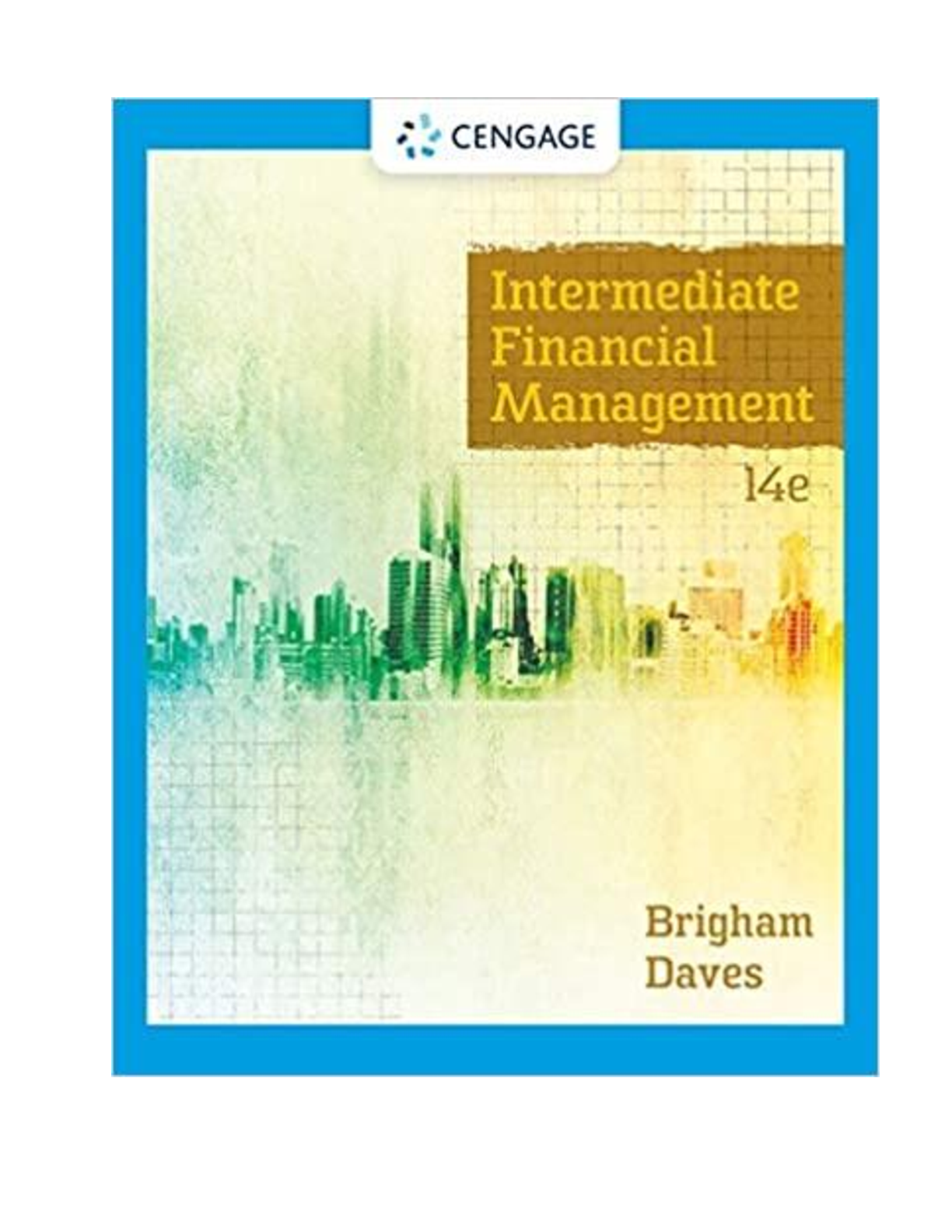
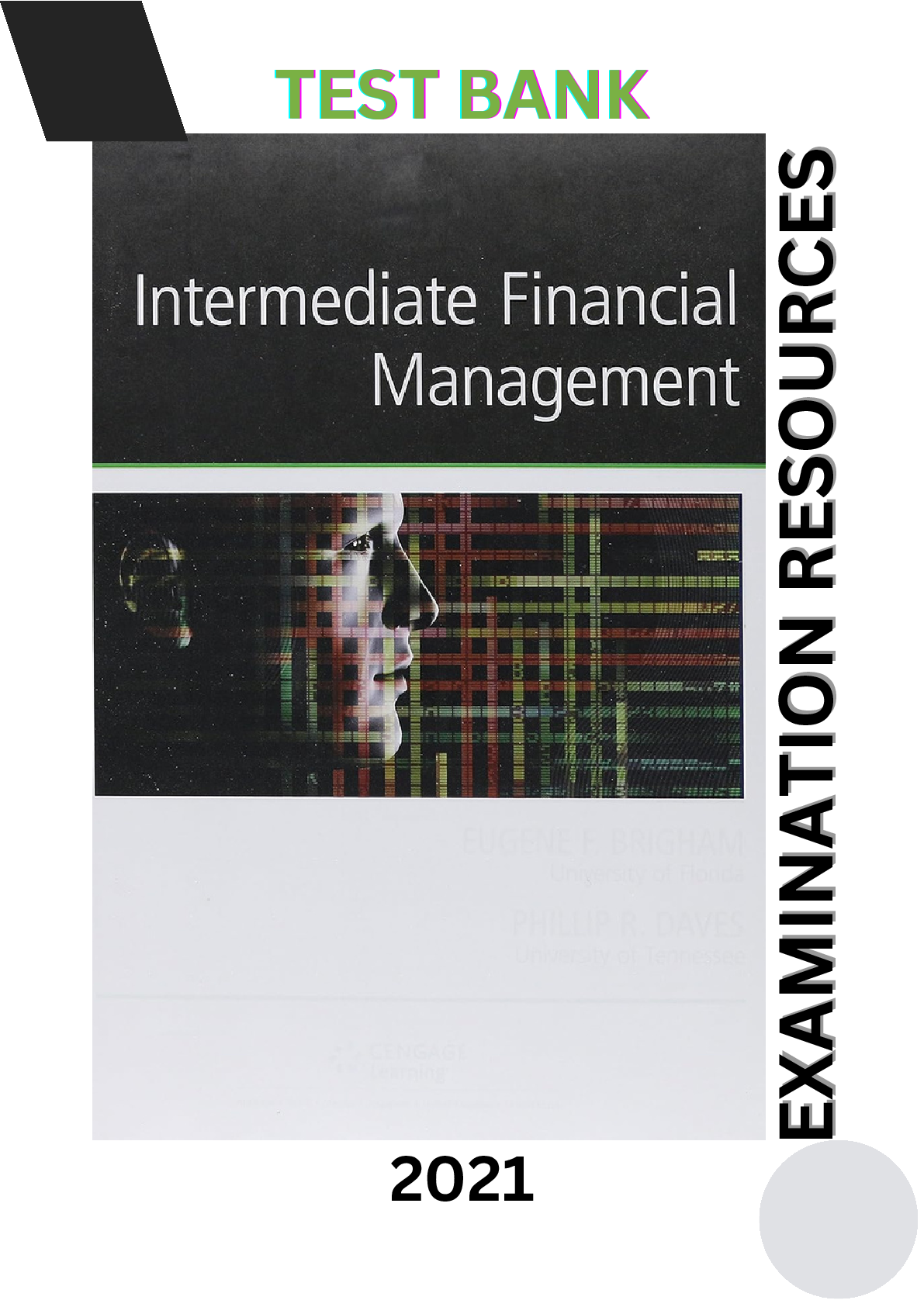
Test Bank for Intermediate Financial Management, 14th Edition, 14e by Eugene F. Brigham, Phillip R. Daves TEST BANK
ISBN-13: 9780357516775
FULL CHAPTERS INCLUDED
Chapter 1: An Overview of Financial Management and
...
Test Bank for Intermediate Financial Management, 14th Edition, 14e by Eugene F. Brigham, Phillip R. Daves TEST BANK
ISBN-13: 9780357516775
FULL CHAPTERS INCLUDED
Chapter 1: An Overview of Financial Management and the Financial Environment
1.1: Introduction
1.2: How to Use This Text
1.3: The Corporate Life Cycle
1.4: Governing a Corporation
1.5: An Overview of Financial Markets
1.6: Claims on Future Cash Flows: Types of Financial Securities
1.7: Claims on Future Cash Flows: The Required Rate of Return (the Cost of Money)
1.8: The Functions of Financial Institutions
1.9: Financial Markets
1.10: Overview of the U.S. Stock Markets
1.11: Trading in the Modern Stock Markets
1.12: Finance and the Great Recession of 2007
1.13: The Big Picture
1.14: e-Resources
Chapter 2: Risk and Return: Part I
2.1: Investment Returns and Risk
2.2: Measuring Risk for Discrete Distributions
2.3: Risk in a Continuous Distribution
2.4: Using Historical Data to Estimate Risk
2.5: Risk in a Portfolio Context
2.6: The Relevant Risk of a Stock: The Capital Asset Pricing Model (CAPM)
2.7: The Relationship between Risk and Return in the Capital Asset Pricing Model
2.8: The Efficient Markets Hypothesis
2.9: The Fama-French Three-Factor Model
2.10: Behavioral Finance
2.11: The CAPM and Market Efficiency: Implications for Corporate Managers and Investors
Chapter 3: Risk and Return: Part II
3.1: Efficient Portfolios
3.2: Choosing the Optimal Portfolio
3.3: The Basic Assumptions of the Capital Asset Pricing Model
3.4: The Capital Market Line and the Security Market Line
3.5: Calculating Beta Coefficients
3.6: Empirical Tests of the CAPM
3.7: Arbitrage Pricing Theory
Chapter 4: Bond Valuation
4.1: Who Issues Bonds?
4.2: Key Characteristics of Bonds
4.3: Bond Valuation
4.4: Changes in Bond Values over Time
4.5: Bonds with Semiannual Coupons
4.6: Bond Yields
4.7: The Pre-Tax Cost of Debt: Determinants of Market Interest Rates
4.8: The Risk-Free Interest Rate: Nominal (r) and Real (r*)
4.9: The Inflation Premium (IP)
4.10: The Maturity Risk Premium (MRP)
4.11: The Default Risk Premium (DRP)
4.12: The Liquidity Premium (LP)
4.13: The Term Structure of Interest Rates
4.14: Financing with Junk Bonds
4.15: Bankruptcy and Reorganization
Chapter 5: Financial Options
5.1: Overview of Financial Options
5.2: The Single-Period Binomial Option Pricing Approach
5.3: The Single-Period Binomial Option Pricing Formula
5.4: The Multi-Period Binomial Option Pricing Model
5.5: The Black-Scholes Option Pricing Model (OPM)
5.6: The Valuation of Put Options
5.7: Applications of Option Pricing in Corporate Finance
Chapter 6: Accounting for Financial Management
6.1: Financial Statements and Reports
6.2: The Balance Sheet
6.3: The Income Statement
6.4: Statement of Stockholders’ Equity
6.5: Statement of Cash Flows
6.6: Net Cash Flow
6.7: Free Cash Flow: The Cash Flow Available for Distribution to Investors
6.8: Performance Evaluation
6.9: Corporate Income Taxes
6.10: Personal Taxes
Chapter 7: Analysis of Financial Statements
7.1: Financial Analysis
7.2: Profitability Ratios
7.3: Asset Management Ratios
7.4: Liquidity Ratios
7.5: Debt Management Ratios
7.6: Market Value Ratios
7.7: Trend Analysis, Common Size Analysis, and Percentage Change Analysis
7.8: Tying the Ratios Together: The DuPont Equation
7.9: Comparative Ratios and Benchmarking
7.10: Uses and Limitations of Ratio Analysis
7.11: Looking Beyond the Numbers
Part 2: Corporate Valuation
Chapter 8: Corporate Valuation and Stock Valuation
8.1: Legal Rights and Privileges of Common Stockholders
8.2: Classified Stock and Tracking Stock
8.3: Stock Market Reporting
8.4: Valuing Common Stocks-Introducing the Free Cash Flow (FCF) Valuation Model
8.5: The Constant Growth Model: Valuation When Expected Free Cash Flow Grows at a Constant Rate
8.6: The Multistage Model: Valuation When Expected Short-Term Free Cash Flow Grows at a Nonconstant
8.7: Application of the FCF Valuation Model to MicroDrive
8.8: Do Stock Values Reflect LongTerm or Short-Term Cash Flows?
8.9: Value-Based Management: Using the Free Cash Flow Valuation Model to Identify Value Drivers
8.10: Why Are Stock Prices So Volatile?
8.11: Dividend Valuation Models
8.12: The Market Multiple Method
8.13: Comparing the FCF Valuation Model, the Dividend Growth Model, and the Market Multiple Method
1.14: Preferred Stock
Chapter 9: Corporate Valuation and Financial Planning
9.1: Overview of Financial Planning
9.2: Financial Planning at MicroDrive Inc.
9.3: Forecasting Operations
9.4: Evaluating MicroDrive’s Strategic Initiatives
9.5: Projecting MicroDrive’s Financial Statements
9.6: Analysis and Selection of a Strategic Plan
9.7: The CFO’s Model
9.8: Additional Funds Needed (AFN) Equation
9.9: Forecasting When the Ratios Change
Chapter 10: Corporate Governance
10.1: Agency Conflicts
10.2: Corporate Governance
10.3: Employee Stock Ownership Plans (ESOPs)
Chapter 11: The Cost of Capital
11.1: The Weighted Average Cost of Capital
11.2: Choosing Weights for the Weighted Average Cost of Capital
11.3: The Cost of Debt
11.4: Cost of Preferred Stock, r
11.5: Cost of Common Stock: The Market Risk Premium, RP
11.6: Using the CAPM to Estimate the Cost of Common Stock, r
11.7: Using the Dividend Growth Approach to Estimate the Cost of Common Stock
11.8: The Weighted Average Cost of Capital (WACC)
11.9: Adjusting the Cost of Equity for Flotation Costs
11.10: Privately Owned Firms and Small Businesses
11.11: The Divisional Cost of Capital
11.12: Estimating the Cost of Capital for Individual Projects
11.13: Managerial Issues and the Cost of Capital
Part 3: Project Valuation
Chapter 12: Capital Budgeting: Decision Criteria
12.1: An Overview of Capital Budgeting
12.2: The First Step in Project Analysis
12.3: Net Present Value (NPV)
12.4: Internal Rate of Return (IRR)
12.5: Modified Internal Rate of Return (MIRR)
12.6: Profitability Index (PI)
12.7: Payback Period
12.8: How to Use the Different Capital Budgeting Methods
12.9: Other Issues in Capital Budgeting
Chapter 13: Capital Budgeting: Estimating Cash Flows and Analyzing Risk
13.1: Identifying Relevant Cash Flows
13.2: Analysis of an Expansion Project
13.3: Risk Analysis in Capital Budgeting
13.4: Measuring Stand-Alone Risk
13.5: Sensitivity Analysis
13.6: Scenario Analysis
13.7: Monte Carlo Simulation Analysis
13.8: Project Risk Conclusions
13.9: Replacement Analysis
13.10: Phased Decisions and Decision Trees
13.11: Other Real Options
Chapter 13A: Depreciation for Tax Purposes
Chapter 14: Real Options
14.1: Valuing Real Options
14.2: The Investment Timing Option: An Illustration
14.3: The Growth Option: An Illustration
14.4: Concluding Thoughts on Real Options
Part 4: Strategic Financing Decisions
Chapter 15: Distributions to Shareholders: Dividends and Repurchases
15.1: An Overview of Cash Distributions
15.2: Procedures for Cash Distributions
15.3: Cash Distributions and Firm Value
15.4: Clientele Effect
15.5: Signaling Hypothesis
15.6: Implications for Dividend Stability
15.7: Setting the Target Distribution Level: The Residual Distribution Model
15.8: The Residual Distribution Model in Practice
15.9: A Tale of Two Cash Distributions: Dividends versus Stock Repurchases
15.10: The Pros and Cons of Dividends and Repurchases
15.11: Other Factors Influencing Distributions
15.12: Summarizing the Distribution Policy Decision
15.13: Stock Splits and Stock Dividends
15.14: Dividend Reinvestment Plans
Chapter 16: Capital Structure Decisions
16.1: An Overview of Capital Structure
16.2: Business Risk and Financial Risk
16.3: Capital Structure Theory: The Modigliani and Miller Models
16.4: Capital Structure Theory: Beyond the Modigliani and Miller Models
16.5: Capital Structure Evidence and Implications
16.6: Estimating the Optimal Capital Structure
16.7: Anatomy of a Recapitalization
16.8: Risky Debt and Equity as an Option
16.9: Managing the Maturity Structure of Debt
Chapter 17: Dynamic Capital Structures and Corporate Valuation
17.1: The Adjusted Present Value (APV) Approach
17.2: The Modigliani and Miller Models
17.3: The Compressed Adjusted Present Value (CAPV) Model
17.4: The Free Cash Flow to Equity (FCFE) Model
17.5: Multistage Valuation When the Capital Structure Is Stable
17.6: Illustration of the Three Valuation Approaches for a Constant Capital Structure
17.7: Analysis of a Dynamic Capital Structure
Part 5: Tactical Financing Decisions
Chapter 18: Initial Public Offerings, Investment Banking, and Financial Restructuring
18.1: The Financial Life Cycle of a Start-Up Company
18.2: The Decision to Go Public
18.3: The Process of Going Public: An Initial Public Offering
18.4: Equity Carve-Outs: A Special Type of IPO
18.5: Other Ways to Raise Funds in the Capital Markets
18.6: Investment Banking Activities
18.7: The Decision to Go Private
Chapter 19: Lease Financing
19.1: Types of Leases
19.2: Reporting Leases on Financial Statements
19.3: Lease Analysis: Determination of Tax Status by the Internal Revenue Service (IRS)
19.4: Lease Analysis: Non-TaxOriented Leases
19.5: Lease Analysis: Tax-Oriented Lease
19.6: Evaluation by the Lessor
19.7: Leases, Taxes, and the 2017 Tax Cuts and Jobs Act
19.8: Other Issues in Lease Analysis
19.9: Other Reasons for Leasing
Chapter 20: Hybrid Financing: Preferred Stock, Warrants, and Convertibles
20.1: Preferred Stock
20.2: Warrants
20.3: Convertible Securities
20.4: A Final Comparison of Warrants and Convertibles
20.5: Reporting Earnings When Warrants or Convertibles Are Outstanding
Part 6: Working Capital Management
Chapter 21: Supply Chains and Working Capital Management
21.1: Overview of Supply Chain Management
21.2: Using and Financing Operating Current Assets
21.3: The Cash Conversion Cycle
21.4: Inventory Management
21.5: Receivables Management
21.6: Accruals and Accounts Payable (Trade Credit)
21.7: The Cash Budget
21.8: Cash Management and the Target Cash Balance
21.9: Cash Management Techniques
21.10: Managing Short-Term Investments
21.11: Short-Term Bank Loans
21.12: Commercial Paper
21.13: Use of Security in Short-Term Financing
Chapter 22: Providing and Obtaining Credit
22.1: Credit Policy
22.2: Monitoring Receivables with the Uncollected Balances Schedule
22.3: Analyzing Proposed Changes in Credit Policy
22.4: Analyzing Proposed Changes in Credit Policy: Incremental Analysis
22.5: The Cost of Bank Loans
22.6: Choosing a Bank
Chapter 23: Other Topics in Working Capital Management
23.1: The Concept of Zero Working Capital
23.2: Setting the Target Cash Balance
23.3: Inventory Control Systems
23.4: Accounting for Inventory
23.5: The Economic Ordering Quantity (EOQ) Model
23.6: EOQ Model Extensions
Part 7: Special Topics
Chapter 24: Enterprise Risk Management
24.1: Reasons to Manage Risk
24.2: An Overview of Enterprise Risk Management
24.3: A Framework for Enterprise Risk Management
24.4: Categories of Risk Events
24.5: Foreign Exchange (FX) Risk
24.6: Commodity Price Risk
24.7: Interest Rate Risk
24.8: Project Selection Risks
24.9: Managing Credit Risks
24.10: Risk and Human Safety
Chapter 25: Bankruptcy, Reorganization, and Liquidation
25.1: Financial Distress and Its Consequences
25.2: Issues Facing a Firm in Financial Distress
25.3: Settlements without Going through Formal Bankruptcy
25.4: Federal Bankruptcy Law
25.5: Reorganization in Bankruptcy (Chapter 11 of Bankruptcy Code)
25.6: Liquidation in Bankruptcy
25.7: Anatomy of a Bankruptcy: Transforming the GM Corporation into the GM
25.8: Other Motivations for Bankruptcy
25.9: Some Criticisms of Bankruptcy Laws
Chapter 26: Mergers and Corporate Control
26.1: Rationale for Mergers
26.2: Types of Mergers: Business Types, Acquisition Methods, and Hidden Liabilities
26.3: Level of Merger Activity
26.4: Hostile versus Friendly Takeovers
26.5: Merger Regulation
26.6: Overview of Merger Analysis
26.7: Estimating a Target’s Value
26.8: Setting the Bid Price
26.9: Who Wins: The Empirical Evidence
26.10: The Role of Investment Bankers
26.11: Other Business Combinations
26.12: Divestitures
26.13: Merger Tax Treatments
26.14: Financial Reporting for Mergers
Chapter 27: Multinational Financial Management*
27.1: Multinational, or Global, Corporations
27.2: Multinational versus Domestic Financial Management
27.3: Exchange Rates
27.4: The Fixed Exchange Rate System
27.5: Floating Exchange Rates
27.6: Government Intervention in Foreign Exchange Markets
27.7: Other Exchange Rate Systems: No Local Currency, Pegged Rates, and Managed Floating Rates
27.8: Forward Exchange Rates and Risk Management
27.9: Interest Rate Parity
27.10: Purchasing Power Parity
27.11: Inflation, Interest Rates, and Exchange Rates
27.12: International Money and Capital Markets
27.13: Multinational Capital Budgeting
27.14: International Capital Structures
27.15: Multinational Working Capital Management
[Show More]