Which ocular emergency requires the most emergent management?
A. Radiation burn
B. Chemical burn
C. Acute angle-closure glaucoma
D. Central retinal artery occlusion Correct Answers Your correct answer: D A chemical
...
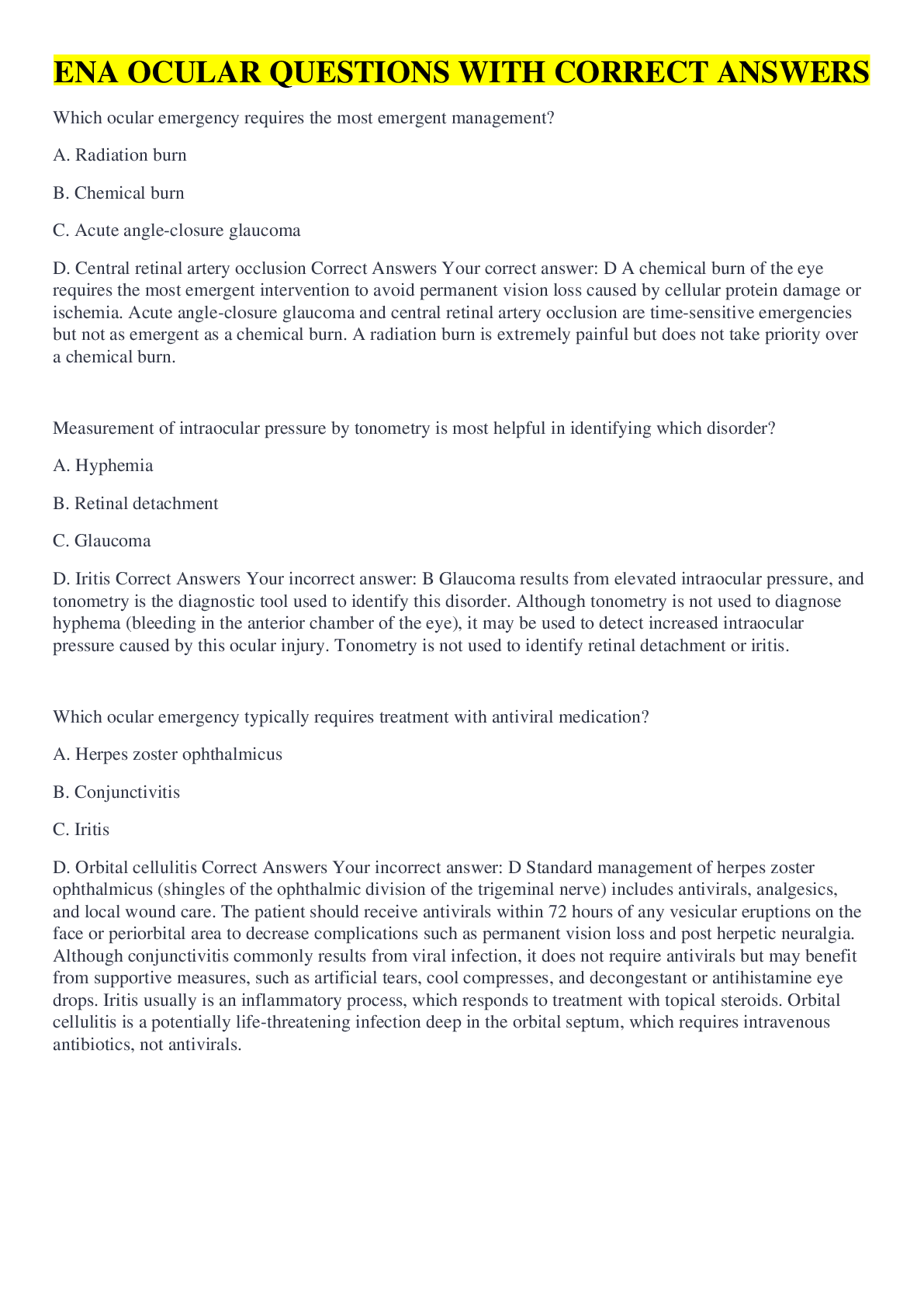
Which ocular emergency requires the most emergent management?
A. Radiation burn
B. Chemical burn
C. Acute angle-closure glaucoma
D. Central retinal artery occlusion Correct Answers Your correct answer: D A chemical burn of the eye requires the most emergent intervention to avoid permanent vision loss caused by cellular protein damage or ischemia. Acute angle-closure glaucoma and central retinal artery occlusion are time-sensitive emergencies but not as emergent as a chemical burn. A radiation burn is extremely painful but does not take priority over a chemical burn.
Measurement of intraocular pressure by tonometry is most helpful in identifying which disorder?
A. Hyphemia
B. Retinal detachment
C. Glaucoma
D. Iritis Correct Answers Your incorrect answer: B Glaucoma results from elevated intraocular pressure, and tonometry is the diagnostic tool used to identify this disorder. Although tonometry is not used to diagnose hyphema (bleeding in the anterior chamber of the eye), it may be used to detect increased intraocular pressure caused by this ocular injury. Tonometry is not used to identify retinal detachment or iritis.
Which ocular emergency typically requires treatment with antiviral medication?
A. Herpes zoster ophthalmicus
B. Conjunctivitis
C. Iritis
D. Orbital cellulitis Correct Answers Your incorrect answer: D Standard management of herpes zoster ophthalmicus (shingles of the ophthalmic division of the trigeminal nerve) includes antivirals, analgesics, and local wound care. The patient should receive antivirals within 72 hours of any vesicular eruptions on the face or periorbital area to decrease complications such as permanent vision loss and post herpetic neuralgia. Although conjunctivitis commonly results from viral infection, it does not require antivirals but may benefit from supportive measures, such as artificial tears, cool compresses, and decongestant or antihistamine eye drops. Iritis usually is an inflammatory process, which responds to treatment with topical steroids. Orbital cellulitis is a potentially life-threatening infection deep in the orbital septum, which requires intravenous antibiotics, not antivirals.
In a patient with an ocular chemical burn, visual acuity should be assessed after which activity has been performed? A. Evaluation by an ophthalmologistB. Copious irrigationC. Application of bilateral eye patchesD. Administration of ophthalmic antibiotic ointment Correct Answers Your correct answer: B A chemical burn of the eye is a vision-threatening emergency that requires immediate, copious irrigation. After irrigation, the patient should receive a thorough eye examination, including a visual acuity assessment. After irrigation and a thorough eye
[Show More]