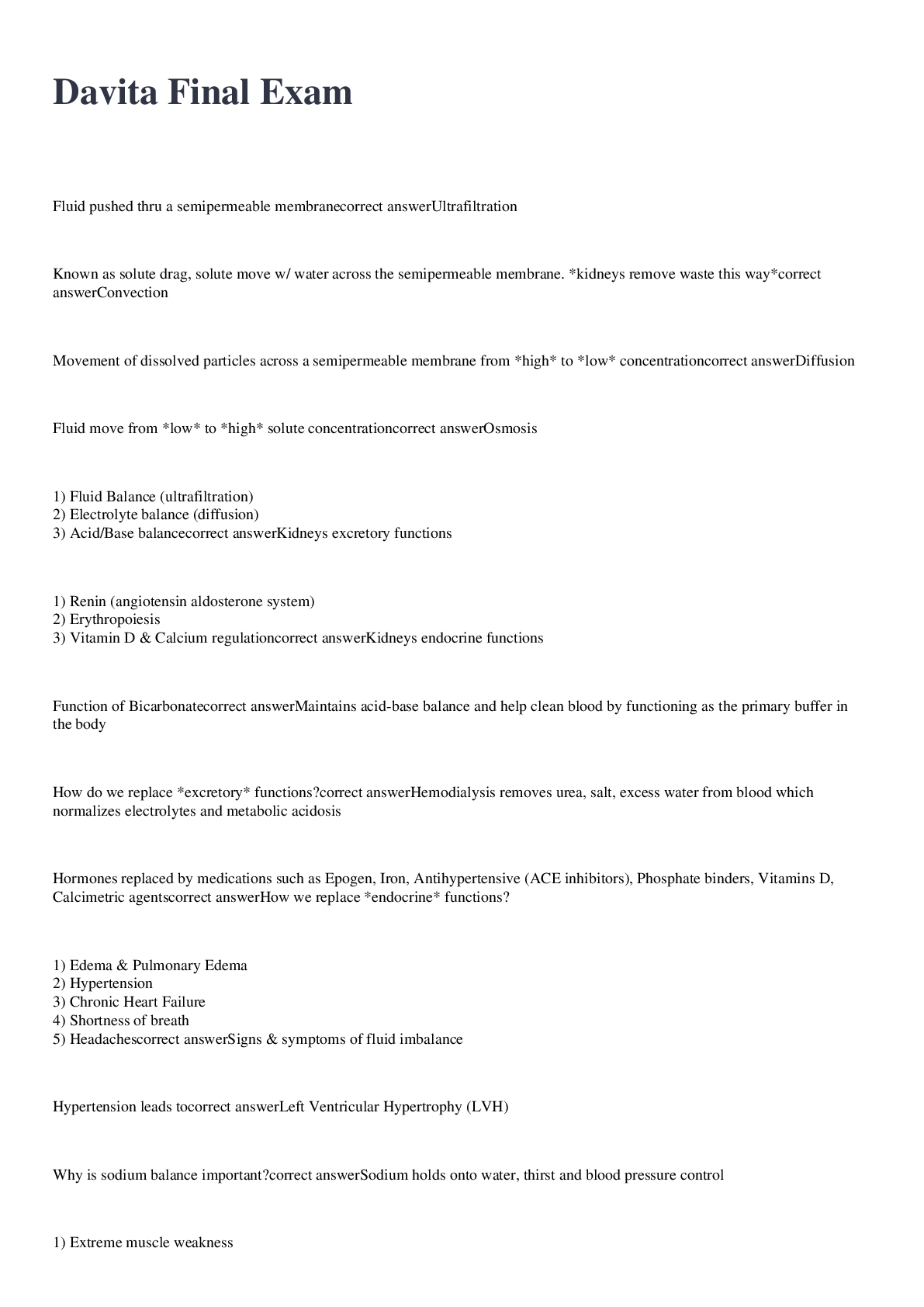
Fluid pushed thru a semipermeable membrane
Ultrafiltration
Known as solute drag, solute move w/ water across the semipermeable membrane. kidneys remove waste this way
Convection
Movement of dissolved part
...
Fluid pushed thru a semipermeable membrane
Ultrafiltration
Known as solute drag, solute move w/ water across the semipermeable membrane. kidneys remove waste this way
Convection
Movement of dissolved particles across a semipermeable membrane from high to low concentration
Diffusion
Fluid move from low to high solute concentration
Osmosis
1) Fluid Balance (ultrafiltration)
2) Electrolyte balance (diffusion)
3) Acid/Base balance
Kidneys excretory functions
1) Renin (angiotensin aldosterone system)
2) Erythropoiesis
3) Vitamin D & Calcium regulation
Kidneys endocrine functions
Function of Bicarbonate
Maintains acid-base balance and help clean blood by functioning as the primary buffer in the body
How do we replace excretory functions?
Hemodialysis removes urea, salt, excess water from blood which normalizes electrolytes and metabolic acidosis
Hormones replaced by medications such as Epogen, Iron, Antihypertensive (ACE inhibitors), Phosphate binders, Vitamins D, Calcimetric agents
How we replace endocrine functions?
1) Edema & Pulmonary Edema
2) Hypertension
3) Chronic Heart Failure
4) Shortness of breath
5) Headaches
Signs & symptoms of fluid imbalance
Hypertension leads to
Left Ventricular Hypertrophy (LVH)
Why is sodium balance important?
Sodium holds onto water, thirst and blood pressure control
1) Extreme muscle weakness
2) Irregular heart rhythm (Brady)
3) Wide QRS
4) Cardia arrest
Signs and symptoms of Hyperkalemia
1. Fatigue
2. Muscle weakness
3. Respiratory failure
4. Irritable heart muscle
4. Dysrhythmias (irregular heartbeat)
6. Cardia arrest
Signs
[Show More]