Identification and referral to Special Education is also called what?
Pre-referral
Where does the pre-referral (identification and referral to Special Education) process take place?
In the general education clas
...
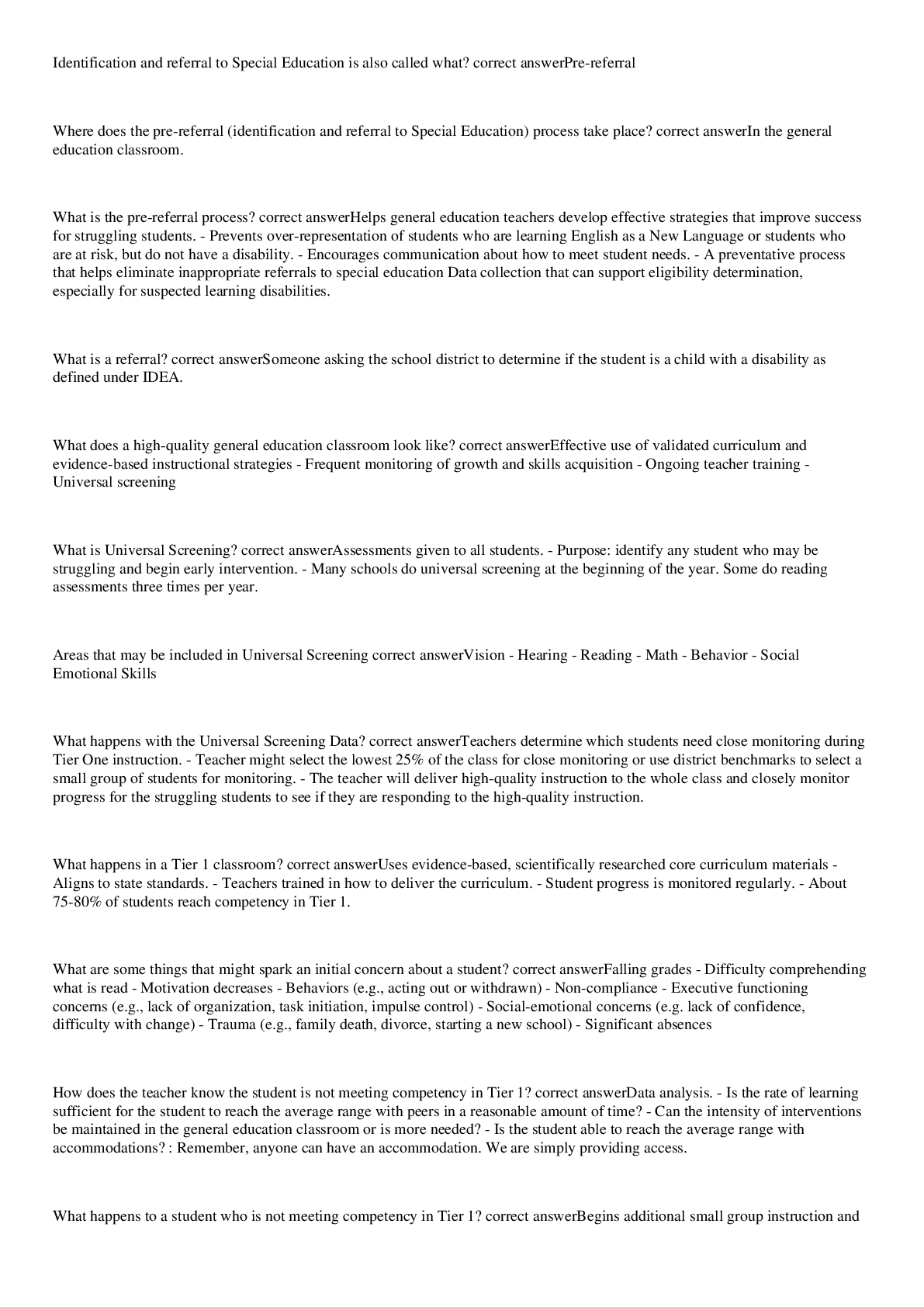
Identification and referral to Special Education is also called what?
Pre-referral
Where does the pre-referral (identification and referral to Special Education) process take place?
In the general education classroom.
What is the pre-referral process?
Helps general education teachers develop effective strategies that improve success for struggling students. - Prevents over-representation of students who are learning English as a New Language or students who are at risk, but do not have a disability. - Encourages communication about how to meet student needs. - A preventative process that helps eliminate inappropriate referrals to special education Data collection that can support eligibility determination, especially for suspected learning disabilities.
What is a referral?
Someone asking the school district to determine if the student is a child with a disability as defined under IDEA.
What does a high-quality general education classroom look like?
Effective use of validated curriculum and evidence-based instructional strategies - Frequent monitoring of growth and skills acquisition - Ongoing teacher training - Universal screening
What is Universal Screening?
Assessments given to all students. - Purpose: identify any student who may be struggling and begin early intervention. - Many schools do universal screening at the beginning of the year. Some do reading assessments three times per year.
Areas that may be included in Universal Screening
Vision - Hearing - Reading - Math - Behavior - Social Emotional Skills
What happens with the Universal Screening Data?
Teachers determine which students need close monitoring during Tier One instruction. - Teacher might select the lowest 25% of the class for close monitoring or use district benchmarks to select a small group of students for monitoring. - The teacher will deliver high-quality instruction to the whole class and closely monitor progress for the struggling students to see if they are responding to the high-quality instruction.
What happens in a Tier 1 classroom?
Uses evidence-based, scientifically researched core curriculum materials - Aligns to state standards. - Teachers trained in how to deliver the curriculum. - Student progress is monitored regularly. - About 75-80% of students reach competency in Tier 1.
What are some things that might spark an initial concern about a student?
Falling grades - Difficulty comprehending what is read - Motivation decreases - Behaviors (e.g., acting out or withdrawn) - Non-compliance - Executive functioning concerns (e.g., lack of organization, task initiation, impulse control) - Social-emotional concerns (e.g. lack of confidence, difficulty with change) - Trauma (e.g., family death, divorce, starting a new school) - Significant absences
How does the teacher know the student is not meeting competency in Tier 1?
Data analysis. - Is the rate of learning sufficient for the student to reach the average range with peers in a reasonable amount of time? - Can the intensity of interventions be maintained in the general education classroom or is more needed? - Is the student able to reach the average range with accommodations? : Remember, anyone can have an accommodation. We are simply providing access.
What happens to a student who is not meeting competency in Tier 1?
Begins additional small group instruction and more intensive monitoring - Tier 2.
What happens in Tier 2?
This is supplemental to what the student continues to receive in Tier 1. - A small group of students may be pulled aside while Tier 1 students are completing some independent work or working in stations. - Tier 2 focuses on specific skill-building and practice. - The teacher chunks down what was taught in Tier 1 and reteaches a smaller chunk, using different strategies and tools. For example, if the students are working on 1:1 correspondence for numerals 1-10; in the Tier 2 group, the students might work on numerals 1-5. - The small group might meet 2-3 times per week to practice the skill. - Skill progress is assessed more frequently than in Tier 1. - Goal is for student to reach the average range in the skill and return to success in Tier 1.
[Show More]