CVA Practice exam
Which of the following is/are a purpose of a valuation?
I. Income tax
II. Divorce
III. Corporate planning
IV. Litigation
V. Going-concern value
VI. Fair market value - ✔✔I, II, III, IV
Relying o
...
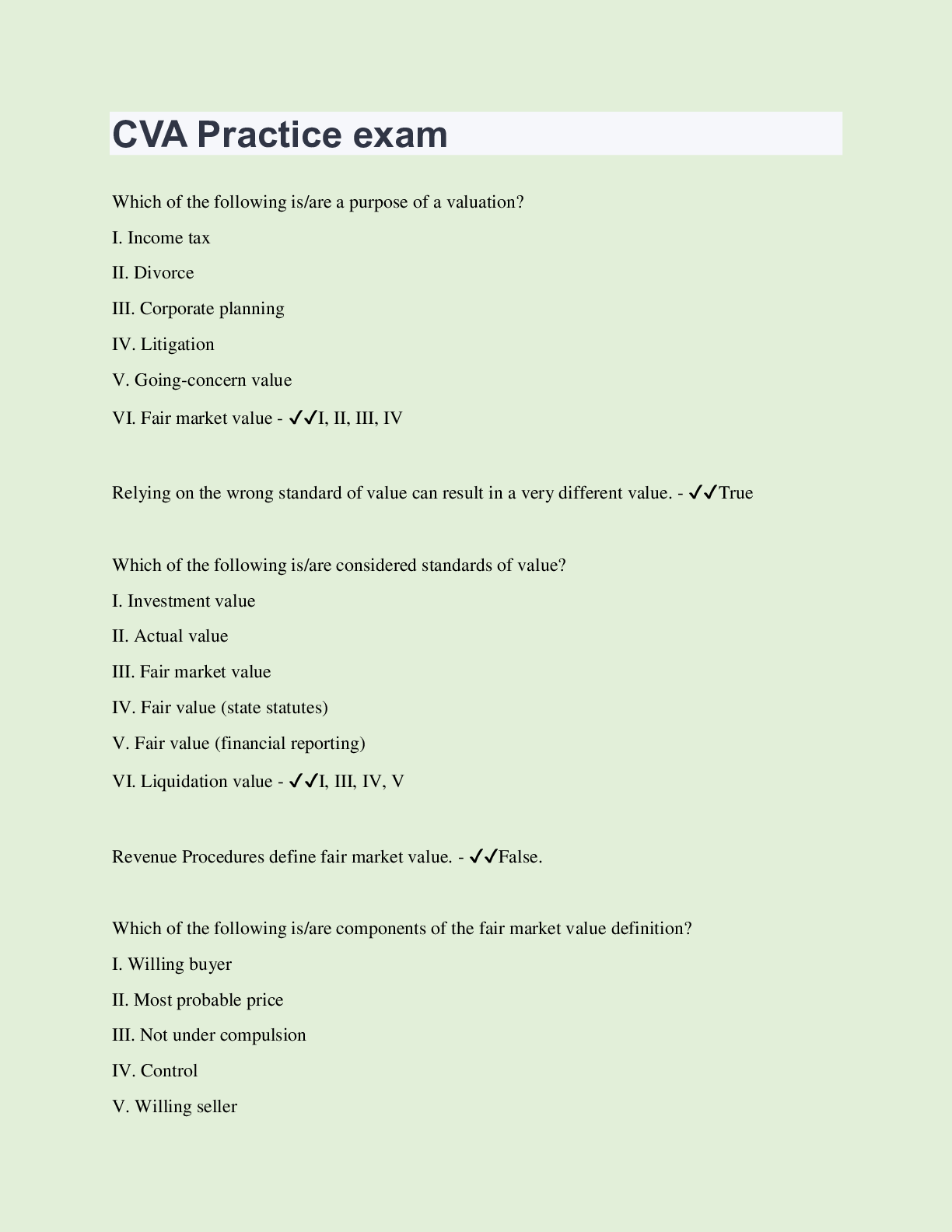
CVA Practice exam
Which of the following is/are a purpose of a valuation?
I. Income tax
II. Divorce
III. Corporate planning
IV. Litigation
V. Going-concern value
VI. Fair market value - ✔✔I, II, III, IV
Relying on the wrong standard of value can result in a very different value. - ✔✔True
Which of the following is/are considered standards of value?
I. Investment value
II. Actual value
III. Fair market value
IV. Fair value (state statutes)
V. Fair value (financial reporting)
VI. Liquidation value - ✔✔I, III, IV, V
Revenue Procedures define fair market value. - ✔✔False.
Which of the following is/are components of the fair market value definition?
I. Willing buyer
II. Most probable price
III. Not under compulsion
IV. Control
V. Willing seller
VI. Knowledge of relevant facts
VII. Normalization admustments
VIII. Lack of marketability - ✔✔I, III, V, VI
Fair market value is a premise of value in divorce cases. - ✔✔False.
Investment value is the value: - ✔✔to a particular investor.
SFAS 141 and 142 (ASC 805 and 350) require which standard of value? - ✔✔fair value
(financial reporting)
All states have the same definition of fair value. - ✔✔False.
The SEC sets the standard of value for financial reporting. - ✔✔False.
Which of the following statements is/are true?
I. Fair value (financial reporting) assumes a hypothetical buyer and seller.
II. Fair market value assumes a hypothetical buyer and seller.
III. Fair value (state rights) assumes a hypothetical buyer and seller. - ✔✔II only
Which of the following is/are considered a premise of value?
I. Intrinsic value
II. Going-concern value
III. Liquidation value
IV. Book value
V. Fair market value
VI. Fair value - ✔✔II, III, IV.
The intangible elements that result from factors such as having a trained work-force, an
operational plant, and the necessary licenses, systems, and procedures in place is/are considered
in what premise of value? - ✔✔Going-concern value
Forced liquidation value assumes an instant sale on the date of the valuation. - ✔✔True.
The valuation date is which of the following? - ✔✔the effective date of the valuation
Name the four major U.S. associations that grant certifications in valuation: - ✔✔AICPA,
NACVA, IBA, ASA
All CPAs are required to follow the Uniform Standards of Professional Practice (USPAP). -
✔✔False.
The IRS follows USPAP exclusively. - ✔✔False.
SFAS 141 and 142 (ASC 805 and 350) were issued for financial reporting purposes in regard to
allocations of purchase price, business combinations, and goodwill impairment. - ✔✔True.
Which of the following Revenue Rulings directly address(es) the valuation of restricted stock? -
✔✔77-287
Revenue Ruling 59-60 is applied only to tax valuations. - ✔✔False.
Which of the following statements are included in Revenue Ruling 59-60?
I. Use common sense, judgment, and reasonableness.
II. Valuation must be based on the facts available at the required date of appraisal.
III. Consider at least five years of income statements and two years of balance sheets.
IV. Valuation of securities is a prophecy as to the future.
V. The appraiser must include subsequent events after the appraisal date. - ✔✔I, II, III, IV.
Which of the following statements is true regarding fair market value for tax purposes? -
✔✔assumes both a hypothetical buyer and seller
The Professional Standards are - ✔✔principles-based
A member shall not express a Conclusion of Value or a Calculated Value unless the member
states:
I. That the member has no financial interest or contemplated financial interest in the subject of
the report.
II. That the member has a financial interest or contemplated financial interest in the subject of
the report. - ✔✔either I or II
An opinion can be expressed on a:
I. Calculated Value
II. Conclusion of Value (detailed report)
III. Conclusion of Value (summary report) - ✔✔II and III only
Match the following types of engagement with its appropriate valuation method:
Tax:
Tax Planning:
Prioritizing discovery issues in litigation:
ESOP:
Regulatory Engagement: - ✔✔- Conclusion of value
- calculated value
- calculated value
- conclusion of value
- conclusion of value
[Show More]







.png)