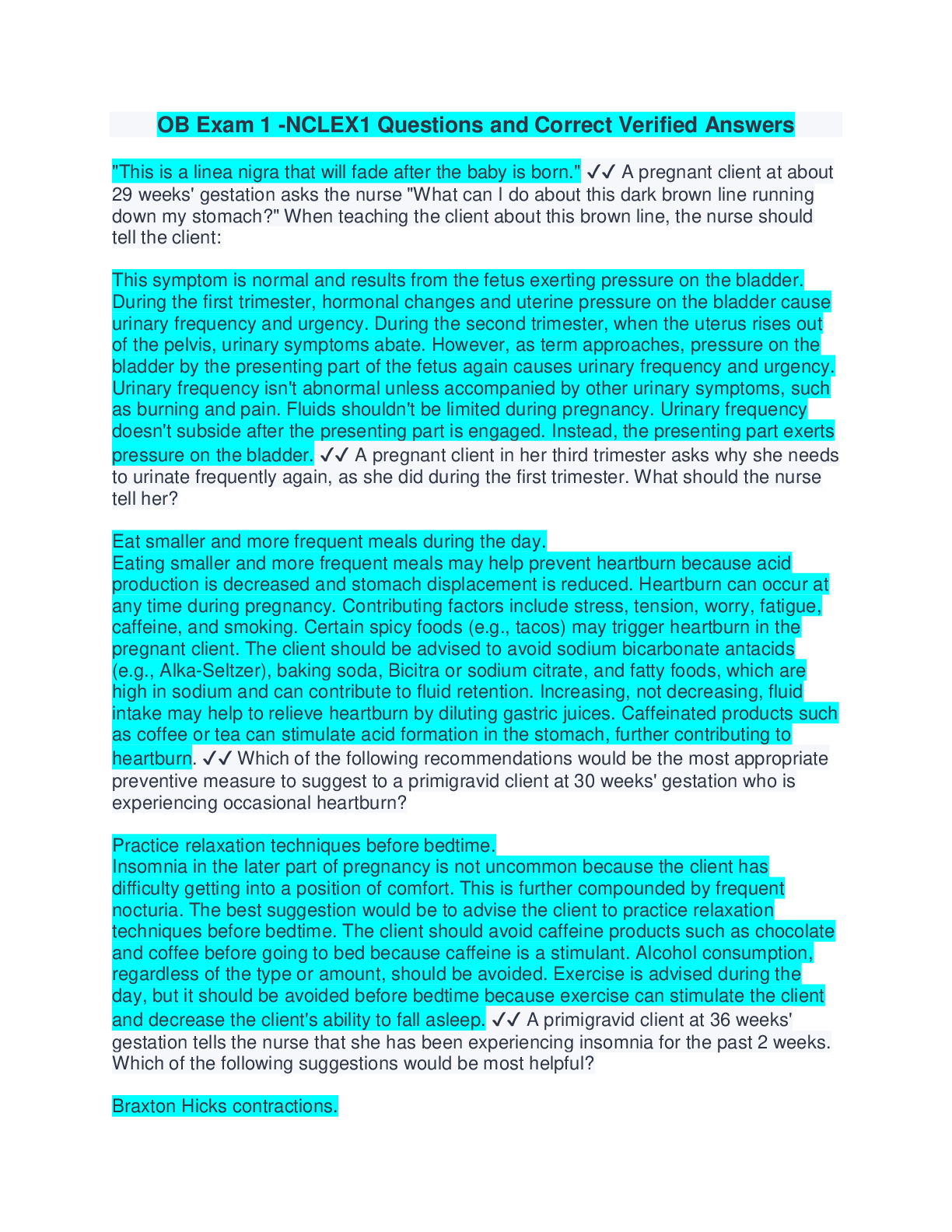
OB Exam 1 -NCLEX1 Questions and Correct Verified Answers
"This is a linea nigra that will fade after the baby is born." ✔✔ A pregnant client at about
29 weeks' gestation asks the nurse "What can I do about this dark br
...
OB Exam 1 -NCLEX1 Questions and Correct Verified Answers
"This is a linea nigra that will fade after the baby is born." ✔✔ A pregnant client at about
29 weeks' gestation asks the nurse "What can I do about this dark brown line running
down my stomach?" When teaching the client about this brown line, the nurse should
tell the client:
This symptom is normal and results from the fetus exerting pressure on the bladder.
During the first trimester, hormonal changes and uterine pressure on the bladder cause
urinary frequency and urgency. During the second trimester, when the uterus rises out
of the pelvis, urinary symptoms abate. However, as term approaches, pressure on the
bladder by the presenting part of the fetus again causes urinary frequency and urgency.
Urinary frequency isn't abnormal unless accompanied by other urinary symptoms, such
as burning and pain. Fluids shouldn't be limited during pregnancy. Urinary frequency
doesn't subside after the presenting part is engaged. Instead, the presenting part exerts
pressure on the bladder. ✔✔ A pregnant client in her third trimester asks why she needs
to urinate frequently again, as she did during the first trimester. What should the nurse
tell her?
Eat smaller and more frequent meals during the day.
Eating smaller and more frequent meals may help prevent heartburn because acid
production is decreased and stomach displacement is reduced. Heartburn can occur at
any time during pregnancy. Contributing factors include stress, tension, worry, fatigue,
caffeine, and smoking. Certain spicy foods (e.g., tacos) may trigger heartburn in the
pregnant client. The client should be advised to avoid sodium bicarbonate antacids
(e.g., Alka-Seltzer), baking soda, Bicitra or sodium citrate, and fatty foods, which are
high in sodium and can contribute to fluid retention. Increasing, not decreasing, fluid
intake may help to relieve heartburn by diluting gastric juices. Caffeinated products such
as coffee or tea can stimulate acid formation in the stomach, further contributing to
heartburn. ✔✔ Which of the following recommendations would be the most appropriate
preventive measure to suggest to a primigravid client at 30 weeks' gestation who is
experiencing occasional heartburn?
Practice relaxation techniques before bedtime.
Insomnia in the later part of pregnancy is not uncommon because the client has
difficulty getting into a position of comfort. This is further compounded by frequent
nocturia. The best suggestion would be to advise the client to practice relaxation
techniques before bedtime. The client should avoid caffeine products such as chocolate
and coffee before going to bed because caffeine is a stimulant. Alcohol consumption,
regardless of the type or amount, should be avoided. Exercise is advised during the
day, but it should be avoided before bedtime because exercise can stimulate the client
and decrease the client's ability to fall asleep. ✔✔ A primigravid client at 36 weeks'
gestation tells the nurse that she has been experiencing insomnia for the past 2 weeks.
Which of the following suggestions would be most helpful?
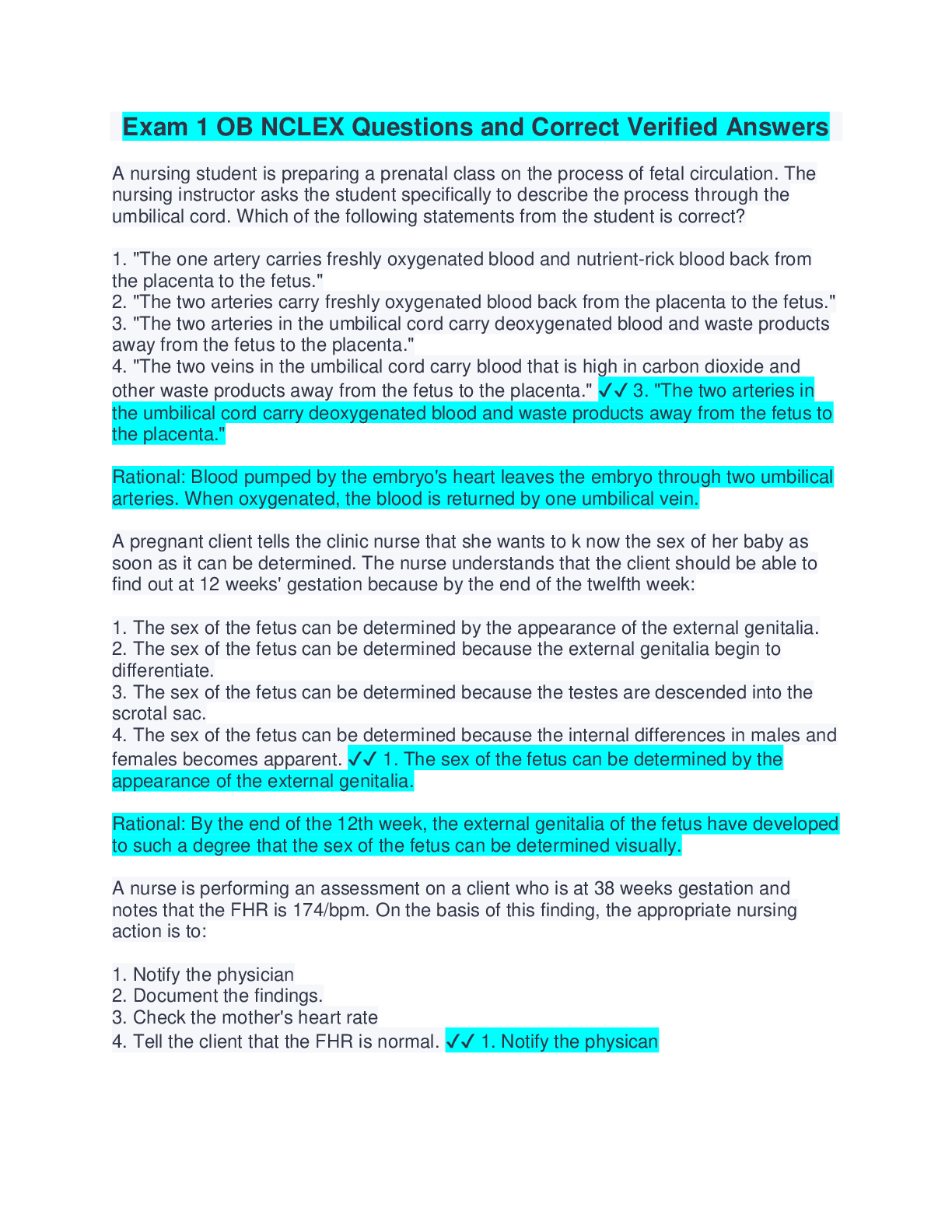
Braxton Hicks contractions.Braxton Hicks contractions cause pulling or tightening sensations, primarily over the
pubic bone. Although these contractions may occur throughout pregnancy, they're most
noticeable during the last 6 weeks of gestation in primigravid clients and the last 3 to 4
months in multiparous clients. Back labor refers to labor pain that typically starts in the
back. Fetal distress doesn't cause contractions, although it may cause sharp abdominal
pain. Decreased or absent fetal movements, green-tinged or yellowish green-tinged
fluid, or port-wine-colored fluid may also indicate fetal distress. Pain from true labor
contractions typically starts in the back and moves to the front of the fundus as a band
of pressure that peaks and subsides in a regular pattern. ✔✔ A client who is pregnant
with her second child comes to the clinic complaining of a pulling and tightening
sensation over her pubic bone every 15 minutes. She reports no vaginal fluid leakage.
Because she has just entered her 36th week of pregnancy, she is apprehensive about
her symptoms. Vaginal examination discloses a closed, thick, posterior cervix. These
findings suggest that the client is experiencing:
Bilateral dependent edema.
As the uterus grows heavier during pregnancy, femoral venous pressure rises, leading
to bilateral dependent edema. Factors interfering with venous return, such as sitting or
standing for long periods, contribute to edema. Absence of pedal pulses and sluggish
capillary refill signal inadequate circulation to the legs — an unexpected finding during
pregnancy. Unilateral calf enlargement, also an abnormal finding, may indicate
thrombosis. ✔✔ A nurse is assessing the legs of a client who's 36 weeks pregnant.
Which finding should the nurse expect?
Keeping crackers at the bedside to eat before getting out of bed.
The nurse should advise the client to keep crackers at the bedside because eating dry
crackers before getting out of bed and before the stomach becomes empty helps
prevent nausea. Drinking water with every meal does not alleviate nausea. Eating six
small meals per day, rather than three large meals, prevents nausea by preventing the
stomach from becoming empty. Drinking liquids with dry food increases nausea. The
client should be instructed to wait at least 30 minutes to consume liquids after eating dry
food. ✔✔ A pregnant client complains of nausea every morning and again before meals.
As a result of the nausea, she's been unable to eat enough and has lost weight. Which
nonpharmacologic intervention should the nurse recommend?
[Show More]










 Answered 2023.png)