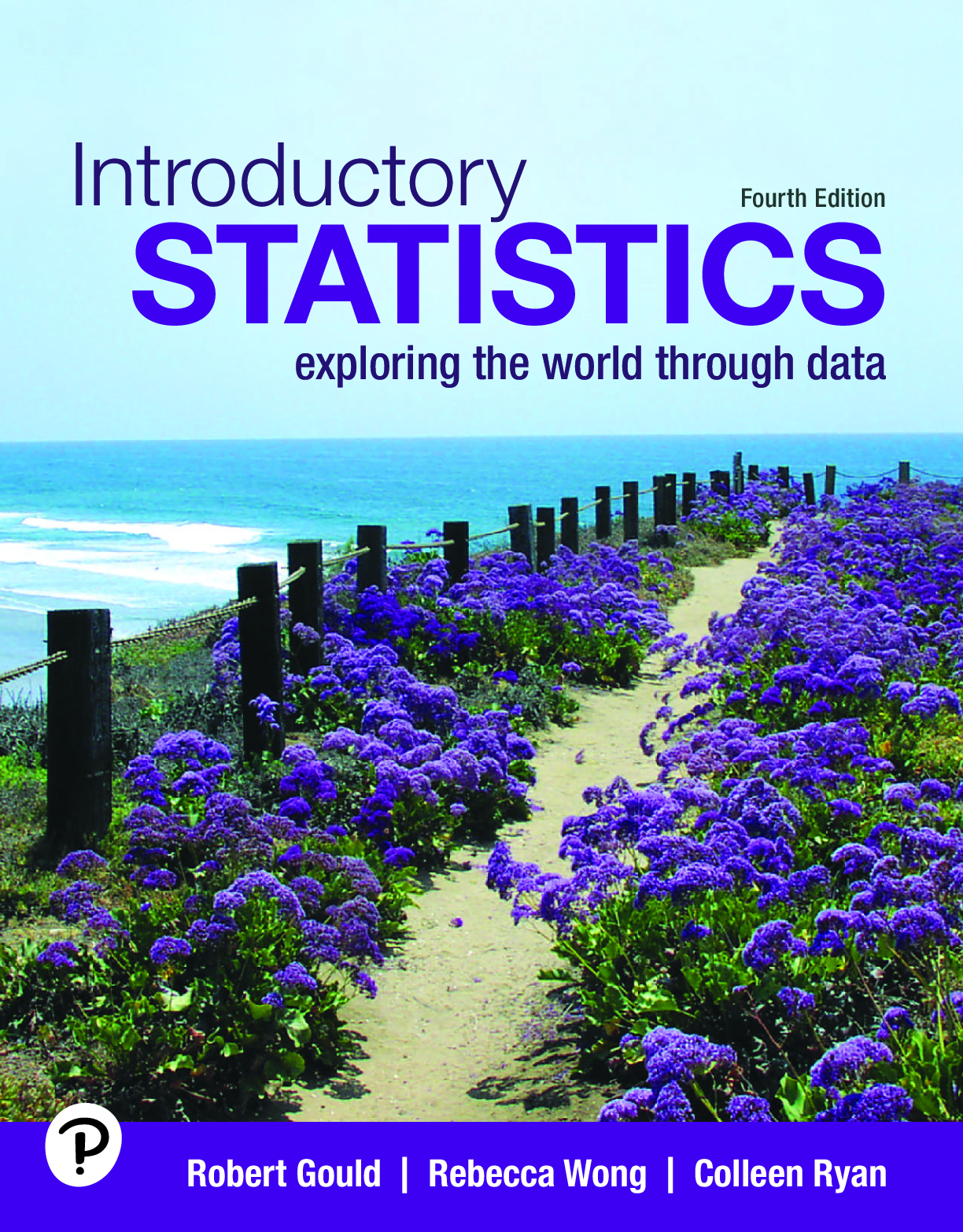
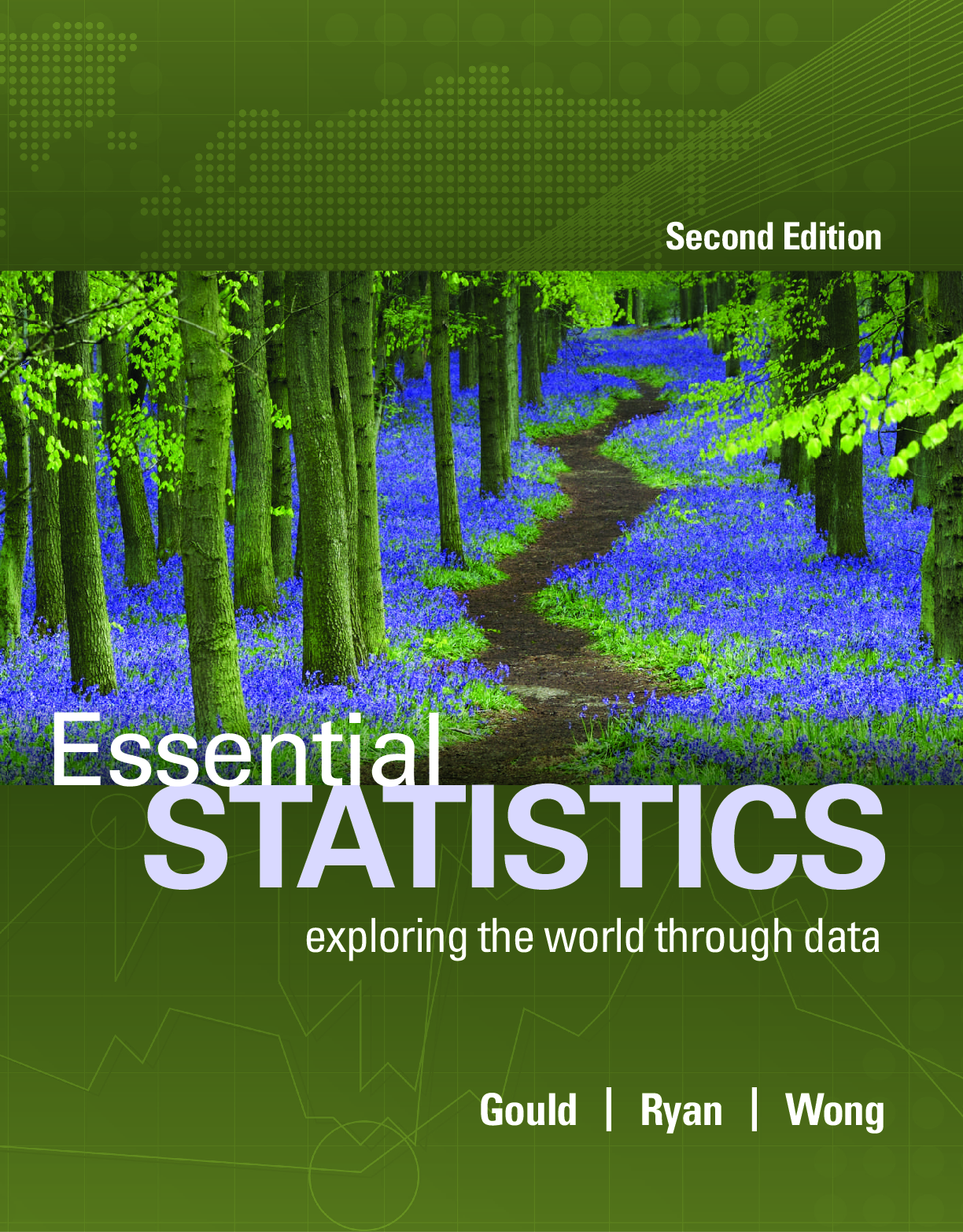
Introductory Statistics: Exploring the World Through Data
Contents
Preface
About This Book
What’s New in the Third Edition
Approach
Coverage
Organization
Features
Pearson MyLab
MyLab Statistics Online Course fo
...
Introductory Statistics: Exploring the World Through Data
Contents
Preface
About This Book
What’s New in the Third Edition
Approach
Coverage
Organization
Features
Pearson MyLab
MyLab Statistics Online Course for Introductory Statistics: Exploring the World Through Data, 3e (Access Code Required)
Resources for Success
Instructor Resources
Index of Applications
Biology
Business and Economics
Crime and Corrections
Education
Employment
Entertainment
Environment
Finance
Food and Drink
Games
General Interest
Health
Law
Politics
Psychology
Social Issues
Sports
Surveys and Opinion Polls
Technology
Transportation
Chapter 1 Introduction to Data
1.1 What Are Data?
What Is Data Analysis?
1.2 Classifying and Storing Data
Two Types of Variables
Coding Categorical Data with Numbers
Storing Your Data
1.3 Investigating Data
1.4 Organizing Categorical Data
1.5 Collecting Data to Understand Causality
Anecdotes
Observational Studies
Controlled Experiments
Sample Size
Random Assignment
Blinding
Placebos
Extending the Results
Statistics in the News
Chapter Review
Key Terms
Learning Objectives
Summary
Sources
Section Exercises
Section 1.2
Section 1.3
Section 1.4
Section 1.5
Chapter Review Exercises
Guided Exercises
Chapter 2 Picturing Variation with Graphs
2.1 Visualizing Variation in Numerical Data
Dotplots
Histograms
Relative Frequency Histograms
Stemplots
2.2 Summarizing Important Features of a Numerical Distribution
Shape
Symmetric or Skewed?
How Many Mounds?
Do Extreme Values Occur?
Center
Why Not the Mode?
Variability
Describing Distributions
2.3 Visualizing Variation in Categorical Variables
Bar Charts
Bar Charts versus Histograms
Pie Charts
2.4 Summarizing Categorical Distributions
The Mode
Variability
Describing Distributions of Categorical Variables
2.5 Interpreting Graphs
Misleading Graphs
The Future of Statistical Graphics
Chapter Review
Key Terms
Learning Objectives
Summary
Sources
Section Exercises
Sections 2.1 and 2.2
Sections 2.3 and 2.4
Section 2.5
Chapter Review Exercises
Guided Exercises
Chapter 3 Numerical Summaries of Center and Variation
3.1 Summaries for Symmetric Distributions
The Center as Balancing Point: The Mean
Visualizing the Mean
The Mean in Context
Calculating the Mean for Small Data Sets
Calculating the Mean for Larger Data Sets
Measuring Variation with the Standard Deviation
Visualizing the Standard Deviation
The Standard Deviation in Context
Calculating the Standard Deviation
Variance, a Close Relative of the Standard Deviation
3.2 What’s Unusual? The Empirical Rule and z-Scores
The Empirical Rule
z-Scores: Measuring Distance from Average
Visualizing z-Scores
Using z-Scores in Context
Calculating the z-Score
3.3 Summaries for Skewed Distributions
The Center as the Middle: The Median
Visualizing the Median
The Median in Context
Calculating the Median
Measuring Variability with the Interquartile Range
Visualizing the IQR
The Interquartile Range in Context
Calculating the Interquartile Range
Finding the Range, Another Measure of Variability
3.4 Comparing Measures of Center
Look at the Shape First
The Effect of Outliers
Many Modes: Summarizing Center and Spread
Comparing Two Groups with Different-Shaped Distributions
3.5 Using Boxplots for Displaying Summaries
Investigating Potential Outliers
Horizontal or Vertical?
Using Boxplots to Compare Distributions
Things to Watch for with Boxplots
Finding the Five-Number Summary
Numerical Summaries and the Data Cycle
Chapter Review
Key Terms
Learning Objectives
Summary
Formulas
Sources
Section Exercises
Section 3.1
Section 3.2
Section 3.3
Section 3.4
Section 3.5
Chapter Review Exercises
Guided Exercises
Questions
Question
Chapter 4 Regression Analysis: Exploring Associations between Variables
4.1 Visualizing Variability with a Scatterplot
Recognizing Trend
Seeing Strength of Association
Identifying Shape
Writing Clear Descriptions of Associations
Asking Statistical Questions About Regression
4.2 Measuring Strength of Association with Correlation
Visualizing the Correlation Coefficient
The Correlation Coefficient in Context
More Context: Correlation Does Not Mean Causation!
Finding the Correlation Coefficient
Understanding the Correlation Coefficient
4.3 Modeling Linear Trends
The Regression Line
Review: Equation of a Line
Visualizing the Regression Line
Regression in Context
Finding the Regression Line
Interpreting the Regression Line
Choosing x and y: Order Matters
The Regression Line Is a Line of Averages
Interpreting the Slope
Interpreting the Intercept
4.4 Evaluating the Linear Model
Pitfalls to Avoid
Don’t Fit Linear Models to Nonlinear Associations
Correlation Is Not Causation
Beware of Outliers
Regressions of Aggregate Data
Don’t Extrapolate!
The Origin of the Word Regression (Regression toward the Mean)
The Coefficient of Determination, r2, Measures Goodness of Fit
Chapter Review
Key Terms
Learning Objectives
Summary
Sources
Section Exercises
Section 4.1
Section 4.2
Section 4.3
Section 4.4
Chapter Review Exercises
Guided Exercises
Chapter 5 Modeling Variation with Probability
5.1 What Is Randomness?
Theoretical, Empirical, and Simulation-Based Probabilities
5.2 Finding Theoretical Probabilities
Facts about Theoretical Probabilities
Finding Theoretical Probabilities with Equally Likely Outcomes
Combining Events with “AND” and “OR”
Using “OR” to Combine Events
Mutually Exclusive Events
5.3 Associations in Categorical Variables
Conditional Probabilities
“Given That” versus “AND”
Finding Conditional Probabilities
Flipping the Condition
Independent and Dependent Events
Intuition about Independence
Sequences of Independent and Associated Events
Independent Events
Watch Out for Incorrect Assumptions of Independence
Associated Events with “AND”
5.4 Finding Empirical and Simulated Probabilities
Designing Simulations
Summary of Steps for a Simulation
The Law of Large Numbers
How Many Trials Should I Do in a Simulation?
What If My Simulation Doesn’t Give the Theoretical Value I Expect?
Some Subtleties with the Law
Streaks: Tails Are Never “Due.”
How Common Are Streaks?
Chapter Review
Key Terms
Learning Objectives
Summary
Sources
Section Exercises
Section 5.1
Section 5.2
Section 5.3
Section 5.4
Chapter Review Exercises
Guided Exercises
Chapter 6 Modeling Random Events: The Normal and Binomial Models
6.1 Probability Distributions Are Models of Random Experiments
Discrete Probability Distributions Can Be Tables or Graphs
Discrete Distributions Can Also Be Equations
Continuous Probabilities Are Represented as Areas under Curves
Finding Probabilities for Continuous-Valued Outcomes
6.2 The Normal Model
Visualizing the Normal Distribution
Center and Spread
The Mean and the Standard Deviation of a Normal Distribution
Finding Normal Probabilities
Finding Probability with Technology
Without Technology: Apply The Empirical Rule
Without Technology: The Standard Normal
Finding Measurements from Percentiles for the Normal Distribution
Appropriateness of the Normal Model
6.3 The Binomial Model
Visualizing the Binomial Distribution
Finding Binomial Probabilities
Finding (Slightly) More Complex Probabilities
Finding Binomial Probabilities by Hand
The Formula
The Shape of the Binomial Distribution: Center and Spread
Interpreting the Mean and the Standard Deviation
Surveys: An Application of the Binomial Model
Chapter Review
Key Terms
Learning Objectives
Summary
Formulas
Sources
Section Exercises
Section 6.1
Section 6.2
Section 6.3
Chapter Review Exercises
Guided Exercises
Question
Question
Chapter 7 Survey Sampling and Inference
7.1 Learning about the World through Surveys
Survey Terminology
What Could Possibly Go Wrong? The Problem of Bias
Measurement Bias
Sampling Bias
Simple Random Sampling Saves the Day
Sampling in Practice
7.2 Measuring the Quality of a Survey
Using Simulations to Understand the Behavior of Estimators
Simulation 1: Statistics Vary from Sample to Sample
Simulation 2: The Size of the Population Does Not Affect Precision
Simulation 3: Large Samples Produce More Precise Estimators
Finding the Bias and the Standard Error
Real Life: We Get Only One Chance
7.3 The Central Limit Theorem for Sample Proportions
Meet the Central Limit Theorem for Sample Proportions
Checking Conditions for the Central Limit Theorem
Using the Central Limit Theorem
7.4 Estimating the Population Proportion with Confidence Intervals
Setting the Confidence Level
Selecting a Margin of Error
Reality Check: Finding a Confidence Interval When p Is Not Known
Interpreting Confidence Intervals
Planning a Study: Finding the Sample Size
7.5 Comparing Two Population Proportions with Confidence
What’s the Difference?
Confidence Intervals for Two Population Proportions
Checking Conditions
Interpreting Confidence Intervals for Two Proportions
Random Assignment versus Random Sampling
Chapter Review
Key Terms
Learning Objectives
Summary
Sources
Section Exercises
Section 7.1
Section 7.2
Section 7.3
Section 7.4
Section 7.5
Chapter Review Exercises
Guided Exercises
Chapter 8 Hypothesis Testing for Population Proportions
8.1 The Essential Ingredients of Hypothesis Testing
Main Ingredient: A Pair of Hypotheses
Add In: Making Mistakes
Mix with: The Test Statistic
Why Is the z-Statistic Useful?
The Final Essential Ingredient: Surprise!
Hypothesis Testing and the Data Cycle: Asking Questions
8.2 Hypothesis Testing in Four Steps
A Few Details
Detail for Step 2: Check Conditions to Find Probabilities
Detail for Step 3: Calculating the p-Value
Detail for Step 4: Making a Decision
The Four-Step Approach
Step 1: Hypothesize
Step 2: Prepare
Step 3: Compute to Compare
Step 4: Interpret
8.3 Hypothesis Tests in Detail
Xtreme Stats!
If Conditions Fail
Sample Size Is Too Small
Samples Are Not Randomly Selected
Balancing Two Types of Mistakes
So What? Statistical Significance versus Practical Significance
Don’t Change Hypotheses!
Hypothesis-Testing Logic
Confidence Intervals and Hypothesis Tests
8.4 Comparing Proportions from Two Populations
Changes to Ingredients: The Hypotheses
Changes to Ingredients: The Test Statistic
Changes to Ingredients: Checking Conditions
Chapter Review
Key Terms
Learning Objectives
Summary
Sources
Section Exercises
Section 8.1
Section 8.2
Section 8.3
Section 8.4
Chapter Review Exercises
Guided Exercises
Question
Question
Chapter 9 Inferring Population Means
9.1 Sample Means of Random Samples
Accuracy and Precision of a Sample Mean
What Have We Demonstrated with These Simulations?
9.2 The Central Limit Theorem for Sample Means
Visualizing Distributions of Sample Means
Applying the Central Limit Theorem
Many Distributions
The t-Distribution
9.3 Answering Questions about the Mean of a Population
Estimation with Confidence Intervals
When Are Confidence Intervals Useful?
Checking Conditions
Interpreting Confidence Intervals
Measuring Performance with the Confidence Level
Calculating the Confidence Interval
Reporting and Reading Confidence Intervals
Understanding Confidence Intervals
9.4 Hypothesis Testing for Means
One- and Two-sided Alternative Hypotheses
9.5 Comparing Two Population Means
Estimating the Difference of Means with Confidence Intervals (Independent Samples)
Interpreting Confidence Intervals of Differences
Testing Hypotheses about Two Means
Into the Pool
Hypotheses: Choosing Sides
CI for the Mean of a Difference: Dependent Samples
Test of Two Means: Dependent Samples
9.6 Overview of Analyzing Means
Don’t Accept the Null Hypothesis
Confidence Intervals and Hypothesis Tests
Hypothesis Test or Confidence Interval?
Chapter Review
Key Terms
Learning Objectives
Summary
Formulas
Formula 9.1: One-Sample Confidence Interval for Mean
Formula 9.2: The One-Sample t-Test for Mean
Formula 9.3: Two-Sample Confidence Interval
Formula 9.4: Two-Sample t-Test (Unpooled)
Sources
Section Exercises
Section 9.1
Section 9.2
Section 9.3
Section 9.4
Section 9.5
Chapter Review Exercises
Guided Exercises
Question
Question
Confidence Interval
Question
Chapter 10 Associations between Categorical Variables
10.1 The Basic Ingredients for Testing with Categorical Variables
1. The Data
2. Expected Counts
Starting with the Physical Abuse Variable
Starting with the TV Violence Variable
3. The Chi-Square Statistic
4. Finding the p-Value for the Chi-Square Statistic
10.2 The Chi-Square Test for Goodness of Fit
Goodness of Fit
10.3 Chi-Square Tests for Associations between Categorical Variables
Tests of Independence and Homogeneity
Random Samples and Randomized Assignment
Relation to Tests of Proportions
10.4 Hypothesis Tests When Sample Sizes Are Small
Combining Categories
Advantages and Disadvantages of Combining Categories
Fisher’s Exact Test
Chapter Review
Key Terms
Learning Objectives
Summary
Formulas
Expected Counts
Chi-Square Statistic
Goodness-of-Fit Test
Hypotheses
Conditions
Sampling Distribution
Test of Homogeneity and Independence
Hypotheses
Conditions (Homogeneity)
Conditions (Independence)
Sampling Distribution
Sources
Section Exercises
Section 10.1
Section 10.2
Section 10.3
Section 10.4
Chapter Review Exercises
Guided Exercises
Question
Question
Chapter 11 Multiple Comparisons and Analysis of Variance
11.1 Multiple Comparisons
Data for Multiple Comparisons
The Problem of Multiple Comparisons
One Solution: The Bonferroni Correction
Finding the Number of Comparisons
Bonferroni Confidence Intervals
11.2 The Analysis of Variance
Visualizing It
Putting a Number on It
ANOVA in Context: A Tour of the ANOVA Table
Explained Variation + Unexpected Variation = Total Variation
The Mean Sum of Squares
In Other Words
Relation of Total Sum of Squares to Variance
11.3 The ANOVA Test
Finding the p-Value
What If Conditions Are Not Satisfied?
Carrying Out an ANOVA Test
11.4 Post Hoc Procedures
Chapter Review
Key Terms
Learning Objectives
Summary
Sources
Section Exercises
Section 11.1
Section 11.2
Section 11.3
Section 11.4
Chapter Review Exercises
Guided Exercises
Question
Conclusion
Question
Question
Chapter 12 Experimental Design: Controlling Variation
12.1 Variation Out of Control
Review of Experimental Basics
Statistical Power
Blocking
Creating Blocks
Blocking and Matching
12.2 Controlling Variation in Surveys
Review of Sampling Basics
Systematic Sampling
Stratified Sampling
Cluster Sampling
12.3 Reading Research Papers
Reading Abstracts
Buyer Beware
Data Dredging
Publication Bias
Profit Motive
Media
Clinical Significance vs. Statistical Significance
Chapter Review
Key Terms
Learning Objectives
Summary
Sources
Section Exercises
Section 12.1
Section 12.2
Section 12.3
Guided Practice
Chapter 13 Inference without Normality
13.1 Transforming Data
Interpreting QQ Plots
The Log Transform
Analyzing Log-Transformed Data
Comparing Means
Median or Geometric Mean?
13.2 The Sign Test for Paired Data
Overview of the Sign Test
Stating Hypotheses
Calculating the Test Statistic
Finding the p-Value
Applying the Sign Test
13.3 Mann-Whitney Test for Two Independent Groups
Overview of the Mann-Whitney Test
Stating Hypotheses
Finding the Test Statistic
Finding the p-Value
Applying the Mann-Whitney Test
Sample Size and the Mann-Whitney Test
What Can Go Wrong?
t-Test or Mann-Whitney Test?
13.4 Randomization Tests
Overview of Randomization Tests
Stating Hypotheses
Finding the p-Value
Applying Randomization Tests
Chapter Review
Key Terms
Learning Objectives
Summary
Sources
Section Exercises
Section 13.1
Section 13.2
Section 13.3
Section 13.4
Chapter Review Exercises
Guided Exercises
Chapter 14 Inference for Regression
14.1 The Linear Regression Model
Components of the Model
Checking the Conditions of the Model
Checking Linearity
Checking the Constant Standard Deviation (SD) Condition
Checking Normality
Checking the Independence Condition
14.2 Using the Linear Model
Estimators for the Intercept and Slope
Hypothesis Tests for Intercept and Slope
Confidence Intervals for Intercept and Slope
Interpreting Confidence Intervals for Regression
14.3 Predicting Values and Estimating Means
What Can Go Wrong?
If the Linearity Condition Is Not Satisfied
If the Errors Are Not Normal
If the Standard Deviation Is Not the Same for All Values of x
If the Errors Are Not Independent of Each Other
Influential Points
Interpreting r-squared
Chapter Review
Key Terms
Learning Objectives
Summary
Sources
Section Exercises
Section 14.1
Section 14.2
Section 14.3
Chapter Review Exercises
Appendix A: Tables
Appendix B Answers to Odd-Numbered Exercises
Chapter 1
Section 1.2
Section 1.3
Section 1.4
Section 1.5
Chapter Review Exercises
Chapter 2
Sections 2.1 and 2.2
Sections 2.3 and 2.4
Chapter Review Exercises
Chapter 3
Section 3.1
Section 3.2
Section 3.3
Section 3.4
Section 3.5
Chapter Review Exercises
Chapter 4
Section 4.1
Section 4.2
Section 4.3
Section 4.4
Chapter Review Exercises
Chapter 5
Section 5.1
Section 5.2
Section 5.3
Section 5.4
Chapter Review Exercises
Chapter 6
Section 6.1
Section 6.2
Section 6.3
Chapter Review Exercises
Chapter 7
Section 7.1
Section 7.2
Section 7.3
Section 7.4
Section 7.5
Chapter Review Exercises
Chapter 8
Section 8.1
Section 8.2
Section 8.3
Section 8.4
Chapter Review Exercises
Chapter 9
Section 9.1
Section 9.2
Section 9.3
Section 9.4
Section 9.5
Chapter Review Exercises
Chapter 10
Section 10.1
Section 10.2
Section 10.3
Section 10.4
Chapter Review Exercises
Chapter 11
Section 11.1
Section 11.2
Section 11.3
Section 11.4
Chapter Review Exercises
Chapter 12
Section 12.1
Section 12.2
Section 12.3
Chapter 13
Section 13.1
Section 13.2
Section 13.3
Section 13.4
Chapter Review Exercises
Chapter 14
Section 14.1
Section 14.2
Section 14.3
Chapter Review Exercises
Appendix C: Credits
Photo Credits
Chapter 1
Chapter 2
Chapter 3
Chapter 4
Chapter 5
Chapter 6
Chapter 7
Chapter 8
Chapter 9
Chapter 10
Chapter 11
Chapter 12
Chapter 13
Chapter 14
[Show More]
![Preview of Introductory Statistics Exploring the World Through Data, 3rd edition By Robert Gould, Colleen Ryan [PDF] [eBook]](https://scholarfriends.com/storage/eBook for Introductory Statistics Exploring the World Through Data, 3rd edition By Robert Gould, Colleen Ryan.png)