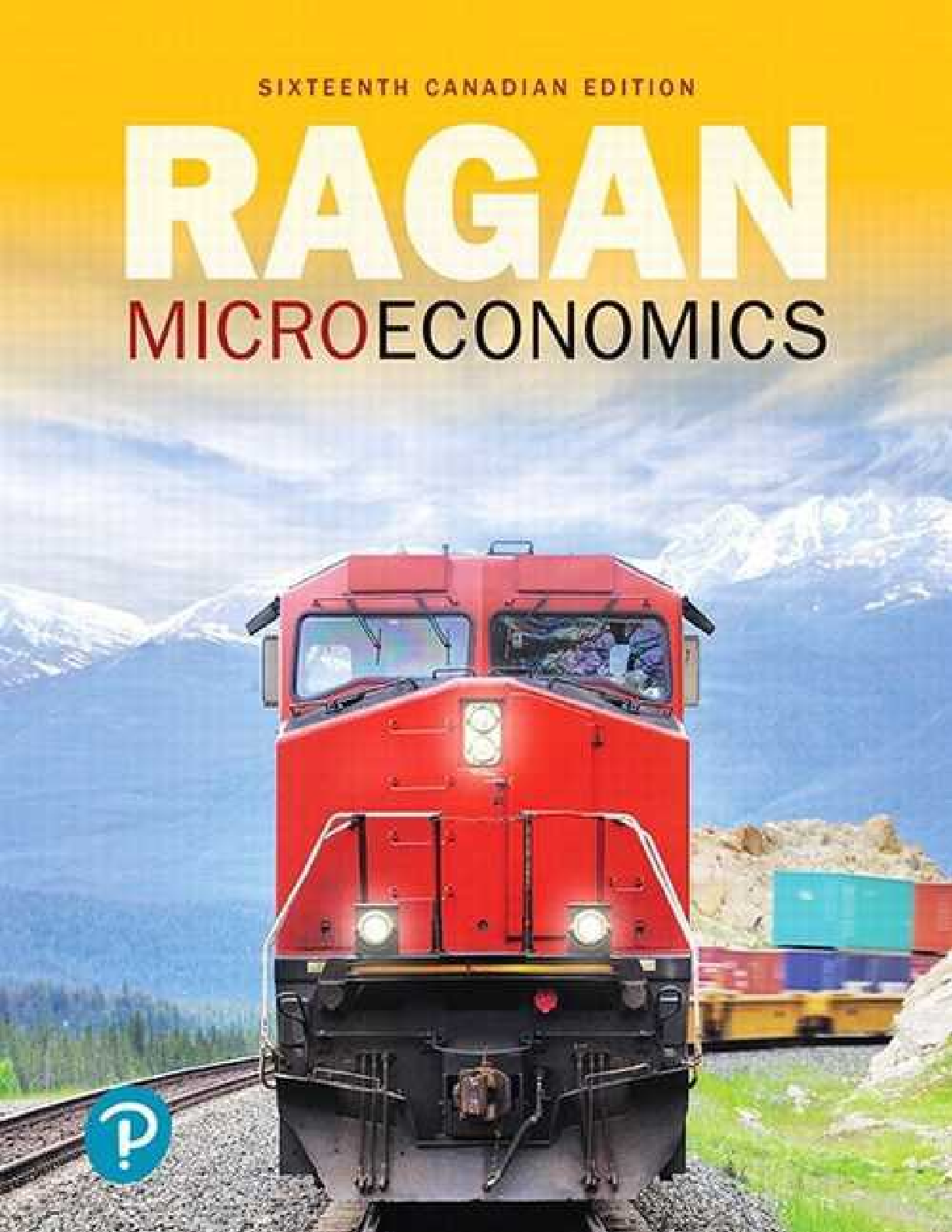
Ragan Microeconomics
Brief Contents
Contents
List of Boxes
To the Instructor
To the Student
About the Author
1 Economic Issues and Concepts
Chapter Outline
Learning Objectives (LO)
1.1 What Is Economics?
Resou
...
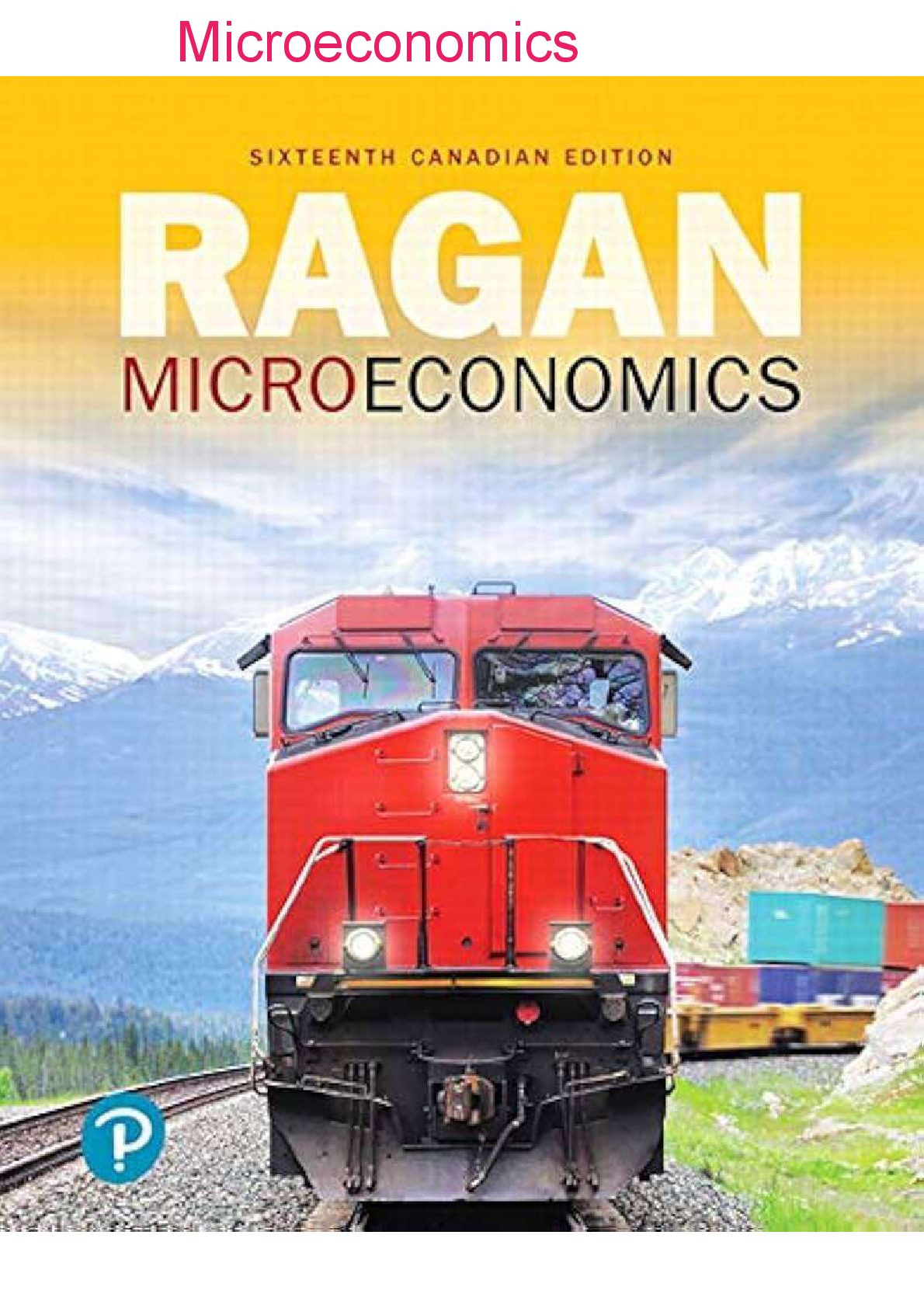
Ragan Microeconomics
Brief Contents
Contents
List of Boxes
To the Instructor
To the Student
About the Author
1 Economic Issues and Concepts
Chapter Outline
Learning Objectives (LO)
1.1 What Is Economics?
Resources
Scarcity and Choice
Opportunity Cost
Opportunity Cost Is a Ratio
Production Possibilities Boundary
Four Key Economic Problems
1. What Is Produced and How?
2. What Is Consumed and by Whom?
3. Why Are Resources Sometimes Idle?
4. Is Productive Capacity Growing?
Microeconomics and Macroeconomics
Economics and Government Policy
1.2 The Complexity of Modern Economies
The Nature of Market Economies
Self-Organizing
Efficiency
Self-Interest and Incentives
The Decision Makers and Their Choices
How Are Decisions Made?
Maximizing Decisions
Marginal Decisions
The Flow of Income and Expenditure
Production and Trade
Specialization
The Division of Labour
Money and Trade
Globalization
1.3 Is There an Alternative to the Market Economy?
Types of Economic Systems
Traditional Economies
Command Economies
Free-Market Economies
Mixed Economies
The Great Debate
Government in the Modern Mixed Economy
Summary
1.1 What Is Economics? LO 1
1.2 The Complexity of Modern Economies LO 2, 3, 4
1.3 Is There an Alternative to the Market Economy? LO 5
Key Concepts
Study Exercises
Fill-in-the-Blank
Review
Problems
2 Economic Theories, Data, and Graphs
Chapter Outline
Learning Objectives (LO)
2.1 Positive and Normative Statements
Disagreements Among Economists
2.2 Building and Testing Economic Theories
What Are Theories?
Variables
Assumptions
Motives
Direction of Causation
Conditions of Application
Predictions
Testing Theories
Statistical Analysis
Correlation Versus Causation
2.3 Economic Data
Index Numbers
How to Build an Index Number
More Complex Index Numbers
Graphing Economic Data
Cross-Sectional and Time-Series Data
Scatter Diagrams
2.4 Graphing Economic Theories
Functions
Graphing Functions
The Slope of a Straight Line
Non-linear Functions
Functions with a Minimum or a Maximum
A Final Word
Summary
2.1 Positive and Normative Statements LO 1
2.2 Building and Testing Economic Theories LO 2, 3
2.3 Economic Data LO 4
2.4 Graphing Economic Theories LO 5
Key Concepts
Study Exercises
Fill-in-the-Blank
Review
Problems
3 Demand, Supply, and Price
Chapter Outline
Learning Objectives (LO)
3.1 Demand
Quantity Demanded
Quantity Demanded and Price1
Demand Schedules and Demand Curves
Shifts in the Demand Curve
1. Consumers’ Income
2. Prices of Other Goods
3. Consumers’ Tastes
4. Population
5. Significant Changes in Weather
Movements Along the Curve Versus Shifts of the Whole Curve
3.2 Supply
Quantity Supplied
Quantity Supplied and Price
Supply Schedules and Supply Curves
Shifts in the Supply Curve
1. Prices of Inputs
2. Technology
3. Government Taxes or Subsidies
4. Prices of Other Products
5. Significant Changes in Weather
6. Number of Suppliers
Movements Along the Curve Versus Shifts of the Whole Curve
3.3 The Determination of Price
The Concept of a Market
Market Equilibrium
Changes in Market Equilibrium
A Numerical Example
Relative Prices
Summary
3.1 Demand LO 1, 2
3.2 Supply LO 3, 4
3.3 The Determination of Price LO 5
Key Concepts
Study Exercises
Fill-in-the-Blank
Review
Problems
4 Elasticity
Chapter Outline
Learning Objectives (LO)
4.1 Price Elasticity of Demand
The Measurement of Price Elasticity
The Use of Average Price and Quantity in Computing Elasticity
Interpreting Numerical Elasticities
What Determines Elasticity of Demand?
Availability of Substitutes
Importance of the Product in Consumers’ Budgets
Short Run and Long Run
Elasticity and Total Expenditure
4.2 Price Elasticity of Supply
Determinants of Supply Elasticity
Ease of Substitution
Short Run and Long Run
4.3 Elasticity Matters for Excise Taxes
4.4 Other Demand Elasticities
Income Elasticity of Demand
Normal Goods
Income Inelastic
Income Elastic
Luxuries Versus Necessities
Inferior Goods
Cross Elasticity of Demand
Summary
4.1 Price Elasticity of Demand LO 1, 2
4.2 Price Elasticity of Supply LO 3
4.3 Elasticity Matters for Excise Taxes LO 4
4.4 Other Demand Elasticities LO 5, 6
Key Concepts
Study Exercises
Fill-in-the-Blank
Review
Problems
5 Price Controls and Market Efficiency
Chapter Outline
Learning Objectives (LO)
5.1 Government-Controlled Prices
Disequilibrium Prices
Price Floors
Price Ceilings
Allocating a Product in Excess Demand
Black Markets
5.2 Rent Controls: A Case Study of Price Ceilings
The Predicted Effects of Rent Controls
Who Gains and Who Loses?
Policy Alternatives
5.3 An Introduction to Market Efficiency
Demand as “Value” and Supply as “Cost”
Economic Surplus and Market Efficiency
Market Efficiency and Price Controls
One Final Application: Output Quotas
A Cautionary Word
Summary
5.1 Government-Controlled Prices LO 1
5.2 Rent Controls: A Case Study of Price Ceilings LO 2
5.3 An Introduction to Market Efficiency LO 3, 4
Key Concepts
Study Exercises
Fill-in-the-Blank
Review
Problems
6 Consumer Behaviour
Chapter Outline
Learning Objectives (LO)
6.1 Marginal Utility and Consumer Choice
Diminishing Marginal Utility
Utility Schedules and Graphs
Maximizing Utility
The Consumer’s Maximizing Decision
An Alternative Interpretation
Is This Realistic?
The Consumer’s Demand Curve
Market Demand Curves
6.2 Income and Substitution Effects of Price Changes
The Substitution Effect
The Income Effect
The Slope of the Demand Curve
Giffen Goods
Conspicuous Consumption Goods
6.3 Consumer Surplus
The Concept
The Paradox of Value
Summary
6.1 Marginal Utility and Consumer Choice LO 1, 2
6.2 Income and Substitution Effects of Price Changes LO 3
6.3 Consumer Surplus LO 4, 5
Key Concepts
Study Exercises
Fill-in-the-Blank
Review
Problems
Appendix to Chapter 6 Indifference Curves
6A.1 Indifference Curves
Diminishing Marginal Rate of Substitution
The Indifference Map
6A.2 The Budget Line
Properties of the Budget Line
The Slope of the Budget Line
6A.3 The Consumer’s Utility-Maximizing Choices
The Consumer’s Response to a Change in Income
The Consumer’s Response to a Change in Price
6A.4 Deriving the Consumer’s Demand Curve
Income and Substitution Effects
Study Exercises
7 Producers in the Short Run
Chapter Outline
Learning Objectives (LO)
7.1 What Are Firms?
Organization of Firms
Financing of Firms
Equity
Debt
Goals of Firms
7.2 Production, Costs, and Profits
Production
Costs and Profits
Economic Versus Accounting Profits
Opportunity Cost of Time
Opportunity Cost of Financial Capital
Profits and Resource Allocation
Profit-Maximizing Output
Time Horizons for Decision Making
The Short Run
The Long Run
The Very Long Run
7.3 Production in the Short Run
Total, Average, and Marginal Products
Diminishing Marginal Product
The Average–Marginal Relationship
7.4 Costs in the Short Run
Defining Short Run Costs
Short-Run Cost Curves
The AFC, AVC, and ATC Curves
The MC Curve
Why U-Shaped Cost Curves?
Capacity
Shifts in Short-Run Cost Curves
Changes in Factor Prices
Changes in the Amount of the Fixed Factor
Summary
7.1 What Are Firms? LO 1
7.2 Production, Costs, and Profits LO 2
7.3 Production in the Short Run LO 3
7.4 Costs in the Short Run LO 4
Key Concepts
Study Exercises
Fill-in-the-Blank
Review
Problems
8 Producers in the Long Run
Chapter Outline
Learning Objectives (LO)
8.1 The Long Run: No Fixed Factors
Profit Maximization and Cost Minimization
Long-Run Cost Minimization
The Principle of Substitution
Long-Run Cost Curves
The Shape of the Long-Run Average Cost Curve
1. Decreasing Costs
2. Constant Costs
3. Increasing Costs
The Relationship Between Long-Run and Short-Run Costs
8.2 The Very Long Run: Changes in Technology
Technological Change
New Techniques
Improved Inputs
New Products
Firms’ Choices in the Very Long Run
Summary
8.1 The Long Run: No Fixed Factors LO 1, 2, 3
8.2 The Very Long Run: Changes in Technology LO 4
Key Concepts
Study Exercises
Fill-in-the-Blank
Review
Problems
Appendix to Chapter 8 Isoquant Analysis
8A.1 Isoquants
An Isoquant Map
8A.2 Cost Minimization
The Principle of Substitution
9 Competitive Markets
Chapter Outline
Learning Objectives (LO)
9.1 Market Structure and Firm Behaviour
Competitive Markets
Competitive Behaviour
9.2 The Theory of Perfect Competition
The Assumptions of Perfect Competition
The Demand Curve for a Perfectly Competitive Firm
Total, Average, and Marginal Revenue
9.3 Short-Run Decisions
Should the Firm Produce at All?
How Much Should the Firm Produce?
Short-Run Supply Curves
The Supply Curve for One Firm
The Supply Curve for an Industry
Short-Run Equilibrium in a Competitive Market
9.4 Long-Run Decisions
Entry and Exit
An Entry-Attracting Price
An Exit-Inducing Price
The Speed of Exit
Long-Run Equilibrium
Conditions for Long-Run Equilibrium
Changes in Technology
Declining Industries
The Response of Firms
The Response of Governments
Summary
9.1 Market Structure and Firm Behaviour LO 1
9.2 The Theory of Perfect Competition LO 2
9.3 Short-Run Decisions LO 3, 4
9.4 Long-Run Decisions LO 5
Key Concepts
Study Exercises
Fill-in-the-Blank
Review
Problems
10 Monopoly, Cartels, and Price Discrimination
Chapter Outline
Learning Objectives (LO)
10.1 A Single-Price Monopolist
Revenue Concepts for a Monopolist
Average Revenue
Marginal Revenue
Short-Run Profit Maximization
No Supply Curve for a Monopolist
Firm and Industry
Competition and Monopoly Compared
Why Are Monopolies Rare?
Entry Barriers
Natural Entry Barriers
Created Entry Barriers
The Very Long Run and Creative Destruction
10.2 Cartels and Monopoly Power
The Effects of Cartelization
Problems That Cartels Face
Enforcement of Output Restrictions
Restricting Entry
10.3 Price Discrimination
When Is Price Discrimination Possible?
Market Power
Different Valuations of the Product
Prevent Arbitrage
Different Forms of Price Discrimination
Price Discrimination Among Units of Output
Price Discrimination Among Market Segments
Hurdle Pricing
The Consequences of Price Discrimination
Price Discrimination and Firm Profits
Price Discrimination and Output
Price Discrimination and Consumers
Summary
10.1 A Single-Price Monopolist LO 1, 2
10.2 Cartels and Monopoly Power LO 3
10.3 Price Discrimination LO 4
Key Concepts
Study Exercises
Fill-in-the-Blank
Review
Problems
11 Imperfect Competition and Strategic Behaviour
Chapter Outline
Learning Objectives (LO)
11.1 Imperfect Competition
Between the Two Extremes
Industries with Many Small Firms
Industries with a Few Large Firms
Industrial Concentration
Concentration Ratios
Defining the Market
Defining Imperfect Competition
Firms Differentiate Their Products
Firms Set Their Prices
Firms Engage in Non-Price Competition
1. Advertising
2. Product Quality
3. Entry Barriers
Two In-Between Market Structures
11.2 Monopolistic Competition
The Assumptions of Monopolistic Competition
Predictions of the Theory
The Short-Run Decision of the Firm
The Long-Run Equilibrium of the Industry
The Excess-Capacity Theorem
11.3 Oligopoly and Game Theory
Profit Maximization Is Complicated
The Basic Dilemma of Oligopoly
Some Simple Game Theory
A Payoff Matrix
Strategic Behaviour
Cooperative Outcome
Non-Cooperative Outcome
Nash Equilibrium
Extensions in Game Theory
11.4 Oligopoly in Practice
Cooperative Behaviour
Explicit Collusion
Tacit Collusion
Competitive Behaviour
The Importance of Entry Barriers
1. Brand Proliferation as an Entry Barrier
2. Advertising as an Entry Barrier
3. Predatory Pricing as an Entry Barrier
Oligopoly and the Economy
Profits Under Oligopoly
Oligopoly and Innovation
Summary
11.1 Imperfect Competition LO 1, 2
11.2 Monopolistic Competition LO 3
11.3 Oligopoly and Game Theory LO 4
11.4 Oligopoly in Practice LO 5
Key Concepts
Study Exercises
Fill-in-the-Blank
Review
Problems
12 Economic Efficiency and Public Policy
Chapter Outline
Learning Objectives (LO)
12.1 Productive and Allocative Efficiency
Productive Efficiency
Productive Efficiency and the Production Possibilities Boundary
Allocative Efficiency
Allocative Efficiency and the Production Possibilities Boundary
Which Market Structures Are Efficient?
Perfect Competition
Monopoly
Monopolistic Competition and Oligopoly
Allocative Efficiency and Total Surplus
Consumer and Producer Surplus
The Allocative Efficiency of Perfect Competition Revisited
The Allocative Inefficiency of Monopoly Revisited
Allocative Efficiency and Market Failure
12.2 Economic Regulation to Promote Efficiency
Regulation of Natural Monopolies
Short-Run Price and Output
1. Marginal-Cost Pricing
2. Two-Part Tariff
3. Average-Cost Pricing
Long-Run Investment
Very Long-Run Innovation
Problems with Regulations
Regulation of Oligopolies
Skepticism About Government Direction
Oligopolies and Innovation
“Capture” of Regulatory Bodies
Deregulation and Privatization
Rising Corporate Concentration
12.3 Canadian Competition Policy
The Canadian Competition Act of 1986
The Reforms of 2009
Future Challenges
Summary
12.1 Productive and Allocative Efficiency LO 1, 2
12.2 Economic Regulation to Promote Efficiency LO 3
12.3 Canadian Competition Policy LO 4
Key Concepts
Study Exercises
Fill-in-the-Blank
Review
Problems
13 How Factor Markets Work
Chapter Outline
Learning Objectives (LO)
13.1 The Demand for Factors
Marginal Revenue Product
The Firm’s Demand Curve for a Factor
The MRP Curve Is the Factor Demand Curve
Elasticity of the Firm’s Factor Demand Curve
1. The Elasticity of Demand for the Firm’s Product
2. The Firm’s Ability to Substitute Between Factors
The Market Demand Curve for a Factor
Shifts of the Market Factor Demand Curve
A Change in the Factor’s Marginal Product
A Change in Firms’ Marginal Revenue
A Complication
13.2 The Supply of Factors
The Supply of Factors to the Economy
Physical Capital
Land
Labour
Population
Labour-Force Participation
Hours per Person
The Supply of Factors to a Particular Industry
The Mobility of Capital
The Mobility of Land
The Mobility of Labour
The Supply of Factors to a Particular Firm
13.3 Factor Markets in Action
Differentials in Factor Prices
Temporary Differentials
Equilibrium Differentials
Intrinsic Differences
Acquired Differences
Compensating Differentials
Can Differentials Be Eliminated?
Economic Rent
How Much of Factor Earnings Is Rent?
Various Perspectives on Economic Rent
A Final Word
Summary
13.1 The Demand for Factors LO 1
13.2 The Supply of Factors LO 2
13.3 Factor Markets in Action LO 3, 4
Key Concepts
Study Exercises
Fill-in-the-Blank
Review
Problems
14 Labour Markets and Income Inequality
Chapter Outline
Learning Objectives (LO)
14.1 Wage Differentials
Wage Differentials in Competitive Labour Markets
1. Working Conditions
2. Inherited Skills
3. Human Capital
Formal Education
On-the-Job Training
4. Discrimination
A Model Without Discrimination
A Model with Discrimination
Temporary or Equilibrium Differentials?
Wage Differentials in Non-competitive Labour Markets
A Monopoly Union in the Labour Market
A Monopsony Firm in the Labour Market
Bilateral Monopoly
Legislated Minimum Wages
Predicted Effects of a Minimum Wage
Competitive Labour Markets
Firms with Monopsony Power
Evidence on the Effects of Minimum Wages
14.2 Labour Unions
Collective Bargaining
Wages Versus Employment
The Union Wage Premium
Employment Effects of Unions
Unanswered Questions
14.3 Income Inequality
Measuring Income Inequality
Canadian Data
International Data
The Rise of the 1 Percent
Changing Income Shares
How Much Does the 1 Percent Earn?
Causes of Rising Income Inequality
Technological Change
Globalization
Other Contributing Causes
Decline of Labour Unions
The “Gig” Economy
Executive Compensation
Superstar Theory
The Piketty Argument
Policy Implications
Does It Matter?
What Can Governments Do?
Summary
14.1 Wage Differentials LO 1, 2
14.2 Labour Unions LO 3
14.3 Income Inequality LO 4
Key Concepts
Study Exercises
Fill-in-the-Blank
Review
Problems
15 Interest Rates and the Capital Market
Chapter Outline
Learning Objectives (LO)
15.1 A Brief Overview of the Capital Market
15.2 Present Value
The Present Value of a Single Future Sum
One Period in the Future
Several Periods in the Future
The Present Value of a Stream of Future Sums
Summary
15.3 The Demand for Capital
The Firm’s Demand for Capital
The Decision to Purchase a Unit of Capital
The Firm’s Optimal Capital Stock
Increase in Future MRPs
Reduction in the Interest Rate
From Capital Stock to Investment Demand
Emphasis on the Interest Rate
The Economy’s Demand for Investment
15.4 The Supply of Capital
Households’ Supply of Saving
Saving and Current Income
Saving and Expected Future Income
Saving and the Interest Rate
The Economy’s Supply of Saving
15.5 Equilibrium in the Capital Market
The Equilibrium Interest Rate
Changes in the Market Equilibrium
Increases in the Supply of Saving
1. Income Growth
2. Population Growth
3. Policies to Increase Desired Saving
Increases in Investment Demand
1. Population and Income Growth
2. Technological Improvement
3. Policies to Encourage Investment
Long-Run Trends in the Capital Market
Summary
15.1 A Brief Overview of the Capital Market LO 1
15.2 Present Value LO 2
15.3 The Demand for Capital LO 3
15.4 The Supply of Capital LO 4
15.5 Equilibrium in the Capital Market LO 5
Key Concepts
Study Exercises
Fill-in-the-Blank
Review
Problems
16 Market Failures and Government Intervention
Chapter Outline
Learning Objectives (LO)
16.1 Basic Functions of Government
16.2 The Case for Free Markets
Automatic Coordination
Innovation and Growth
Decentralization of Power
16.3 Market Failures
Market Power
Externalities
Non-Rivalrous and Non-Excludable Goods
Private Goods
Common-Property Resources
Excludable but Non-Rivalrous Goods
Public Goods
Asymmetric Information
Moral Hazard
Adverse Selection
Summary
16.4 Broader Social Goals
Income Distribution
Preferences for Public Provision
Protecting Individuals from Others
Paternalism
Social Responsibility
A General Principle
16.5 Government Intervention
The Tools of Government Intervention
1. Public Provision
2. Redistribution Programs
3. Regulation
The Costs of Government Intervention
Direct Costs
Indirect Costs
1. Changes in Costs of Production
2. Costs of Compliance
3. Rent Seeking
Government Failure
Decision Makers’ Objectives
Public Choice Theory
Governments as Monopolists
How Much Should Government Intervene?
Summary
16.1 Basic Functions of Government LO 1
16.2 The Case for Free Markets LO 2
16.3 Market Failures LO 3, 4, 5
16.4 Broader Social Goals LO 6
16.5 Government Intervention LO 7
Key Concepts
Study Exercises
Fill-in-the-Blank
Review
Problems
17 The Economics of Environmental Protection
Chapter Outline
Learning Objectives (LO)
17.1 The Economic Rationale for Reducing Pollution
Pollution as an Externality
The Optimal Amount of Pollution Abatement
Marginal Cost of Abatement
Marginal Benefit of Abatement
Optimal Abatement
17.2 Pollution-Reduction Policies
Direct Regulatory Controls
Problems with Direct Controls
Emissions Taxes
Problems with Emissions Taxes
Tradable Pollution Permits: “Cap and Trade”
Technological Improvement
Problems with Cap-and-Trade Systems
Pricing Pollution
17.3 The Challenge of Global Climate Change
Greenhouse-Gas Emissions
Flows Versus Stocks
The Effect on Global Climate
The Case for Global Collective Action
The Kyoto Protocol
Performance
Recent UN Agreements
Energy Use, GDP, and Greenhouse-Gas Emissions
Reducing Global GDP
Reducing the Energy Intensity of GDP
Reducing the GHG Intensity of Energy
The Substitution Approach: Alternative Energy
The Emissions-Prevention Approach: Carbon Capture and Storage
Significant Policy Challenges
International Tensions
Coherent Climate Policy
A Price on GHG Emissions
Public Support for Technology
Canadian Climate-Change Policy
Summary
Summary
17.1 The Economic Rationale for Reducing Pollution LO 1
17.2 Pollution-Reduction Policies LO 2, 3
17.3 The Challenge of Global Climate Change LO 4
Key Concepts
Study Exercises
Fill-in-the-Blank
Review
Problems
18 Taxation and Public Expenditure
Chapter Outline
Learning Objectives (LO)
18.1 Taxation in Canada
Progressive Taxes
The Canadian Tax System
Personal Income Taxes
Corporate Income Taxes
Taxes on Expenditure
Property Taxes
18.2 Evaluating the Tax System
Taxation and Equity
The Ability-to-Pay Principle
The Benefit Principle
How Progressive Is the Canadian Tax System?
Taxation and Efficiency
The Two Burdens of Taxation
Efficient and Equitable Taxation
Disincentive Effects of Income Taxes
18.3 Public Expenditure in Canada
Government Purchases and Transfers
Canadian “Fiscal Federalism”
The Logic of Fiscal Federalism
1. Differences in Tax Bases
2. Geographic Scope of Services
3. Regional Differences in Preferences
4. Administrative Efficiency
Intergovernmental Transfers
Canada Health and Social Transfers
Equalization Payments
Canadian Social Programs
Education
Primary and Secondary Education
Post-Secondary Education
Healthcare
Cost Containment
The Role of the Private Sector
Income-Support Programs
Welfare
Child Benefits
Employment Insurance
Retirement Benefits
The Canada Pension Plan (CPP)
Retirement Income-Support Programs
Tax-Assisted Saving Plans
18.4 Evaluating the Role of Government
Public Versus Private Sector
Scope of Government Activity
Evolution of Policy
Summary
18.1 Taxation in Canada LO 1
18.2 Evaluating the Tax System LO 2, 3
18.3 Public Expenditure in Canada LO 4
18.4 Evaluating the Role of Government LO 5
Key Concepts
Study Exercises
Fill-in-the-Blank
Review
Problems
32 The Gains from International Trade
Chapter Outline
Learning Objectives (LO)
32.1 The Gains from Trade
Interpersonal, Interregional, and International Trade
Illustrating the Gains from Trade
Absolute Advantage
Comparative Advantage
Production Possibilities Boundaries
The Gains from Trade with Variable Costs
Economies of Scale
Learning by Doing
Sources of Comparative Advantage
Different Factor Endowments
Different Climates
Human Capital
Acquired Comparative Advantage
Contrasting Views?
32.2 The Determination of Trade Patterns
The Law of One Price
The Pattern of Foreign Trade
An Exported Product
An Imported Product
Is Comparative Advantage Obsolete?
The Role of Public Policy
The Importance of Modern Supply Chains
The Terms of Trade
Summary
32.1 The Gains from Trade LO 1, 2
32.2 The Determination of Trade Patterns LO 3, 4
Key Concepts
Study Exercises
Fill-in-the-blank
Review
Problems
33 Trade Policy
Chapter Outline
Learning Objectives (LO)
33.1 Free Trade or Protection?
The Case for Free Trade
The Case for Protection
Promoting Diversification
Protecting Specific Groups
Improving the Terms of Trade
Protecting Infant Industries
Earning Economic Profits in Foreign Markets
Invalid Arguments for Protection
Keep the Money at Home
Protect Against Low-Wage Foreign Labour
Exports Are Good; Imports Are Bad
Create Domestic Jobs
33.2 Methods of Protection
Tariffs
Import Quotas
Tariffs Versus Quotas: An Application
Trade-Remedy Laws and Non-Tariff Barriers
Dumping
Countervailing Duties
33.3 Current Trade Policy
The GATT and the WTO
Regional Trade Agreements
Trade Creation and Trade Diversion
The North American Free Trade Agreement
National Treatment
Dispute Settlement
Other Major Provisions
Results
Trade Creation.
Trade Diversion.
Transition and Surprises.
Dispute Settlement.
The Current Threat to NAFTA
Summary
33.1 Free Trade or Protection? LO 1, 2
33.2 Methods of Protection LO 3, 4
33.3 Current Trade Policy LO 5, 6
Key Concepts
Study Exercises
Fill-in-the-Blank
Review
Problems
Mathematical Notes
Timeline of Great Economists
Common Abbreviations Used in the Text
Economists on record …
On the economic problem …
On “balance” in economics …
On choosing between theories …
Glossary
[Show More]



.png)