Topic 17: Review and Final Exam. Questions and answers. Rated A
Question 1
Complete
Not graded
Flag question
Question text
What is the smallest level of organization in the body that contains the body’s gene
...
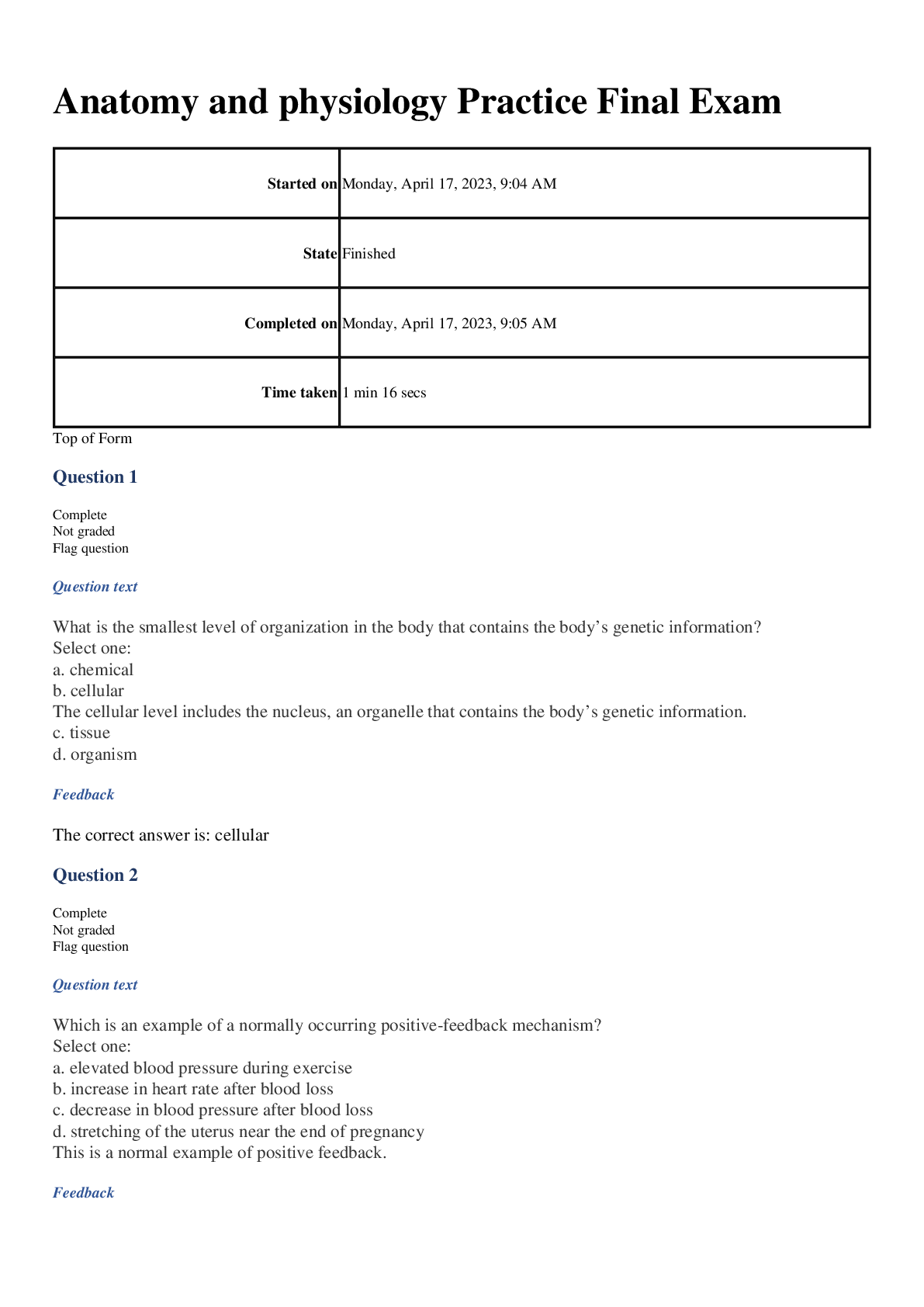
Topic 17: Review and Final Exam. Questions and answers. Rated A
Question 1
Complete
Not graded
Flag question
Question text
What is the smallest level of organization in the body that contains the body’s genetic information?
Select one:
a. chemical
b. cellular
The cellular level includes the nucleus, an organelle that contains the body’s genetic information.
c. tissue
d. organism
Feedback
The correct answer is: cellular
Question 2
Complete
Not graded
Flag question
Question text
Which is an example of a normally occurring positive-feedback mechanism?
Select one:
a. elevated blood pressure during exercise
This is an example of negative feedback.
b. increase in heart rate after blood loss
c. decrease in blood pressure after blood loss
d. stretching of the uterus near the end of pregnancy
Feedback
The correct answer is: stretching of the uterus near the end of pregnancy
Question 3
Complete
Not graded
Flag question
Question text
Which of the following processes generates the most ATP within a human cell?
Select one:
a. glycolysis
Glycolysis produces only 6 molecules of ATP.
b. lactic acid fermentation
c. oxidative phosphorylation
d. citric acid cycle
Feedback
The correct answer is: oxidative phosphorylation
Question 4
Complete
Not graded
Flag question
Question text
During DNA replication, how does each template strand eventually become two identical DNA molecules?
Select one:
a. The two strands form continuously, catalyzed by DNA polymerase.
There is a leading strand and a lagging strand; they don’t both form continuously.
b. The two strands form continuously, catalyzed by DNA ligase.
c. One strand forms continuously, the other forms in short segments spliced by DNA polymerase.
d. One strand forms continuously, the other forms in short segments spliced by DNA ligase.
Feedback
The correct answer is: One strand forms continuously, the other forms in short segments spliced by DNA ligase.
Question 5
Complete
Not graded
Flag question
Question text
Which is the most superficial layer of skin that is composed primarily of living cells?
Select one:
a. stratum corneum
This is the most superficial layer, but consists of mostly dead cells.
b. stratum lucidum
c. stratum basale
d. stratum spinosum
Feedback
The correct answer is: stratum spinosum
Question 6
Complete
Not graded
Flag question
Question text
Which of the following is the definition of a third degree burn?
Select one:
a. a burn that covers at least 25% of the skin
b. a burn that has destroyed the dermis and epidermis
This is the correct definition of a third-degree burn, which is the deepest type of burn.
c. a burn that can only be caused by fire
d. a burn that does not leave scars
Feedback
The correct answer is: a burn that has destroyed the dermis and epidermis
Question 7
Complete
Not graded
Flag question
Question text
Which of the following types of openings in the skeletal system does a “sinus” describe?
Select one:
a. cavity
A sinus is an air space within bone.
b. cleft
c. hole
d. tunnel
Feedback
The correct answer is: cavity
Question 8
Complete
Not graded
Flag question
Question text
Which of the following components of the bone matrix, when removed, allows the bone to be easily shattered?
Select one:
a. cartilage
b. collagen
c. hydroxyapatite
d. mineral
Minerals do make up part of the bone matrix, but if removed, it would allow the bone to be bent easily though not shattered.
Feedback
The correct answer is: collagen
Question 9
Complete
Not graded
Flag question
Question text
Which of the following is the most widely distributed type of muscle in the body?
Select one:
a. cardiac
b. postural
c. skeletal
Skeletal muscle is not as widely distributed as smooth muscle.
[Show More]