ATI
Fundamentals
Proctored Exam
Test Bank
2020 - 2021
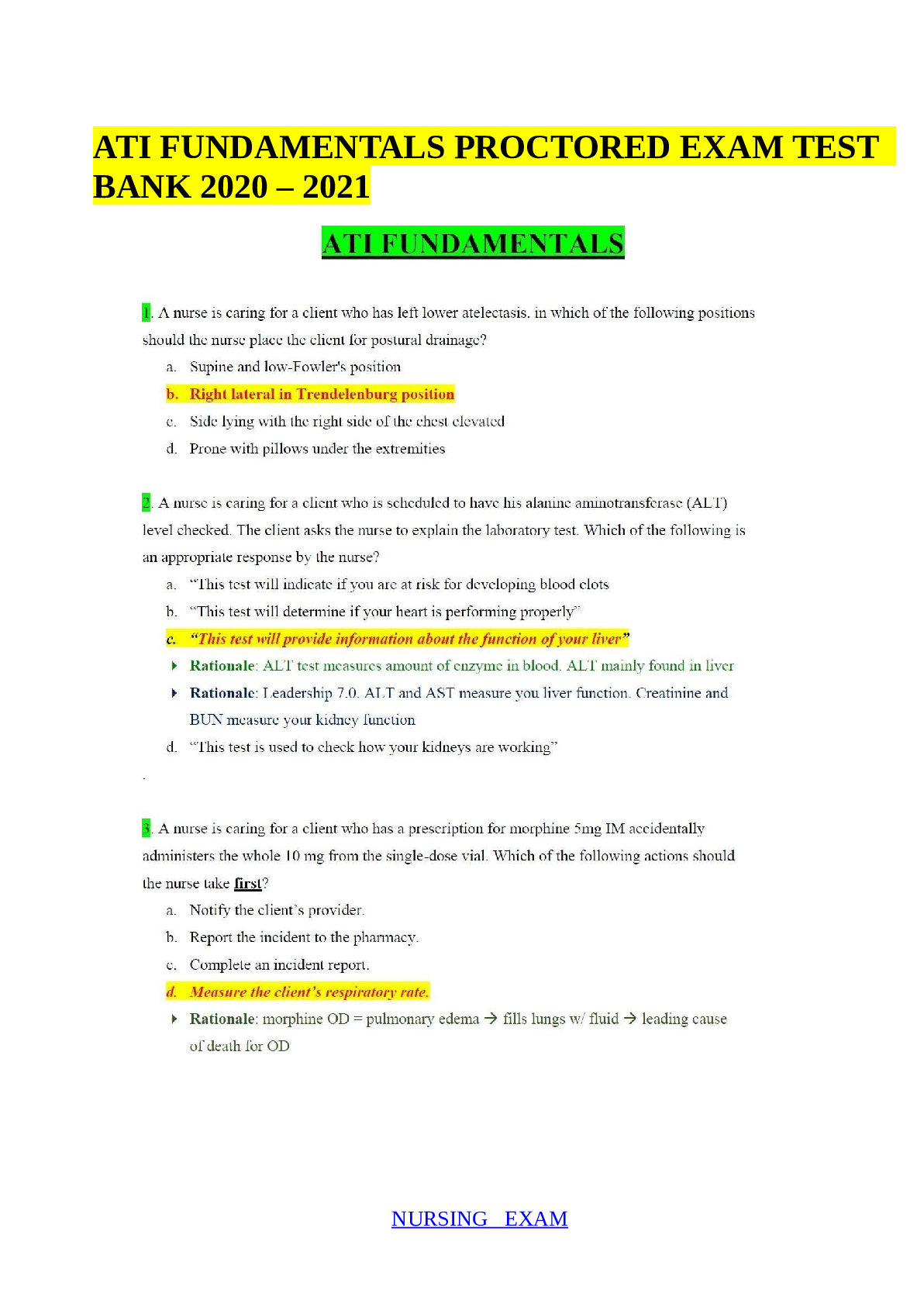
Rationale: Morphine can cause respiratory depression if given too much. Also you should ALWAYS ASSESS the pat
...
ATI
Fundamentals
Proctored Exam
Test Bank
2020 - 2021
Rationale: Morphine can cause respiratory depression if given too much. Also you should ALWAYS ASSESS the patient first when a med error is performed to make sure med error doesn‟t put the client‟s health in risk.
4. A nurse is preparing to administer diphenhydramine 20 mg orally to a 6-year-old child who has difficulty swallowing pills. Available is diphenhydramine 12.5 mg/5 mL oral syrup. Which of the following images shows the correct # of mL the nurse should administer? (Round the answer to the nearest whole number.)
Click on the syringe that has 8 mL of med.
20 mg x (5mL/12.5mg) = 8 mL
5. A nurse is caring for a 6-year-old child who has a new prescription for cefoxitin 80 mg/kg/day administered intravenously every 6 hour. The child weighs 20 kg. How much cefoxitin should the nurse administer with each dose? (Round the answer to the nearest whole number. Use a leading zero if it applies. Do not use a trailing zero.)
So it says each dose for the final answer, but we are given 80 mg/kg/day.
80 x 20 = 1600 / 4 (dose is given every 6 hours a day) =400 mg
Rationale: 80 mg x 20 kg = 1,600 1,600/4 x day (q6h) = 400 mg
6. A nurse is preparing to administer IV fluids to a client. The nurse notes sparks when plugging in the IV pump. Which of the following actions should the nurse take first?
a. Label the pump with a defective equipment sticker.
b. Unplug the pump.
c. Obtain a replacement pump.
d. Notified the biomedical department to fix the pump.
Rationale: Prioritization question. YOU WILL FIRST UNPLUG the IV pump to avoid causing a fire.
7. A nurse is caring for a client who has a surgical wound. Which of the following laboratory values places the client at risk for poor wound healing?
[Show More]