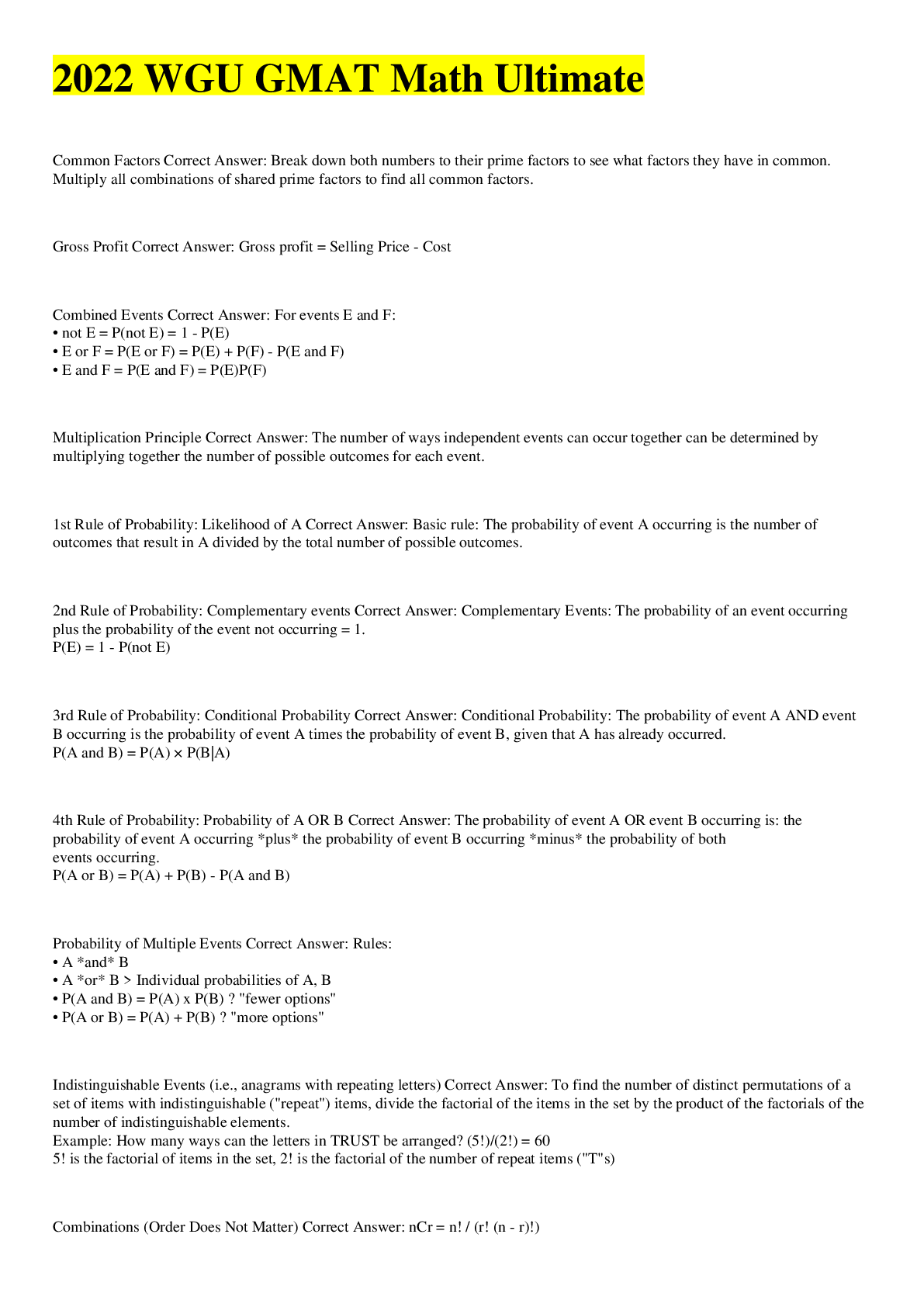
Common Factors
Break down both numbers to their prime factors to see what factors they have in
common. Multiply all combinations of shared prime factors to find all common factors.
Gross Profit
Gross profit = Selling
...
Common Factors
Break down both numbers to their prime factors to see what factors they have in
common. Multiply all combinations of shared prime factors to find all common factors.
Gross Profit
Gross profit = Selling Price - Cost
Combined Events
For events E and F:
• not E = P(not E) = 1 - P(E)
• E or F = P(E or F) = P(E) + P(F) - P(E and F)
• E and F = P(E and F) = P(E)P(F)
Multiplication Principle
The number of ways independent events can occur together can be determined by
multiplying together the number of possible outcomes for each event.
1st Rule of Probability: Likelihood of A
Basic rule: The probability of event A occurring is the number of outcomes that result in
A divided by the total number of possible outcomes.
2nd Rule of Probability: Complementary events
Complementary Events: The probability of an event occurring plus the probability of the
event not occurring = 1.
P(E) = 1 - P(not E)
3rd Rule of Probability: Conditional Probability
Conditional Probability: The probability of event A AND event B occurring is the
probability of event A times the probability of event B, given that A has already
occurred.
P(A and B) = P(A) × P(B|A)
4th Rule of Probability: Probability of A OR B
The probability of event A OR event B occurring is: the probability of event A
occurring plus the probability of event B occurring minus the probability of both
events occurring.
P(A or B) = P(A) + P(B) - P(A and B)
Probability of Multiple Events
Rules:
• A and B < A or B
• A or B > Individual probabilities of A, B• P(A and B) = P(A) x P(B) ← "fewer options"
• P(A or B) = P(A) + P(B) ← "more options"
Indistinguishable Events (i.e., anagrams with repeating letters)
To find the number of distinct permutations of a set of items with indistinguishable
("repeat") items, divide the factorial of the items in the set by the product of the factorials
of the number of indistinguishable elements.
Example: How many ways can the letters in TRUST be arranged? (5!)/(2!) = 60
5! is the factorial of items in the set, 2! is the factorial of the number of repeat items
("T"s)
Combinations (Order Does Not Matter)
nCr = n! / (r! (n - r)!)
Where n is the total number of items in the set and r is the number of chosen items.
Permutations (Order Does Matter)
nPr = n! / (n - r)!
Where n is the total number of items in the set and r is the number of chosen items.
Circular Permutations
The number of ways to arrange n distinct objects along a fixed circle is: (n - 1)!
Slope of a Line
y = mx + b
m = slope = (difference in y coordinates)/(difference in x coordinates) = (y2 - y1)/(x2-x1)
30-60-90 Triangle
30-60-90
x (shorter leg), x(sqrt 3) (longer leg), 2x (hypotenuse)
45-45-90 Triangle
45-45-90
x (shorter legs), x(sqrt 2) (hypotenuse)
Common Right Triangles
3-4-5 or 6-8-10 or 9-12-15
5-12-13
Number Added or Deleted
Use the mean to find number that was added or deleted.
• Total = mean x (number of terms)
• Number deleted = (original total) - (new total)
• Number added = (new total) - (original total)
Factors of Odd Numbers
Odd numbers have only odd factors
Quadratic Formula
To find roots of quadratic equation: ax^2+ bx + c = 0
x = [−b ± √(b^2 − 4ac)]/2a
Discriminant
Quadratic equation: ax^2+ bx + c = 0
Dicriminant = b^2 - 4ac
If discriminiant > 0, there are two roots (and two x-intercepts)
If discriminant = 0, there is one root (and one x-intercept)
If discriminant < 0, there are no (real) roots
Exponents(x^r)(y^r)=(xy)^r
(3^3)(4^3)=12^3 = 1728
Prime Factorization: Greatest Common Factor (GCF)
1. Start by writing each number as product of its prime factors.
2. Write so that each new prime factor begins in same place.
3. Greatest Common Factor (GCF) is found by multiplying all factors appearing on
BOTH lists.
60 = 2 x 2 x 3 x 5
72 = 2 x 2 x 2 x 3 x 3
GCF = 2 x 2 x 3 = 12
Prime Factorization: Lowest Common Multiple (LCM)
1. Start by writing each number as product of its prime factors.
2. Write so that each new prime factor begins in same place.
3. Lowest common multiple found by multiplying all factors in EITHER list.
60 = 2 x 2 x 3 x 5
72 = 2 x 2 x 2 x 3 x 3
LCM = 2 x 2 x 2 x 3 x 3 x 5 = 360
Check for Prime
1. Pick a number n.
2. Start with the least prime number, 2. See if 2 is a factor of your number. If it is, your
number is not prime.
3. If 2 is not a factor, check to see if the next prime, 3, is a factor. If it is, your number is
not prime.
4. Keep trying the next prime number until you reach one that is a factor (in which case
n is not prime), or you reach a prime number that is equal to or greater than the
square root of n.
5. If you have not found a number less than or equal to the square root of n, you can be
sure that your number is prime.
Ex: the number n=19 has a square root of ~4.35. Test 2, 3, 4 --> you know 19 is prime
because none of them are factors, and any other factor would be greater than sqrt(19).
Rate x Time = Distance (rt = d)
For a fixed distance, the average speed is inversely related to the amount of time
required to make the trip.
[Show More]