Pharmacology and the Nursing Process 9th Edition, chapter 1>58 Question and Answers (101 % verified)
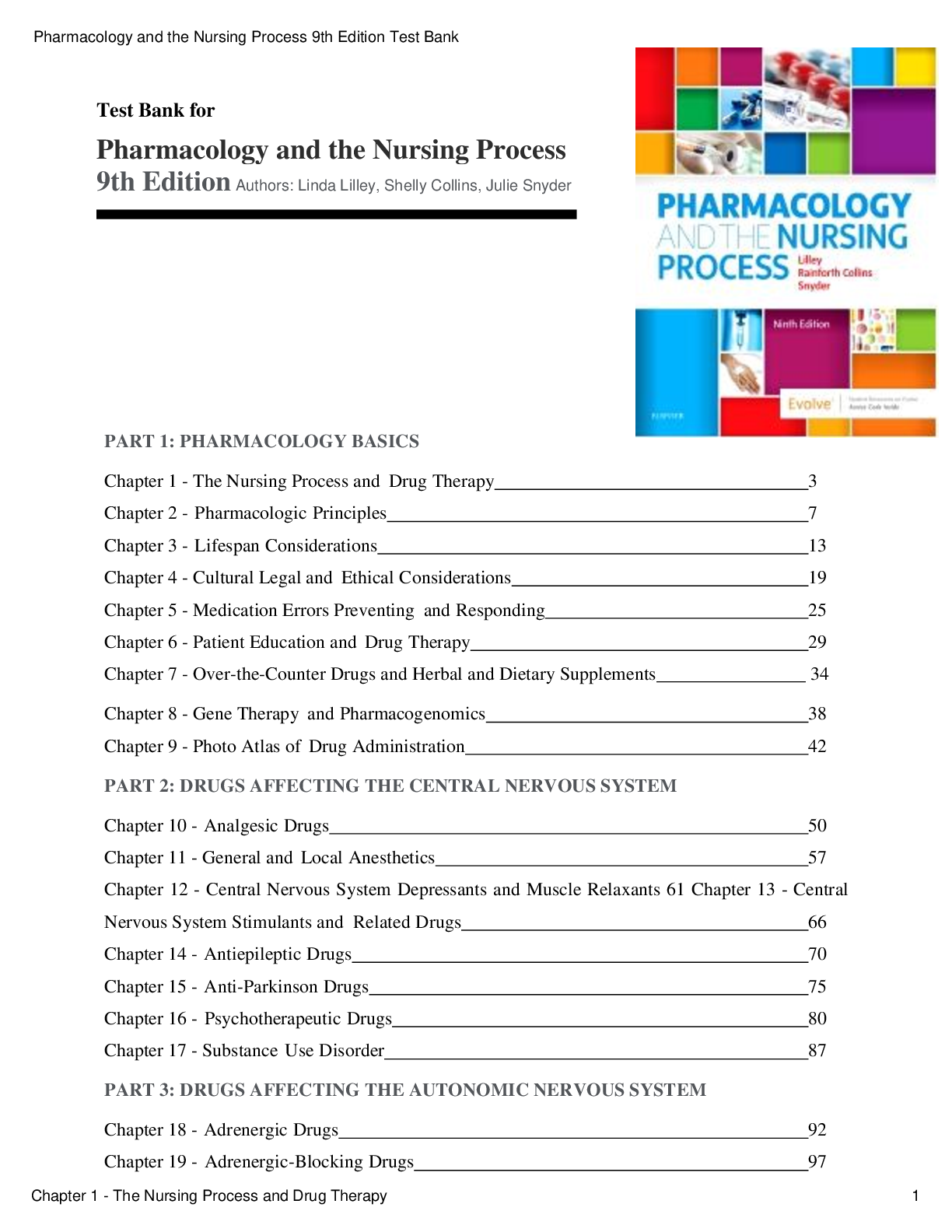
Chapter 1 - The Nursing Process and Drug Therapy 3
Chapter 2 - Pharmacologic Principles 7
Chapter 3 - Lifesp
...
Pharmacology and the Nursing Process 9th Edition, chapter 1>58 Question and Answers (101 % verified)
Chapter 1 - The Nursing Process and Drug Therapy 3
Chapter 2 - Pharmacologic Principles 7
Chapter 3 - Lifespan Considerations 13
Chapter 4 - Cultural Legal and Ethical Considerations 19
Chapter 5 - Medication Errors Preventing and Responding 25
Chapter 6 - Patient Education and Drug Therapy 29
Chapter 7 - Over-the-Counter Drugs and Herbal and Dietary Supplements 34
Chapter 8 - Gene Therapy and Pharmacogenomics 38
Chapter 9 - Photo Atlas of Drug Administration 42
Chapter 10 - Analgesic Drugs 50
Chapter 11 - General and Local Anaesthetics 57
Chapter 12 - Central Nervous System Depressants and Muscle Relaxants 61
Chapter 13 - Central Nervous System Stimulants and Related Drugs 66
Chapter 14 - Antiepileptic Drugs 70
Chapter 15 - Anti-Parkinson Drugs 75
Chapter 16 - Psychotherapeutic Drugs 80
Chapter 17 - Substance Use Disorder 87 Chapter 18 - Adrenergic Drugs 92
Chapter 19 - Adrenergic-Blocking Drugs 97
Chapter 20 - Cholinergic Drugs 102
Chapter 21 - Cholinergic-Blocking Drugs 107
Chapter 22 - Antihypertensive Drugs 112
Chapter 23 - Antianginal Drugs 118
Chapter 24 - Heart Failure Drugs 124
Chapter 25 - Ant dysrhythmic Drugs 129
Chapter 26 - Coagulation Modifier Drugs 134
Chapter 27 - Antilipemic Drugs 140
Chapter 28 - Diuretic Drugs 145
Chapter 29 - Fluids and Electrolytes 151
Chapter 30 - Pituitary Drugs 157
Chapter 31 - Thyroid and Antithyroid Drugs 161
Chapter 32 - Antidiabetic Drugs 166
Chapter 33 - Adrenal Drugs 174
Chapter 34 - Women’s Health Drugs 178
Chapter 35 - Men’s Health Drugs 185
Chapter 36 - Antihistamines Decongestants Antitussives and Expectorants 189
Chapter 37 - Respiratory Drugs 194 Chapter 38 - Antibiotics Part 1 199
Chapter 39 - Antibiotics Part 2 206
Chapter 40 - Antiviral Drugs 211
Chapter 41 - Ant tubercular Drugs 216
Chapter 42 - Antifungal Drugs 221
Chapter 43 - Antimalarial Antiprotozoal and Anthelmintic Drugs 226
Chapter 44 - Anti-inflammatory and Antigout Drugs 231
Chapter 45 - Antineoplastic Drugs Part 1 Cancer Overview and Cell Cycle 236
Chapter 46 - Antineoplastic Drugs Part 2 Cell Cycle Nonspecific and Misc Drugs 242
Chapter 47 - Biologic Response–Modifying and Ant rheumatic Drugs 247
Chapter 48 - Immunosuppressant Drugs 252
Chapter 49 - Immunizing Drugs 257
Chapter 50 - Acid-Controlling Drugs 262
Chapter 51 - Bowel Disorder Drugs 268
Chapter 52 - Antiemetic and Ant nausea Drugs 275
Chapter 53 - Vitamins and Minerals 280
Chapter 54 - Anaemia Drugs 286
Chapter 55 - Nutritional Supplements 292
Chapter 56 - Drugs 296
Chapter 57 - Ophthalmic Drugs 302
Chapter 58 - Otic Drugs 307
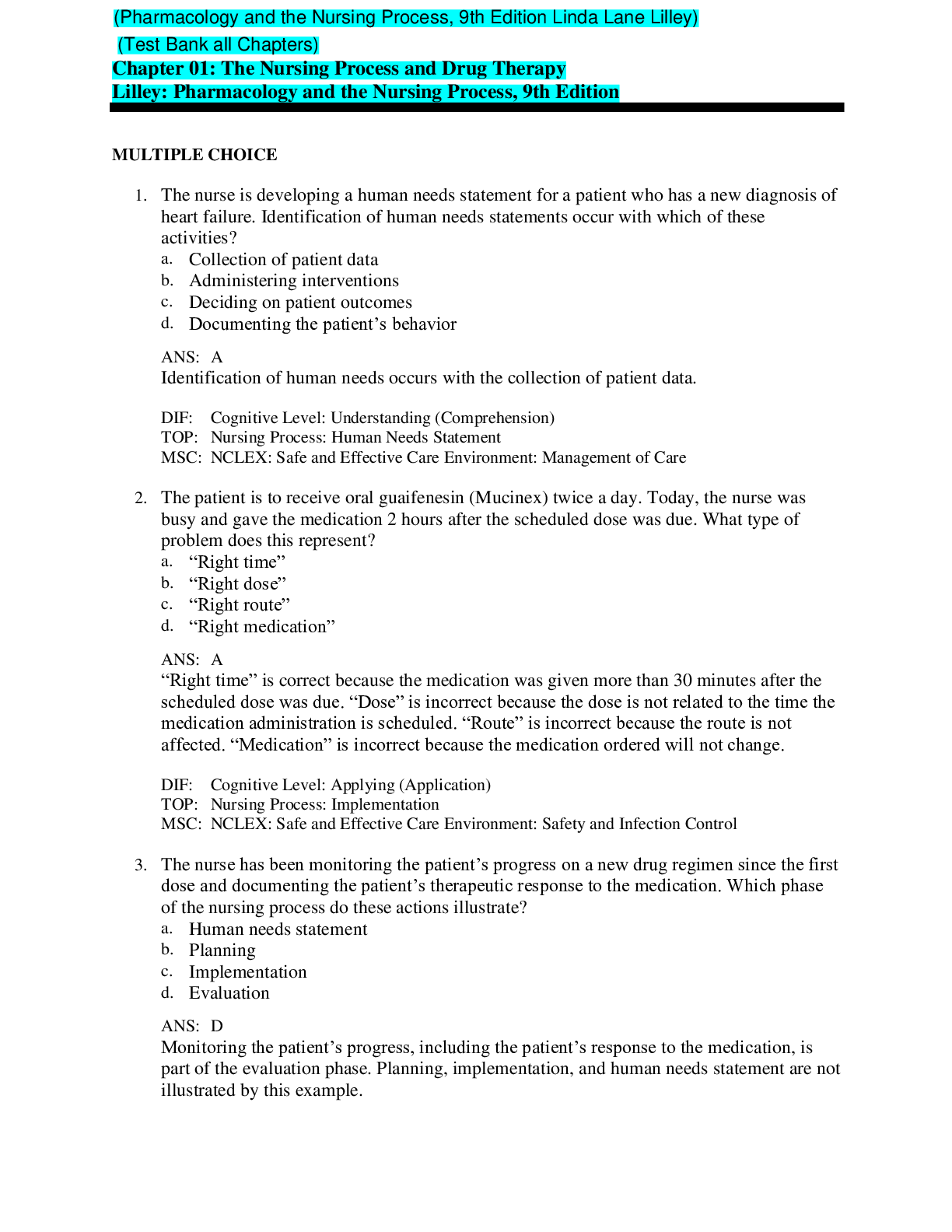
Chapter 01: The Nursing Process and Drug Therapy Lilley: Pharmacology and the Nursing Process, 9th Edition
MULTIPLE CHOICE
1.The nurse is developing a human needs statement for a patient who has a new diagnosis of heart failure. Identification of human needs statements occur with which of these activities?
a. Collection of patient data
b. Administering interventions
c. Deciding on patient outcomes
d. Documenting the patient’s behavior
ANS: A
Identification of human needs occurs with the collection of patient data.
DIF: Cognitive Level: Understanding (Comprehension) TOP: Nursing Process: Human Needs Statement
MSC: NCLEX: Safe and Effective Care Environment: Management of Care
2.The patient is to receive oral guaifenesin (Mucinex) twice a day. Today, the nurse was busy and gave the medication 2 hours after the scheduled dose was due. What type of problem does this represent?
a. “Right time”
b. “Right dose”
c. “Right route”
d. “Right medication”
ANS: A
“Right time” is correct because the medication was given more than 30 minutes after the scheduled dose was due. “Dose” is incorrect because the dose is not related to the time the medication administration is scheduled. “Route” is incorrect because the route is not affected. “Medication” is incorrect because the medication ordered will not change.
DIF: Cognitive Level: Applying (Application) TOP: Nursing Process: Implementation
MSC: NCLEX: Safe and Effective Care Environment: Safety and Infection Control
3. The nurse has been monitoring the patient’s progress on a new drug regimen since the first dose and documenting the patient’s therapeutic response to the medication. Which phase of the nursing process do these actions illustrate?
a. Human needs statement
b. Planning
c. Implementation
d. Evaluation
ANS: D
Monitoring the patient’s progress, including the patient’s response to the medication, is part of the evaluation phase. Planning, implementation, and human needs statement are not illustrated by this example.
DIF: Cognitive Level: Understanding (Comprehension) TOP: Nursing Process: Evaluation
MSC: NCLEX: Safe and Effective Care Environment: Management of Care
4. The nurse is assigned to a patient who is newly diagnosed with type 1 diabetes mellitus. Which statement best illustrates an outcome criterion for this patient?
a. The patient will follow instructions.
b. The patient will not experience complications.
c. The patient will adhere to the new insulin treatment regimen.
d. The patient will demonstrate correct blood glucose testing technique.
ANS: D
“Demonstrating correct blood glucose testing technique” is a specific and measurable outcome criterion. “Following instructions” and “not experiencing complications” are not specific criteria. “Adhering to new regimen” would be difficult to measure.
[Show More]