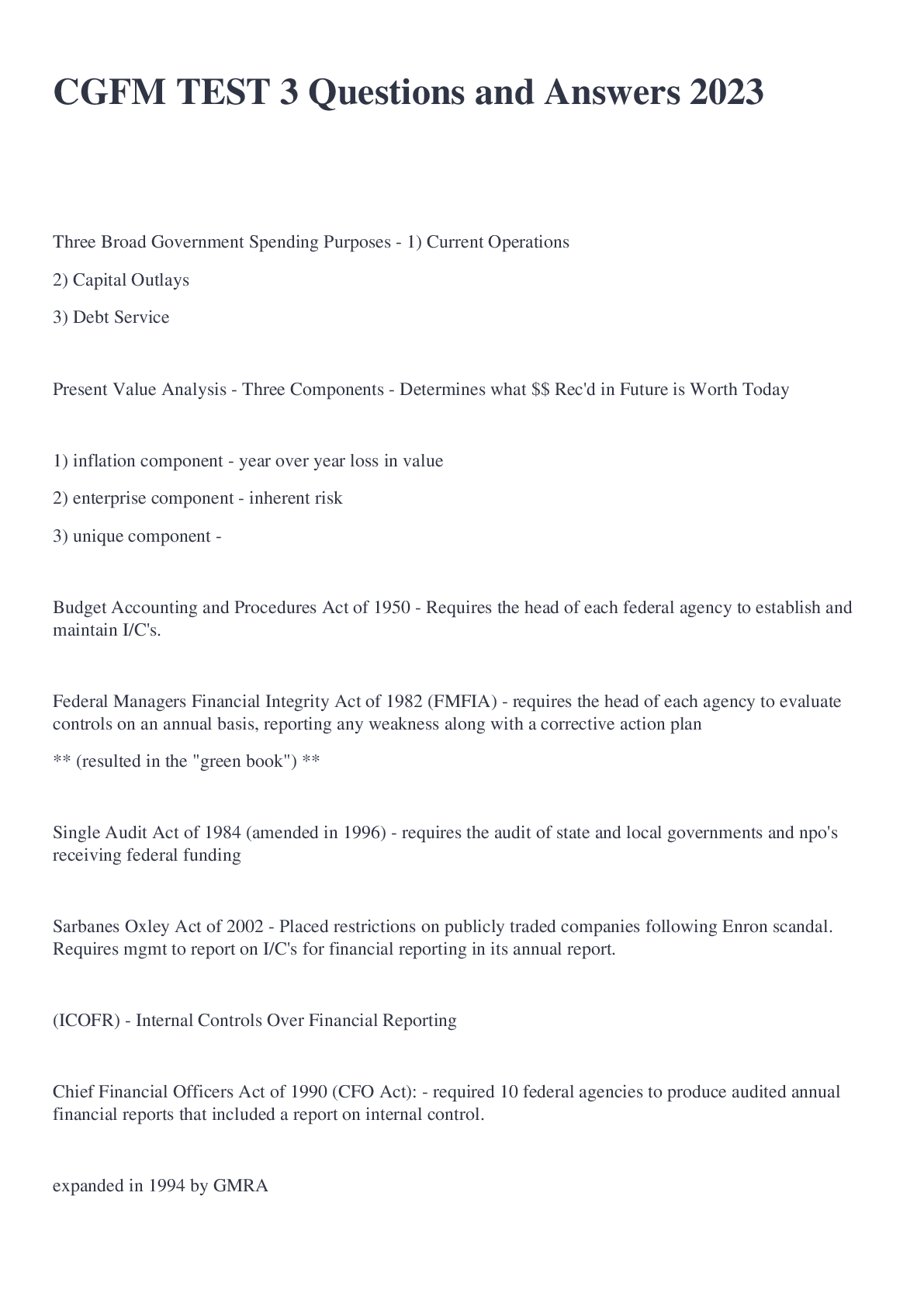
Three Broad Government Spending Purposes - 1) Current Operations
2) Capital Outlays
3) Debt Service
Present Value Analysis - Three Components - Determines what $$ Rec'd in Future is Worth Today
1) inflation compo
...
Three Broad Government Spending Purposes - 1) Current Operations
2) Capital Outlays
3) Debt Service
Present Value Analysis - Three Components - Determines what $$ Rec'd in Future is Worth Today
1) inflation component - year over year loss in value
2) enterprise component - inherent risk
3) unique component -
Budget Accounting and Procedures Act of 1950 - Requires the head of each federal agency to establish and maintain I/C's.
Federal Managers Financial Integrity Act of 1982 (FMFIA) - requires the head of each agency to evaluate controls on an annual basis, reporting any weakness along with a corrective action plan
** (resulted in the "green book") **
Single Audit Act of 1984 (amended in 1996) - requires the audit of state and local governments and npo's receiving federal funding
Sarbanes Oxley Act of 2002 - Placed restrictions on publicly traded companies following Enron scandal. Requires mgmt to report on I/C's for financial reporting in its annual report.
(ICOFR) - Internal Controls Over Financial Reporting
Chief Financial Officers Act of 1990 (CFO Act): - required 10 federal agencies to produce audited annual financial reports that included a report on internal control.
expanded in 1994 by GMRA
INTERNAL CONTROLS - systems and techniques managers use to provide reasonable assurance that agency objectives met in an effective/efficient manner, in compliance with laws/regulations, and to safeguard assets.
Implemented to accomplish certain results, prevent problems, or detect problems that have occurred.
Some controls can both detect and prevent problems (but only if their existence is known).
TIME VALUE OF MONEY - Used in consideration of capital budgeting
1) Present Value Analysis
2) Future Value Analysis
3) Payback Analysis
Flowcharting - Iterative process requiring changes throughout development, each step represents a decision, also used to evaluate processes for effective internal controls
Earned Value Management (EVM) - project mgmt system that weighs both schedule and cost performance to determine if a project is delivering expected results on time and within budget
Regression Analysis - Predicts the relationship between variables:
1) Direct Linear Regression
2) Indirect Linerar Regression
3) Non-linear Regression
4) No Relationship
** See Limits of Regression Analysis
Correlation Coefficient - Determines the degree of accuracy the analysis (variables) can be used to predict results (1=perfect correlation
.85 considered reliable for forecasting)
Multiple Regressions - analyzes multiple IV's and look for items with the highest correlation coefficient as being the most like predictors
Limits of Regression Analysis - Data ranges must be relevant (e.g., sample size might be too small to project on a larger population)
Difficult to find data sets with high correlation coefficients
Bad data = bad results (garbage in, garbage out)
Correlation is not Causation, have to be able to explain how one set of data would influence another
Data Analytics - inspecting, cleaning, transforming, and modeling data to find useful information, conclusions, and support decision making
Data Mining - (Predictive) sorting through large data sets and using filters and algorithms to pick out relationships
** See strengths and weaknesses
Predictive Analytics - data collected through a variety of techniques to analyze current and historical facts to make predictions about future events
Data Mining Strengths and Weaknesses - * Strengths
Analyst is able to review complete data sets
Ability to link together multiple data sources
* Weaknesses
Must have quality data
Must have ability to understand program requirements and how this is represented in the data
Starting a Data Analytic Program - Collaborate with other agencies for data collection and sharing
Determine ROI in Analytics Programs
Give leaders clear concise analysis they can use to support data driven programs
Enable employees at all levels to see and utilize data for their needs (not just the needs of senior leaders
Managers to demand the use of data and provide employees with targeted on the job training
Forensic Auditing - examination of financial information that is likely to be used for the investigation and prosecution of financial crimes
Need to have knowledge of basic legal principles, standards for discovery
Steps for Forensic Auditing - a) data collection,
b) data preparation,
c) data analysis,
and d) reporting
Benford Digital Analysis - based on observation that more transactions begin with the number one than larger numbers. More transactions will start with number one than number two ... and more with number two, than number three, etc...
Because there is an expected distribution of numbers, the testing an point out potentially fraudulent transactions
Competitive Source Analysis - Used to determine if there is a benefit to contracting government services to the private sector:
1) Conduct a management study
2) Prepare a performance work statement - defines the expected outputs/results
3) Project the in-house and contract costs
4) Select the best alternative - combination of performance and price
Ratio Analysis - Active use of numbers to point out problems and indicate performance, questions to ask, etc. They serve as starting points for further inquiry.
Ex. numbers revealing that receivables are increasing could trigger an increase in debt collection efforts. Other rations could indicate fiscal stress, adequacy of reserves, liquidity, workloads, response times, and accuracy rates.
Pure Ratios - relating one number to another to create a meaningful indicator of performance (ex., total expenditures to budget).
Comparative Analysis - Comparing entities numbers and ratios to another agency or benchmarks. Credit rating agencies also publish median ratios by industry and what they consider to be reasonable ranges and ratios
Time Series Analysis - comparing the agency against itself over time, ex. Calculating the percentage change from year to year
Common Size Statements - converts all data elements in a statement to percentages of 100, Examines expenditures of a function as compared to total expenditures (ex., percentage of total budget spent on public safety year over year, and if it is growing disproportionately to other programs)
Per Capita Information - Debt per capita
Cautionary Note on Ratio Analysis - Not an ends unto themselves but serve as a starting point for further investigation.
Liquidity Ratios - Determines entities ability to meet creditors demands:
1) Current Ratio
2) Quick Ration
Current Ratio = current assets/current liabilities - current assets = cash and those assets that will become cash within one year (including inventories)
Current liabilities = those that are due and payable within one year
Should be a ratio of 2:1
Quick Ratio = Cash and equivalents, and receivables/current liabilities - Removes the uncertainty over inventories
Ideal ration should be 1:1
Asset efficiency and Turn-Over ratios - Efficiency in using assets and converting them to cash.
1) Receivables Ratios
2) Inventory Ratios
Receivables Ratios - ex., percentage of tax collections/taxes levied. Rating agencies expect 98-99% range.
Days outstanding = Avg receivables/Annual revenues x 365
Avg receivables = (Beg of year receivables + end of year receivables)/2
Inventory Ratios - helps determine risk of loss from spoilage, pilfering, obsolescence, etc.
Inventory turnover = Revenues from sales of inventory/Avg inventory during the period
Avg inventory = 365/Inventory Turnover
Operating Costs and Budgetary Cushions - Extent to which entities revenues are sufficient to cover costs, or build balances for working capital, rainy day funds, emergency needs, or debt service coverage.
Budgetary cushion is considered to be one of the most important financial ratios for state and local governments
Need to watch out for balancing the budget with one time inflows
Debt Burden - Burden of 15-20% and above considered "high" by rating agencies. Measured by:
* outstanding LTD/population
* outstanding LTD/assessed property values
Ability to repay Debt - Excess revenues over operating expenditures/
Principal payment + interest expense
Government Mgmt Reform Act of 1994 (GMRA) - Expanded CFO Act to require 24 agencies to prepare an audited annual consolidated financial statement for the executive branch of the federal government
Federal Financial Mgmt Improvement Act of 1996 (FFMIA) - requirement to follow federal accounting standards, a standardized financial mgmt system, and standard general ledger (sgl) at the transaction level
Accountability of Tax Dollars Act of 2002 - Annual audit requirement expanded to include ALL federal agencies
* OMB Circular A-123 - Mgmts Responsibility for Internal Control - Mgmt responsible for:
1) develop/implement cost effective I/C's
2) assess the adequacy of I/C's in programs/ operations
3) assess/correct ICOFR
4) identify needed improvements
5) take corresponding corrective action
6) report annually on I/C through mgm Statement of Assurance (SOA)
Appendix A - strengthened process for ICOFR
Appendix B - mgmt of gov't charge card programs
Appendix C - measurement and remediation of improper payments
Appendix D (2013) - FFMIA guidance for agencies subject to CFO Act
OMB Circular A-130 Mgmt of Federal Information Resources - establishes minimum set of controls in federal automated information security programs
GAO Standards for I/C in Fed Gov't - See Appendix 2
Government Accountability w/Reasonable Assurance of ... - 1) achieving program objectives/mission
2) using resources efficiently
3) complying with legal requirements
4) accurate and reliable financial reporting
5) safeguarding resources/assets
Five Internal Control Components/Standards - Development - Developed by the Committee of Sponsoring Organizations (COSO) in 1992, updated in 2013
Per COSO, Internal controls are intended to meet three major objectives:
1) Operations, 2) Reporting, 3) Compliance
Five Internal Control Components/Standards - TRIANGLE - 1) Control Environment - Base -> most important
2) Risk Assessment
3) Control Activities
4) Info and Communication
5) Monitoring
IC Standard 1: Control Environment - 5 Principles - Five principles of Control Environment:
1) Commitment to integrity and ethical values
2) Independence of oversight body and mgmt
3) Establish structures, reporting lines, and responsibilities
4) retain competent individuals in alignment with objectives
5) individuals held accountable for their I/C responsibilities
* Most important component of Internal Control
Control Environment - Commitment to Integrity - Demonstrated by:
* code of conduct that reflects organizational core values
* employees understand what is ethical by mgmt communications and actions
* employees know how to act if they see unethical behavior
* management does not routinely override controls
* management emphasizes long-term goals instead of short term gains
* management actively discourages unethical behavior
Control Environment - Commitment to Competence - Demonstrated by:
* clearly defined KSA's assigned to job functions
* ambiguous and unrealistic job descriptions revised when necessary
* periodic EE evaluations and counseling
* EE training and development programs
* Appropriate levels of supervision
* promotions/compensation consistent with evaluation results
Control Environment - Mgmt Philosophy and Operating Style - * overly aggressive = values short term over long term and results over integrity
* turn over in key positions a red fla
[Show More]