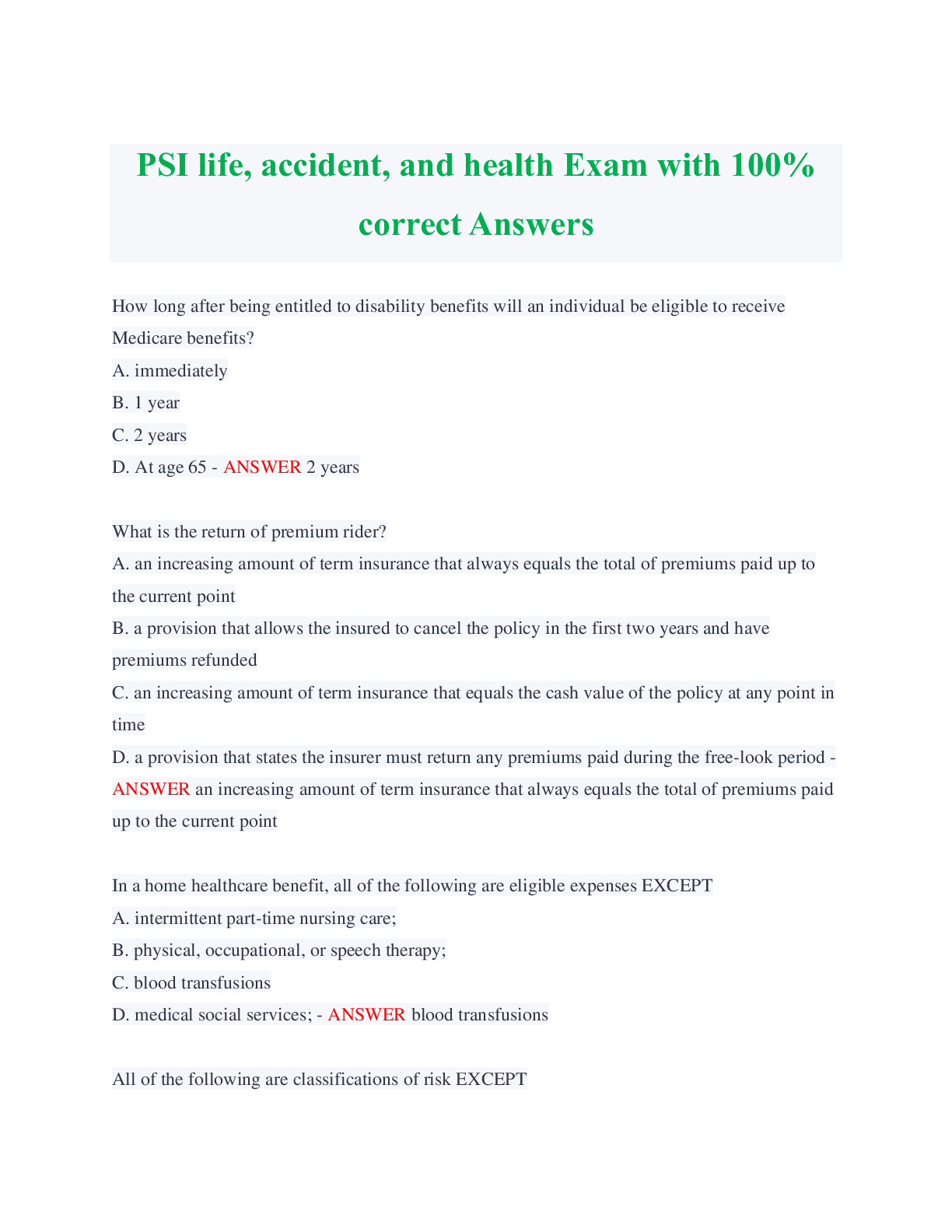
Accountability - ANSWER-Principle that, in a democracy, government operates by the consent of the people. Therefore, it is responsible to, and must answer to, the people for its actions and results, including the taking
...
Accountability - ANSWER-Principle that, in a democracy, government operates by the consent of the people. Therefore, it is responsible to, and must answer to, the people for its actions and results, including the taking and using of the people's resources
Allotment - ANSWER-In the federal government, an agency's distribution of apportioned budgetary authority to various components within the agency. After the executive agency receives its apportionment, it allots budgetary authority to specific components within the agency
Anti-Deficiency Act - ANSWER-At the federal level, a law stating that officials can be fined and/or jailed if they obligate the government to spend funds beyond the legally authorized purpose, time, or amount
Apportionment - ANSWER-Definitions may vary at different levels of government. At the federal level, this is OMB's approval to use a portion of the legislatively approved budgetary authority
Appropriated Budget - ANSWER-Budget that has been passed by the legislative branch (and signed by the chief executive, if required); has effect of law
Appropriation - ANSWER-A legislative enactment (law, statute, or ordinance) that created spending authority; the legal authority to incur expenses and spend money
Attestation Engagement - ANSWER-Engagement concerning with examining, reviewing, or performing agreed-upon procedures on a limited subject matter, or a limited assertion about a subject matter, and reporting on the results. The subject matter may be financial or nonfinancial
Authorization - ANSWER-Legislative enactment that approves programs; prescribes what activities an agency may pursue if funding is available
Block Grant - ANSWER-One type of formula grant. Block grants combine several service categories into one grant and, thus, allow maximum flexibility to the grantee to use the funds to meet local needs
Capital Budget - ANSWER-Forecasts and controls spending for "big-ticket" items that are acquired and used over a period of several years, such as construction projects and major equipment purchases. Used at state and local levels
Capital Lease - ANSWER-A lease of real property that meets defined criteria requiring the government to report the property as if it were purchased with the proceeds of long-term debt
Cash-flow budget - ANSWER-Forecasts the timing, as well as amount of cash flows, for a period. Use to project required cash levels
Categorical grant - ANSWER-One type of formula grant that can be used for a narrowly defined purpose
Central management agencies - ANSWER-Government agencies that provide central management services to other components. An example would be a state government's human resource office (that serves all state agencies) or the OMB at the federal level
Certificate of Excellence in Accountability Reporting (CEAR) - ANSWER-An AGA program that helps federal agencies and their components produce effective, high-quality Performance and Accountability Reports/Agency Financial Reports
Certificate of participation - ANSWER-Form of share government financing. In a typical form, several financial institutions share in a loan arrangement with a government entity
Charter - ANSWER-Local government version of a constitution. States may provide for the establishment of local governments through charters.
Checks and Balances - ANSWER-Process by which one branch of government (legislative, executive, or judicial) can constrain actions of the other branches. Flows from separation of powers
Chief Financial Officers (CFO) Act - ANSWER-A 1990 law that, among other provisions, requires the federal government's major executive branch agencies to have a CFO. Prescribes duties and reporting requirements, and requires audited financial statements
Commission - ANSWER-Government component established by law, statute, or ordinance. May be permanent or temporary. Because it is establish by law, it may have greater autonomy and authority that government components that are administratively established.
Component - ANSWER-Organized unit of government, such as agency, office, or department. Found in all branches of government at all levels
Comprehensive Annual Financial Report (CAFR) - ANSWER-A financial report that includes MD&A, basic financial statements, footnotes, and other required supplementary information, as well as an introductory section, additional financial information (i.e. combing and individual fund schedules, if applicable), and a statistical section
Conflict of Interest - ANSWER-Arise when one has a personal interest in matters relating to official duties or activities. Such conflicts can destroy objectivity and independence and prevent the exercise of due care
Consumption tax - ANSWER-Broad category of tax that includes sales, use, excise and value-added taxes
Continuity of operations - ANSWER-Refers to efforts to ensure the organization can sustain essential operations, regardless of planned or unplanned incidents or disruptions
Covenant (bond) - ANSWER-legal requirements pertaining to a specific bond issue. Typically defined the maturity date, revenue stream that will be used to repay the debt, interest rate and repayment schedule. May require a sinking fund and may specify conditions that must be met while bonds are outstanding, and/or before new debt can be issued
Credit-rating Agency - ANSWER-Independent organization that assesses the credit worthiness of borrower. Three major rating agencies are Standards & Poors, Moody's Investor Service, and Fitch Ratings
Data Mining - ANSWER-Using special, computer-based techniques, such as filters and algorithms, to extract meaningful information from large bodies of data
Dedicated collections - ANSWER-Taxes levied or other revenues collected to finance a specific activity. Proceeds that are deposited into an account restricted to that activity. Also referred to as earmarked or restricted taxes
Deficit - ANSWER-Occurs when government expenditures for a specific fiscal period exceed revenues and other financial inflows
Diligence - ANSWER-Pursuing an event, action, or assignment to a timely and sufficient end or close
Discretionary grant - ANSWER-A term sometimes used to mean "Project Grant"
Donation - ANSWER-Voluntary contribution that confers no rights or benefits on the giver
Due Care - ANSWER-To discharge professional responsibilities with competence and diligence, to the best of one's ability, and with the same level of ability and skill as others in similar positions. It also means to act in the best interest of those served
Earmarking - ANSWER-Variation on use of special funds. Revenues from specific taxes or other sources is set aside for specific activities. One example is the use of gasoline taxes for highway improvements. Also referred to as "dedicated collections". The term is used to signify the legislature reserving a portion of an appropriation for a specific, limited purpose
Enterprise resource planning (ERP) system - ANSWER-Major "end-to-end" computer system that links many functions and departments. Used to simplify and streamline financial management, and to integrate operations with financial mangement
Estate tax - ANSWER-Form of wealth tax. Levied on the estate of the deceased person before his or her assets are distributed to heirs
Ethics - ANSWER-A complex system of discipline that civilized societies impose on themselves through laws, customs, standards, social etiquette and other rules to govern moral conduct.
Excise tax - ANSWER-Form of consumption tax. Levied on the consumption of a particular type of good or participation in a certain type of activity. Whereas general sales taxes are broad-based, this is more narrow
Executive Order - ANSWER-Order issues by the president, governor or a local government's chief executive that does not violate laws or statutes, and has substantial impact on policy and procedures of government. It carries less weight than a law because of the legislature or next chief executive may overturn the previous order
Fair - ANSWER-Free form of self-interest, prejudice, or favoritism. Implies an elimination of one's own feelings, prejudices, and desires so as to achieve a proper balance of conflicting interests
Federal Accounting Standards Advisory Board (FASAB) - ANSWER-Defined GAAP for entities of the federal government; this includes the national government as whole plus distinct components
Federalism - ANSWER-Principle that government authority and responsibility is shared among different levels of government
Financial Accounting Standards Board (FASB) - ANSWER-Defined GAAP for private sector entities. Occasionally, GASB and FASAB make FASB standards applicable to state or local or the national, governments, respectively
Financial Management System - ANSWER-Organized means for the collection, processing, transmission and dissemination of financial information. Includes policies and procedures and trained personnel, as well as any applicable computer hardware and software.
Financial Statement Audit - ANSWER-Examination of financial statements, accomplished by an independent auditor. Results in an opinion on whether the financial statements are presented fairly in accordance with GAAP or other comprehensive basis of accounting
Financai Report - ANSWER-External report that depicts financial position and financial results of an entity
Formula Grant - ANSWER-A type of intergovernmental grant that includes both categorical grants and block grants, in which the amount of the grant is based on a formula, contained in law or regulation that determines the total amount each recipient will receive, if basic eligibility requirements are satisfied
Forensic audting - ANSWER-"Forensic" implies that the results will be admissible as legal evidence. Combines the skills of auditors and accountants with investigative techniques, useful for both the detecting and prevention of fraud
General Assembly - ANSWER-Name often applied to the legislative branch at the state level
General obligation bonds - ANSWER-Form of government debt that is back by the full faith and credit of the government. Contracts with revenue bonds
General-purpose government - ANSWER-Entity at the national, state or local level that provides a broad range of services
Generally Accepted Government Auditing Standards (GAGAS) - ANSWER-Issued by the GAO, to define the expected levels of performance for the conduct of an audit or attestation of a government organization, program, activity, or function (also called government auditing standards or Yellow Book)
Governmental Accounting Standards Board (GASB) - ANSWER-Defined GAAP for state and local government entities
Government Corporation - ANSWER-Quasi-government entity formed to support businesslike functions where most, if not all, operating expenses are expected to be covered through revenues and feeds, rather than from appropriated budget authority
Government Performance and Results Act (GPRA) - ANSWER-U.S. law passed in 1993; required federal agencies to create long-term strategic plans. The strategic plans are followed by annual performance plans (currently performance budgets), and annual performance reports. (The law has been updated with the Government Performance and Results Act Modernization Act, enacted in 2010)
Grant - ANSWER-Funds transferred from one level of government to another for specific or broad purposes
Impartial - ANSWER-Lack of favoritism. The absence of favor or prejudice. Treating or affecting all equally
Income Tax - ANSWER-Tax based on income and levied on individuals or corporations. Used most often at national and state levels, though some states allow local governments to impose income taxes
Independence - ANSWER-Free of relationship that may impair, or appear ti impair, one's ability to act with objectivity. It is the quality of being free of an obligation to particular parties or interest
Inheritance tax - ANSWER-Form of wealth tax. Levied on the person receiving a bequest
Initiative - ANSWER-Process that enables citizens to present their view of a problem and a proposed solution, rather than depending on a solution devised and enacted by the legislative branch. Allows direct citizen action to affect laws
Intangibles tax - ANSWER-Form of wealth tax. Applied to intangible assets such as stocks and bonds, savings accounts, trademarks, and accounts receivable
Internal Control - ANSWER-Organization and activities design to ensure programs achieve their intended results; resources are used efficiently and effectively; programs and resources are protected from waste, fraud, and mismanagement; laws and regulations are followed; and reliable and timely information is obtained, maintained, and reported
Judicial Review - ANSWER-Principle by which the judicial branch may review actions by the legislative branch and if appropriate, declare them unconstitutional or illegal. Flows from the separation of powers
Lease-purchase - ANSWER-Practice by which a government entity assumes a long-term lease on a capital asset and, at the end of the lease period, the asset may transfer to the government. Usually, these do not require voter approval.
License fee - ANSWER-Fee paid to the government for a specific privilege, often related to an activity. Ranges from recreation to business
Line-item veto - ANSWER-Authority that allows the chief executive, such as a governor or mayor, to strike individual line items from the budget without vetoing the enter budget bill.
Lottery - ANSWER-State-controlled gambling, used by many states as a source of revenue
Management Cycle - ANSWER-Refers to the sequence of activities entailed in managing a government and/or its operations. The activities include planning, programming, budgeting, operations, accounting, reporting and auditing
Mediation - ANSWER-Form of conflict resolution that involves an objective, third-party mediator who tried to bring the disputants closer together. Unlike arbitration, mediation is usually voluntary and nonbinding
Note - ANSWER-Form of government debt used as a short-term financing source. Due to the short maturity period, the principle and interest for a note are frequently retired simultaneously upon maturity (that is, no periodic interest payments)
Object Class - ANSWER-A budget or accounting category that defined the resources to be applied to specific types of inputs, such as personnel, travel, tools or supplies
Objectivity - ANSWER-Imposes the obligation to be impartial, intellectually honest, and free from conflicts of interest
Operating budget - ANSWER-Defines level of resources to be applied in providing government programs and services; usually covers periods of one to two years
Ordinance - ANSWER-Law enacted by a legislative body below the state level, such as a county, city, or town
Outcome - ANSWER-Results of government programs, such as the number of gainfully employed graduates or reduction in road accidents. More difficult to measure than outputs
Output - ANSWER-The goods or services produces
Performance and accountability report - ANSWER-A single report that combines financial results and performance results. Recent requirement for federal executive agencies, but may be practiced at other levels of government
Performance audit - ANSWER-Examination of the performance and management of a program against objective criteria. Contrasts
[Show More]











![Preview of THE TEFL ACADEMY LEVEL 5 - ASSIGNMENT C - AUTHENTIC MATERIAL [2026]](https://browseimages.nyc3.digitaloceanspaces.com/paper-images/2026/04/10/HpVkRcWV2026-04-10-11-5769d96426bd64f.png)