WGU D033 Questions and Answers
Already Passed
Information System ✔✔an automated system that uses computer hardware and software to
record, manipulate, store, recover, and disseminate data (that is, a system that recei
...
WGU D033 Questions and Answers
Already Passed
Information System ✔✔an automated system that uses computer hardware and software to
record, manipulate, store, recover, and disseminate data (that is, a system that receives and
processes input and provides output)
Financial applications ✔✔software applications that handle patient accounts, budgets, and other
financial activities
Mainframe computers ✔✔large computers that are used by the government and other
organizations that require speed and the ability to process large amounts of data.
Dumb Terminals ✔✔all of the processing is performed at the server or mainframe
Cloud Computing ✔✔a system that operates on a computer that is owned and maintained by a
vendor.
Intranet ✔✔a private information network that uses Internet technologies; however, its servers
are located inside a firewall or security barrier so that the general public cannot gain access to
information housed within the network
Health Information Exchange ✔✔the exchange of health information electronically between
providers and others with the same level of interoperability.
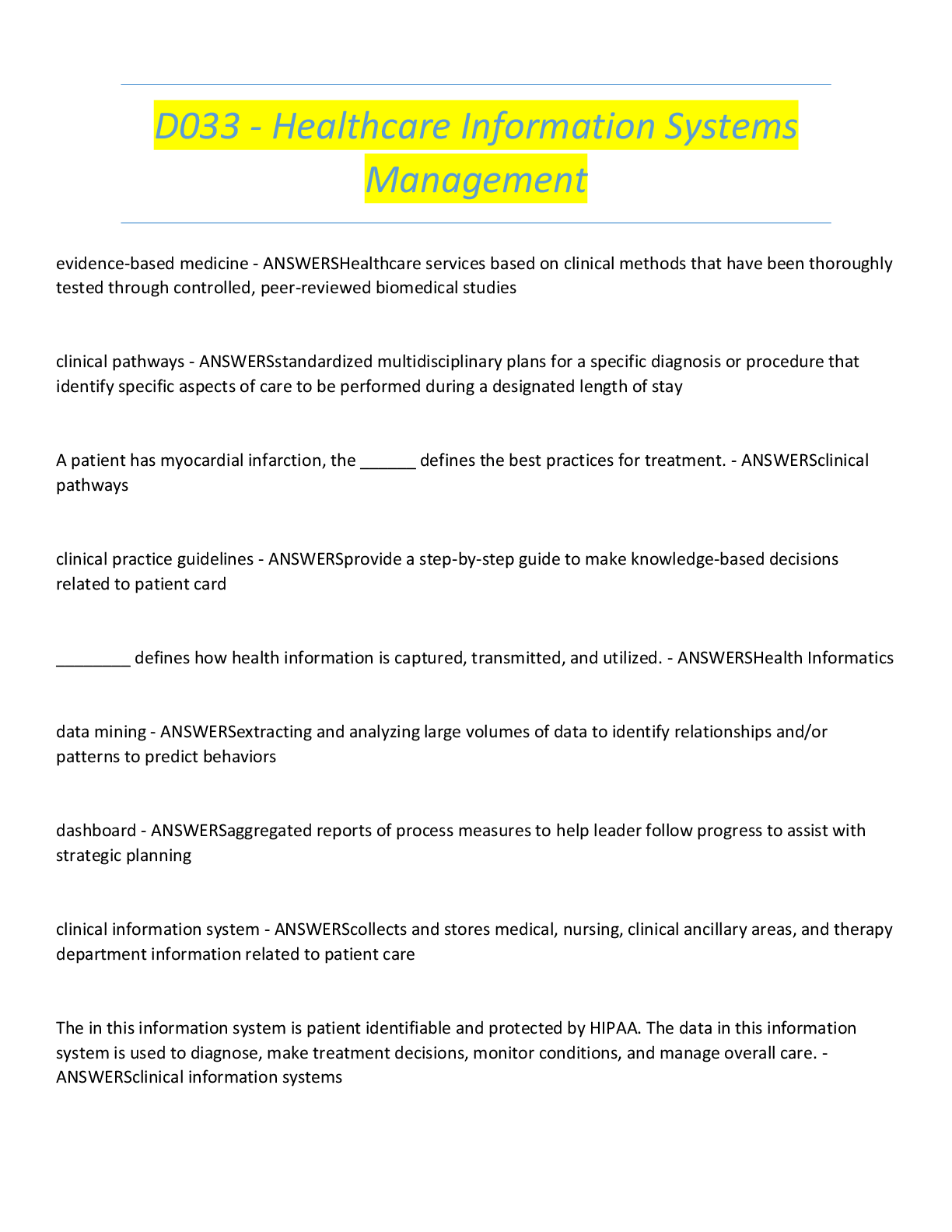
Evidence-based medicine ✔✔healthcare services based on clinical methods that have been
thoroughly tested through controlled, peer-reviewed biomedical studies
Clinical pathways ✔✔a tool designed to coordinate multidisciplinary care planning for specific
diagnoses and treatments
clinical practice guidelines ✔✔provide a detailed, step-by-step guide used by healthcare
practitioners to make knowledge-based decisions related to patient care and issued by an
authoritative organization such as a medical society.
Health Informatics ✔✔scientific discipline that is concerned with the cognitive, informationprocessing, and communication tasks of healthcare practice, education, and research, including
the information science and technology to support these tasks
Data Analytics ✔✔the science of examining raw data with the purpose of drawing conclusions
about that information
Data mining ✔✔process of extracting and analyzing large volumes of data from a database for
the purpose of identifying hidden and sometimes subtle relationships or patterns and using those
relationships to predict behaviors.
dashboards ✔✔reports of process measures to help leaders follow progress to assist with
strategic planning
descriptive statistics ✔✔set of statistical techniques used to describe data, such as means,
frequency distributions, and standard deviations; describes the characteristics of a specific group
or a population
inferential statistics ✔✔set of statistical techniques that allows researchers to make
generalizations about a population's characteristics on the basis of a sample's characteristics,
predictive modeling ✔✔process used to identify patterns that can be used to predict the odds of a
particular outcome based on the observed data. Uses historical data in order to predict what is
likely to happen in the future.
certified health data analyst (CHDA) ✔✔advanced certification covers data management, data
analytics, and data reporting
Clinical Information Systems ✔✔collects and stores medical, nursing, clinical ancillary areas
(such as radiology and laboratory), and therapy department information related to patient care
document management system ✔✔electronic method of capturing and managing documents.
target sheets ✔✔pages that contain only a barcode that tells the scanner and, ultimately, the
computer the content of the pages that follow
file server ✔✔large PC or other computer that is extremely powerful and has a large amount of
memory and magnetic hard drive
abstracting and quality control workstation ✔✔workstation is used for indexing and quality
control
backscanning ✔✔process of scanning past health records into the DMS so there is an existing
database of patient information
symbiology ✔✔format; for barcodes it is Code 39, also known as Code 3 of 9
Radiology Information System (RIS) ✔✔used to collect, store, and provide information on
radiological tests such as x-rays, ultrasound, magnetic resonance imaging (MRI), computed
tomography (CT), and positron emission tomography (PET)
Picture Archiving and Communication System (PACS) ✔✔integrated information system that
obtains, stores, retrieves, and displays digital images
Teleradiology ✔✔ability to view radiology images from any location by the radiologist and
other users
Laboratory information system (LIS) ✔✔collects, stores, and manages laboratory tests and their
respective results
Nursing Information System ✔✔assists in the planning and monitoring of overall patient care.
Will document the nursing care provided to a patient
clinical documentation ✔✔any manual or electronic notation or recording made by a physician
or other healthcare clinician related to a patient's medical condition or treatment
Pharmacy Information System ✔✔assists providers in ordering, allocating, and administering
medication. With a focus on patient safety issues, especially medication errors
interdisciplinary charting system ✔✔can be used by any healthcare professional to collect and
store patient assessments, progress notes, and care plans
emergency department system ✔✔designed to meet the unique needs of the emergency
department, including tracking patients from triage to discharge
Anesthesia information system ✔✔collects information on preoperative, operative, and
postoperative anesthesia-related clinical information. This system follows the patient through the
surgical process.
patient monitoring system ✔✔automatically collects and stores patient data from various
information systems used in healthcare. Data collected include fetal monitoring, vital signs, and
oxygen saturation rates. Typically utilized in the intensive care units and other specialty areas
such as the operating and recovery rooms.
Telehealth ✔✔Professional services given to a patient through an interactive telecommunications
system by a practitioner at a distant site.
telesurgery ✔✔use of robotics to perform surgery
smart card ✔✔plastic card, similar in appearance to a credit card, with a computer chip
embedded in it. Enable portable storage of health and insurance information
health Information Technology ✔✔hardware, software, integrated technologies or related
licenses, intellectual property, upgrades, or packaged solutions sold as services that are designed
for or support the use by healthcare entities or patients for the electronic creation, maintenance,
access, or exchange of health information
Longitudinal health record ✔✔permanent record of significant information listed in
chronological order and maintained across time, ideally from birth to death.
Electronic Medical Record (EMR) ✔✔electronic collection of all of the patient's health
information and clinical care that is stored, managed, and referred to by authorized members of
one healthcare entity
Interoperability ✔✔ability of different information technology systems and software applications
to communicate; to exchange data accurately, effectively, and consistently; and to use the
information that has been exchanged.
Health Level Seven (HL7) ✔✔not-for-profit, American National Standards Institute-accredited
standards-developing organization dedicated to providing a comprehensive framework and
related standards for the exchange, integration, sharing, and retrieval of electronic health
information that supports clinical practice
core data set ✔✔A data set that contains the most relevant administrative, demographic, and
clinical information about a patient's healthcare
Continuity of Care Record (CCR) ✔✔A core data set, covering one or more healthcare
encounters
Source systems ✔✔information systems that capture and feed data into the EHR. Includes the
electronic medication administration record (EMAR), laboratory information system, radiology
information system, etc.
four types of interoperability ✔✔technical, syntactic, semantic, process
Technical interoperability ✔✔Based on the hardware and equipment connectivity used in the
exchange, this type of interoperability allows any computer or device to exchange data with
another computer or device without corrupting the data or creating errors
Syntactic interoperability ✔✔Message format standards identify how the data should be
formatted or structured to allow the exchange. Interface software must be employed for
compatibility to enable the exchange.
Semantic interoperability ✔✔use of standardized terminologies (such as SNOMED-CT) to
provide clarity, consistency, and appropriate meaning in HIE
process interoperability ✔✔degree to which the integrity of workflow can be maintained
between systems and includes maintaining and conveying information such as user roles, data
protection, and system service quality between systems
Office of the National Coordinator for Health Information Technology (ONC) ✔✔federal entity
charged with the coordination of nationwide efforts to implement and use the most advanced
HIT and the electronic exchange of health information and, in so doing, establishing
interoperability among all health information systems
database ✔✔organized collection of data, text, references, or pictures in a standardized format
Data Definition Language (DDL) ✔✔type of software used to create the tables within a
relational database. It translates how data are stored in the computer from the physical view
(physical structure of the database) to the logical view (one that is understandable by the user).
Data Manipulation Language (DML) ✔✔software used to retrieve, update, and edit data in a
relational database
data control language ✔✔controls access to data within a database
Database Management System (DBMS) ✔✔manipulate and control the data stored within the
database to meet the needs of the user. It controls the ability to create, read, write, and delete data
stored in the database.
query by example (QBE) ✔✔query method whereby the user only has to point and click to
choose tables and fields contained in the database
Structured Query Language (SQL) ✔✔standard language for the relational database
data manipulation ✔✔allows the user to add and delete rows in a table and to sort, find, and
compare
data dictionary ✔✔descriptive list of the names, definitions, and attributes of data elements to be
collected in an IS or database whose purpose is to standardize definitions and ensure consistent
use
data standards ✔✔allow us to share data in a uniform way
Data Modeling ✔✔process of determining the users' information needs and identifying
relationships among the data
data repository ✔✔open-structure database (not dedicated to the software of any particular
vendor or data supplier) in which data from multiple ISs are stored so that an integrated,
multidisciplinary view of the data can be achieved in a single source. Updated in real time
data warehouse ✔✔database that makes it possible to access data from multiple databases and
combine the results into a single query and reporting interface. Holds an abundance of data from
many different source systems and are designed for specific types of analyses, such as patient
care or business.
data mart ✔✔subset of the data warehouse designed for a single purpose or specialized use. The
data mart performs the same type of analysis as a data warehouse; however, the scope of the data
is narrower.
Online Analytical Processing (OLAP) ✔✔data access architecture that allows the user to retrieve
specific information from a large volume of data.
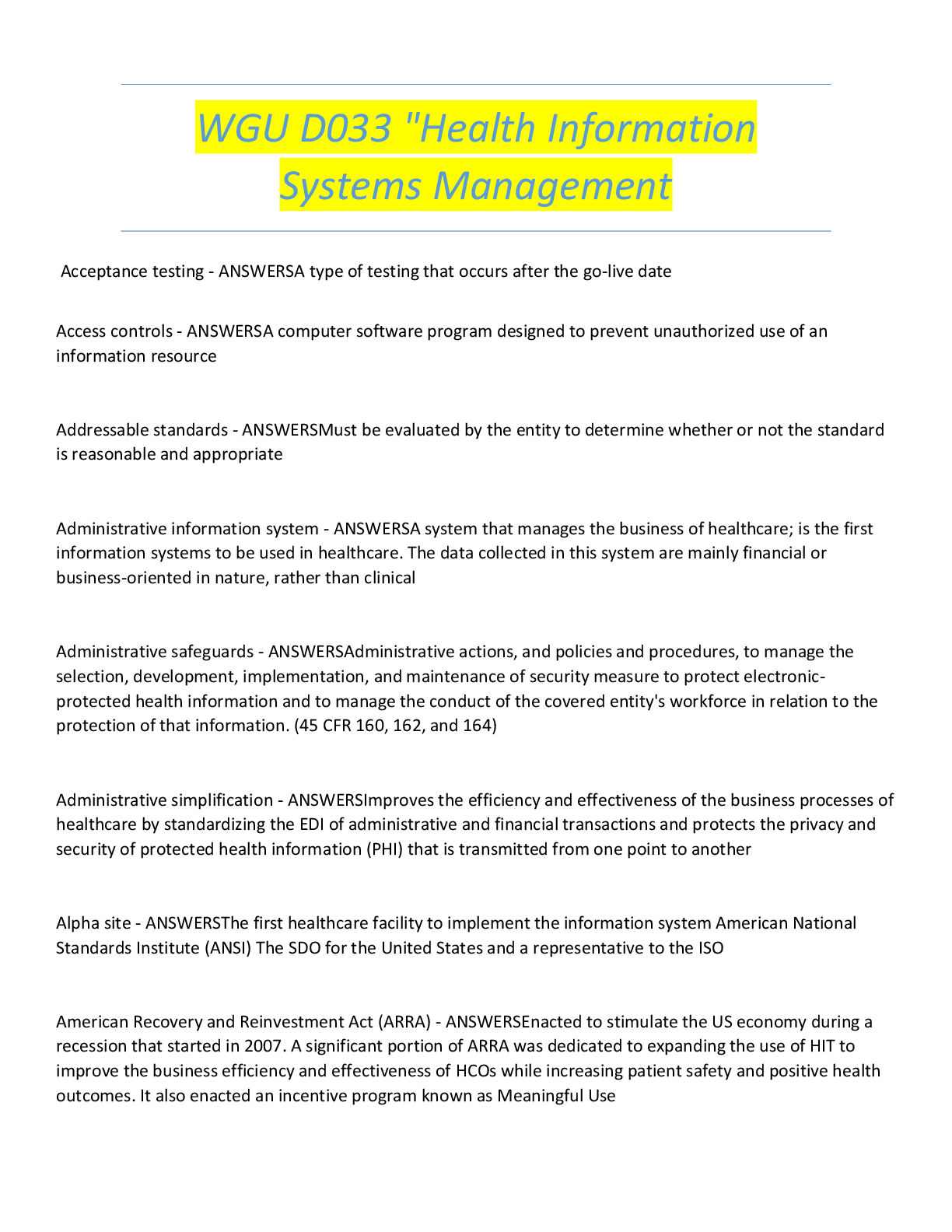
administrative information systems ✔✔the first information systems to be used in healthcare,
mainly financial or business-oriented in nature
Decision Support System (DSS) ✔✔gathers data from a variety of sources to assist management
and staff in decision-making tasks associated with the nonroutine and nonrepetitive problems.
109
Master Patient Index (MPI) ✔✔permanent record of patients treated at the healthcare facility.
patient registration system ✔✔collects information on patients receiving treatment
practice management system ✔✔combines a number of applications required to manage a
physician practice
materials management system ✔✔manages the supplies and equipment within the facility
facilities management system ✔✔allows physical plant operations to control the automated
systems within the facility for patient safety and comfort—that is, heating and air systems,
automated key control, and preventive maintenance tasks such as testing fire extinguishers,
elevator inspections, and the care of various equipment used in the healthcare facility
revenue cycle management (RCM) ✔✔management of the accounts receivable and the accounts
payable on a daily basis by the healthcare facility
chargemaster (charge description master [CDM]) ✔✔financial management form or software
that contains information about the healthcare facility's charges for the services it provides to
patients
Clinical Documentation Improvement (CDI) ✔✔process an organization undertakes that will
improve clinical specificity and documentation that will allow coding professionals to assign
more concise disease and procedural classification codes
Executive information system (EIS) ✔✔decision support system that is designed to be used by
healthcare administrators. As such, it must be easy to use and have access to a wide range of
data. With the EIS, a lot of graphs and charts generally are used as part of the results.
soundex ✔✔Phonetic-based indexing system that is easily incorporated into computer software
for searching surnames that sound alike but are spelled differently
Enterprise master patient index (EMPI) ✔✔provides access to multiple repositories of
information from overlapping patient populations that are maintained in separate information
systems and databases. Arrangement of a network of health providers that may include hospitals,
physicians that provide coordinated services along the continuum of care from ambulatory,
acute, and long-term care and may extend across a geographical region
chief clinical informatics officer ✔✔works with clinical providers, such as physicians and
nurses, to lead them in the use of technology to improve quality of care, medical education, and
healthcare research. Is a "big picture" role, works to ensure that the technologies needed by the
healthcare providers are identified and ultimately implemented
director of clinical informatics ✔✔leader in the implementation of the EHR as well as the postimplementation services
mapping specialist ✔✔creates maps between systems such as vocabularies and classification
systems
clinical informatics coordinator ✔✔requires knowledge of clinical information systems. They
are experts in the data retrieval needed by healthcare providers while conducting patient care
Chief Security Officer (CSO) ✔✔responsible for protecting data from unauthorized access,
alteration, and destruction
Chief Technology Officer (CTO) ✔✔assists in the development of the healthcare facility's
strategic business plan in relation to information systems and technology. Their goal is to ensure
the healthcare facility operates effectively and that they are competitive with other healthcare
facilities within their community
content analyst ✔✔designs the clinical information system that will be implemented. Their work
is directed by the needs of the users.
interface ✔✔takes data from one system and plugs that data into another IS. Acts as a bridge
between two ISs or databases to translate data into each IS's respective language
Best of breed ✔✔Choosing the ISs based on functionality rather than by vendor
personal health record (PHR) ✔✔electronic or paper health record maintained and updated by
individuals that can be used to collect, track, and share past and current information about their
health or the health of someone in their care
Health information blocking ✔✔occurs when "persons or entities knowingly and unreasonably
interfere with the exchange or use of electronic health information
clinical messaging ✔✔connects the medical staff and hospital by providing access to information
systems such as order entry and results reporting and DMS
electronic medication administration record (EMAR) ✔✔automates many of the medication
administration processes in a healthcare facility.
radiofrequency identification devices (RFIDs) ✔✔a microchip implanted in an item to allow
tracking of that item
population health ✔✔cohesive, integrated, and comprehensive approach to health considering
the distribution of health outcomes in a population, the health determinants that influence the
distribution of care, and the policies and interventions that impact and are impacted by the
determinants
Conceptual Data Model ✔✔not tied to a particular database model, but rather defines the
requirements for the database to be developed. Is the basis for the logical and physical data
models
physical data model ✔✔shows how the data are physically stored within the database. The users
are not involved with this level of the database because of its technical complexity.
logical data model ✔✔it ensures that the data are available and in a useful format for the
intended purpose.
Use Case ✔✔technique that is used to develop scenarios based on how users will use the data
and functionality to assist in developing ISs that support the information requirements
direct data entry ✔✔includes a number of manual data entry methods such as keyboard, mouse,
or other devices for entering data into the computer
hot spot ✔✔type of help message that is triggered when the cursor is placed on top of a data
field.
data integrity ✔✔extent to which healthcare data are complete, accurate, consistent, and timely
data quality ✔✔the reliability and effectiveness of data for its intended uses in operations,
decision making, and planning. Focuses on the use of data
data quality management ✔✔the business processes that ensure the integrity of an organization's
data during collection, application (including aggregation), warehousing, and analysis
Data accessibility ✔✔means that data items are easily obtainable by authorized users
Data accuracy ✔✔data are free of identifiable errors
quantitative analysis ✔✔review of the health record to determine its completeness and accuracy.
Used to detect if elements of the health record are missing
qualitative analysis ✔✔review of the health record to ensure that standards are met and to
determine the adequacy of entries documenting the quality of care. The reviewer considers
whether the health record appropriately documents the care provided
Data comprehensiveness ✔✔means that the patient's health record must be complete, meaning
that all required data are included
Physician advisor (PA) ✔✔hired by the healthcare facility to act as a liaison between the HIM or
others and the patient's physician. reviews health records for various reasons
peer review ✔✔review by like professionals, or peers, established according to an organization's
medical staff bylaws, organizational policy and procedure, or the requirements of state law. The
peer review system allows medical professionals to candidly critique and criticize the work of
their colleagues without fear of reprisal, as the feedback comes from the committee, not a
specific individual
data consistency ✔✔ensures that like data are the same on each document or computer screen
data currency ✔✔ensures that data are up to date. A data value is up to date if it is current for a
specific point in time
data definition ✔✔the specific meaning of a healthcare-related data element. Allows everyone to
interpret and collect the data in the same way
data granularity ✔✔describes the level of detail at which the attributes and values of healthcare
data are defined
data relevancy ✔✔the extent to which healthcare-related data are useful for the purposes for
which they were collected
data timeliness ✔✔that data should be recorded in an appropriate period of time after the event
and should be available to the user when needed. The healthcare facility determines the
appropriate period of time for each data element based on accreditation, state licensure, and other
requirements
Data Cleansing ✔✔process of checking internal consistency and duplication as well as
identifying outliers and missing data
version control ✔✔the process whereby a healthcare facility ensures that only the most current
version of a patient's health record is available for viewing, updating, and so forth
data quality measure ✔✔mechanism to assign a quantitative figure to quality of care by
comparison to a criterion. Typically focus on structures or processes of care that have a
demonstrated relationship to positive health outcomes
encoder ✔✔software program used to assign the diagnosis and procedure codes.
health literacy ✔✔the degree to which individuals have the capacity to obtain, process, and
understand basic health information and services needed to make appropriate health decisions
consumer health applications ✔✔healthcare-based applications designed for use by the patient or
provider on smart phones, tablets, and other computers
systems analysis ✔✔process of collecting, organizing, and evaluating data on the healthcare
facility and the information that it needs
internal scanning ✔✔identifying changes within the healthcare facility that will impact the IS,
such as if new services or new clinics will be implemented
integrated information systems ✔✔separate applications that are designed to work together. Data
are entered into one IS and then are accessible to the other ISs. Easier to manage. Collect, store,
and retrieve information from the same database.
Best of Fit ✔✔The decision to purchase software from a single vendor
Acceptasnce testing ✔✔type of testing that occurs after the go-live date. It tests the IS to confirm
that it is working as expected as per the contract, RFP response, and any other documentation.
parallel method ✔✔the development cycle begins with planning and analysis, and the project
team developing a high level design of the system. They then divide the project into smaller subprojects that they develop and implement parallel with each other
validation and verification model (V-model) ✔✔integrates testing design with all the life cycle
stages, beginning at the requirements analysis stage and extending through the implementation
stage
Rapid Application Development (RAD) ✔✔group of developmental methodologies that attempt
to address the long development time problem of the waterfall and similar sequential methods
iterative method ✔✔divides system development into small parts, or versions, each going
through all stages of the SDLC
spiral method ✔✔type of iterative development that incorporates the best features of the
prototyping and waterfall methods. emphasis on risk assessment at each iteration
agile development ✔✔group of practices that, when used together, are intended to shorten and
improve the SDLC. The method emphasizes short, simple, and iterative development cycles
Requirements Analysis ✔✔processes used for identifying what function(s) an information
system must perform and how it is to provide them
data silo ✔✔separate database or system within a department that does not integrate into the
main organizational system nor can others outside of that specific department access it
charter ✔✔document that identifies the purpose, scope, and functions of a program
SBAR ✔✔(situation, background, assessment, recommendation) is a process for facilitating
communication and resolving problems that has been used by many healthcare facilities in their
quest to implement IG
information asset inventory ✔✔list of information resources throughout the healthcare facility
information technology governance (ITG) ✔✔management of all information technology
investments, including the selection, implementation, maintenance, evaluation and its
coordination
triple aim ✔✔to improve population health, enhance the patient's experience within the
healthcare field, and to reduce the per capita cost of healthcare services
administrative simplification ✔✔improve the efficiency and effectiveness of the business
processes of healthcare by standardizing the EDI of administrative and financial transactions
Privacy Rule ✔✔defines how covered entities may use PHI
Security Rule ✔✔defines the minimum a covered entity must do to protect ePHI
risk management ✔✔comprehensive program of activities intended to minimize the potential for
injuries to occur in a CE and to anticipate and respond to ensuring liabilities for those injuries
that do occur
security management plan ✔✔policies required to prevent, identify, control, and resolve security
incidents
workforce clearance procedure ✔✔ensures that each member of the workforce's level of access
is appropriate
contingency plan ✔✔policies and procedures that identify how a CE will react in the event of an
information system emergency, such as power failure, natural disaster, a hacker, malware, or a
system failure.
emergency mode operation plan ✔✔encompasses procedures necessary to keep the critical
business processes of the CE in place during information system downtime
access controls ✔✔computer software program designed to prevent unauthorized use of an
information resource.
audit-reduction tools ✔✔review the audit trail and compare it to criteria specified by the CE,
which eliminates routine entries such as the periodic backups
virus ✔✔propagates by inserting a copy of itself into and becoming part of another program. It
spreads from one computer to another
worm ✔✔standalone software and does not require a host program or human help to propagate.
Is programmed to install itself onto a computer attached to a computer network and then moves
to all computers on the network
phishing ✔✔a scam by which an e-mail user is duped into revealing personal or confidential
information which the scammer can use illicitly
ransomware ✔✔type of malicious software that prohibits access to information systems in an
organization
remote wipe ✔✔when data must be deleted from the mobile device remotely because it has been
lost or stolen
effectiveness ✔✔degree to which stated outcomes are attained
Efficiency ✔✔how the desired outcome is achieved or produced, particularly without wasting
resources, such as time, personnel, and money
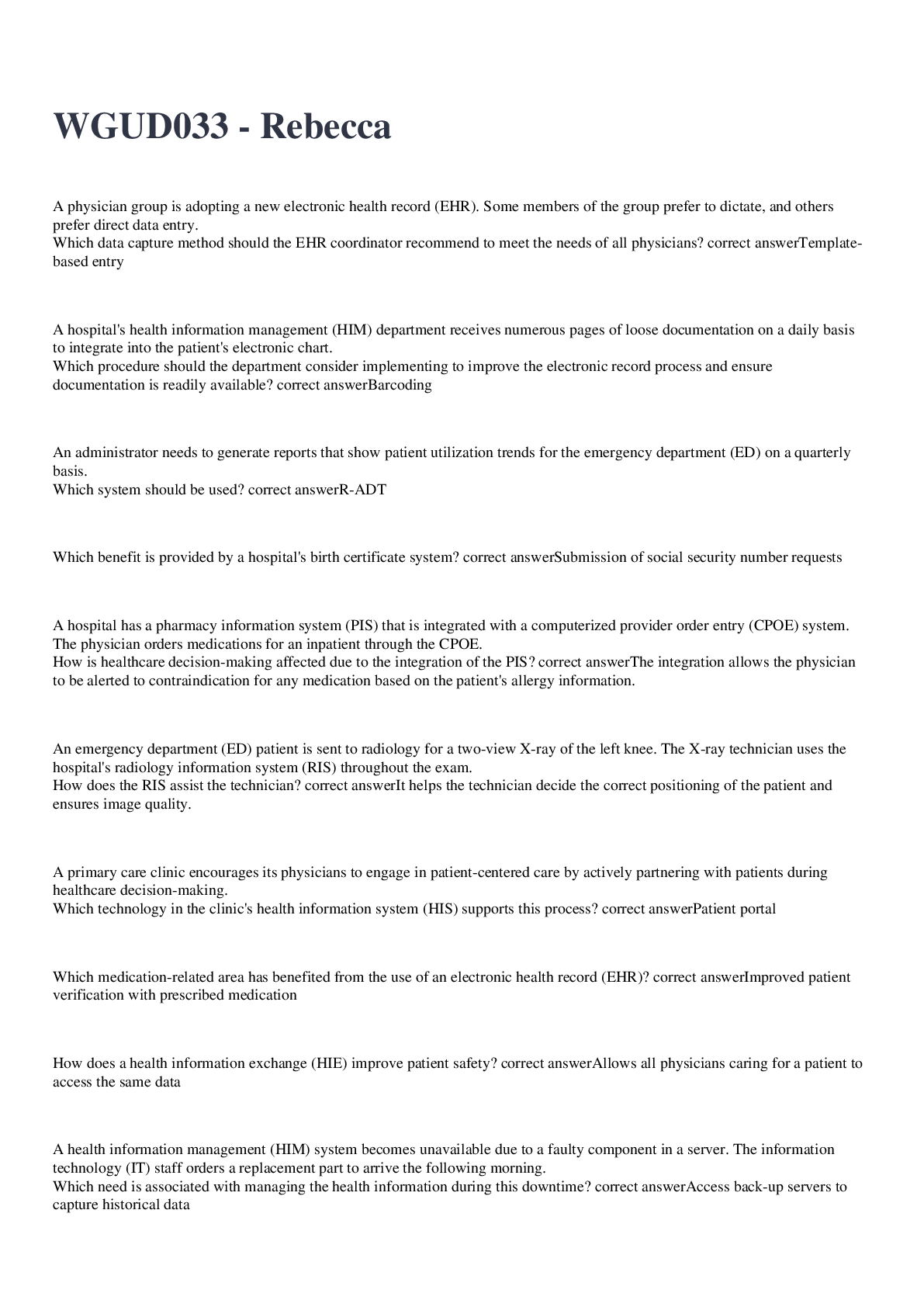
template based data entry ✔✔a cross between free text and structured data entry. The user can
pick and choose data that are entered frequently, thus requiring the entry of data that change
from patient to patient
Systems Analyst ✔✔Identifies the stakeholders of an information system as well as the
functionality required of a system. Tasks include data collection, data analysis, and developing
data flow diagrams. Would assist in the reengineering of business processes that would take
advantage of the benefits of the system being implemented
System implementation ✔✔Assist in many aspects of the process, such as systems analysis,
developing the request for proposal, selecting systems, setting configurations, training,
reengineering
System development ✔✔Adds value to the programming staff because they know the HIM
functions and processes needed
Technical Support ✔✔Assists with technical problems that are encountered with an information
system. They identify the source of the problems and take the necessary steps to resolve them.
These problems could be inability to access an information system or a function that is not
working
ANSI ✔✔The SDO for the United States and a representative to the ISO; American National
Standards Institute
ASC X12N ✔✔Responsible for developing the EDI standards used to share information needed
for health insurance administrative transactions; ANSI Accredited Standards Committee X12N
DICOM ✔✔Standard retrieves images and other information from imaging equipment of a
variety of different vendors. Digital Imagine and Communications in Medicine
LOINC ✔✔The preferred standardized terminology for laboratory data in information systems
and provides a standard set of codes and names for the electronic reporting of laboratory results;
Logical Observation Identifiers Names and Codes
MEDCIN ✔✔A nomenclature and knowledge-based system, It is the most comprehensive
vocabulary for signs and symptoms
NDC ✔✔National Drug Codes; Developed by FDA to act as a universal unique identifier for
human drugs; identifies the labeler or vendor, product, and trade package size
[Show More]
.png)

.png)


.png)
.png)