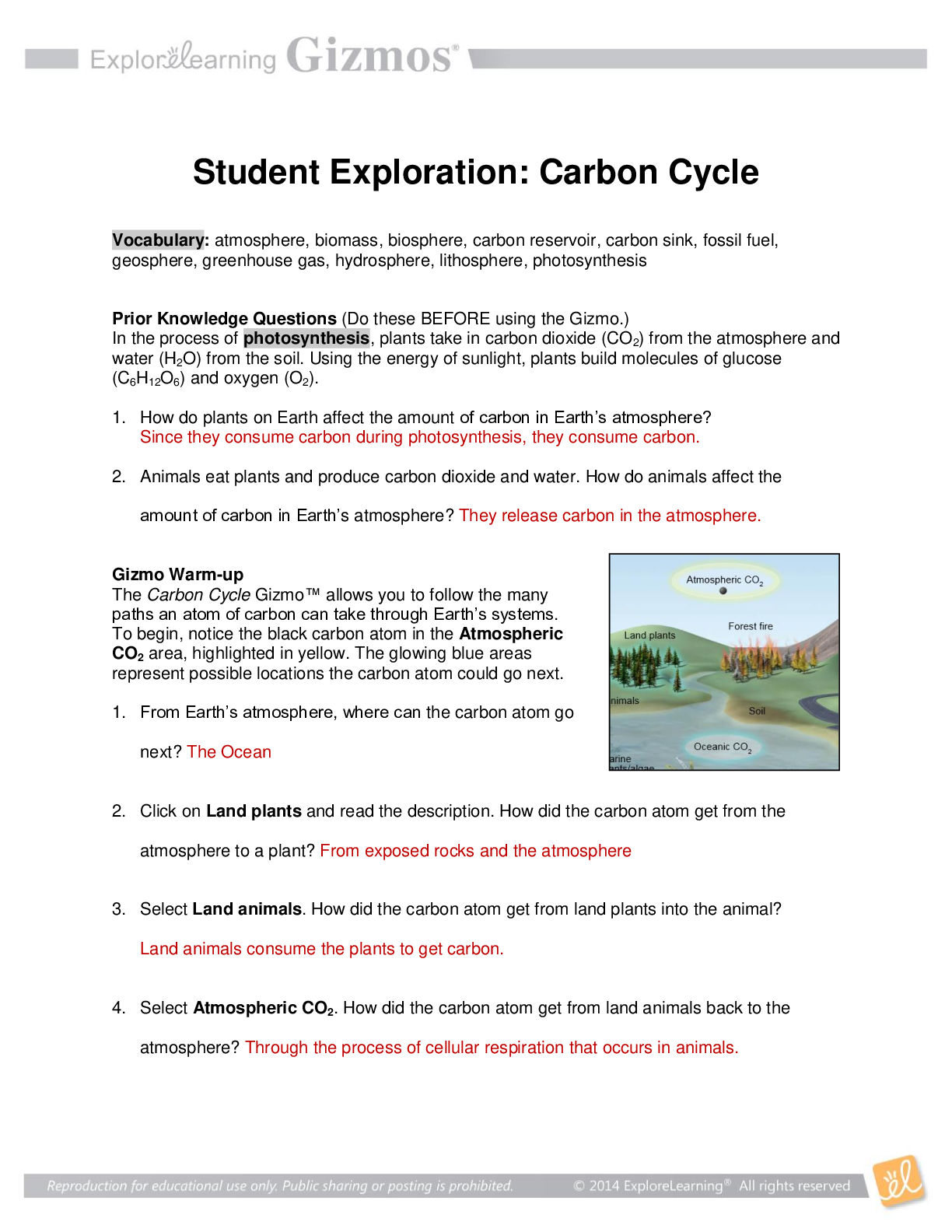
Student Exploration: Period of a Pendulum
Directions: Follow the instructions to go through the simulation. Respond to the questions and
prompts in the orange boxes.
Vocabulary: controlled experiment, mean, pendulum,
...
Student Exploration: Period of a Pendulum
Directions: Follow the instructions to go through the simulation. Respond to the questions and
prompts in the orange boxes.
Vocabulary: controlled experiment, mean, pendulum, period
Prior Knowledge Questions (Do these BEFORE using the Gizmo.)
A pendulum is a weight that can swing freely back and forth. The period of a pendulum is the amount of time
required to make one full back-and-forth swing.
In each of the comparisons below, highlight the pendulum that you think will have a shorter period.
Long pendulum vs. Short pendulum
Heavy pendulum vs. Light pendulum
Pendulum on Earth vs. Pendulum on Moon
Pendulum with a large arc vs. Pendulum with a small arc
Gizmo Warm-up
The Period of a Pendulum Gizmo allows you to explore the factors that control
how quickly a pendulum swings back and forth.
To begin, practice measuring the period of the pendulum. On the Gizmo, check
that all variables are set to their original values:
m = 0.5 kg, L = 2.0 m, g = 9.8 m/s2, and θ = 20°. Open the Tools tab and drag
an arrow so that it just touches the pendulum at its left-most position, as shown at
right.
1. A full “swing” of the pendulum is one complete back-and-forth movement. Select the TABLE tab. Click
Mark time each time the pendulum touches the arrow. Mark 10 times. What values do you get for the
period of the pendulum?
2. What is the mean of these values? (Note: To find the mean, add up the values and divide by the number of
values, or 10.)
Reproduction for educational use only. Public sharing or posting prohibited. © 2020 ExploreLearning™ All rights reserved
Name: Date:
2.83
Introduction: The Period of a Pendulum Gizmo allows you to investigate four factors: mass (m), length (L),
gravitational acceleration (g), and angle (θ).
Question: Which factors affect the period of a pendulum?
1. Measure: Click Mark time. Carefully count 10 swings of the pendulum, and click Mark time again at the
conclusion of the last swing.
2. Design an experiment: To conduct a fair test of the factors that could affect the period of a pendulum,
change only one factor at a time. This is known as a controlled experiment.
First, design a controlled experiment to find the effect of mass (m) on period. Describe your experiment
below.
3. Gather data: Record the results of your experiment in the table below.
4. Analyze: What was the effect of pendulum mass on the period of the pendulum?
Reproduction for educational use only. Public sharing or posting prohibited. © 2020 ExploreLearning™ All rights reserved
A. What is the time for 10 swings?
B. Divide the time by 10. What is the measured
period of the pendulum?
C. How does this value compare to the mean
period you found in the Gizmo Warm-up?
5. Investigate: Conduct similar controlled experiments on the effects of length, gravitational acceleration, and
angle on the pendulum period. Record your results below.
Length experiment
Gravitation experiment
Angle experiment
6. Analyze: Look at your data.
A. How did changing the length (L) affect the period?
B. How did changing the gravitational acceleration (g) affect the period?
C. How did changing the initial angle (θ) affect the period?
7. Compare: How did the results of your experiments compare to the predictions you made in the Prior
Knowledge Questions?
.
Introduction: The Dutch scientist Christiaan Huygens is credited as the first to create a formula that describes
the period of a pendulum. In this and the next activity, you will derive Huygens’s formula by measuring the
effect of length and gravitation on the period of a pendulum.
Question: What is the effect of length on the period of a pendulum?
1. Predict: How do you think a pendulum’s period will change if its length is multiplied by 2?
2. Measure: Keeping g and θ constant, measure the period for each of the following lengths. Leave the last
three columns blank for now. Include all units.
3. Calculate: Divide each length by the original length (0.2 m). Record in the “Length factor” column. Fill in the
“Time factor” column by dividing each period by the original period.
4. Calculate: Find the square root of each length factor, and fill in the last column of the table.
A. What do you notice?
B. How does the period of a pendulum relate to the square root of the length factor?
5. Apply: A pendulum with a length of 10 meters has a period of 6.34 seconds.
Reproduction for educational use only. Public sharing or posting prohibited. © 2020 ExploreLearning™ All rights reserved
A. What is the period of a pendulum with a length of 90 meters?
B. What is the period of a pendulum with a length of 160 meters?
Question: What is the effect of gravitational acceleration on the period of a pendulum?
2. Measure: Keeping L and θ constant, measure the period for each of the following values of g. Leave the
last two columns of the table blank for now.
3. Calculate: Divide each period by the original period, and fill in these values under “Time factor.” Then, take
the reciprocal of each of these values, and fill in the last column.
4. Analyze: Compare the value of g to the time factors and reciprocals.
5. Generalize: How does the period relate to the square root of the value of g?
Reproduction for educational use only. Public sharing or posting prohibited. © 2020 ExploreLearning™ All rights reserved
Activity C:
Gravity and
period Get the Gizmo ready:
● Click Reset.
● Set L to 1.0 m, g to 1.0 m/s2, and θ to 20°.
D.
How did the period change when g was multiplied by 4?
How did the period change when g was multiplied by 9?
In general, what is the relationship between the reciprocal of
the time factor and the value of g?
6. Challenge: Put together what you learned in the previous activity and this activity to come up with a formula
for the period of a pendulum (T) based on its length and the strength of gravity. The format of the formula is
shown below. (Note: In the equation, a is a constant that takes the shape of a pendulum’s arc into
account.)
Write your formula here:
Have your teacher check your formula when it is complete.
7. Measure: Find the period when L is 1.0 m and g is 1.0 m/s2. This is the value of the constant a in your
formula. What is the value of a?
8. Apply: Use your formula to find the periods of pendulums with the following parameters. Use the Gizmo to
check the first three pendulums. (The Gizmo cannot be used to check the last two sets of parameters.)
9. Think and discuss: The formula you created does not include the initial angle of the pendulum. How do you
think the initial angle would affect the formula? Experiment with the Gizmo, and then discuss your results
with your classmates and teacher.
[Show More]