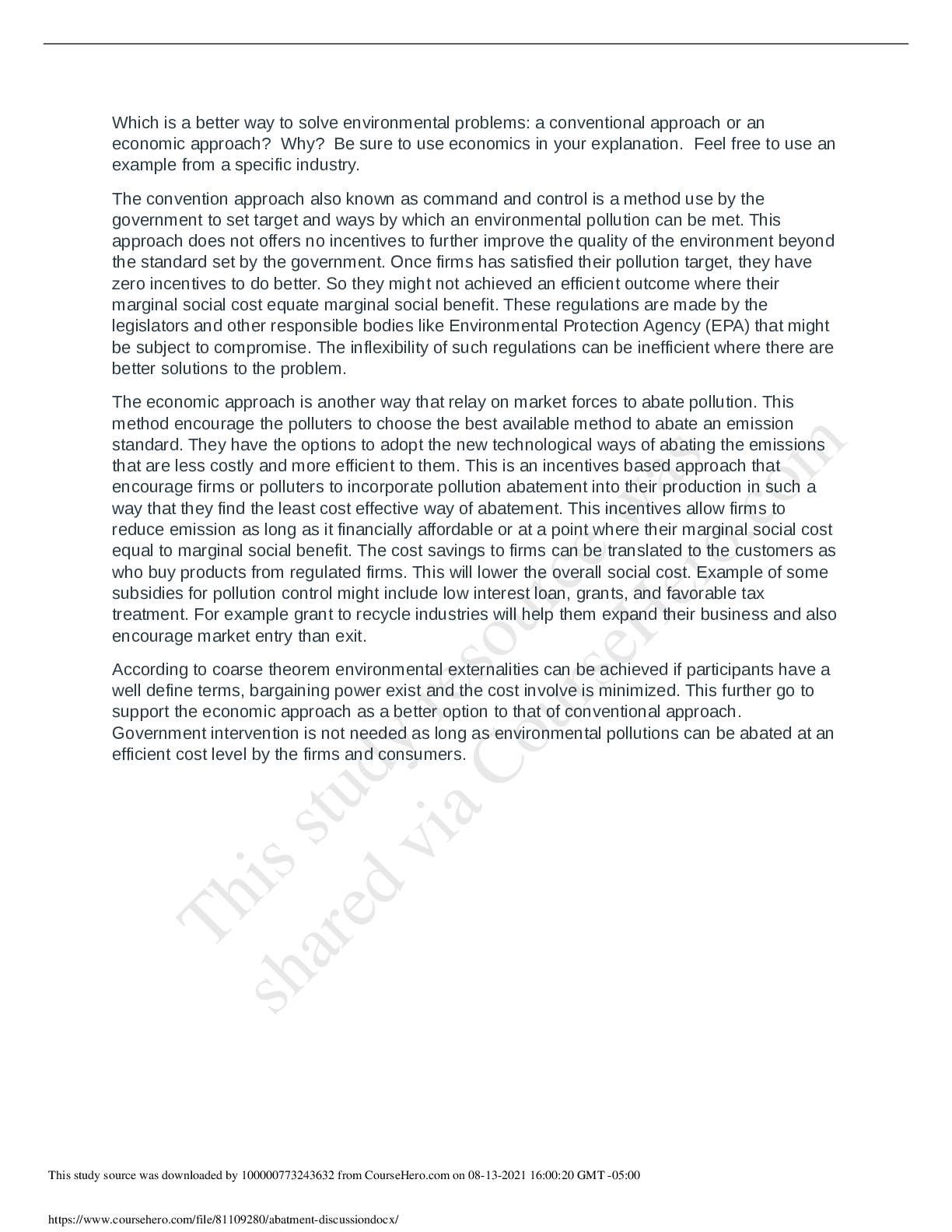
Essay > Pennsylvania State UniversityECON 425abatment discussion.100% score
Physics > QUESTIONS & ANSWERS > Questions and Answers > San Joaquin Delta College PHYSC 2B Planetary Motion Online Simulations KEY (All)
San Joaquin Delta College PHYSC 2B Planetary Motion Online Simulations KEY CLASS COPY - For your own copy, find this document under “Physics – Handouts” Continued on back → PLANETAR ... Y MOTION SIMULATIONS KEY Simulation 1: Universal Gravitation| 2. d. 3. Change the planet’s mass. RESET. What happened to the orbit? 4. Change the star’s mass. RESET. What happened to the orbit? 5. What do you have to change to make the planet leave the orbit of the star only changing masses? 6. What do you have to change to make the planet crash into the star only changing the masses? . 7. FULL RESET, then recheck all the boxes. Select Sun, Earth, & Moon: a. b. What happened to the planet’s orbit? c. What does the moon’s orbit look like? 8. Change both the star and planet’s masses. RESET. What happened to the orbits of the moon and planet? 9. Copy this table into your journal and fill it in by describing what you observe: How can you…. Explain what you changed Draw the orbital path What other changes did you observe? …make the Moon orbit Earth in an orbit with a larger radius? …make the Earth take more time to orbit the Sun? …make the Earth take less time to orbit the Sun? 10. Along the bottom bar, choose “To Scale” d. Describe what you see. 11. Choose one: Change the star’s mass, change Earth’s mass, change both masses. What happened to the orbit? 12. FULL RESET, then recheck all the boxes. Select Sun, Earth, & Moon: a. Set the Star Mass to “1.5” and the Planet Mass to “Earth” b. Start the simulation with and allow 365 days to pass c. What happened to the planet’s orbit? d. What happened to the moon’s orbit? e. What happens when you turn off gravity? 13. FULL RESET, then recheck all the boxes. Select Earth & Satellite: a. Start the simulation with b. What happens to the orbit when you change the satellite’s mass? c. What happens to the orbit when you change the planet’s mass? Simulation 2: Orbital Motion Vectors| 16. Describe the object's velocity during the course of the elliptical orbit. Comment on both the magnitude and the direction. 17. Describe the net force acting upon the object during the course of the elliptical orbit. Comment on both the magnitude and the direction. 18. How does changing the eccentricity of the orbit effects the shape of the orbit? What eccentricity results in a perfectly circular orbit? 19. Sketch the diagrams below in your journals. Then draw and label the net force (FNET) and velocity (v) vectors for each of the six marked positions for a clockwise orbit. Draw the vectors in the appropriate direction and of the proper relative magnitude. Elliptical Orbit Circular Orbit 20. Fill in the blanks in the following statements for a planet orbiting the Sun: a. The direction of the velocity of the planet is perpendicular to the net force acting upon the planet. b. The planet will move when it’s closest to the Sun. c. While moving towards the Sun (along the path from D to A) there is a component of force in the same direction as the motion; this causes the planet to d. While moving away from the Sun (along the path from A to D) there is a component of force in the opposite direction as the motion; this causes the planet to 21. Summarize what you’ve learned from this simulation. Be sure to describe the features of a planet’s elliptical orbit including velocity, acceleration and force. [Show More]
Last updated: 2 years ago
Preview 1 out of 4 pages

Buy this document to get the full access instantly
Instant Download Access after purchase
Buy NowInstant download
We Accept:

Can't find what you want? Try our AI powered Search
Connected school, study & course
About the document
Uploaded On
Jan 15, 2023
Number of pages
4
Written in
All
This document has been written for:
Uploaded
Jan 15, 2023
Downloads
0
Views
69
Scholarfriends.com Online Platform by Browsegrades Inc. 651N South Broad St, Middletown DE. United States.
We're available through e-mail, Twitter, Facebook, and live chat.
FAQ
Questions? Leave a message!
Copyright © Scholarfriends · High quality services·