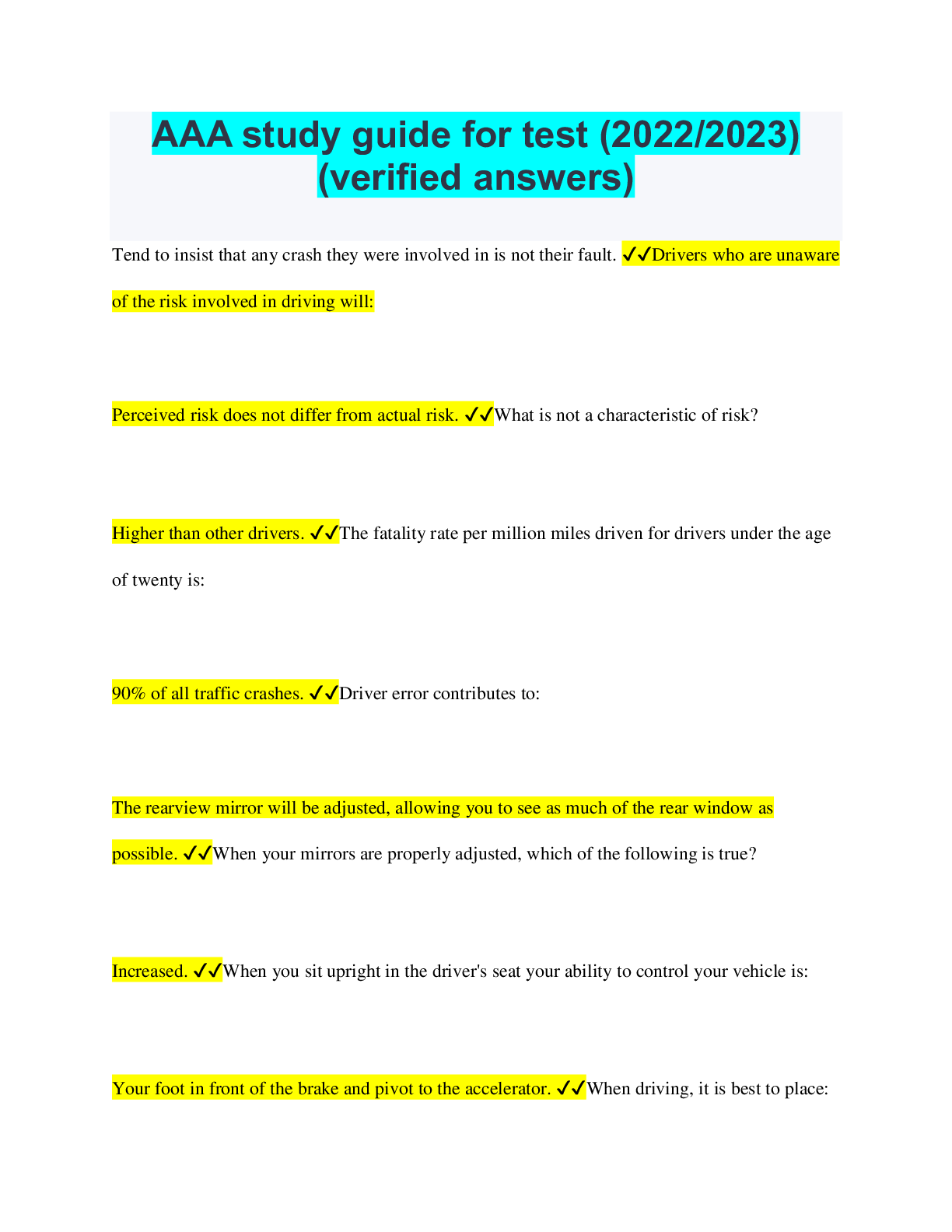
Sociology > QUESTIONS & ANSWERS > Roles and Responsibilities in an Interdisciplinary Team D047 Latest 2022 Already Passed (All)
Roles and Responsibilities in an Interdisciplinary Team D047 Latest 2022 Already Passed
Document Content and Description Below
Last updated: 3 years ago
Preview 1 out of 25 pages
Instant download

Buy this Document to get the Full Access Instantly
Provided by Students Who Aced it
We Verify Document Content to Gurantee Accuracy
Reviews( 0 )
Document information
Connected school, study & course
About the document
Uploaded On
Jan 18, 2023
Number of pages
25
Written in
All

Additional information
This document has been written for:
Uploaded
Jan 18, 2023
Downloads
0
Views
77
Topic Tags
Recommended For You
Get more on QUESTIONS & ANSWERS »
ASM 275 / ASM275 Exam #1 Answers Latest 2022 Already Passed

Chamberlain College of Nursing Week 5 Math 225N Statistics Qui...

STRATFORD UNIVERSITY – NSG 325 / NSG325 COMPLEX FINAL EXAM LAT...
MED SURG HESI EXIT EXAM QUESTIONS AND ANSWERS CORRECT/VERIFIED...
MED SURG HESI EXIT EXAM Compilation of highly tested Questions...

SAUNDERS COMPREHENSIVE REVIEW FOR NCLEX TEST BANK latest 2022/...

Test Bank for Discover Sociology 4th Edition By William Chambl...
Medical Sociology, 15th Edition William Cockerham | Test Bank
The Real World An Introduction to Sociology 5th Edition By Ker...
.png)
Social-Behavioral-Educational (SBE) Comprehensive, All unit te...

SOCS 325 – Environmental Sociology Midterm Answers ( 100% all...
You have been asked to develop a food culture experience for c...