● Cell Theory: describes uniformity and persistence of organisms over time
○ All organisms are made of cells, all cells come from preexisting cells (a pattern and a process)
○ Robert Hooke and Leeuwenhoek were the firs
...
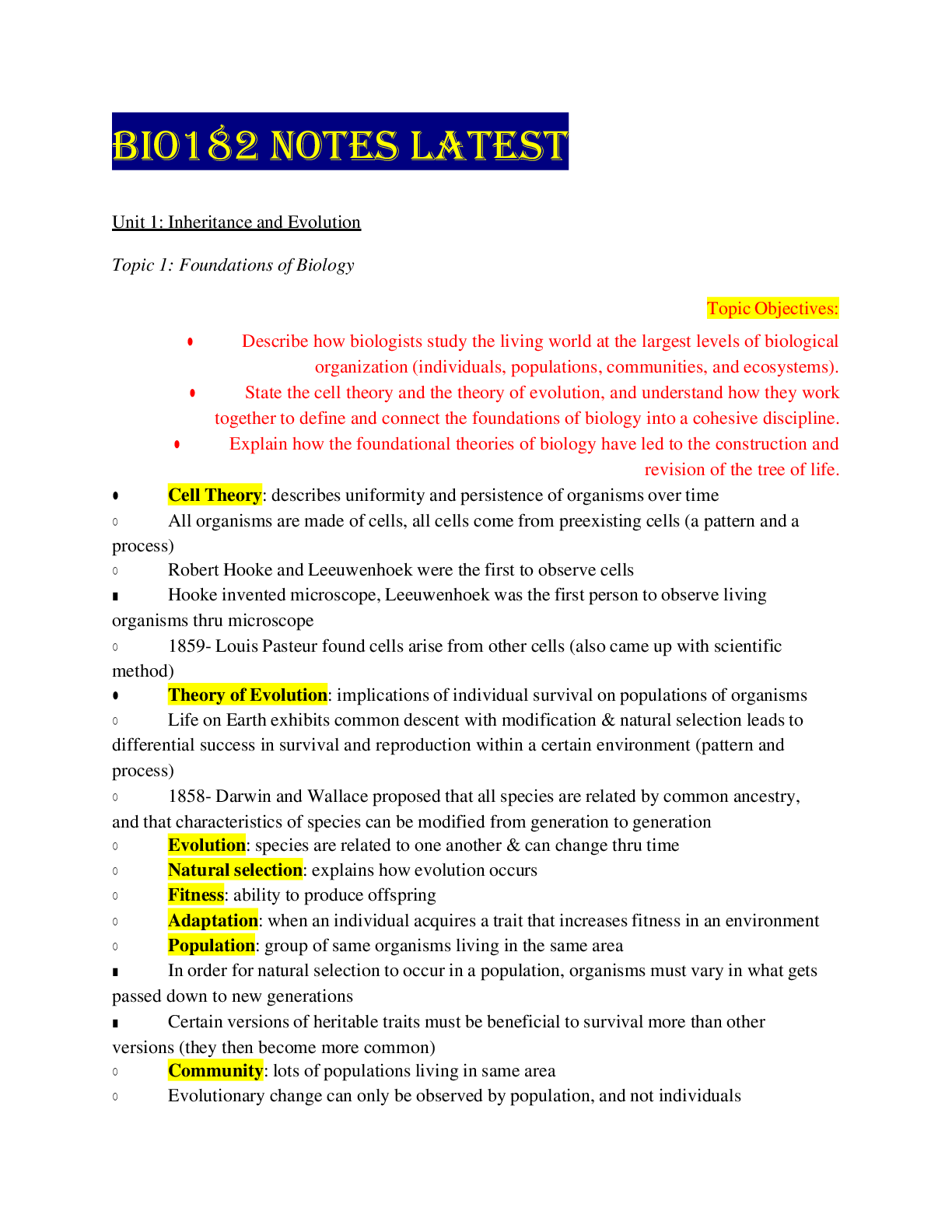
● Cell Theory: describes uniformity and persistence of organisms over time
○ All organisms are made of cells, all cells come from preexisting cells (a pattern and a process)
○ Robert Hooke and Leeuwenhoek were the first to observe cells
■ Hooke invented microscope, Leeuwenhoek was the first person to observe living organisms thru microscope
○ 1859- Louis Pasteur found cells arise from other cells (also came up with scientific method)
● Theory of Evolution: implications of individual survival on populations of organisms
○ Life on Earth exhibits common descent with modification & natural selection leads to differential success in survival and reproduction within a certain environment (pattern and process)
○ 1858- Darwin and Wallace proposed that all species are related by common ancestry, and that characteristics of species can be modified from generation to generation
○ Evolution: species are related to one another & can change thru time
○ Natural selection: explains how evolution occurs
○ Fitness: ability to produce offspring
○ Adaptation: when an individual acquires a trait that increases fitness in an environment
○ Population: group of same organisms living in the same area
■ In order for natural selection to occur in a population, organisms must vary in what gets passed down to new generations
■ Certain versions of heritable traits must be beneficial to survival more than other versions (they then become more common)
○ Community: lots of populations living in same area
○ Evolutionary change can only be observed by population, and not individuals
○ Individuals are essentially dead-ends, unless they reproduce
○ Evolution occurs when heritable variation leads to differential success in reproduction
[Show More]