WGU C368 OA Questions and Answers
with Complete Solutions
Metacognition ✔✔awareness and understanding of one's own thought processes.
Cooperative Learning ✔✔students work together to perform specific tasks in small mi
...
WGU C368 OA Questions and Answers
with Complete Solutions
Metacognition ✔✔awareness and understanding of one's own thought processes.
Cooperative Learning ✔✔students work together to perform specific tasks in small mixed ability
group with shared responsibility for learning
Debate ✔✔Competitive discussion of topic between individuals or team of students
Differentiated instruction ✔✔students engage in different pathways to learning designed to meet
their needs and abilities
Discovery ✔✔students take an active role in their learning process by answering a series of
questions or solving problems designed to introduce a concept or skill
Discussion ✔✔student are active in processing information, defining problems, understanding
different points of view
Independent study ✔✔students with teacher to define a topic or concept for an individualized
plan of study
Inquiry ✔✔student explore course content and learn to ask questions, make discoveries, or solve
problems
Panel ✔✔students present and/or discuss information on important topics
Role Playing ✔✔students act out roles or situation followed by a debriefing to define what they
have learned
Simulations/Games ✔✔Students engage by becoming directly involved in mock events or
conflict.
Demostration ✔✔teacher exhibits or displays an experiment, process, or skill to the class and
discusses concepts embedded in lesson
Lecture ✔✔Teacher directed lesson with teacher verbalizing for a majority of the class time with
questions often asked and answered
Modeling ✔✔Teacher clearly describes the skill or concept often in multisensory manner
(tactile, visual, auditory, kinesthetic) and thinks aloud during modeling
Socratic ✔✔teacher uses questions to draw out student thinking and analysis
Five Steps of PBL ✔✔1. presented with problem
2. describe what is creating the problem
3. identify solutions
4. gather data and try solutions
4. analyze data
Gradual Release of Responsibility ✔✔I do (focus lesson), we do (guided instruction), you do
(collaborative), and you do (independent)
Four ways to differentiate instruction ✔✔Content
Process
Product
Environment
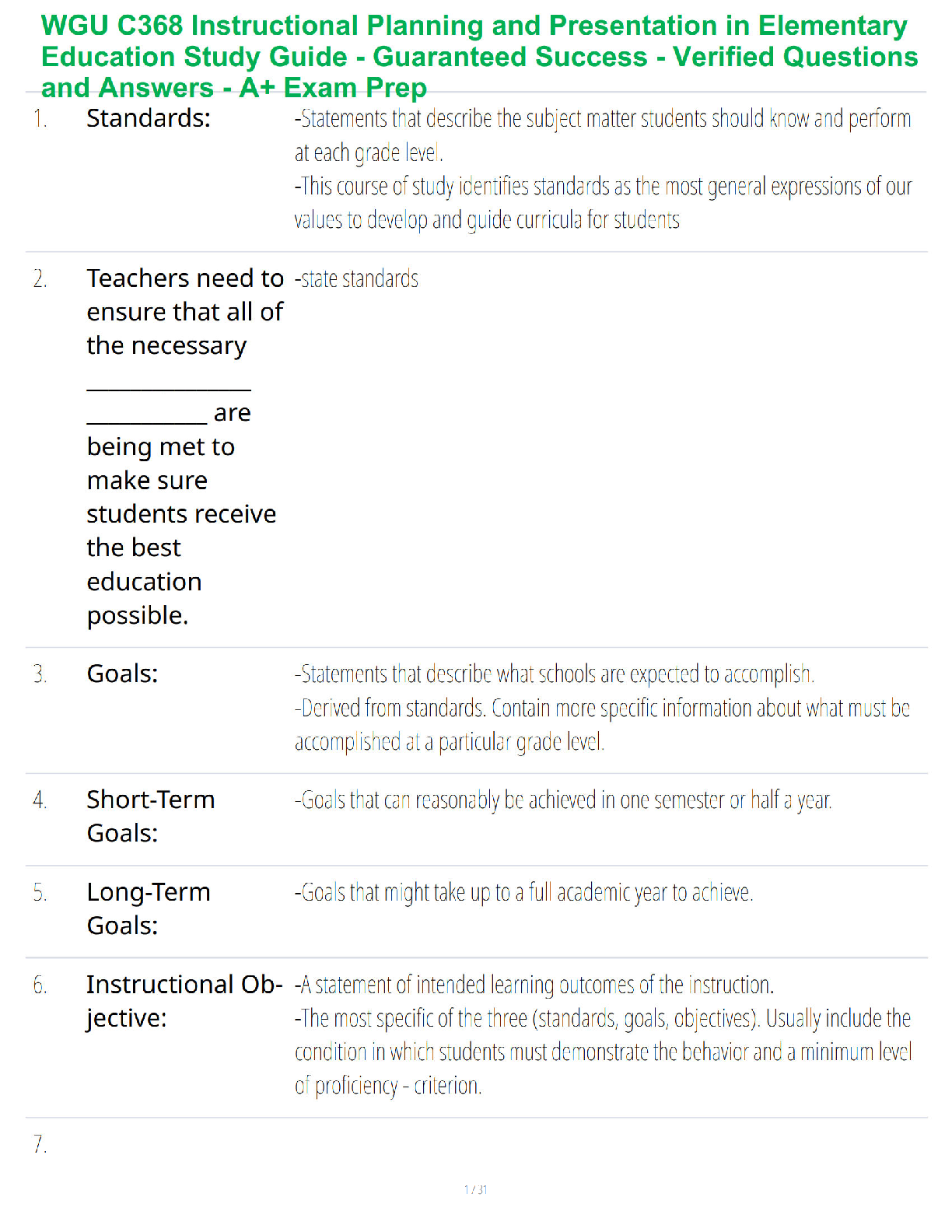
Educational Objective ✔✔a statement of an intended learning outcome for the student; narrower
in scope than subject specific and are commonly used in units
Instructional objective ✔✔Desired outcome of a lesson or unit.; written in terms of what is to be
observed and measured
Elements of objective statement ✔✔Condition, Behavior, Criterion
Deductive instruction ✔✔start with concept followed by examples
Inductive instruction ✔✔start with examples for students to try to identify main principle or
concept
Direct Instruction ✔✔Teacher-centered instruction which includes lecture, presentation, and
recitation.
Indirect instruction ✔✔primarily student centered and include instructional strategies such as
concept mapping, inquiry, discovery learning, case studies, and problem solving; teacher is a
guide
Reciprocal teaching ✔✔A cooperative learning model used to improve reading, in which
students play the teacher's role
Learning Centers ✔✔areas of the classroom set up to promote student-centered, hands-on, active
learning, organized around student interests, themes, and academic subjects
Informal groups ✔✔short term, accomplished by asking student to turn and talk; used to clarify
information, focus students on objectives, or bring closure on a topic
formal group ✔✔carefully designed so that a heterogeneous mix of students works together on
specific learning tasks
base groups ✔✔long term, heterogeneous groups that stay together across tasks throughout the
year
Inquiry ✔✔students explore course content, ask questions, solve problems
Discussion ✔✔students actively process information and understanding different points of view
[Show More]