68WM6 Nutrition
Question Answer
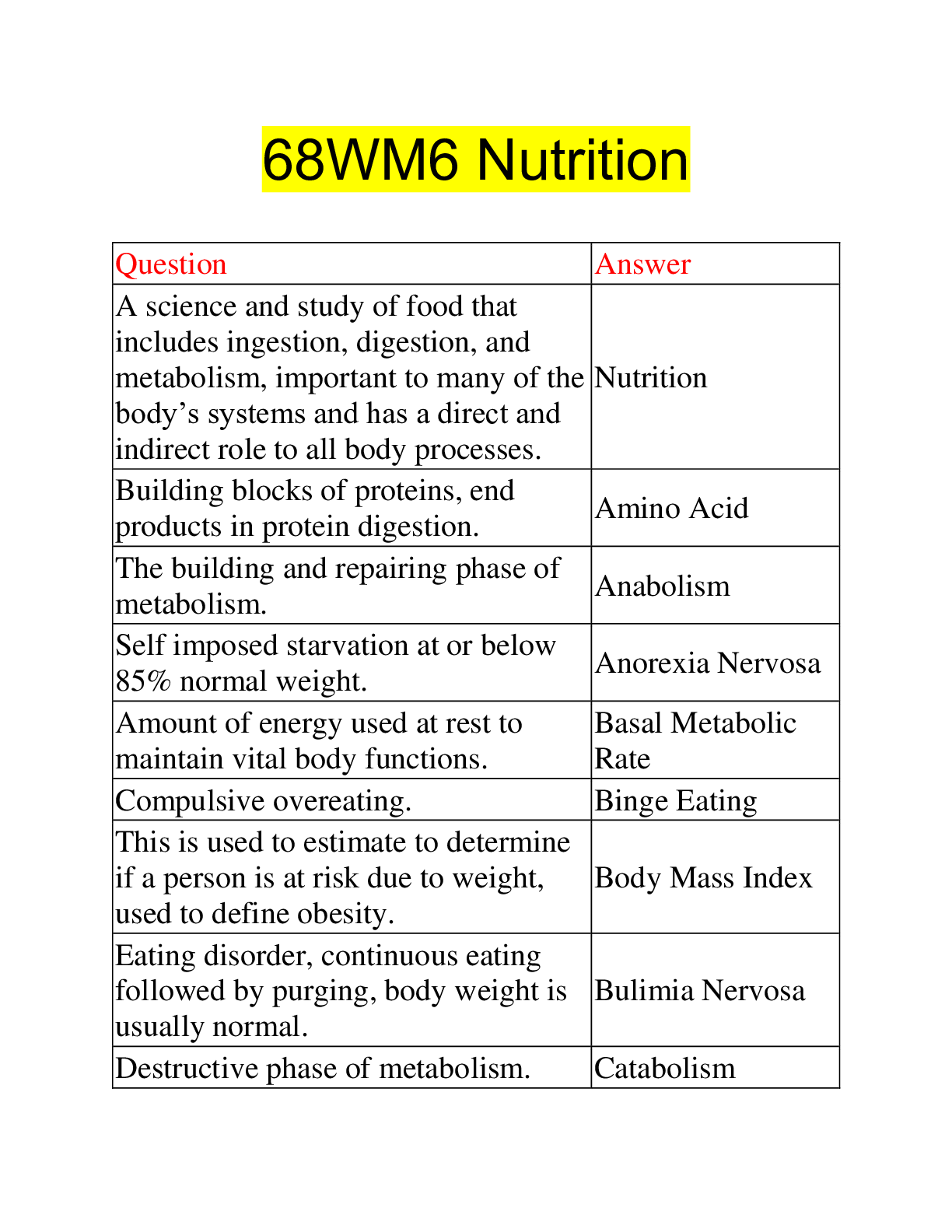
A science and study of food that
includes ingestion, digestion, and
metabolism, important to many of the
body’s systems and has a direct and
indirect role to all body processes.
Nut
...
68WM6 Nutrition
Question Answer
A science and study of food that
includes ingestion, digestion, and
metabolism, important to many of the
body’s systems and has a direct and
indirect role to all body processes.
Nutrition
Building blocks of proteins, end
products in protein digestion. Amino Acid
The building and repairing phase of
metabolism. Anabolism
Self imposed starvation at or below
85% normal weight. Anorexia Nervosa
Amount of energy used at rest to
maintain vital body functions.
Basal Metabolic
Rate
Compulsive overeating. Binge Eating
This is used to estimate to determine
if a person is at risk due to weight,
used to define obesity.
Body Mass Index
Eating disorder, continuous eating
followed by purging, body weight is
usually normal.
Bulimia Nervosa
Destructive phase of metabolism. Catabolism
Waxy fat-like substance found in the
blood stream that is needed to make
cell membranes, Vitamin D, and
hormones.
Cholesterol
Nondigestible chemical substances
found in plants. Dietary Fiber
When the contents of the stomach
enter too rapidly into the duodenum.
Dumping
syndrome
Administration of nutrients into the
G.I. Tract. Enteral Nutrition
Nutrients that must be obtained from
the diet. Essential Nutrients
The body’s storage form of carbs in
the liver and skeletal muscles. Glycogen
Process when hydrogen is added to
vegetable oil to make it solid at room
temperature.
Hydrogenation
A measurement of energy that a
specific food can provide the body. Kilocalorie
No meat or eggs, but will consume
dairy. Lactovegetarian
No meat, but will eat dairy products
and eggs. Lactovovegetarian
Fats, oils, sterols, phospholipids, and
waxes (all water insoluble.) Lipids
Lipid surrounded by protein.
Transport lipids. LDL, VLDL, HDL. Lipoprotein
Specific nutrition services to treat a
condition.
Medical Nutrition
Therapy
The amount of nitrogen consumed
compared to the amount excreted. Nitrogen Balance
Foods with one or more high quality
nutrients in a small amount of
calories.
Nutrient Dense
Food
Excess of adipose, 33% adults and
22% of children are obese, genetics
and lifestyle contribute.
Obesity
Administering nutrients in a way
other than the alimentary canal
(Example: IV.)
Parenteral
Nutrition
Related to inadequate intake of B12,
more common in older people. Pernicious Anemia
Substances that remain in the colon
after digestion is completed. Residue
A feeling of fullness and satisfaction
from food. Satiety
A diet used as a medical treatment. Therapeutic Diet
Instance when no food is given by
other routes.
Total Parental
Nutrition
Liquefied food is put into the
stomach, duodenum, jejunum, or
feeding tube.
Tube Feeding
A person that eliminates all intake of
foods of animal origin. Vegan
A vitamin that primarily helps with
blood clotting. Vitamin K
A mineral that primarily regulates
fluid and acid base balance. Sodium
A mineral that primarily helps in
cellular function and regulation of
fluid, has a role in acid base balance,
helps lower high BP.
Potassium
A mineral that primarily deals with
bone and teeth formation, also aids in
clotting.
Calcium
A mineral that primarily works on
Energy Metabolism, Oxygen
transport. Part of hemoglobin and
myoglobin.
Iron
A mineral that primarily works on
Bone mineralization, BP regulation.
Contraction and relaxation of
muscles.
Magnesium
A mineral that primarily forms RBCs.
Necessary to use iron. Copper
A mineral that is essential to immune
function, Wound healing. Involved in
metabolism, second only to iron.
Zinc
The human body is 60% water at
adult, 80% at infant. This transports
substances, serves as a lubricant.
Regulates body temperature, Aids in
digestion, provides moisture. Vary
depending on age, activity, and
health.
Water
Polysaccharides, Nondigestible.
Prevents constipation, Reduces
cholesterol. Speeds transit of foods,
Reduces colon pressure.
Dietary Fibers
Fiber that dissolves in water, Slows
digestion rate. Decrease in blood
sugar absorption.
Soluble Fiber
Fiber that does not dissolve in water.
Aids in material movement through
GI Tract.
Insoluble Fiber
Stage of growth where most rapid
growth and development occurs,
average infant birth weight triples by
age one.
Infancy
Stage of growth where appetite
tapers, growth rate slows; Food is Childhood
[Show More]