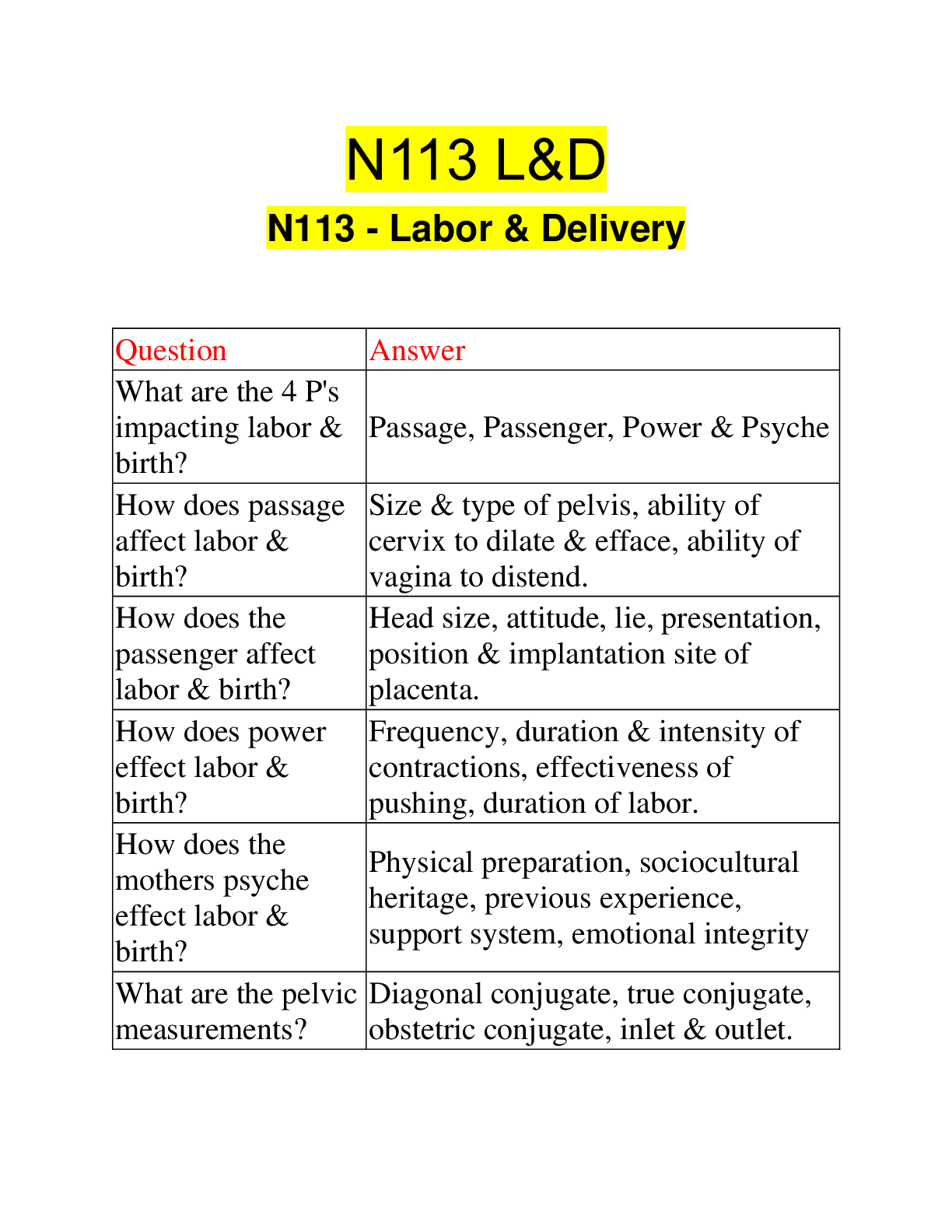
N113 L&D
N113 - Labor & Delivery
Question Answer
What are the 4 P's
impacting labor &
birth?
Passage, Passenger, Power & Psyche
How does passage
affect labor &
birth?
Size & type of pelvis, ability of
cervix t
...
N113 L&D
N113 - Labor & Delivery
Question Answer
What are the 4 P's
impacting labor &
birth?
Passage, Passenger, Power & Psyche
How does passage
affect labor &
birth?
Size & type of pelvis, ability of
cervix to dilate & efface, ability of
vagina to distend.
How does the
passenger affect
labor & birth?
Head size, attitude, lie, presentation,
position & implantation site of
placenta.
How does power
effect labor &
birth?
Frequency, duration & intensity of
contractions, effectiveness of
pushing, duration of labor.
How does the
mothers psyche
effect labor &
birth?
Physical preparation, sociocultural
heritage, previous experience,
support system, emotional integrity
What are the pelvic
measurements?
Diagonal conjugate, true conjugate,
obstetric conjugate, inlet & outlet.
What is the
diagonal
conjugate?
The distance between the lower
border of the symphysis pubis to
sacral promontory. Should be >11.5
cm for pelvic inlet to be adequate.
Measured by hand during pelvic
exam.
What is the true
conjugate?
Distance from upper border of
symphysis pubis to middle of sacral
promontory, determined by
subtracting 1 cm from the diagonal -
estimated, cannot be measured.
What is the
obstetric
conjugate?
Determined by subtracting 1.5 to 2
cm from diagonal. Smallest diameter
through which the fetus must pass.
Can be measured by x-ray, should be
>10 cm.
What is the inlet?
The upper border of the true pelvis,
transverse diameter of the true pelvis
is the largest.
What is the outlet?
The lower border of the true pelvis.
Extends from the lower border of the
symphysis pubis to the tip of the
sacrum. Anterior to posterior
measurement should be the largest.
What is the most
common type of
pelvis?
Gynecoid or round, 50% of females
have this type
What is the most
favorable type of
pelvis?
Gynecoid or round, anthropoid or
oval is usually adequate
What is the least
favorable type of
pelvis?
Android or heart shaped, platypelloid
or flat
What is attitude?
The relation of fetal parts to one
another. Normal is flexion of head,
arms to chest, legs to abdomen,
classic fetal position.
What is lie?
Relation of long axis (spine) of the
fetus to that of the mother. Normal is
longitudinal, transvers is when baby
is laying across the abdomen.
What is
presentation?
What part is first in the maternal
pelvis.
What is cephalic
presentation? Head first, 97% of term births.
What are the
different types of
cephalic
presentation?
Vertex - neck completely flexed,
most common - smallest diameter of
head presents, Military - neck neither
flexed or extended - head & neck is
straight, Brow - neck partially
extended - head tipped slightly back,
Face - neck hyperextended
What are the risks
associated with
brow presentation?
Trauma to neck, trachea, & larynx,
facial edema, detected by palpating
fontanelle, anterior fontanelle will be
felt instead of posterior.
What are the risks
associated with
face presentation?
Increased risk of CPD -
cephalopelvic disproportion - head
won't fit through pelvis, facial edema
What is associated
with breech
presentation?
Decreased weight of baby, increased
mortality & anomalies, more
common with placenta previa,
multiple gestation & grand
multiparity. Possible head
entrapment, increased chance of cord
prolpse. Passage of merconium due
to compression of intestines.
What are the 3
types of breech
presentation?
Complete - fetus sitting indian style,
Frank - butt first with legs & feet
straight up by head, Footling - single
or double feet present first.
What is a shoulder
presentation?
When fetus is across the abdomen.
Can lead to uterine rupture due to
stress on uterus, increased danger of
cord prolapse.
What is
engagement?
When largest diameter of presenting
part reaches or passes through pelvic
inlet - upper diameter of pelvis
What is station?
Relationship of presenting part to
imaginary line drawn between the
ischial spines, graded at + or -.
What is fetal
position?
Relationship of the landmark on the
fetal presenting part to the front,
sides or back of the maternal pelvis.
What are the fetal
positions?
O - Vertex or occiput - normal fetal
position, M - face, chin or mentum
presenting, S - breech, sacrum
presenting, A - shoulder, scapula or
acromion process presenting.
What are the
cardinal
movements in
labor?
Engagement & descent, flexion,
internal rotation, extension, external
rotation, expulsion.
What is
engagement &
descent?
head enters inlet in occiput
transverse position because the inlet
is widest from side to side
What is flexion? Occurs as head meets resistance from
musculature & soft tissue.
What is internal
rotation?
Fetus rotates 45 to 90 degrees to fit
the widest anterior/posterior diameter
of the outlet
What is extension?
Head passes under the symphisis
pubis; occiput, brow & face emerge;
complete when entire head is born.
What is external
rotation?
As shoulders rotate to anterior
posterior position the head is turned
further to one side
Which stages can
be seen?
Extension, external rotation &
expulsion
What are the 3
stages of a
contraction?
Increment - building up - longest,
Acme - peak, Decrement - period of
decreasing intensity
How is the
frequency timed?
From the beginning of one
contraction to the beginning of the
next.
How is the duration
calculated?
From the beginning of one to the end
of same contraction.
How is intensity
rated?
Mild - fingertips can easily indent
fundus - cheek, moderate - can
indent sligntly - chin, strong/hard -
cannot indent - forehead.
How is the latent
phase
characterized?
Last 2-16 hours, cervical dilation up
to 3-4 cm, mild contractions, with
short duration and long interval in
between. Mother feels excited,
happy, some apprehension
How is the active
phase
characterized?
Cervical dilation from 4-8 cm,
contraction stronger & longer, more
frequent, more painful, Mother needs
to use breathing techniques, pain
medication is usually administered
How is the
transition phase
characterized?
Cervical dilation 8-10 cm,
contraction longer & stronger, may
experience nausea & possible
vomiting, mother becoming tired,
frustrated & unable to cope, need to
focus mom and have her concentrate
What is the second
stage of delivery?
This is when the mom feels the need
to push, doctor may do episiotomy at
this time, contractions are less
painful since cervix is completely
dilated
What is the third
stage of delivery?
Birth of baby and delivery of
placenta, mother is exhausted and
eager to see baby, very hungry &
thirsty.
What is the fourth
stage of delivery? This is the first hour post partum
What is the main
difference between
true & false labor?
There is no change in the cervical
consistency in false labor.
[Show More]