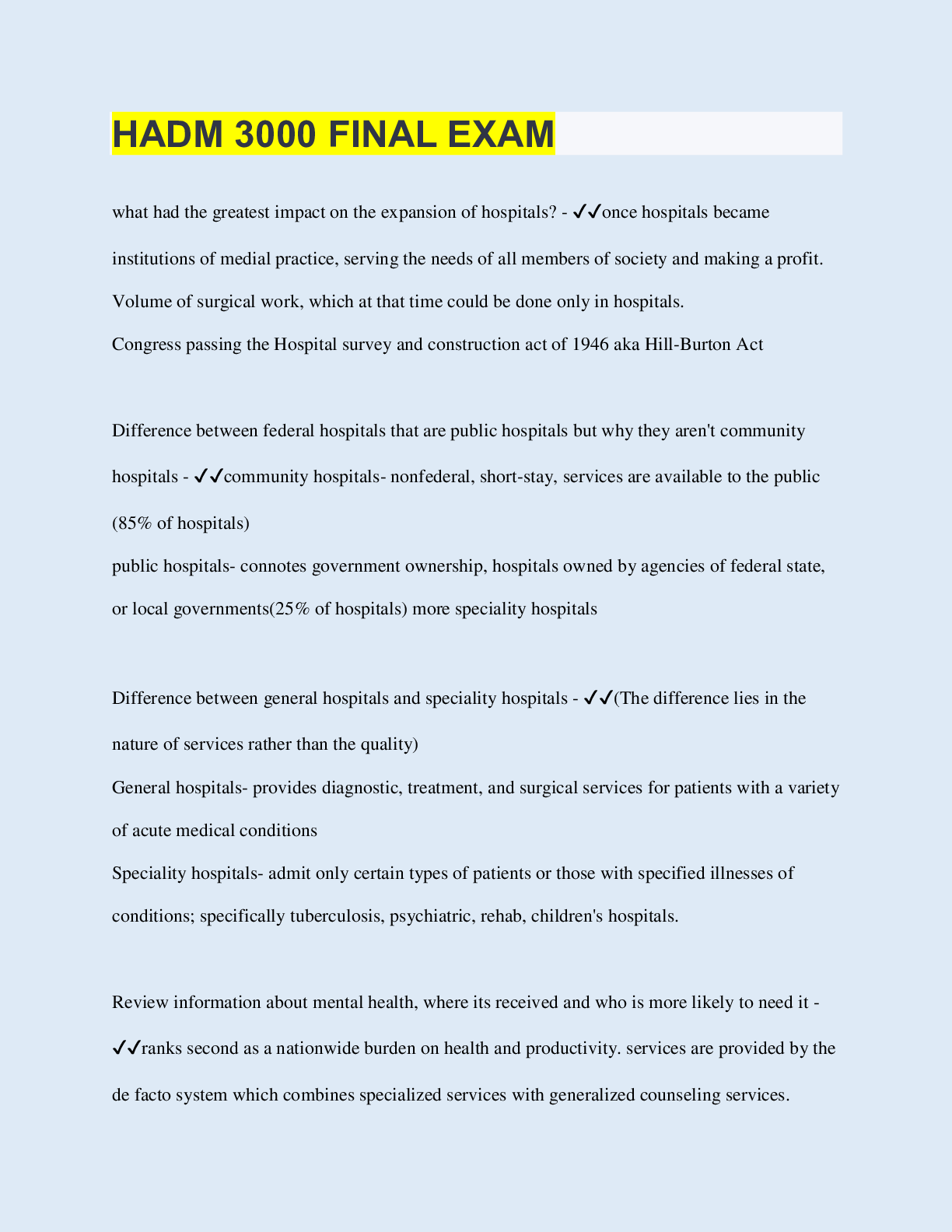
HADM 3000 FINAL EXAM
what had the greatest impact on the expansion of hospitals? - ✔✔once hospitals became
institutions of medial practice, serving the needs of all members of society and making a profit.
Volume of su
...
HADM 3000 FINAL EXAM
what had the greatest impact on the expansion of hospitals? - ✔✔once hospitals became
institutions of medial practice, serving the needs of all members of society and making a profit.
Volume of surgical work, which at that time could be done only in hospitals.
Congress passing the Hospital survey and construction act of 1946 aka Hill-Burton Act
Difference between federal hospitals that are public hospitals but why they aren't community
hospitals - ✔✔community hospitals- nonfederal, short-stay, services are available to the public
(85% of hospitals)
public hospitals- connotes government ownership, hospitals owned by agencies of federal state,
or local governments(25% of hospitals) more speciality hospitals
Difference between general hospitals and speciality hospitals - ✔✔(The difference lies in the
nature of services rather than the quality)
General hospitals- provides diagnostic, treatment, and surgical services for patients with a variety
of acute medical conditions
Speciality hospitals- admit only certain types of patients or those with specified illnesses of
conditions; specifically tuberculosis, psychiatric, rehab, children's hospitals.
Review information about mental health, where its received and who is more likely to need it -
✔✔ranks second as a nationwide burden on health and productivity. services are provided by the
de facto system which combines specialized services with generalized counseling services.
Homeless & women (anxiety, eating, depression). Services provided in Psychiatric Hospitals
(speciality hospitals)
What type of reimbursement method involves a fixed monthly payment- - ✔✔captation; is used
by HMO's under managed care. Under this reimbursement scheme a provider is paid a set
monthly fee per enrollee, regardless of whether the enrollee sees the provider or not, and
regardless of how often an enrollee sees the provider
Discussion of utilization of uninsurance companies, which has the tightest control? - ✔✔HMO's
employ higher utilization controls than other types of managed care plans. The methods most
commonly used for utilization monitoring are gatekeeping and utilization review
Managed care defined - ✔✔a mechanism of providing health care services in which a single
organization takes on the management of financing, insurance, delivery, and payment
3 Main approaches to monitor and control the utilization of services - ✔✔1.expert evaluation of
which services are medically necessary in a given case
2. determination of how services can be provided most inexpensively while maintaining
acceptable standards of quality
3. review of the process of care and changes in the patient's condition to revise the course of
medical treatment if necessary
Gate keeping Method - ✔✔requires a primary care physician to coordinate all health care
services needed by the enrollee. emphasizes preventative care, routine physical examinations,
and other primary care services that are delivered by the primary care gatekeeper. Secondary
care services, such as diagnostic testing, consultation from specialists, and admission to a
hospital are provided only a referral from the gatekeeper. In this way, the gatekeeper controls
access to costly medical services.
Concurrent, prospective and retrospective utilization - ✔✔Prospective (before you get there) (to
prevent unnecessary institutionalization, such as surgery)
Concurrent (if you go to EAMC, someone will be looking @ chart while you're there)
(monitoring the length of inpatient stays/discharging)
Retrospective (after you leave)
Medicare managed care option; part C what is it called? - ✔✔Medicare Advantage, extra
benefits such as basic dental and vision benefits, helps with out of pocket costs.
Why is long term care special? what is it about long term care that makes it different? -
✔✔individualized- well coordinated services that promote the max possible independence for
people with functional limitations and are provided over an extended period of time in
accordance with a holistic approach, while maximizing their quality of life.
word for end of life care that is not hospice - ✔✔palliative care
Long term care facilities and what is important - ✔✔not restricted to the elderly; anyone with a
chronic condition
- associated with nursing homes, skilled nursing facilities, subacute care facilities, specialized
care facilities
other long term facilities - ✔✔community based LTC, Home Health Care, Adult Day-Care,
Senior Centers, Home-delivered and congregate meals, Handyman services, emergency response
systems, retirement facilities, Personal care facilities, skilled nursing facilities, subacute care
facilities
- ✔✔1. community based LTC- a) supplement informal care b) economical least restrictive
c)temp respite for families d) delay/prevent institutionalization EX. Area AGencies on Aging
(p.245)
2.Home health Care- Medicare main single payer for this type (246)
3.Adult Day Care- community based group program for anything from social, medcal, and
specialized care(247)
4.Adult Foster Care- family run home providing care to norelated adults that cant care for
themselves
5.Senior Centers- community center for older adults to socialize
6.Home-delivered and congregate meals- EX. meals on wheels generally one hot meal at 12 for
ppl 60 and older
7.handyman services- community performs household chores and repairs for the house
8. Emergency response systems- electronic device allowing ppl to call for help during an
emergency Ex. Life Alert
{9. Retirement Facilities- Community of elderly people do not deliver nursing care services,
organize programs for them emphasize privacy, security, independence, & active lifestyles
10. Personal Care Facilities- non-medical custodial care- basic assistance provided in a protected
environment and does not include active medical or rehabilitative treatments
11. Assisted living facilities- residential setting providing personal care services 24 hour
supervision- assistance with ADLs are bathing, dressing, and toileting
categorized between personal care homes and nursing homes
12. skilled nursing facilities- provides a full range of clinical LTC services- skilled nursing care,
*rehab*, assistance with all ADLs treatment authorized by a physician
13. Subacute Care Facilities- } blend of intensive medical nursing and other services that are
technically complex 3 Types: 1)LTC hospitals 2) SNFs 3)community based home health
agencies
It is important to be licensed-can't operate without one and certified-don't have to be but can't
receive medicaid or medicare payments
ADL Scale - ✔✔the ADL scale is used to assess a person's ability to perform certain common
tasks referred to as "Activities of daily living"
Scale- 6 basic activities: eating, bathing, dressing, using a toilet, maintaining bowel and bladder
control, and transferring (such as getting out of bed and moving to a chair)
quote from Jason Banks - ✔✔
Vulnerabilities - ✔✔denotes susceptibility to negative events. refers to the likelihood of
experiencing poor health or illness
determined by:
*Predisposing characteristics- racial/ethical, gender & age, geographical location
*Enabling characteristics- insurance status, homelessness
*Need characteristics: mental health, chronic illness/disability, HIV/AIDS
Developmental - ✔✔refers to the rapid cumulative physical and emotional changes that
characterize childhood, and the potential effects that illness, injury, or untoward family and
social circumstances can have on a child's life-course trajectory
Dependency - ✔✔refers to the special circumstances that children face that require others to
recognize and respond to their health needs
New Morbidity - ✔✔includes drug and alcohol abuse, obesity, family and neighborhood
violence, emotional disorders and learning problems
Mental Disorder (vulnerabilities) - ✔✔composed of two subsystems- one primarily for
individuals w/ insurance coverage or private funds and the other for those without private means
of coverage
Hospital Utilization - ✔✔*elderly individuals spend more time in hospitals than do younger
people.
*women are admitted more than men, but men incur longer stays
*utilization is higher among blacks than whites, and higher among the poor than the non poor
*Medicare and Medicaid recipients have higher hospital utilization.
3rd party payment system & where it increases costs of healthcare or decreases - ✔✔Increases:
Third party, not the consumer, pays the lion's share for most of the services used—one of the
main reasons for the HIGH cost of health care.
· The use of health care is driven by need rather than economic demand; The quantity of health
care services produced and delivered is likely to be much higher than in a competitive market;
prices shared for health care services are permanently higher than the true economic cost of
production.
defensive medicine - ✔✔leads to test and services that aren't medically justified but rather
performed by physicians to protect themselves against potential malpractice lawsuits.
unrestrained malpractice awards by the courts and increased malpractice insurance premiums for
physicians significantly add to the cost of healthcare.
Questions about the reform:
1.)when obama tried and clinton tried
2.)how many uninsured americans we still have; what the statistics show
3.)conceptually understand what we think about when we talk about central health planning;
what does that mean? - ✔✔Obama- ACA Clinton CHIP & HIPAA in '96.
Obama had more interest groups and more Dem. congressional leaders.
21 people are currently uninsured.
DRGS (Diagnosis-Related Groups) = controls cost - ✔✔Put in place to allow hospitals to be
reimbursed according to procedure and services codes
the important undertaking to control prices for inpatient hospital care was the conversion of
hospital medicare reimbursement from retrospective plan to prospective system based on DRGs
as authorized under social security amendments of 1983. this reduced growth in inpatient
hospital spending.
Jason Banks about the future change and reform with medicaid payments- why the state is doing
that - ✔✔
How health care policy operates in the US??? - ✔✔A. Government as subsidiary to private
sector-fragmented, incremental, piecemeal reform -not a right of citizenship -fills gaps in private
sector -ACA created
B. interest group politics AMA and AARP
C.decentralized role for the states -medicaid financed by the states -have most authority for
regulating the health care system
D. Impact of presidents- Lyndon Johnson passed medicare and medicaid in 1965 -Harry truman
passed hill-burton hospital construction Act (322) (grew hospitals) Obama- ACA
p.334 health policies are developed to serve public interests
[In case she meant how things get passed]
Legislative process(324)
introduced in the House of Rep.-->assigned to a committee-->sub-committee-->hearings
commence-->can be tabled recommended or not recommended
if recommended: whole house hears the bill-->can add amendments-->may or may not be
approved
(2) once approved goes to senate-->same process→ any changes require the house to see it again
(3)it's been passed by house and senate then the President must sign off for it to become law--
>he also can veto it
(4) bureaucracy figures out how to implement the law
Know the number of people who fall in the gap between affording the marketplace and medicaid
- ✔✔21 million people will remain uninsured; 3 million people are in the coverage gap??
2 major concerns regarding medicare reform - ✔✔1. How to finance for future generations
without underlying burdening beneficiaries, taxpayers, or the general economy.
2.There is a pressing issue relating to the role of private plans in Medicare, and concerns about
the current paying systems for private plans.
3. The relatively new Medicare prescription drug Benefit and how to address concerns about its
current structure and further limit the burden of prescription drug spending.
percent of population that is uninsured - ✔✔12-16%
primary objective of ACA - ✔✔•From Group 1 PowerPoint: Obama didn't take on health reform
because of "good politics" or to "get some legislative victory", he solely was committed to
"relieve the burden on middle class families".
3 main purposes:p.147
1) reform private insurance market- especially for individuals and small-group purchases
2) expand medicaid to the working poor with income up to 133% of the federal poverty level
3) to change the way that medical decisions are made
interest groups that played a part in the ACA - ✔✔the most effective demanders of policies are
the well-organized interest groups. they resist major change. Ex. physicians in the American
Medical Association, señor citizens allied with AARP, Institutional providers such as hospitals
belong to American Hospital Association, nursing homes belonging to American Health Care
Assoc. or the American Association of Homes and Services for the Aging. and the members
companies in the Pharmaceutical Research and Manufacturers of Americans
Why don't americans like national health care - ✔✔it runs contrary to the beliefs and values that
have been prevalent since the nation was founded. Americans maintenance a strong belief in
capitalism and individual achievement with little government.
*High in costs, unequal in access, average in outcomes*
What employers have been doing with rising healthcare costs - ✔✔cost shifting- the ability of
providing to make up for lost revenues in one area by increasing utilization or charging higher
prices in other areas that are free of controls. Providers are able to shift costs when cost-contra
measures are not applied on a system-wide basis
Workforces shortages; what is a great solution; what is something we need to promote to help
with the shortages - ✔✔nurses should practice to the full extent of their educations and training.
Residency programs for nurses need to incorporate raining in community and public health and
geriatrics. Primary care physicians need to be "comprehensive" to address more complex chronic
conditions and pharmacology, understand end-of-life issues and medical ethics, and lead health
care teams
Primary care physicians what's important for them? - ✔✔need training so they can adequately
function as "comprehensives" to address the needs of a growing number of people with complex
chronic conditions. They must be prepared to manage complex pharmacology, understand end-of
life issues and medical ethics and lead healthcare teams
Which administration's major health reform happened - ✔✔*Lyndon Johnson passed Hill-burton
Hospital Construction Act- grew hospitals.
*Harry Truman passed Hill-Burton Hospital Construction Act- grew hospitals
*Bill clinton passed CHIP and HIPAA in 1996
*Barack Obama passed ACA
US Supreme Court Ruling on the ACA - ✔✔since it generates revenue supposed to be proposed
in the house and it was started in the senate and on those grounds considered unconstitutional.
left states to rule if medicare expanded
Overall idea of what america's beef is with universal health care - ✔✔runs contrary to the beliefs
and values that have been prevalent since the nation was founded. traditionally maintained a
strong belief in capitalism and individual achievement. preferred small government involvement
in private affairs. Basically culture values and beliefs.
Dependency of americans on the government - ✔✔may 2011 15% of population relied on
welfare assistance to buy food with an increasing dependency on the government
the way medicare beneficiaries how they are paying for medicare, who? - ✔✔The financing of
Medicare is essentially a generation transfer system in which current taxpayers pay for the
benefits of current beneficiaries. Shortfalls in such a financial system must be paid by future
generation
Definition of bipartisan support - ✔✔Marked by or involving cooperation, agreement, and
compromise between two major political parties democrats and republicans
[Show More]