Warm up and Flexibility
How does warm-ups benefit exercise/training/sports? - ✔✔Proper preparation essential for
optimal exercise or athletic performance. It functions as a bridge/transition from rest to exercise.
- P
...
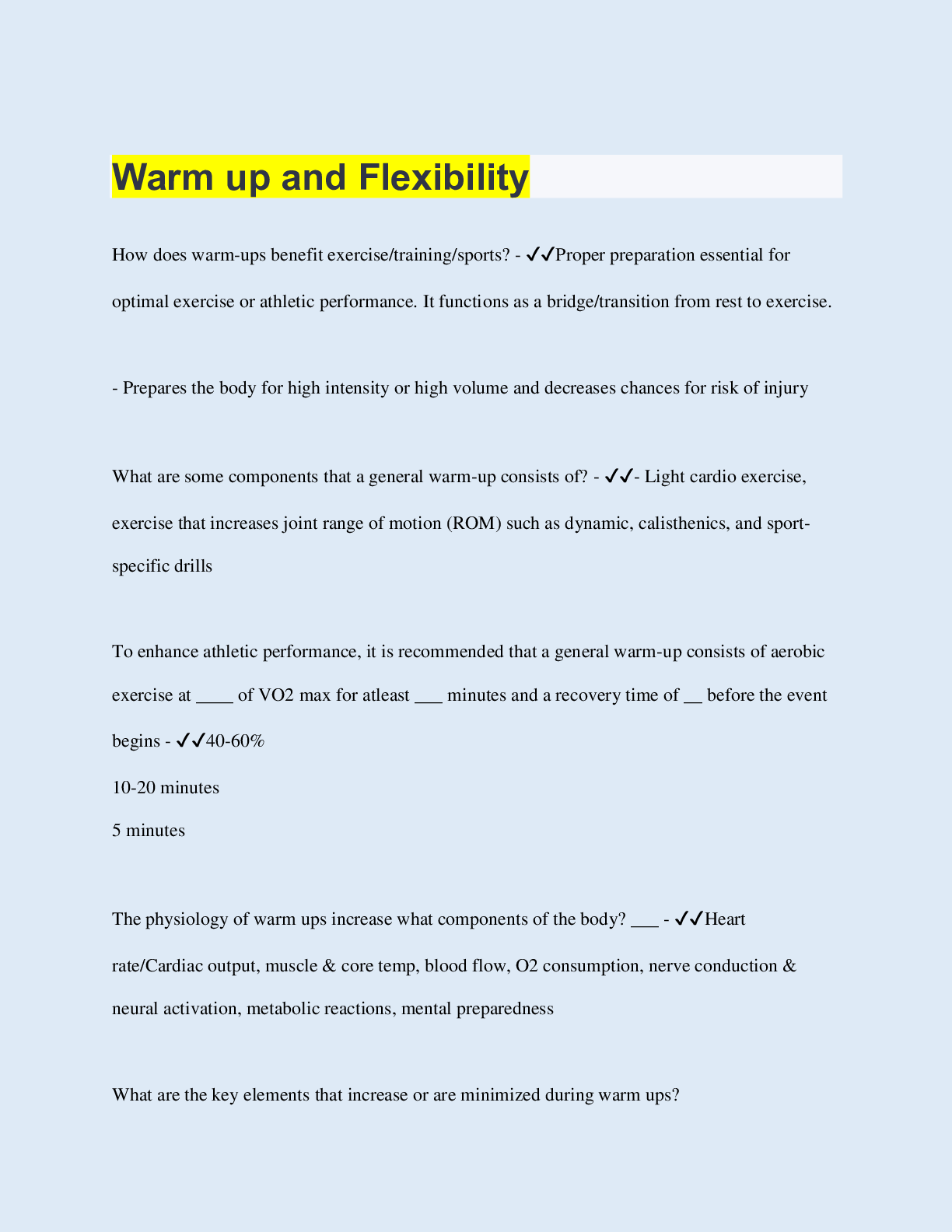
Warm up and Flexibility
How does warm-ups benefit exercise/training/sports? - ✔✔Proper preparation essential for
optimal exercise or athletic performance. It functions as a bridge/transition from rest to exercise.
- Prepares the body for high intensity or high volume and decreases chances for risk of injury
What are some components that a general warm-up consists of? - ✔✔- Light cardio exercise,
exercise that increases joint range of motion (ROM) such as dynamic, calisthenics, and sportspecific drills
To enhance athletic performance, it is recommended that a general warm-up consists of aerobic
exercise at ____ of VO2 max for atleast ___ minutes and a recovery time of __ before the event
begins - ✔✔40-60%
10-20 minutes
5 minutes
The physiology of warm ups increase what components of the body? ___ - ✔✔Heart
rate/Cardiac output, muscle & core temp, blood flow, O2 consumption, nerve conduction &
neural activation, metabolic reactions, mental preparedness
What are the key elements that increase or are minimized during warm ups?
After 3-5 minutes of warm-up, there is an enhanced performance in what areas? ___ -
✔✔Increase muscle temperature, increase VO2, minimize fatigue.
Vertical jump, swimming time, running time, and cycling power
What is the difference between passive warm-ups v. active warm-ups?
Which of those warm ups results in better short term performance? - ✔✔- Passive: temperature
increased without exercise (Sauna, hot shower, water immersion, heat application)
- Active: body temperature increased via exercise (enhances moderate to long duration exercise)
- Active warm-ups
What is the difference between general and specific warm ups?
Progressive warm ups uses which of these types of exercises? - ✔✔- General: Low intensity
exercise for 5-10 minutes, usually aerobic in nature (jogging, cycling)
- Specific: Dynamic or very light static movements, similar to sport/activity, 5-15 minutes, warm
ups vary depending on the sport or activity
-Both general and sport specific exercise/movements
Progressive warm ups focus on ____
- Athletes who participate in progressive warm ups perform near ___% game speed by ___ -
✔✔- The progression of complexity and speed of movement throughout the warm up
-100% by the end of the warm up
Describe what post activation potentiation is ___ and how does it benefit an individual/athlete?
___
- How do some people view post activation potentiation as? ___ - ✔✔- Muscular performance is
enhanced as a result of previous contractions. (Squatting before doing a vertical jump enhances
performance)
- Perform a max or near-max repetition (1-3 reps)
Activated motor units stay facilitated for a period of time following maximal or near-maximal
muscle contractions
Muscle strength, power, & endurance can be enhanced
- Some view it as a warm up while others view it as a separate entity & part of workout
The warm up continuum is divided into what three categories? - ✔✔1) Low intensity general
warm up
2) Moderate intensity general & specific warm up
3) High intensity potentiation warm up
Dynamic v. Static warm ups ___ - ✔✔- Dynamic: enhances performance due to a series of
movements/Joint ROM during movement
- Static: reduce performance due to the stretch and hold format/Joint ROM without movement
Intense stretching is recommended for strength/power athletes after ___
What are important things to consider when selecting a warm up? - ✔✔Work out as a cool down
Who is my client, what type of physical activity are they doing, FITT principles, what is their
sport, ect.
Define flexibility ___
What are the 3 types of flexibility? ___
What are the 3 types of stretching?
Which type of stretching is the most familiar? - ✔✔- A measure of joint ROM without injury
1) Static (stretch to SLIGHT discomfort and hold)
2) Dynamic
3) Ballistic (form of dynamic described during power/explosive or bouncing movements)
- Static (most familiar), Dynamic, PNF
What are health benefits from flexibility? - ✔✔Maintains appropriate muscle lengths, improves
muscle balance/muscular weakness/[posture/ability to move, reduces risk of injury, relives stress
How does flexibility improve:
Olympic weightlifter
Tennis player
Gymnast
Hurdler
Volleyball player - ✔✔- Proper overhead position in the snatch
- Maximizing velocity & accuracy of serve
- Proper position during a split
- Elevating over the hurdle w/out deviation in stride
- Blocking a shot & spiking the ball
How does flexibility reduce injury prevention? - ✔✔- Decrease risk of pain
- Increase compliance of tendon
- Reduce acute tendon stiffness
- Decrease hysteresis
- Enhances joint ROM
What are factors that affect flexibility?
When selecting stretches, what do you want to look for? - ✔✔Age, gender, muscular control,
joint structure, muscular imbalance, bulk, training in a limited ROM, activity level
- stretches that work each major muscle group and joint
Describe PNF stretching __
What does it utilize? __
When doing PNF and you hold the stretch, what type of movement is done? ___
When you hold-relax or contract-relax what type of muscle contraction is done? ___ - ✔✔-
Partner stretch
- Contraction of antagonist (stretched muscle) and agonist (opposite muscle) groups along with
passive (partner) stretching of muscle
- Isometric movement
- Agonist contraction
What is the FITT recommendation for flexibility?
What are activities that perform flexibility other than stretching? - ✔✔F: 2-3 days a week, 4 reps
per muscle group
I: stretch to a point of MILD discomfort; hold for 15-60 seconds
T: 10 mins per session
T: Dynamic, Static, PNF (ballistic for athletes)
- Yoga, Pilates, Tia Chi
You should stretch after a ___ or a ___
When doing PNF streching, allow a __ second contraction followed by a ___ second assisted
strech - ✔✔work out or general warm up
6 sec, 10-30 sec assisted
Describe cool down - ✔✔- post workout light exercise to provide an adjustment period to allow
body to return to a resting status (5-10 mins of light exercise)
[Show More]




.png)
.png)


 (1).png)