ILRHR 2600 Exam 3 Study Guide
Why should we care about diversity in organizations? - ✔✔- Social Justice
- Legal Requirements (EEOC)
- Access to Niche Markets
- Organizational Effects
Workplace diversity - ✔✔Variatio
...
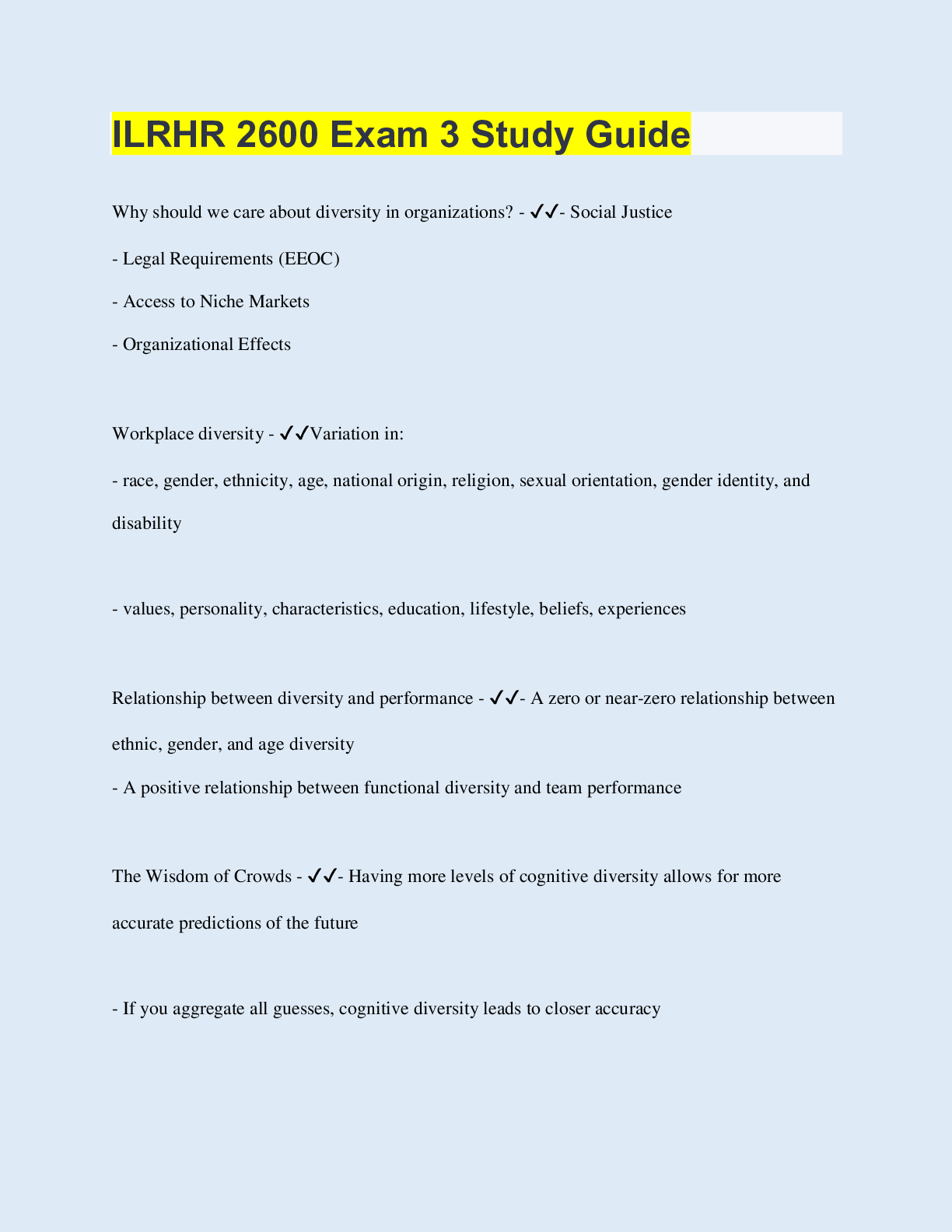
ILRHR 2600 Exam 3 Study Guide
Why should we care about diversity in organizations? - ✔✔- Social Justice
- Legal Requirements (EEOC)
- Access to Niche Markets
- Organizational Effects
Workplace diversity - ✔✔Variation in:
- race, gender, ethnicity, age, national origin, religion, sexual orientation, gender identity, and
disability
- values, personality, characteristics, education, lifestyle, beliefs, experiences
Relationship between diversity and performance - ✔✔- A zero or near-zero relationship between
ethnic, gender, and age diversity
- A positive relationship between functional diversity and team performance
The Wisdom of Crowds - ✔✔- Having more levels of cognitive diversity allows for more
accurate predictions of the future
- If you aggregate all guesses, cognitive diversity leads to closer accuracy
Supply side factors - ✔✔(Drivers of Inequality in the Workforce) Differences in perceptions,
decisions, and behaviors on the part of the individual
Demand side factors - ✔✔(Drivers of Inequality in the Workforce) Differences in the
environment that the individual interacts with
Stereotype - ✔✔Category based expectation
Prejudice - ✔✔Attitudes towards a particular social group
Discrimination - ✔✔Acting on stereotypes, and, or prejudices
Out-group homogeneity - ✔✔Views in-group as variable, but outside groups are perceived as the
same
in-group favoritism - ✔✔The tendency to view people in your in-group as having positive traits
as compared to out-group members
Stereotype Threat - ✔✔When members of certain stereotyped groups worry about confirming a
stereotype about their group and this interferes with their performance
True - ✔✔When you control the task for men and women, but change what type of task it is
there is little performance differences in regards to stereotypes (For example, saying a finance
task is a marketing task)
Stereotype lift effect - ✔✔Telling men and women there are differences in performances on
tasks based on gender, men will usually perform much better and women worse
Prescriptive norms - ✔✔The way people are supposed to act
Biased Interpretation - ✔✔When one receives ambiguous information, they are more likely to
fall back on preconceived notions
Backlash - ✔✔Penalties faced when failing to adhere to stereotypes
When do we use unconscious information? - ✔✔- High cognitive load: thinking of lots of
different things
- Low attention: tired or distracted
- Ambiguous situations: conflicting evidence about ability
Ways to reduce the use of stereotypes - ✔✔- Blinding
- Awareness: commitment to egalitarian principles reduces discriminatory behavior
- Contact: familiarity increases accuracy of perceptions (bringing people together from diverse
backgrounds can allow them to eliminate stereotypes of specific groups)
Efficient wage theory - ✔✔Pay level matters
- the more you pay people the happier they will be
Equity theory - ✔✔Pay comparisons matter
- inputs should determine outputs & they should be equitable relative to others inputs
Contingent Reward - ✔✔Pay based on performance
- increase employee effort
- reinforce specific behaviors
Compensation - ✔✔salary + rate of contingent reward(effort)
False - ✔✔Pay-for-performance does not work when there is a strong link between effort,
performance, and compensation
Problems with Contingent Rewards - ✔✔- People have an overinflated perception of
contributions
- Unintended consequences (negative work behaviors)
- Can undermine creativity and enjoyment
- Inconsistent or noisy relationship between effort, performance, and rewards
Factors that lead to intrinsic motivation - ✔✔- Meaningfulness of Work (Purpose)
- Enjoyment/Mastery
- Autonomy
How does extrinsic reward hurt intrinsic motivation? - ✔✔- Signaling that task must be "work"
and not interesting
- Shifts thinking to narrow cost-benefit calculations
True - ✔✔Incentives decrease performance on tasks that are complex cognitive-skilled tasks.
Therefore, they work best on simple tasks
Global Advantages - ✔✔New market = new customers
Foreign country = lower labor costs
Global operations = continuous work day
Parent-country nationals - ✔✔People from the country where the company is headquartered
Expatriate - ✔✔Parent-country nationals assigned to an international affiliate
Host-country nationals - ✔✔Employees from the country where the internal affiliate is located
Impatriates - ✔✔Home-country nationals assigned to parent country
Third-country nationals - ✔✔Employees who are neither PCNs or HCNs, "migrant workers"
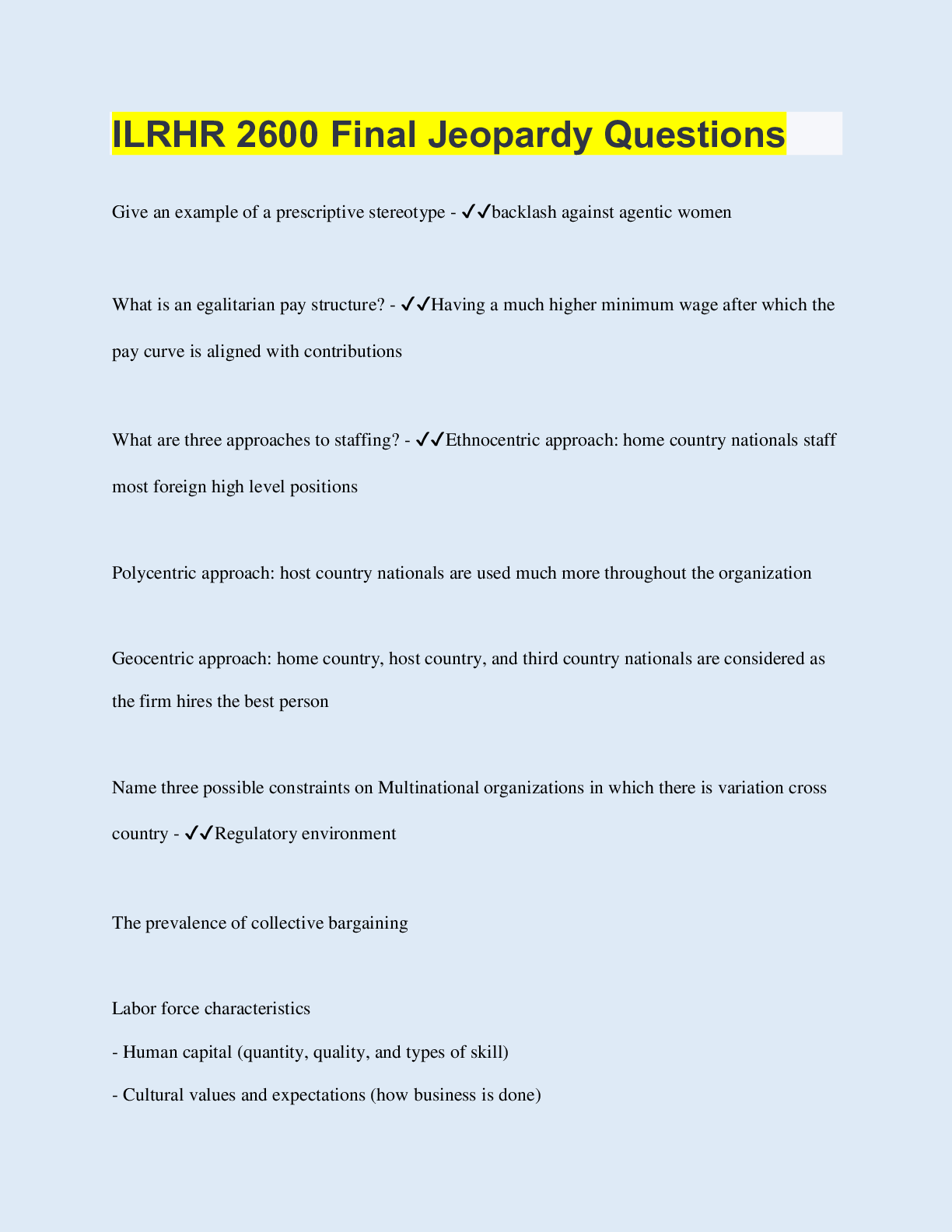
Constraints on Multinational organizations - ✔✔- The regulatory environment
- The presence of collective bargaining
- Labor force characteristics --> human capital & cultural values/expectations
Ethnocentric Approach - ✔✔Taking home country nationals to foreign countries
Polycentric Approach - ✔✔Host-country nationals are used much more throughout the
organization
Geocentric Approach - ✔✔Home-country, host-country, and third-country nationals are
considered as the firm hires the best person for each position
What predicts Expatriate Success? - ✔✔General Adjustment: weather, food, living conditions
Cultural Adjustment: values, expectations, standards
Interaction Adjustment: native communication style
Balance Sheet Approach (build-up approach) - ✔✔Linked to home country's salary structure
Advantages
- Equity --> between assignments & between expatriates of the same nationality
- Facilitates expatriate re-entry
-Easy to communicate to employees
Disadvantages
- Can result in great disparities between expatriates of different nationalities & between
expatriates and local nationals
- Can be complex to administer
Going Rate Approach (Market Rate approach) - ✔✔Linked to host country salary structure
[Show More]