Mist 2090 Exam 2
Document Content and Description Below
Mist 2090 Exam 2
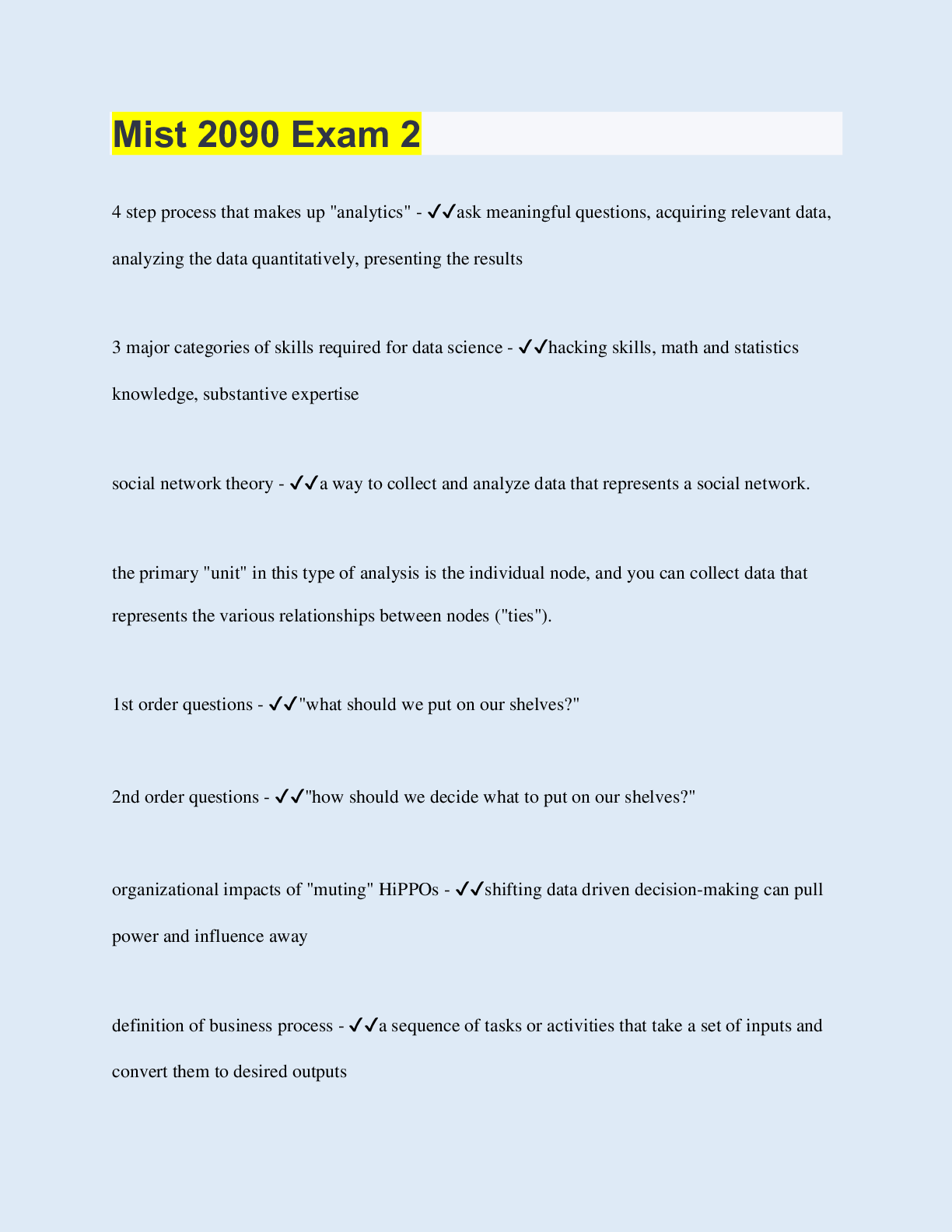
4 step process that makes up "analytics" - ✔✔ask meaningful questions, acquiring relevant data,
analyzing the data quantitatively, presenting the results
3 major categories of
...
skills required for data science - ✔✔hacking skills, math and statistics
knowledge, substantive expertise
social network theory - ✔✔a way to collect and analyze data that represents a social network.
the primary "unit" in this type of analysis is the individual node, and you can collect data that
represents the various relationships between nodes ("ties").
1st order questions - ✔✔"what should we put on our shelves?"
2nd order questions - ✔✔"how should we decide what to put on our shelves?"
organizational impacts of "muting" HiPPOs - ✔✔shifting data driven decision-making can pull
power and influence away
definition of business process - ✔✔a sequence of tasks or activities that take a set of inputs and
convert them to desired outputs
functions - ✔✔- many existing companies are setup as different units
- departments in an organization are responsible for different things
- each unit often has its own info system that optimizes its work
processes - ✔✔- cross functional
- no single group or function is responsible for their execution
- rely on each functional group to execute its individual steps
silo effect - ✔✔workers complete their tasks in their functional silos without regard to the
consequences for the components of the process
consequences of poor organizational coordination - ✔✔delays, excess inventory, lack of
visibility across the process
delays - ✔✔- increased lead and cycle times
- lead times - customer's perspective
- cycle times - organization's perspective
excess inventory - ✔✔"just in case"
lack of visibility across the process - ✔✔status: "where is my order?" and how is the process
doing
BPMN - ✔✔- the emerging standard for specifying business processes in a business process
model
- goal is to provide standard notation readily understandable by all business stakeholders
basic notation for BPMN - ✔✔event, task/activity, flow/arc, gateway
event - ✔✔represents a thing that happens instantly
task/activity - ✔✔represents a unit of work that has a duration
flow/arc - ✔✔connects objects with each other and shows the order of elements in the process
gateway - ✔✔object that represents things that separate and/or recombine flows
user experience (UX) - ✔✔how effective and pleasant a product is to use
user interface (UI) - ✔✔the set of ways in which a person interacts with a technology
krug's first law of usability - ✔✔- don't make me think
- as far as humanely possible, when you look at a web page, it should be self-evident. obvious.
self-explanatory.
how humans use apps/sites - ✔✔visual, precedence, Z pattern, F pattern, larger text usually a
headline that summarizes a story below, and user decides what parts are useful
1st step of UX design process - ✔✔do research on your users: who are they? where are they
from? where can you find them?
2nd step of UX design process - ✔✔build user personas
- summarize your research from the first step into 2-3 (or more) discrete user personas
- personas are fictional characters created to represent the different user types that might use a
site, brand, or product in a similar way
3rd step of UX design process - ✔✔create user stories
- bring the whole team together to define goals for each user
- try to map out the whole scenario for the user's experience on the site or app ("scenario map")
- build out the sitemap and think about navigation
4th step of UX design process - ✔✔start creating wireframes and interaction prototypes
5th step of UX design process - ✔✔UI, visual design, and delivery
- UX refers to user experience design while UI stands for user interface design (and is closer to
graphic design)
- create a style guide for spacing, padding, font sizes, etc.
6th step of UX design process - ✔✔metrics analysis: validate your design
- use analytics tool track down how users use the product, how they interact, can they reach the
goal we want them to, etc.
- a UX researcher will test designs and analyze data from actual users and give recommendations
to improve the function and design
wireframes - ✔✔- a visual guide that represents the skeletal framework of a website
- should include: navigation, input components, key interface elements
- not the final design
definition of a platform - ✔✔a digital environment characterized by near-zero marginal cost of
access, reproduction, and distribution
advantages of platform-based business models - ✔✔- reduce or remove long-standing barriers
that keep people from transacting with each other
- can influence the flow of transactions to absorb more of the benefits of those transactions
disadvantages of platform-based business models - ✔✔- you have to decide what to focus
on...the consumer or the producers
- it's hard to lure people away from a mature platform because the content producers want to be
where the consumers are, and the content consumers want to be where the producers are
more advantages/disadvantages of platform-based business models - ✔✔- massively distributed
- innovation
- risk transfer
- capturing the long tail
- competitive sustainability
free - ✔✔once something has been digitized, it's essentially free to make an additional copy of it
perfect - ✔✔copies are every bit as good as their digitized originals
instant - ✔✔networks allow distribution of a free, perfect copy of information goods from one
place to another virtually immediately
network effects - ✔✔refers to the phenomenon by which a product or service gains additional
value as more people use it
benefits of platform-based business models - ✔✔bundling/unbundling, pre-purchase sampling,
service-based revenue models, ecosystem of complementary products
unbundling - ✔✔separating resources that used to be tightly clustered together and difficult to
consume one-by-one
bundling - ✔✔grouping a popular resource with an unpopular resource to encourage
consumption
pre-purchase sampling - ✔✔allow platform users to sample goods before purchasing
service-based revenue models - ✔✔sell goods as a service with a monthly fee
the role of complementary goods in shifting demand curves - ✔✔when the price of good A goes
down, the demand curve of good B shifts out (demand increases)
cost of open platform ecosystems - ✔✔being too open/allowing things like cybercrime into the
market
benefits of open platform ecosystems - ✔✔increase consumer surplus, increase demand, and
platform owners get data
curation - ✔✔platform owner sets strict standards for user generated content, but it has to be
approved under strict guidelines
reputation systems - ✔✔platform owner establishes a system for users to rate content to ensure
that high-quality content is easily accessible and low-quality content falls away
habits of successful platforms - ✔✔- early to the space
- take advantage of the economics of complementary goods
- open up platforms to a broad range of contributers
- curate platforms to deliver a consistent experience
platform management of perishing inventory - ✔✔when inventory is perishable, the marginal
cost of filling the spaces can be very low (fixed costs are constant)
O2O platforms - ✔✔- platforms whose offerings involve atoms (as opposed to bits) and take
place in the real world
- do not necessarily have perishing inventory problems...when assets are long-lived rather than
perishable, owning them enables companies to rent them as a service (ex. Rent the Runway)
- while much of the development in these platforms has been B2C, the authors predict the growth
of B2B platforms in the future; examples: empty space on trucks and in warehouses, freelance
work, booking venues, etc.
platforms as engines for liquidity in markets - ✔✔assurance that a transaction will happen
without huge price changes
incumbent organizations and the role of regulation - ✔✔- a mature, well-designed platform
ecosystem has so much power that it becomes nearly impossible for other players in a market to
compete with it
- regulation was at times the incumbents' best defense against digital upstarts
[Show More]
Last updated: 2 years ago
Preview 1 out of 9 pages






.png)







.png)