CHD 2220 Exam 2 Krantz Ch 5,6,7
infants come to know each other by - ✔✔mutual touch, speech, and glances
how long does it take for someone to say wow your kid has grown - ✔✔approx 3 weeks
avg weight of newborn - ✔✔7.5
...
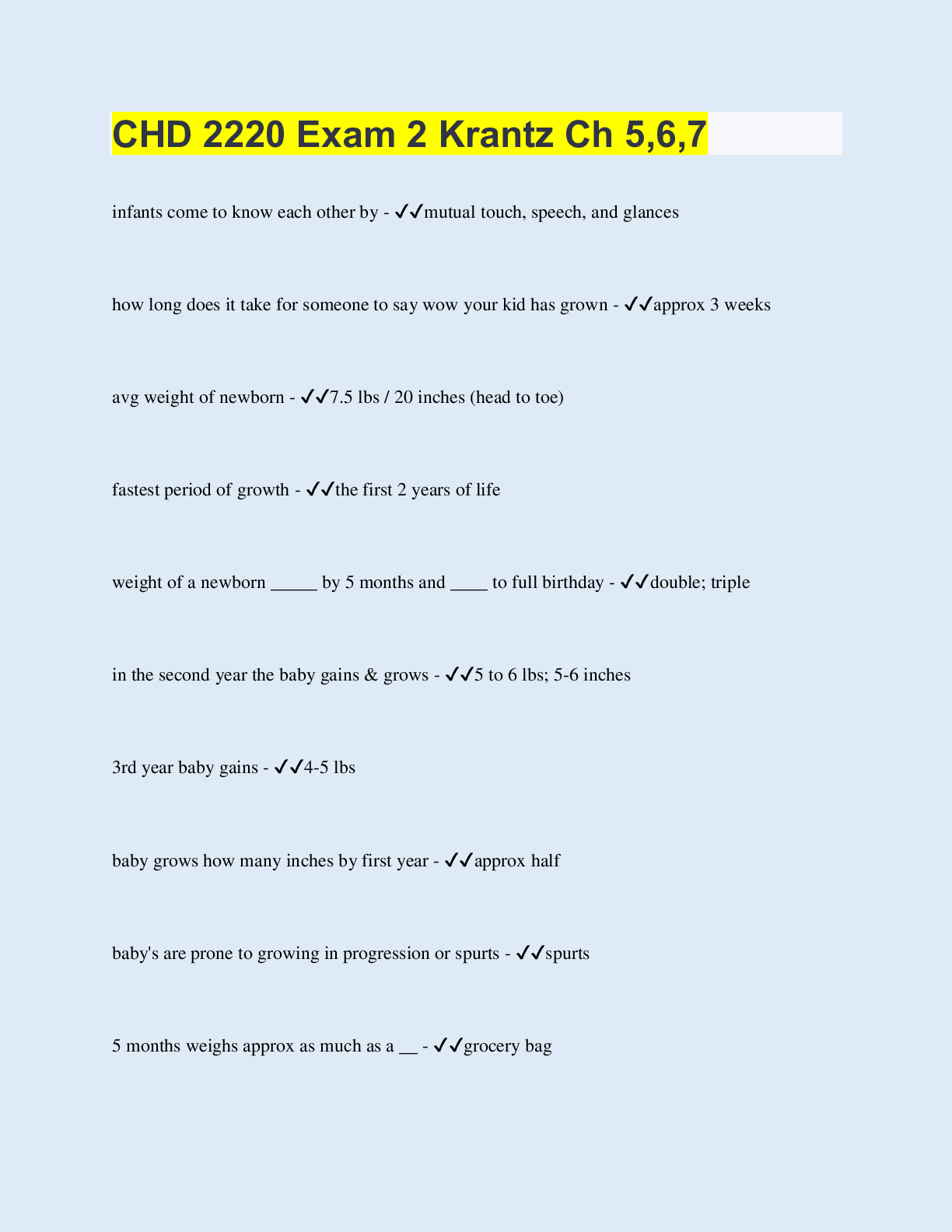
CHD 2220 Exam 2 Krantz Ch 5,6,7
infants come to know each other by - ✔✔mutual touch, speech, and glances
how long does it take for someone to say wow your kid has grown - ✔✔approx 3 weeks
avg weight of newborn - ✔✔7.5 lbs / 20 inches (head to toe)
fastest period of growth - ✔✔the first 2 years of life
weight of a newborn _____ by 5 months and ____ to full birthday - ✔✔double; triple
in the second year the baby gains & grows - ✔✔5 to 6 lbs; 5-6 inches
3rd year baby gains - ✔✔4-5 lbs
baby grows how many inches by first year - ✔✔approx half
baby's are prone to growing in progression or spurts - ✔✔spurts
5 months weighs approx as much as a __ - ✔✔grocery bag
cephalocaudal principle - ✔✔head to tail in latin; growth of the head and upper body priced
growth in the lower body
8 weeks after conception, the head is ___ of the fetus length - ✔✔1/2
at birth the head is ___ of the body length - ✔✔1/4
during adulthood, the head counts for ___ of body length; and the legs for __ - ✔✔12% & 50%
proximodistal principle - ✔✔near to far; body grows from the center outward; the torso develops
prior to the arms and legs, & the arms an legs develop prior to the hands and fingers; & then
reverses before puberty when the hands and feet grow rapidly to mature size before other body
parts
examples of child proofing - ✔✔Light sockets must be covered by protective caps, stairs and
dropoffs blocked by secure gates, and dangerous objects (e.g., knives and tools) and substances
(e.g., wpe11.jpg (5084 bytes)bleach and insecticides) securely stored.
child proofing requires - ✔✔progressive adjustment and elaboration synchronized to the rapidly
increasing ability of the infant and toddler to defeat the protective hardware typically employed
by parents and caregivers in day care facilities.
should the baby drink breast milk or formula? - ✔✔although the breast milk of a healthy, wellnourished mother contains all of the required nutrients in perfect proportion to the infant's needs
during the first 3-4 months of life, formulas made of modified cow's milk are nutritionally
acceptable for babies of mothers who cannot or choose not to breast-feed.
breast milk offers several important health advantages when compared to formula
can baby still have fats protein carbs mineral and vitamins with either formula or breast milk -
✔✔yes
breast feeding can promote - ✔✔the early development of the infant's brain and on has positive
effects on long-term cognitive-intellectual development.
breast milk contains - ✔✔a distinct immunological benefit that cannot be duplicated in formula
when does a baby's immune system become effective - ✔✔middle of first eyar
colostrum - ✔✔a thin, yellowish fluid secreted by the breast for several days before milk is
produced; contains antibodies which cannot be duplicated in infant formula.
children that are breast fed can develop - ✔✔ADHD at adolescence
mothers also benefit from breast feeding - ✔✔more likely to lose weight; lower rates of breast
and ovarian cancer
recommend period of breast feeding - ✔✔1st 6 months
many woman (do.dont) breast feed - ✔✔dont; less than 50%
you should/ shouldn't feed your baby when they feed themselves - ✔✔shouldn't
most important part of the brain - ✔✔cns
when does the brain form - ✔✔only days after conception and its structure continues to emerge
throughout the prenatal stage
the structure of the brain evenness for - ✔✔the first 10 years
the neuron - ✔✔transmits impluses from dendrites to the cell body and from the cell body to the
axon ; line up into sequences or nerve pathways that conduct impulses throughout the body.
nerve cells - ✔✔do not actually touch each other, but axon of one cell butts up again the dendrite
of another cell forming a microscopic gap called a synapse.
synapse - ✔✔gap
Impulses are transmitted across the the synapse (and from cell to cell) by chemicals -
✔✔neurotransmitters
myelination - ✔✔28 weeks; axons develop an insulating, fatty coating that improves the
efficiency of nerve impulse transmission. continues throughout childhood and continues to some
extent into adolescence and adulthood.
synaptogensis - ✔✔Synapses begin to develop in very large numbers prenatally and continue to
increase in extraordinarily large numbers through the first 3 years of life in a process
highest level of synaptic density - ✔✔3rd year of life
prenatal stage of development - ✔✔architecture of the brain is formed; primary driver by genetic
influences
stages of development - ✔✔Neurons extend their axons toward the dendrites of other cells in an
intricate pattern predetermined by genetic forces and fueled by proteins and enzymes that are
perfectly orchestrated to assure the finished product. Late in gestation, nerve cells begin to fire,
sending impulses through various pathways in the developing brain, organizing brain function.
After the baby is born, the brain is barraged by patterned stimulation from multiple sources,
particularly from the routine interaction with caregivers. This external stimulation will have
profound effects on the developing brain through infancy and beyond
The fundamental structure of the nervous system is designed to - ✔✔to manage the storage and
transfer of all of the information necessary to support the biological functions of bodily systems
and the psychological functions of sensation, perception, learning and intelligence.
is the brain too much for us? - ✔✔yes;the human brain has evolved as a immense network that
can potentially handle far more information than it will ever be required to use.
hemispherectomy - ✔✔the radical removal of half of a child's brain in the treatment of extreme
cases of brain seizures.
. If one part of the nervous system becomes damaged or unable to function, other parts of the
system will be able to take over. - ✔✔plasticity
results in a leveling off of the number of synapses from the end of the second year through
approximately the tenth year, about the time children graduate from the elementary school. -
✔✔use it or lose it principle
pruning - ✔✔the greater the variation and organization of incoming stimuli, the greater the
number of pathways that survive. Synapses and cells that are not stimulated are eliminated
through a massive and continuing destructive process
stopped at development of the brain go in depth more - ✔✔
stages of development - ✔✔Neurons extend their axons toward the dendrites of other cells in an
intricate pattern predetermined by genetic forces and fueled by proteins and enzymes that are
perfectly orchestrated to assure the finished product
sensation - ✔✔the ability to passively receive and register information concerning internal and
external events and to transmit that information to the central nervous system.
perception - ✔✔infants active searching for information and the processing of that sensory
information by the brain.
infants are ____ vulnerable to injury than children at older age - ✔✔more
infants are not/are ____ capable of expressing their willingness to participate in a research study
- ✔✔not
visual preference method- from robert frantz - ✔✔the researcher presents pairs of stimuli to the
baby. The researcher observes the infant from a hidden vantage point between the two stimuli,
detects
The Looking Chamber presents stimuli to the infant and allows the researcher to record infant
visual fixation on various stimuli.
which stimulus the infant is looking at by the reflection of the fixated stimulus on the pupil of the
infant's eye, and records changes in fixation
electroencephalography (EEG) - ✔✔The measurement and interpretation of electrical activity in
the brain; Variations in brain wave patterns to different stimuli are interpreted as indications that
the infant has perceived the stimuli as different;
example of EEG - ✔✔infants were shown familiar visual stimuli either with or without verbal
labels that were familiar to the infants. When infants were presented with visual stimuli
accompanied by familiar verbal labels,
react to changes in sound, smell, taste, or visual display by staring, blinking, ducking, reaching,
or blushing and/or by changes in heart rate and respiration - ✔✔habituation-dishabituation
habituate - ✔✔showing a stimulus over and over again then the intensity of their response will
decrease;
high amplitude sucking - ✔✔researchers use of a special pacifier with an internal sensing device
that indicates when the infant's rate or intensity of sucking increases. An increase sucking
activates a device that generates a visual or auditory stimulus. If the infant likes the stimulus, it
keeps sucking; if not, it will decrease its sucking.
carlos has jerky ____ - ✔✔eyes;; yet he just has to learn how to aim and focus his eyes
optic nerve - ✔✔carries the impulses to the brain for interpetation
retina - ✔✔complex layered tissue on the back surface of the eye made up of light sensitive cells
and nerve cells; transforms visual info into neural impulses
fovea - ✔✔a densely packed set of highly sensitive cells at the center of the retina--can
discriminate the detail necessary to perceive objects.
infants have low visual acuity-- - ✔✔sharpness of vision, is quite low
cillary muscles function is to - ✔✔to bend (or focus) light waves reflected off objects at varying
distances toward the fovea
visual perception in infnats involve these parts of the brain - ✔✔primary visual cortex,
subcortical areas, basil ganglia, and the frontal and temporal lobes
euroimaging and electrophysiological techniques are used to - ✔✔to study the interaction
between the developing mechanism of the eyes and the integrated structures of the brain that
direct the eyes in their search for information from the environment and interpret the visual
signals that the eyes detect.
cortical function appears to be in 3 streams - ✔✔-where an object is located
- who or what the object is
-attempts to interact with the object
visuel evoked poteintal - VEP - ✔✔electrodes are place on the baby's head to record electrical
impulses generated by the infant brain in response to visual stimulation. applied in clinical and
research settings.
[Show More]


.png)